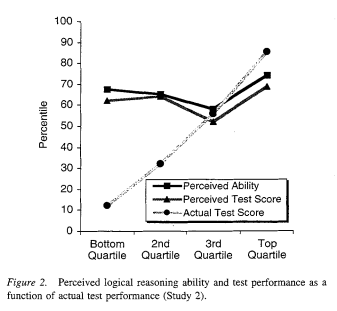
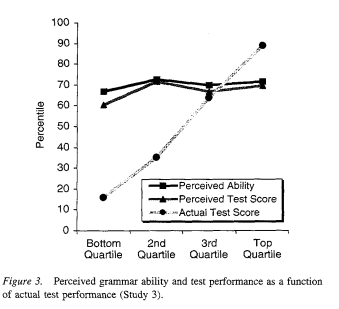
The grammar test is the easiest explanation of the Dunning-Kruger effect. The only way to know you have bad grammar is to have good ground but as you don’t have good grammar you think you have good grammar because you don’t know you have bad grammar because you have no way of self-assessing your bad grammar because you don’t have good grammar.
Unskilled but Unaware of It
14 May 2015 Leave a comment
in economics of education, human capital, labour economics, labour supply, occupational choice Tags: cognitive psychology, Dunning-Kruger effect, economics of personality traits, educational psychology
How motherhood in America has changed
14 May 2015 Leave a comment
in discrimination, economic history, gender, job search and matching, labour economics, labour supply, politics - USA Tags: female labour force participation
How motherhood in America has changed pewrsr.ch/1kRRCey http://t.co/9lTNrzDlSJ—
PewResearch FactTank (@FactTank) May 10, 2015
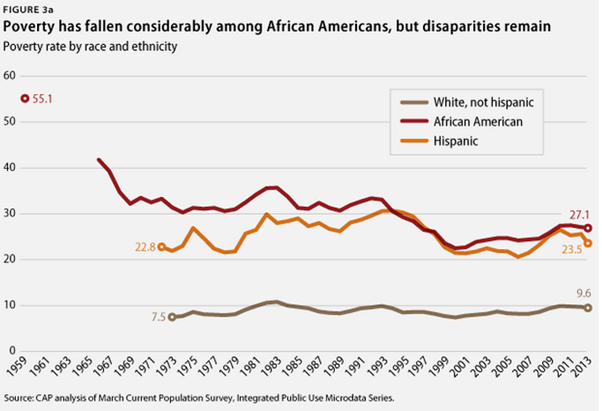
Black and Hispanic poverty dropped by a third after the 1996 US welfare reforms
13 May 2015 Leave a comment
in labour economics, labour supply, politics - USA, poverty and inequality, welfare reform Tags: 1996 welfare reforms, child poverty, family poverty, welfare state
Child poverty and single parenthood
13 May 2015 Leave a comment
in economics of love and marriage, gender, labour economics, labour supply, occupational choice, poverty and inequality, welfare reform Tags: child poverty, economics of marriage, family poverty, marriage and divorce, single mothers, single parents, welfare reform
Over half of all births to young adults in the U.S. now occur outside of marriage. bit.ly/1qONO10 http://t.co/KXl4sFd122—
Isabel Sawhill (@isawhill) September 17, 2014
Despite forgoing #marriage, young Americans are not forgoing parenthood. bit.ly/1sMG2bJ http://t.co/1aSELaJlfg—
Isabel Sawhill (@isawhill) October 31, 2014
Despite forgoing #marriage, young Americans are not forgoing #parenthood. bit.ly/1xLa1AJ http://t.co/fetnPAiCPG—
Isabel Sawhill (@isawhill) October 13, 2014
Almost 60% of births to women with only a high school degree occur out of wedlock. bit.ly/1sMG2bJ http://t.co/zomTFjZwA2—
Isabel Sawhill (@isawhill) October 14, 2014
Creative destruction in occupations
12 May 2015 Leave a comment
in labour economics, labour supply, occupational choice, personnel economics Tags: creative destruction, innovation, skill biased technological change
"The Changing Nature of Middle-Class Jobs" – via @nytimes nyti.ms/17Jzp1N http://t.co/2vRL6idiXt—
PewResearch FactTank (@FactTank) February 22, 2015
Annual hours worked per working age American, German and French, 1950–2013
12 May 2015 Leave a comment
in applied price theory, economic growth, economic history, great depression, labour economics, labour supply, macroeconomics, politics - USA, Public Choice, public economics, taxation Tags: Edward Prescott, Euroclerosis, France, Germany, labour supply, Robert Lucas, taxation and labour supply
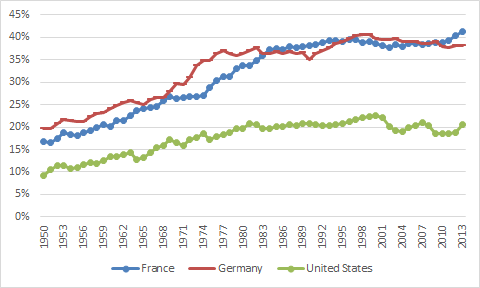
Figure 1 shows that Americans work the same hours per year pretty much the entire post-war period. By contrast, there is been a long decline in hours worked in Germany and France. The large drop in 1992 was German unification.
Figure 1: annual hours worked per working age American, German and French, 1950 – 2013
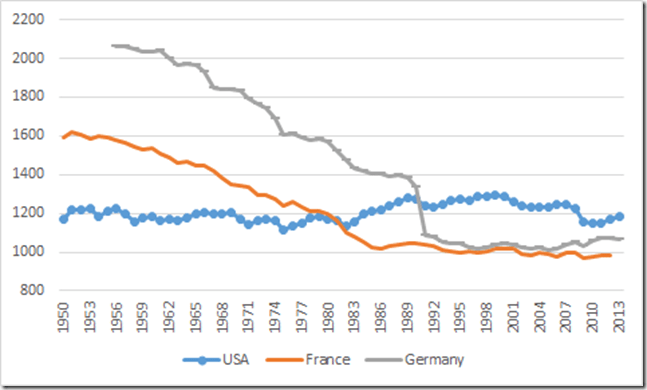
Source: OECD StatExtract and The Conference Board Total Economy Database™,January 2014, http://www.conference-board.org/data/economydatabase/
The long decline seemed to tally with the disproportionately sharp rise in the average tax rate on labour income, including social security contributions in France and Germany. When tax rates on labour income, including social security contributions stabilised in about 1980, hours worked stabilised in all countries.
Figure 2: average tax rate on labour income,USA, Germany and France, 1950 – 2013
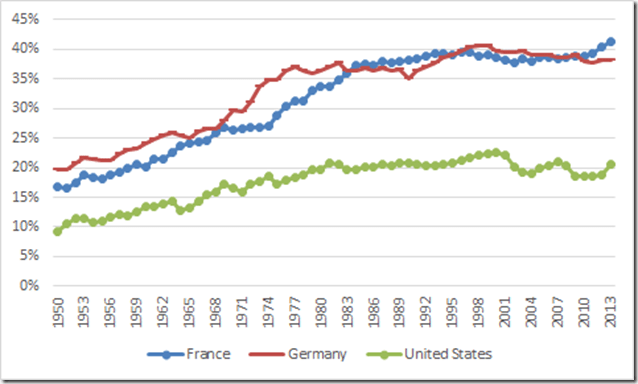
Source: Source: Cara McDaniel.
Some pander to the great vacation theory of European labour supply. This is the hypothesis of a large increase in the preference for leisure in the European Union member states. That is, mass voluntary unemployment and mass voluntary reductions and labour supply by choice by Europeans. They just decided to work less.
This is not the first outing for the great vacation theory of labour supply. In the late 1970s, Modigliani dismissed the new classical explanation of Lucas and Rapping (1969) of the U.S. great depression in which the 1930s unemployment was voluntary unemployment – the great depression was just a great vacation – with the following remarks:
Sargent (1976) has attempted to remedy this fatal flaw by hypothesizing that the persistent and large fluctuations in unemployment reflect merely corresponding swings in the natural rate itself.
In other words, what happened to the U.S. in the 1930’s was a severe attack of contagious laziness!
I can only say that, despite Sargent’s ingenuity, neither I nor, I expect most others at least of the non-Monetarist persuasion, are quite ready yet. to turn over the field of economic fluctuations to the social psychologist!
As Prescott has pointed out, the USA in the Great Depression and France since the 1970s both had 30% drops in hours worked per adult. That is why Prescott refers to France’s economy as depressed. The reason for the depressed state of the French (and German) economies is taxes, according to Prescott:
Virtually all of the large differences between U.S. labour supply and those of Germany and France are due to differences in tax systems.
Europeans face higher tax rates than Americans, and European tax rates have risen significantly over the past several decades.
Countries with high tax rates devote less time to market work, but more time to home activities, such as cooking and cleaning. The European services sector is much smaller than in the USA.
Time use studies find that lower hours of market work in Europe is entirely offset by higher hours of home production, implying that Europeans do not enjoy more leisure than Americans despite the widespread impression that they do. Europeans did not work less. They worked more on activities that were not taxed.
The robots are coming, the robots are coming – been there, done that in Japan
12 May 2015 1 Comment
in applied price theory, development economics, economic history, entrepreneurship, growth miracles, industrial organisation, labour economics, labour supply, survivor principle, unemployment Tags: creative destruction, entrepreneurial alertness, innovation, Japan, technological unemployment
When I was a kid, I used to like reading the Encyclopaedia Britannica. I read them from cover to cover.
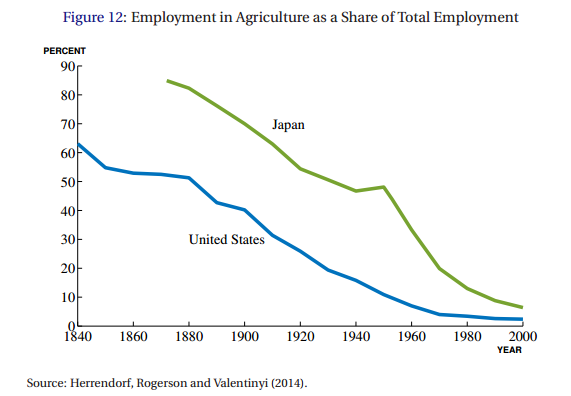
One of the things I recalled from the Encyclopaedia Britannica was that in 1961 nearly half of the Japanese workforce worked in the agricultural sector.
I notice that anomaly when I was reading the Encyclopaedia Britannica entry on Japan in the 1970s. Japan had undergoing an economic transformation since my Encyclopaedia Britannica’s were written in 1961. It was very much out of date.
Australian manufacturing was being outcompeted in every direction from automobiles to clothing and footwear by the Japanese manufacturing sector back when I was a teenager.
The Japanese economic miracle absorbed the Japanese agricultural labour force without anybody having time to shout "the robots are coming, the robots are coming".

There is a lesson in there somewhere for the current breathless journalism, with far too many academic fellow travellers about "the robots are coming, the robots are coming".
When I was a student at graduate school in Japan, I visited a Japanese factory in 1996 that was completely automated bar one function. Only once did a human hand actually touch the electrical goods they were making. Naturally, at the Q&A session at the end of our visit, I asked when was his job going to be automated.

The primary school teachers union has done very well in New Zealand in recent times
12 May 2015 Leave a comment
in economics of bureaucracy, economics of education, labour economics, labour supply, occupational choice, Public Choice, rentseeking, unions Tags: public sector wage premium, union power, union wage premium
Employment and the risk of deep poverty in the USA
12 May 2015 Leave a comment
in labour economics, labour supply, poverty and inequality Tags: child poverty, family poverty, labour force participation
The best defense against deep poverty is a paycheck: brook.gs/1IVXiTo http://t.co/BsermWSDZk—
Brookings (@BrookingsInst) May 10, 2015
Despite being a wealthy nation, extreme & deep poverty has become more prevalent in the U.S.: brook.gs/1IVVI3O http://t.co/cfnlkrXuw6—
Brookings (@BrookingsInst) May 09, 2015
More than 7.1 million U.S. children live in deep poverty. Get the facts on America's poor: brook.gs/1IWlK74 http://t.co/K4Uwrl5TOg—
Brookings (@BrookingsInst) May 08, 2015
The average CEO in America earns about as much as the average dentist
12 May 2015 Leave a comment
in human capital, labour economics, labour supply, occupational choice, politics - USA, poverty and inequality Tags: CEO pay, top 1%
Are 40% of workers on zero hours contracts, almost?
12 May 2015 1 Comment
in labour economics, labour supply, managerial economics, organisational economics, personnel economics, politics - Australia, politics - New Zealand, politics - USA, theory of the firm Tags: zero hours contracts
4 in 10 hourly workers know their schedules just a week or less in advance brook.gs/1wkfkXW http://t.co/6JNkYlftjL—
Richard V. Reeves (@RichardvReeves) December 11, 2014
What’s left of the welfare state after dastardly neoliberalism still lifts most out of poverty
12 May 2015 Leave a comment
in labour economics, labour supply, politics - USA, poverty and inequality Tags: child poverty, family poverty, Leftover Left, neoliberalism, welfare reform, welfare state
How government reduces child poverty (SPM-measured) in the U.S. bit.ly/1D7eXjZ From: @aecfkidscount http://t.co/80m2jjXxvY—
Richard V. Reeves (@RichardvReeves) April 16, 2015
To tackle poverty, the Left says welfare, the Right says work. Guess what? They're both right: brook.gs/1zSabJI http://t.co/E4AZR05CQJ—
Richard V. Reeves (@RichardvReeves) February 13, 2015
The magic of (increasing) redistribution in one @EugeneSteuerle graph blog.metrotrends.org/2015/02/addres… http://t.co/lbtlM3zT5L—
Richard V. Reeves (@RichardvReeves) February 18, 2015
Women and Social Mobility – Key Facts
11 May 2015 Leave a comment
in discrimination, gender, labour economics, labour supply, occupational choice, politics - USA, population economics Tags: gender wage gap
How are today's baby boomer women faring compared to their #mothers? Check out these 6 facts: brook.gs/1J2Hq1l http://t.co/DMZG536cE3—
Brookings (@BrookingsInst) May 11, 2015
1. Today’s working women (henceforth described as “daughters”) have higher wages than their mothers – but do not have higher wages than their fathers. Men have higher wages than both their fathers and their mothers.
2. The poorest women are doing best. 80% of daughters raised in the bottom quintile have higher wages than their fathers did. (h/t Scott Winship)
3. “Men’s wages remain more important to increasing couples’ family income,” despite “women’s significant generational gains” …
4. Women who grew up in households where their mother did not work actually have the highest family incomes today—but not because they themselves earn more. Daughters’ individual incomes do not vary significantly by mother’s work status, but family income does—suggesting that daughters whose mothers didn’t work have higher earning husbands. (Catherine Rampell discovered this by asking Pew to split out their analyses by mothers’ labor choices.) Perhaps those raised in more traditional settings are more likely to replicate a traditional division of labor?

via via Women and Social Mobility: Six Key Facts | Brookings Institution.
Income by educational attainment in the USA
10 May 2015 Leave a comment
in economics of education, human capital, labour economics, labour supply, occupational choice Tags: College premium, education premium, labour demographics
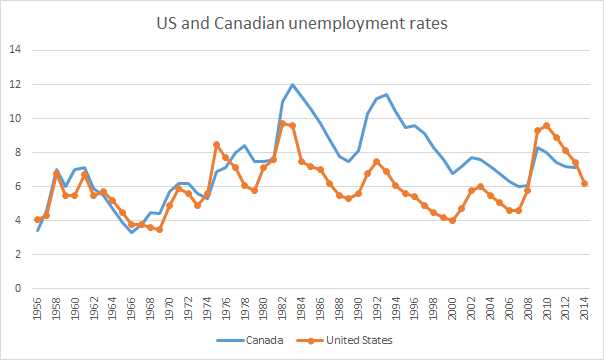
US and Canadian unemployment rates, 1956–2014
10 May 2015 Leave a comment
in business cycles, economic growth, job search and matching, labour economics, labour supply, macroeconomics, politics - USA, unemployment Tags: Canada, unemployment rates
Source: OECD StatExtract
Unemployed people are defined as those who report that they are without work, that they are available for work and that they have taken active steps to find work in the last four weeks.
The ILO Guidelines specify what actions count as active steps to find work; these include answering vacancy notices, visiting factories, construction sites and other places of work, and placing advertisements in the press as well as registering with labour offices.
Recent Comments