

via CONVERSABLE ECONOMIST: Lower Working Age Population and Secular Stagnation.
Celebrating humanity's flourishing through the spread of capitalism and the rule of law
11 Feb 2015 Leave a comment
in labour economics, labour supply, population economics Tags: ageing society, ageing workforce, Population demographics
10 Feb 2015 Leave a comment
in labour economics, labour supply Tags: engines of liberation, female labour force participation, household production, motherhood penalty
Notice that mothers spent about 30 hours per week on housework in the 1960s. The engines of liberation were smaller families and the availability of a large number of labour saving household white goods, and preprepared and takeaway food.


09 Feb 2015 Leave a comment
in labour economics, labour supply, unemployment Tags: unemployment insurance
09 Feb 2015 Leave a comment
in health and safety, human capital, labour economics, labour supply, managerial economics, market efficiency, occupational choice, organisational economics, personnel economics Tags: modern human resource management
08 Feb 2015 Leave a comment
in labour economics, labour supply, unemployment Tags: ageing society, ageing workforce, labour force participation, labour market demographics
06 Feb 2015 Leave a comment

05 Feb 2015 Leave a comment

30 Jan 2015 Leave a comment
in applied price theory, economics of crime, labour economics, labour supply, law and economics, occupational choice Tags: crime and punishment, death penalty, deterrence, occupational hazards, prison conditions, punishment
– Updated
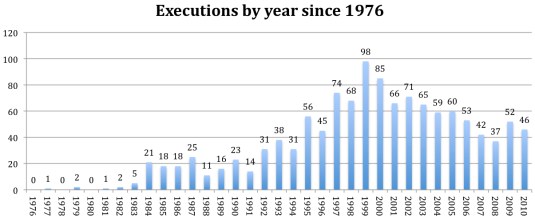
Many a data shyster will make hay with the above chart on the simple correlation between executions and the drop in the US murder rate.

The reality is there are so few executions and they are so infrequent with the exception of Texas that any purported correlation between the death penalty and murder rates requires careful study.

Indeed, for some condemned prisoners, gang bangers are an example, their life expectancy may be increased by the long time they spend on death row versus been murdered by a business associated or a business rival on the streets. As Levitt noted:
no rational criminal should be deterred by the death penalty, since the punishment is too distant and too unlikely to merit much attention.
As such, economists who argue that the death penalty works are put in the uncomfortable position of having to argue that criminals are irrationally overreacting when they are deterred by it.
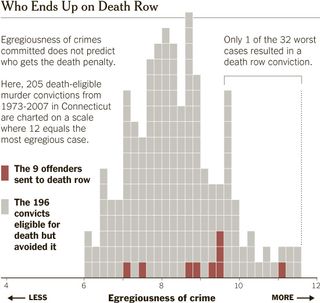
The occupational hazard of been murdered by business rival for gang bangers is higher than the chance of them been arrested, tried , convicted, and condemned to death and then executed after a long appeals process. Not surprisingly, Levitt argued that:
…the quality of life in prison is likely to have a greater impact on criminal behaviour than the death penalty.
Using state-level panel data covering the period 1950–90, we demonstrate that the death rate among prisoners (the best available proxy for prison conditions) is negatively correlated with crime rates, consistent with deterrence. This finding is shown to be quite robust.
In contrast, there is little systematic evidence that the execution rate influences crime rates in this time period.
30 Jan 2015 Leave a comment
in gender, labour economics, labour supply Tags: engines of liberation, female labour force participation, gender wage gap, sex discrimination

First, work changed to offer more jobs to women. Farming declined sharply; industrial jobs peaked and then declined. Brawn became less important; precise skills, learning, and personal service became more important.
The new economy generated millions of white-collar and “pink-collar” jobs that seemed “suited” to women. That cannot be the full story, of course; women also took over many jobs that had once been men’s, such as teaching and secretarial work.
Second, mothers responded to those job opportunities. Some took jobs because the extra income could help families buy cars, homes, furnishings, and so on. Some took jobs because the family needed their income to make up for husbands’ stagnating wages (a noteworthy trend after the 1970s). And some took jobs because they sought personal fulfilment in the world of work.
via Why Did Married Mothers Go To Work? » Sociological Images.
Celebrating humanity's flourishing through the spread of capitalism and the rule of law
Scholarly commentary on law, economics, and more
Beatrice Cherrier's blog
Celebrating humanity's flourishing through the spread of capitalism and the rule of law
Celebrating humanity's flourishing through the spread of capitalism and the rule of law
Celebrating humanity's flourishing through the spread of capitalism and the rule of law
Why Evolution is True is a blog written by Jerry Coyne, centered on evolution and biology but also dealing with diverse topics like politics, culture, and cats.
Celebrating humanity's flourishing through the spread of capitalism and the rule of law
Celebrating humanity's flourishing through the spread of capitalism and the rule of law
A rural perspective with a blue tint by Ele Ludemann
DPF's Kiwiblog - Fomenting Happy Mischief since 2003
Celebrating humanity's flourishing through the spread of capitalism and the rule of law
The world's most viewed site on global warming and climate change
Tim Harding's writings on rationality, informal logic and skepticism
A window into Doc Freiberger's library
Let's examine hard decisions!
Commentary on monetary policy in the spirit of R. G. Hawtrey
Thoughts on public policy and the media
Celebrating humanity's flourishing through the spread of capitalism and the rule of law
Politics and the economy
A blog (primarily) on Canadian and Commonwealth political history and institutions
Reading between the lines, and underneath the hype.
Economics, and such stuff as dreams are made on
"The British constitution has always been puzzling, and always will be." --Queen Elizabeth II
Celebrating humanity's flourishing through the spread of capitalism and the rule of law
Celebrating humanity's flourishing through the spread of capitalism and the rule of law
WORLD WAR II, MUSIC, HISTORY, HOLOCAUST
Undisciplined scholar, recovering academic
Celebrating humanity's flourishing through the spread of capitalism and the rule of law
Res ipsa loquitur - The thing itself speaks
Celebrating humanity's flourishing through the spread of capitalism and the rule of law
Researching the House of Commons, 1832-1868
Articles and research from the History of Parliament Trust
Reflections on books and art
Posts on the History of Law, Crime, and Justice
Celebrating humanity's flourishing through the spread of capitalism and the rule of law
Exploring the Monarchs of Europe
Cutting edge science you can dice with
Small Steps Toward A Much Better World
“We do not believe any group of men adequate enough or wise enough to operate without scrutiny or without criticism. We know that the only way to avoid error is to detect it, that the only way to detect it is to be free to inquire. We know that in secrecy error undetected will flourish and subvert”. - J Robert Oppenheimer.
The truth about the great wind power fraud - we're not here to debate the wind industry, we're here to destroy it.
Celebrating humanity's flourishing through the spread of capitalism and the rule of law
Celebrating humanity's flourishing through the spread of capitalism and the rule of law
Economics, public policy, monetary policy, financial regulation, with a New Zealand perspective
Celebrating humanity's flourishing through the spread of capitalism and the rule of law
Restraining Government in America and Around the World



 Utopia, you are standing in it!
Recent Comments