Price Floors: The Minimum Wage
17 Jun 2017 Leave a comment
in applied price theory, applied welfare economics, economics of regulation, labour economics, minimum wage Tags: price controls
PRECARIOUS WORK AS THE FLIP SIDE OF EFFICIENCY WAGES
02 Jun 2017 Leave a comment
in labour economics, labour supply, Marxist economics, minimum wage, poverty and inequality, unemployment Tags: living wage
Efficiency wages were put forward as a cause of what is now called precarious work. The efficiency wage hypothesis breathed considerable new life into the old theory of dual labour markets (Katz 1986; Dickens and Lang 1985).

The notion of a segmented labour market, of a primary and a secondary labour market, each with distinctly different wage setting mechanisms, was very much a fringe idea prior to the 1980s:
Efficiency wage theory provides a rare common meeting ground for mainstream and radical economists, because the far left in U.S. economics has taken the lead in developing theories of dual labor markets and for setting-out policy proposals for higher minimum wages based on the assumed validity of the efficiency wage approach (Gordon 1990, p. 1157).
The workers privileged enough to hired by firms paying an efficiency wage would enjoy job security, low job quit rates, good working conditions, career advancement, training and higher pay (Akerlof 1982, 1984; Bulow and Summers 1986; Dickens and Lang 1993). The remaining equally productive workers who were unlucky enough to be priced out of these good jobs by the job rationing implicit in an efficiency wage must fend for themselves in a secondary labour market; in precarious work with high quit rates, harsh workplace discipline, few promotions, little training and poor pay (Akerlof 1982, 1984; Katz 1986; Dickens and Lang 1985). Efficiency wages do not motivate greater employee effort unless the prospect of precarious work in this secondary labour market looms large in the back of their minds as their main alternative source of employment for those lucky enough to be employed in the good jobs in the primary labour market (Katz 1986; Bulow and Summers 1986).
Those workers crowded into these bad jobs in the secondary labour market find it to be a slow and difficult process to break into these better paying good jobs in the primary labour market. There are queues for the good jobs because they are paying above-market wages; many of those crowded into the bad jobs are women and minorities (Bulow and Summers 1986; Dickens and Lang 1985, 1993).
Akerlof, in his Nobel Prize lecture on behavioural macroeconomics, contended that the good and bad jobs caused by paying efficiency wages is central to explaining involuntary mass unemployment:
The existence of good jobs and bad jobs makes the concept of involuntary unemployment meaningful: unemployed workers are willing to accept, but cannot obtain, jobs identical to those currently held by workers with identical ability. At the same time, involuntarily unemployed workers may eschew the lower-paying or lower-skilled jobs that are available. The definition of involuntary unemployment implicit in efficiency wage theory accords with the facts and agrees with commonly held perceptions. A meaningful concept of involuntary unemployment constitutes an important first step forward in rebuilding the foundations of Keynesian economics (Akerlof 2002, p. 415).
Living wage activists already doubt that the market can provide steady wages growth and stable employment. Efficiency wages are a leading New Keynesian macroeconomic explanation for that. The living wage movement cannot pick and choose from what the efficiency wage hypothesis says about how well the labour market functions for those who are and are not in efficiency wage jobs.
Living wage activists are unwittingly following a course of action that leads to more job rationing, more precarious work and more unemployment. Those priced out of council jobs by a living wage such as the 17 parking wardens are left to take their chances in the rest of the local labour market. These workers must take bad jobs while queueing for the good jobs in the primary labour market. Instead of being sources of opportunity in their communities, councils through a living wage policy risk becoming drivers of labour market segmentation and the fostering of a precariat.
Short Cut: Macron’s Scandi-Solution for France
16 May 2017 Leave a comment
in economics, fiscal policy, labour supply, macroeconomics, minimum wage, Public Choice, public economics, welfare reform
#livingwage movement just can’t handle the truth @LWEmployerNZ
27 Apr 2017 Leave a comment
in industrial organisation, labour economics, labour supply, minimum wage, personnel economics, politics - New Zealand Tags: conjecture and refutation, critical discussion, crybaby left, living wage, Twitter left

Looks like the living wage movement will not be taking up my challenge for a public debate anytime soon.
It is illegal to mention the 3% minimum wage increase surcharge in New York State
13 Mar 2017 Leave a comment

The Racist Origin of the Minimum Wage — Deirdre McCloskey
03 Mar 2017 Leave a comment
in economics, labour economics, minimum wage, politics - USA
What’s the Right Minimum Wage?
25 Feb 2017 Leave a comment
in applied price theory, applied welfare economics, economics, labour economics, minimum wage Tags: offsetting behaviour, The fatal conceit, unintended consequences
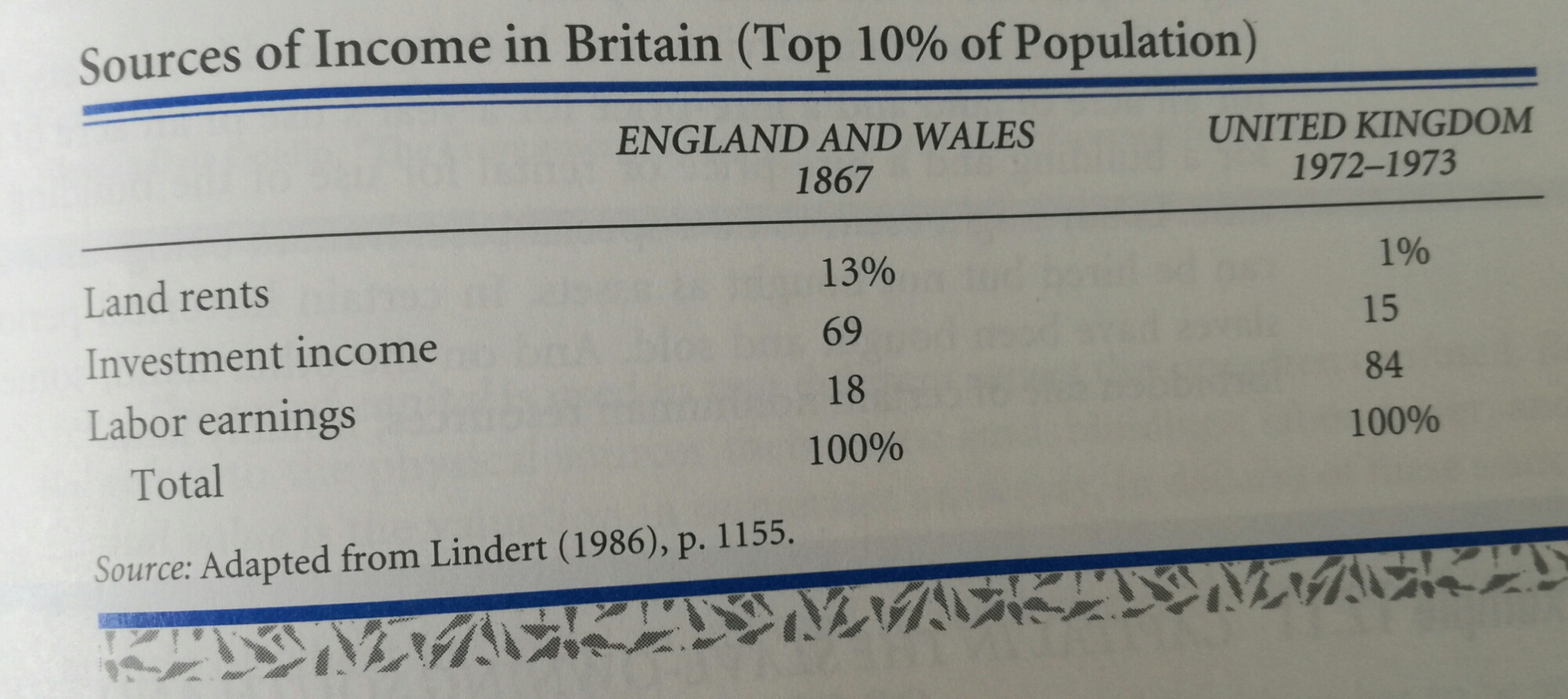
Deirdre McCloskey on the Unsavory History of the Minimum Wage – Cafe Hayek
14 Feb 2017 Leave a comment
in applied price theory, economic history, history of economic thought, labour economics, minimum wage
Information costs in the labour market
31 Jan 2017 Leave a comment
in job search and matching, labour economics, labour supply, minimum wage, unions Tags: inequality of bargaining power, job matching, job search, monopsony

Every worker, even the low-paid worker, is alert to their opportunities and take the best jobs that come to their notice but it is gaps in their information is the sand in the wheels of this search. As Manning (2005) observed in his superb Monopsony in Motion:
That important frictions exist in the labor market seems undeniable: people go to the pub to celebrate when they get a job rather than greeting the news with the shrug of the shoulders that we might expect if labor markets were frictionless. And people go to the pub to drown their sorrows when they lose their job rather than picking up another one straight away. The importance of frictions has been recognized since at least the work of Stigler (1961, 1962) (Manning 2005, p. 4).
The left has a certain view of how the labour market works and how to best move workers into better paying jobs. Standing against this are arguments that it is a want of information rather than weak bargaining power is what slows workers down from moving to a better job. As Stigler (1961, 1962) argued, information is costly to obtain in the labour market:
No worker, unless his degree of specialization is pathological, will ever be able to become informed on the prospective earnings which would be obtained from every one of these potential employers at any given time, let alone keep this information up to date. He faces the problem of how to acquire information on the wage rates, stability of employment, conditions of employment, and other determinants of job choice, and how to keep this information current (Stigler 1962, p. 94).
The left accepts that low-paid workers respond actively to news of better paying job opportunities. They do this by arguing that a living wage improves the quality of recruitment pools. More workers apply for the living wage vacancies on the news of a living wage policy. Fewer employees quit and they work harder in response to a living wage.

Activists should mind how they go by stressing an inequality of bargaining power but also letting through the door even one market discipline such as a sensitivity of wage offers and profits to job turnover rates:
Let us consider the extreme case of highly specialized, non-versatile labor. If we consider (a) the continuous replacement of personnel who gradually leave through competing employment openings, retirement and death, and (b) (in an expanding industry) the recruitment needed for expansion, we must recognize that the probability of the workers’ exploitation is remote. The observable labor turnover between firms suggests indeed that collusive action to reduce the price of labor has virtually never been regarded as profitable (Hutt 1973, p. 4).
But not every worker knows there are better paying options which may be even just a few steps away from their current job. Information costs are a better explanation than pinning everything on an inequality in bargaining power. This is because information costs have a profound impact on labour market workings (Stigler 1962; Alchian 1969; Alchian and Allen 1967, 1983). For unequal bargaining power to keep the wages of the low-paid down, collusion must succeed between a great many employers recruiting across many industry and occupational labour markets (Hutt 1973, Alchian and Allen 1983).

More insight is gleaned from the fact that job seekers do not initially know the location of suitable vacancies, the wages for various skills, differences in job security and other factors. They must find this knowledge, keep it current and forecast whether better vacancies may open soon. Employers must learn the location, availability and asking wages of suitable applicants.
Long-term contracts arise to share risks and curb opportunism over sunken investments in specialised human capital. These factors lead to queues, unemployment, spare capacity, layoffs, shortages, inventories and non-price rationing in conjunction with wage rigidity (Alchian 1969; Alchian and Allen 1967, 1983). Labour market analysis must stay within McCloskey’s maxim that
Every piece of economic analysis is not complete until everyone is earning only normal profits, or at least the analyst can identify a reason why not (McCloskey 1985).
The labour market has good and bad jobs, the jobs that can pay more than or less than the going rate, resulting from the costs of job search and matching. These good and bad jobs arise from the element of chance in every job search and job match rather than betting it all on an enduring employer conspiracy to keep wages down. Some workers are paid less than the going rate because they are down on their luck rather than under the thumb.
The compassion of unions towards the minimum waged
24 Jan 2017 1 Comment
in labour economics, minimum wage, poverty and inequality, unemployment, unions Tags: do gooders, The fatal conceit, The pretense to knowledge
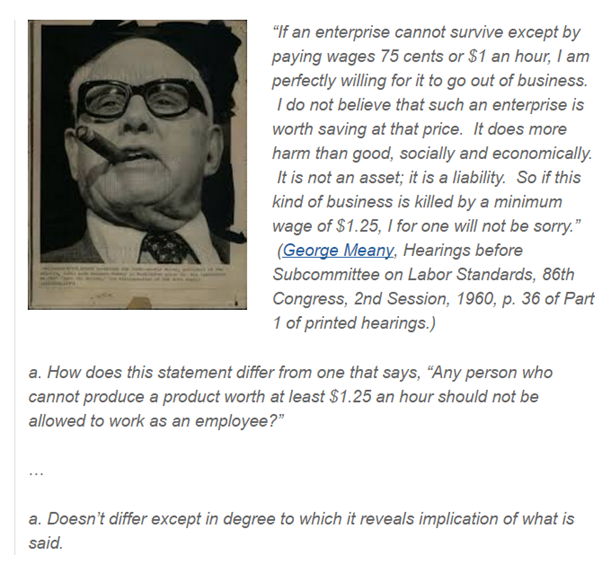
Source: page 451 and page 828 of the 3rd edition (1972) of University Economics by Armen Alchian and William Allen; the first part of the quotation is Question #30 at the end of Chapter 22. via Bonus Quotation of the Day… – Cafe Hayek
The first @PaulKrugman explains European labour market regulation
02 Jan 2017 Leave a comment
in applied price theory, income redistribution, labour economics, labour supply, law and economics, minimum wage, Public Choice, rentseeking Tags: employment law, labour market regulation, minimum wage laws, rent control, social insurance, unemployment insurance
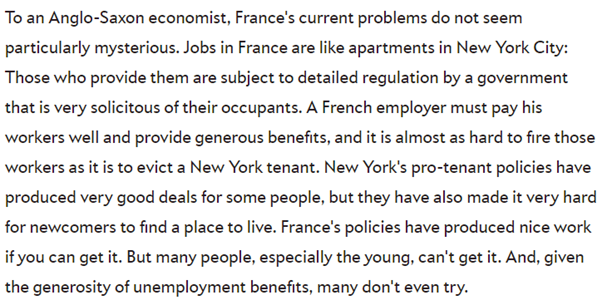
Source: Unmitigated Gauls (1998).
Thomas Sowell – Black Lives and Social Policy
08 Dec 2016 Leave a comment
in applied price theory, discrimination, economics of education, human capital, labour economics, minimum wage, occupational choice, poverty and inequality, unemployment Tags: economics of families, racial discrimination, Thomas Sowell
The old and new theories of monopsony have clashing predictions
06 Dec 2016 Leave a comment
in applied price theory, labour economics, minimum wage Tags: job search and matching, monopsony
Robinson’s (1933) theory of monopsony, of employer market power, is about fewness in the number of employers allow them to pay below-market wages. This means a minimum wage will raise wages, employment and, importantly, output. Her’s is a joint hypothesis. Employers will hire more workers and will produce more which means the firm must cut its prices to sell this additional output.

The new theories of monopsony such as in Manning’s Monopsony in Motion: Imperfect Competition in the Labour Market have ambiguous predictions about output and employment because they arise out of how the surplus from job matching is split. They acknowledge the possibility that some firms will close because they cannot afford the higher minimum wage rate.
The old monopoly monopsony theories are vindicated if output rises and prices fall as they must to sell the additional output. The new monopsony theories are vindicated if some firms close but employment does not fall much.
Because the new monopsony theories arise from a specific hypothesis about the labour market that it more difficult for larger employers to recruit, Kuhn (2005) argued that the title “Search Models with Ex-Ante Posted Wages in Motion, while considerably more accurate than Monopsony on Motion, is less catchy”.
 Utopia, you are standing in it!
Recent Comments