Susan Hornsby-Geluk writes: Among the most controversial aspects of the recently enacted Employment Relations Amendment Act 2026 is the introduction of a high-income threshold for personal grievance claims. Under the new provisions, employees earning $200,000 or more in annual remuneration will lose the right to bring a personal grievance for unjustified dismissal, or an unjustified…
A worthwhile trade off
A worthwhile trade off
25 Mar 2026 Leave a comment
in applied price theory, economics of regulation, human capital, labour economics, labour supply, law and economics, occupational choice, politics - New Zealand, property rights Tags: employment law, offsetting behavior, unintended consequences
Medical Council proposes striking off doctors who disagree with their political views
17 Mar 2026 Leave a comment
in discrimination, economics of education, economics of regulation, human capital, labour economics, labour supply, liberalism, Marxist economics, occupational choice, occupational regulation, politics, politics - New Zealand
The Medical Council has proposed a statement on cultural competence that is basically a political litmus test. It is outrageous overreach, and an example of why Parliament needs to rein in all these regulatory bodies. No one would object to a statement that doctors must be respectful of all cultures and beliefs, while undertaking their…
Medical Council proposes striking off doctors who disagree with their political views
Minimum Wages for Gig Workers Can’t Work
17 Feb 2026 Leave a comment
in applied price theory, labour economics, labour supply, occupational choice
In 2017, I analyzed the Uber Tipping Equilibrium: What is the effect of tipping on the take-home pay of Uber drivers? Economic theory offers a clear answer. Tipping has no effect on take home pay. The supply of Uber driver-hours is very elastic. Drivers can easily work more hours when the payment per ride increases…
Minimum Wages for Gig Workers Can’t Work
Changes in the Gender Wage Gap for Business Professionals
14 Feb 2026 1 Comment
in applied price theory, discrimination, economics of education, gender, human capital, labour economics, labour supply, managerial economics, occupational choice, organisational economics, personnel economics Tags: gender wage gap
In the United States, much of the gap in earnings between men and women is due to the persistent gap for high wage earners. This paper explores changes in the gender wage gap for MBAs graduating from a large public university over 30 years. We document large gender wage gaps on average, which grow in…
Changes in the Gender Wage Gap for Business Professionals
Human Capital Hara-Kiri
06 Dec 2025 Leave a comment
in human capital, labour economics, labour supply, occupational choice, poverty and inequality Tags: economics of immigration, Japan

In Japan, you see native-born East Asians doing menial jobs everywhere you look. You see Japanese janitors, Japanese street-sweepers, Japanese convenience store workers, Japanese crossing guards, Japanese taxi drivers, and Japanese laborers on construction sites. 904 more words
Human Capital Hara-Kiri
The Great Means-Testing Debate
05 Dec 2025 Leave a comment
in applied price theory, history of economic thought, human capital, labour economics, labour supply, Milton Friedman, occupational choice, poverty and inequality, unemployment, welfare reform
Nine years ago, I critically analyzed the Cohen-Friedman debate on means-testing Social Security. Only recently, though, did I find the original footage from 1971. As far as I know, this is the first time that any prominent social scientist made the “A program only for the poor will always be a poor program” argument that…
The Great Means-Testing Debate
My Econoboi Poverty Debate vs. Matt Bruenig
04 Dec 2025 Leave a comment
in applied price theory, human capital, labour economics, labour supply, occupational choice, politics - USA, poverty and inequality, welfare reform Tags: child poverty, family poverty, social insurance
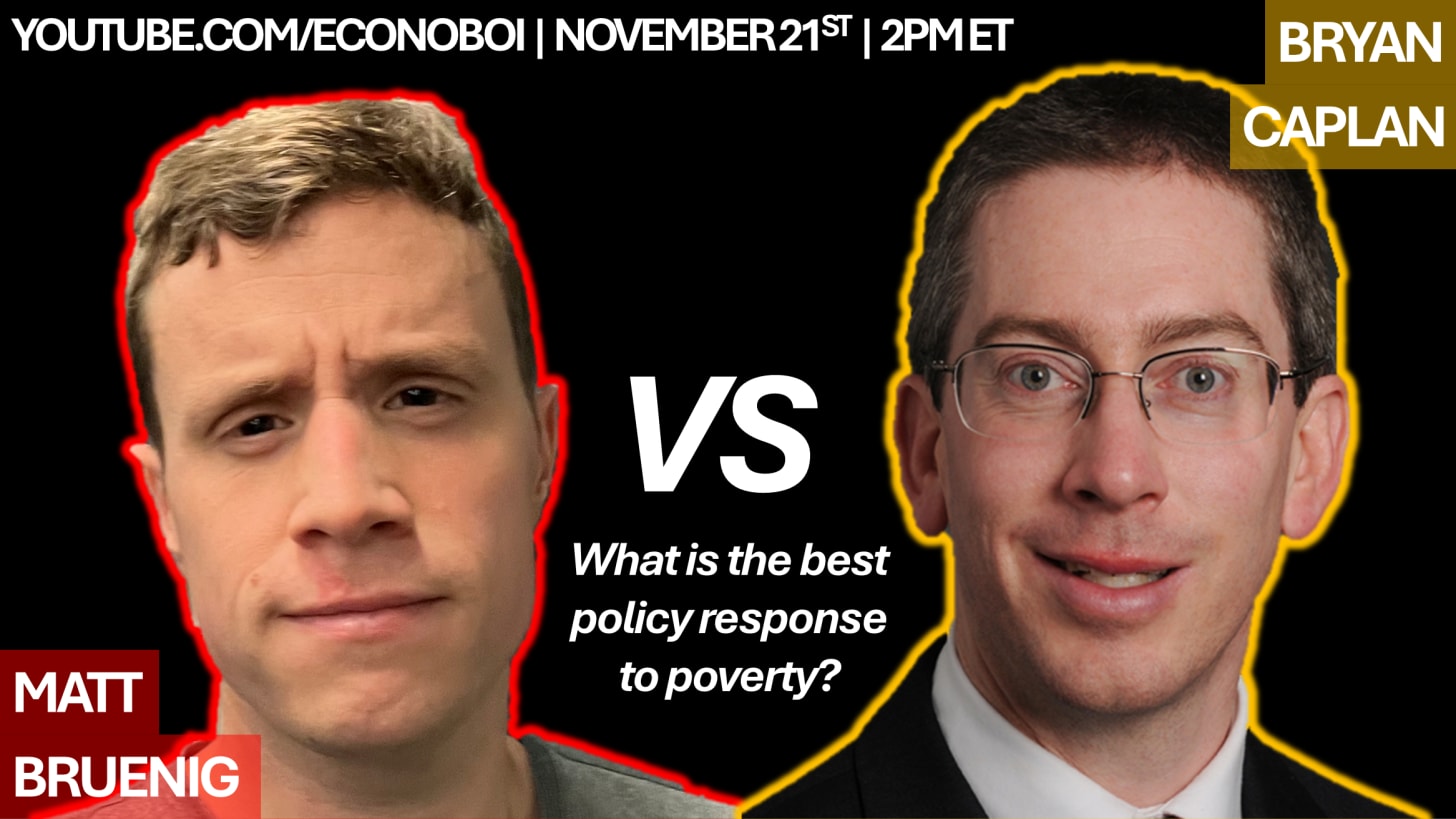
Tomorrow at 2 PM ET, I’ll be debating “What is the best policy response to poverty?” versus Matt Bruenig. Venue: Econoboi channel P.S. You might recall that… 9 more words
My Econoboi Poverty Debate vs. Matt Bruenig
The terrible Supreme Court decision on Uber
28 Nov 2025 Leave a comment
in applied price theory, economics of regulation, industrial organisation, labour economics, labour supply, occupational choice, politics - New Zealand, transport economics, urban economics Tags: employment law
The Supreme Court has ruled that four Uber drivers are employees of Uber, despite written agreements they are contractors, not employees. The practical effect of this decision is terrible. Uber has been great for passengers. Not only can we hold drivers to account through ratings, we save a lot of money. An Uber to the…
The terrible Supreme Court decision on Uber
The Flaw at the Core of the Supreme Court’s Uber Decision
25 Nov 2025 Leave a comment
in economics of regulation, industrial organisation, labour economics, labour supply, law and economics, occupational choice, politics - New Zealand, Public Choice, rentseeking, transport economics, urban economics Tags: creative destruction, employment law
Roger Partridge writes – The Supreme Court’s Uber judgment (Rasier Operations BV v E Tū Inc [2025] NZSC 162) has delivered clarity of a sort. The Court dismissed Uber’s appeal, upholding the finding that the drivers involved in the proceedings are employees when logged into the Uber app. Yet the decision is deeply flawed. The Court […]
The Flaw at the Core of the Supreme Court’s Uber Decision
If this is employment law, the law needs to change
22 Nov 2025 Leave a comment
in economics of regulation, industrial organisation, labour economics, labour supply, law and economics, managerial economics, occupational choice, organisational economics, personnel economics, politics - New Zealand, property rights, Public Choice, transport economics, urban economics Tags: employment law
Eric Crampton writes – Yesterday [November 17], the Supreme Court ruled that Uber did not merely facilitate connections between four drivers and their various passengers – as Uber has maintained. And that the four drivers were not contractors for Uber either. Instead, those drivers were Uber employees while logged into the app.
If this is employment law, the law needs to change
*The Science of Second Chances*
15 Nov 2025 Leave a comment
in applied price theory, economics of crime, economics of education, human capital, labour economics, labour supply, law and economics, occupational choice Tags: criminal deterrence
The author is economist Jennifer Doleac, and the subtitle is A Revolution in Criminal Justice. Excerpt: We found that adding anyone charged with a felony to the law enforcement DNA database in Denmark reduced future criminal convictions by over 40 percent. Again, people responded to the higher probability of getting caught by committing fewer cimres. …
*The Science of Second Chances*
Ten Modest Proposals to End the Gender Pay Gap
17 Oct 2025 Leave a comment
in applied price theory, discrimination, economics of crime, economics of education, gender, human capital, labour economics, labour supply, law and economics, occupational choice, politics - USA Tags: gender wage gap

An anonymous Swiftian guest essay
Ten Modest Proposals to End the Gender Pay Gap
Is the earned income tax overrated?
09 Oct 2025 Leave a comment
in applied price theory, economics of education, human capital, income redistribution, labour economics, labour supply, occupational choice, Public Choice, public economics, welfare reform Tags: taxation and labour supply
This policy has been so popular with economists on a bipartisan basis, yet a recent piece in ReStud raises some doubts, as the wage subsidies induce many to drop out of school: As a complement to the federal earned income tax credit (EITC), some states offer their own EITC, typically calculated as a percentage of […]
Is the earned income tax overrated?
Newsflash! The super-rich are mobile, and higher taxes incentivise them to move away
25 Sep 2025 1 Comment
in applied price theory, human capital, income redistribution, labour economics, labour supply, occupational choice, Public Choice, public economics Tags: taxation and entrepreneurship, taxation and investment
The super-rich are super-mobile. So, if a country decides to increase taxes on the super-rich (for example, with a wealth tax), some (but not all) of the super-rich will simply move elsewhere. This should not be a surprise to anyone. And yet, simplistic proposals to tax the super-rich are a favourite policy for some political…
Newsflash! The super-rich are mobile, and higher taxes incentivise them to move away
The evolution of the economics job market
24 Sep 2025 Leave a comment
in economics of education, human capital, labour economics, labour supply, managerial economics, occupational choice, organisational economics, personnel economics
In the halcyon days of 2015-19, openings on the economics job market hovered at around 1900 per year. In 2020, Covid was a major shock, but the market bounced back quickly in 2021 and 2022. Since then, though, the market has clearly been in a funk. 2023, my job market year, saw a sudden dip […]
The evolution of the economics job market
 Utopia, you are standing in it!
Recent Comments