Roger Partridge writes – The Supreme Court’s Uber judgment (Rasier Operations BV v E Tū Inc [2025] NZSC 162) has delivered clarity of a sort. The Court dismissed Uber’s appeal, upholding the finding that the drivers involved in the proceedings are employees when logged into the Uber app. Yet the decision is deeply flawed. The Court […]
The Flaw at the Core of the Supreme Court’s Uber Decision
The Flaw at the Core of the Supreme Court’s Uber Decision
25 Nov 2025 Leave a comment
in economics of regulation, industrial organisation, labour economics, labour supply, law and economics, occupational choice, politics - New Zealand, Public Choice, rentseeking, transport economics, urban economics Tags: creative destruction, employment law
If this is employment law, the law needs to change
22 Nov 2025 Leave a comment
in economics of regulation, industrial organisation, labour economics, labour supply, law and economics, managerial economics, occupational choice, organisational economics, personnel economics, politics - New Zealand, property rights, Public Choice, transport economics, urban economics Tags: employment law
Eric Crampton writes – Yesterday [November 17], the Supreme Court ruled that Uber did not merely facilitate connections between four drivers and their various passengers – as Uber has maintained. And that the four drivers were not contractors for Uber either. Instead, those drivers were Uber employees while logged into the app.
If this is employment law, the law needs to change
*The Science of Second Chances*
15 Nov 2025 Leave a comment
in applied price theory, economics of crime, economics of education, human capital, labour economics, labour supply, law and economics, occupational choice Tags: criminal deterrence
The author is economist Jennifer Doleac, and the subtitle is A Revolution in Criminal Justice. Excerpt: We found that adding anyone charged with a felony to the law enforcement DNA database in Denmark reduced future criminal convictions by over 40 percent. Again, people responded to the higher probability of getting caught by committing fewer cimres. …
*The Science of Second Chances*
Ten Modest Proposals to End the Gender Pay Gap
17 Oct 2025 Leave a comment
in applied price theory, discrimination, economics of crime, economics of education, gender, human capital, labour economics, labour supply, law and economics, occupational choice, politics - USA Tags: gender wage gap

An anonymous Swiftian guest essay
Ten Modest Proposals to End the Gender Pay Gap
Is the earned income tax overrated?
09 Oct 2025 Leave a comment
in applied price theory, economics of education, human capital, income redistribution, labour economics, labour supply, occupational choice, Public Choice, public economics, welfare reform Tags: taxation and labour supply
This policy has been so popular with economists on a bipartisan basis, yet a recent piece in ReStud raises some doubts, as the wage subsidies induce many to drop out of school: As a complement to the federal earned income tax credit (EITC), some states offer their own EITC, typically calculated as a percentage of […]
Is the earned income tax overrated?
Newsflash! The super-rich are mobile, and higher taxes incentivise them to move away
25 Sep 2025 1 Comment
in applied price theory, human capital, income redistribution, labour economics, labour supply, occupational choice, Public Choice, public economics Tags: taxation and entrepreneurship, taxation and investment
The super-rich are super-mobile. So, if a country decides to increase taxes on the super-rich (for example, with a wealth tax), some (but not all) of the super-rich will simply move elsewhere. This should not be a surprise to anyone. And yet, simplistic proposals to tax the super-rich are a favourite policy for some political…
Newsflash! The super-rich are mobile, and higher taxes incentivise them to move away
The evolution of the economics job market
24 Sep 2025 Leave a comment
in economics of education, human capital, labour economics, labour supply, managerial economics, occupational choice, organisational economics, personnel economics
In the halcyon days of 2015-19, openings on the economics job market hovered at around 1900 per year. In 2020, Covid was a major shock, but the market bounced back quickly in 2021 and 2022. Since then, though, the market has clearly been in a funk. 2023, my job market year, saw a sudden dip […]
The evolution of the economics job market
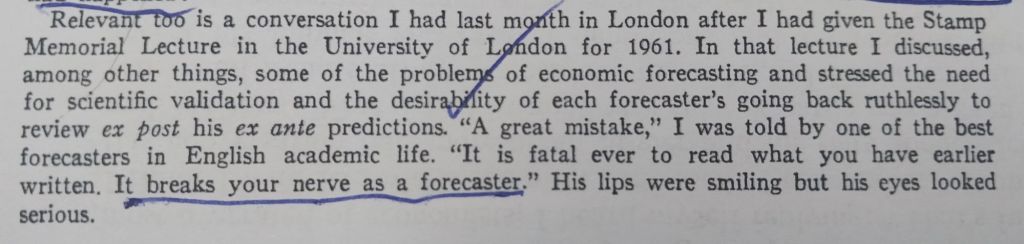
Samuelson on forecasting as a vocation
23 Sep 2025 Leave a comment
in budget deficits, business cycles, economic growth, fiscal policy, human capital, labour economics, macroeconomics, occupational choice Tags: forecasting errors
The smallest gender pay gap in history
28 Aug 2025 Leave a comment
in applied price theory, discrimination, econometerics, economic history, gender, human capital, labour economics, labour supply, occupational choice, politics - New Zealand, poverty and inequality Tags: gender wage gap, sex discrimination
Stats NZ reports: The gender pay gap was 5.2 percent in the June 2025 quarter, down from 8.2 percent in the June 2024 quarter, according to figures released by Stats NZ today. “The June 2025 quarter gender pay gap of 5.2 percent is the lowest since the series began in 1998,” labour market spokesperson Abby […]
The smallest gender pay gap in history
World War II Liberty Ships and the Law of Increasing Opportunity Cost
27 Aug 2025 1 Comment
in applied price theory, defence economics, economic history, entrepreneurship, industrial organisation, labour economics, labour supply, occupational choice, war and peace Tags: World War II
See ‘Launching Liberty’ Review: Shipyard Victory The U.S. quickly constructed a fleet of vessels to carry vital war supplies across the oceans. Did the rush to build so fast affect quality? by Marc Levinson. He reviewed the book Launching Liberty: The Epic Race to Build the Ships That Took America to War by Doug Most.The Liberty…
World War II Liberty Ships and the Law of Increasing Opportunity Cost
Dude, Whatever Happened to Difference Feminism?
17 Aug 2025 Leave a comment
in discrimination, economics of education, gender, human capital, labour economics, labour supply, occupational choice Tags: gender gap, sex discrimination

Time to Revive an Out of Fashion Idea
Dude, Whatever Happened to Difference Feminism?
The Tragedy of India’s Government-Job Prep Towns
04 Aug 2025 Leave a comment
in applied price theory, development economics, economics of bureaucracy, economics of regulation, growth disasters, growth miracles, labour economics, labour supply, occupational choice, Public Choice Tags: India
In Massive Rent-Seeking in India’s Government Job Examination System I argued that the high value of government jobs has distorted India’s entire labor market and educational system. India’s most educated young people—precisely those it needs in the workforce—are devoting years of their life cramming for government exams instead of working productively. These exams cultivate no […]
The Tragedy of India’s Government-Job Prep Towns
The gender gap that dare not speak its name
28 Jul 2025 Leave a comment
in gender, health and safety, labour economics, occupational choice
Govt fiscal constraints are the elephant in the pay equity room
11 Jul 2025 Leave a comment
in applied price theory, discrimination, fiscal policy, gender, human capital, income redistribution, labour economics, labour supply, occupational choice, politics - New Zealand, Public Choice, public economics, rentseeking Tags: gender wage gap, pay equity, sex discrimination
Michael Johnston writes – The way the government went about rolling back 33 pay equity claims lodged under the last government’s Pay Equity legislation was clumsy at best. The changes were made under urgency and applied retrospectively. It was not a good look. Predictable howls of rage and furious accusations ensued. Critics say the government […]
Govt fiscal constraints are the elephant in the pay equity room
EPA Suspends over 140 Toxic Employees Who Wrote Letter Denouncing Trump Policies
09 Jul 2025 1 Comment
in economics of bureaucracy, economics of climate change, energy economics, environmental economics, environmentalism, global warming, labour economics, labour supply, occupational choice, personnel economics, politics - USA, Public Choice

The best part of this story is two fold. First, these individuals have done a good job of self-identif[ying] themselves as fifth columnists inside the Trump administration, making it easier to get rid of them.
EPA Suspends over 140 Toxic Employees Who Wrote Letter Denouncing Trump Policies


Recent Comments