HT: Helen Dale.
Celebrating humanity's flourishing through the spread of capitalism and the rule of law
17 Feb 2016 Leave a comment
in economics, labour economics, occupational choice, personnel economics
HT: Helen Dale.
12 Feb 2016 Leave a comment
in human capital, labour economics, labour supply, occupational choice, personnel economics, poverty and inequality, unions Tags: compensating differentials, union wage premium, unions

11 Feb 2016 Leave a comment
in discrimination, gender, labour economics, occupational choice Tags: gender wage gap, maternity leave, Parental leave
06 Feb 2016 Leave a comment
in discrimination, gender, human capital, labour economics, labour supply, occupational choice, politics - New Zealand, politics - USA
04 Feb 2016 Leave a comment
in discrimination, gender, labour economics, labour supply, occupational choice, transport economics, urban economics Tags: commuting times, reverse gender gap
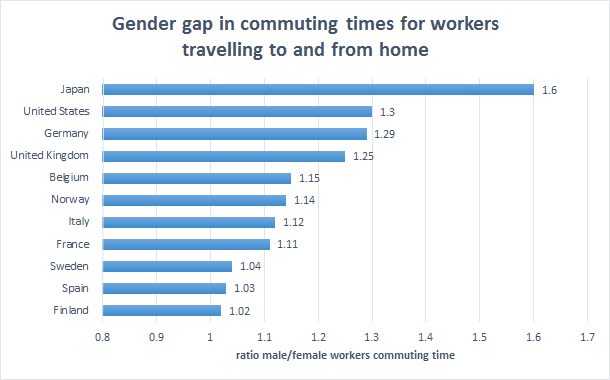
I lived in Japan so that 60% extra time the Japanese men spend travelling to and from work in those cramped trains is not to be underrated.
Source: OECD Family Database – OECD.
04 Feb 2016 Leave a comment
in discrimination, economics of love and marriage, gender, human capital, labour economics, labour supply, occupational choice, transport economics, urban economics Tags: asymmetric marriage premium, commuting times, gender wage gap, reversing gender gap
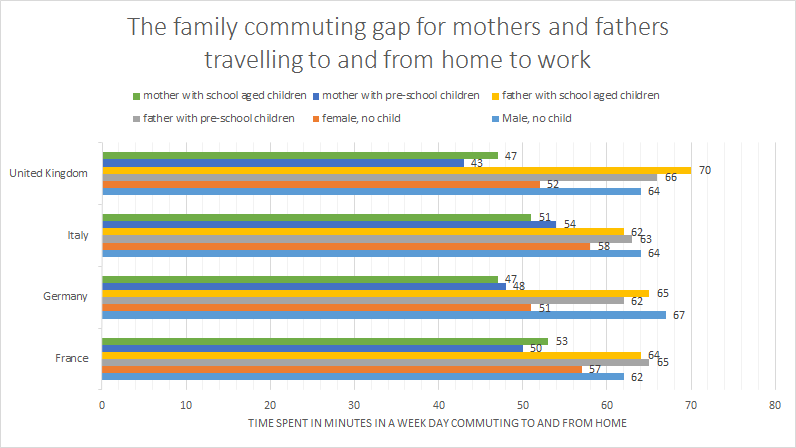
Few labour market statistics have any meaning unless broken down by gender. The compensating differentials that explain much of the family pay gap extend strongly to commuting times.
Source: OECD Family Database – OECD, Table LMF2.6.A.
Mothers commute a good 15 to 20 minutes less than fathers in the UK, Italy, Germany and France. Single women commute 5 to 10 minutes further than mothers. Single men and fathers commute much the same distance.
31 Jan 2016 2 Comments
in discrimination, gender, labour economics, labour supply, occupational choice, transport economics, urban economics Tags: commuting times, compensating differentials, gender wage gap, reversing gender gap
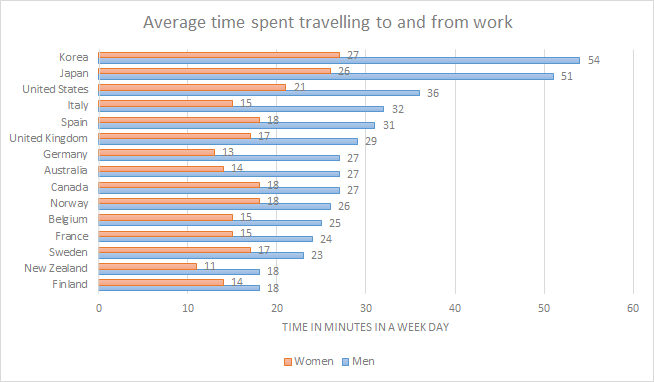
Commuting times need to be incorporated into calculations of the gender wage gap because they do represent a serious fixed cost of working that is higher for men than for women.
Source: OECD Family Database.
Not only is the commuting time for female workers less, there is much less variation across the OECD member countries than for men.
The figures for New Zealand are so low that they are suspicious.
31 Jan 2016 Leave a comment
in discrimination, gender, labour economics, labour supply, occupational choice, poverty and inequality Tags: asymmetric marriage premium, gender wage gap, high-powered jobs, offsetting behaviour, Parental leave, paternity leave, unintended consequences
30 Jan 2016 Leave a comment
in discrimination, gender, human capital, labour economics, labour supply, occupational choice Tags: gender wage gap
29 Jan 2016 1 Comment
in discrimination, economics of love and marriage, gender, job search and matching, labour economics, occupational choice Tags: asymmetric marriage premium, gender wage gap, marital division of labour, marriage and divorce
Geoff Simmons attributes part of the gender wage gap to the reluctance especially among women in high-paying jobs to haggle over pay. These women at the top end of the labour market are more likely to accept the first offer.
This relative reluctance of women to haggle over their pay is important to explaining why the gender wage gap is much larger at the top end of the labour market than at the bottom according to Geoff Simmons. Women have to haggle more if the gender pay gap is to close further.
Haggling over the wage has costs as well as benefits as Richard Epstein explained 20 years ago within a search and matching framework when commenting on a paper written by Carol Rose in 1992:
If one party is known to gobble up virtually all the cooperative surplus, then that party will find it difficult to attract deals. People anticipate getting some portion of the gain and will have a tendency to migrate to other individuals and transactions when they do not have to be ever watchful of their fair share of the gain.
If women have the characteristics that Rose attributes to them, then they would be able to enter more deals and find jobs more easily than men. At this point it becomes an empirical question: whether the greater frequency of deals (or shorter periods of unemployment) offset the tendency to gain a larger share of the profits of any given transaction.
Women will find it easier to get a job because they haggle less and therefore negotiations are less likely to breakdown, which will increase their lifetime income. This reduction in the cost of search because of a greater prospect of a match offset the losses in wages from successful haggling.
Indeed, does not this reluctance to haggle among women make it more likely that employers will hire women and promote the because their reluctance to haggle makes them cheaper. This starts off a competition between employers that will slowly drive up the wages offered to women.
It is also the case that women invest in human capital that is more mobile between the jobs and they are more likely to quit the workforce and return again after motherhood.
The ability to quickly find a job after a career interruption is a competitive advantage rather than a disadvantage.
Men have more specialised human capital and are more likely to stay in one job so they have more to gain from haggling. In comparison, women invest in human capital that is more mobile between jobs because they anticipate downscaling or quitting because of motherhood.
In such a case, it is advantageous to have human capital that appeals to a wide range of employers and become can be quickly matched so that full-time or part-time employment and the associated income stream can start quick as quickly as possible. Workers who changed jobs more often and have shorter job tenures have less to gain and more to lose from haggling and not getting the job at all.
If women do not like to haggle, does this not imply they are less likely to be attracted the jobs with performance pay? Alan Manning investigated this specific question a few years ago.
The propensity of women to seek or avoid jobs with performance pay in a more competitive workplace is an important question because up to 40% of jobs have some form of performance pay which would put women off if they do not like to haggle as Geoff Simmons implies.
Manning used jobs with performance pay in the the 1998 and 2004 British Workplace Employees Relations Survey as a proxy for the level of competition in the workplace.
If Geoff Simmons is right, women should shy away from jobs with performance pay. Women should be less likely to hold these jobs with performance pay, other things being equal. That is precisely the hypothesis that Alan Manning explored. He is a world-class labour economist. What did he find?
We find very modest evidence for differential sorting into performance pay schemes by gender, and small effects of performance pay on hourly wages. Furthermore, and unlike the laboratory studies, we find no significant effect of the gender mix in the job on the responsiveness to performance pay.
We do find some evidence for an effect of performance pay on a measure of work effort in line with the experimental evidence but the bottom line is that a very small part of the gender pay gap can be attributed to these factors.
The gender pay is already tiny in New Zealand and only a tiny part of that can be explained as any reluctance of women to compete in the workforce such as through signing on for performance pay.
Manning found that the gender mix of jobs in occupation is not affected by the presence of performance pay but it should be if women are reluctant to angle and to be competitive as suggested by Geoff Simmons.
The reluctance of women to sign on for performance pay maybe be an aspect of the asymmetric marriage premium and the marital division of effort. Mothers, unlike fathers, cannot afford to go home at the end of the workday completely exhausted if there are children to care for.
Women have a long history of carefully selecting education and other human capital and occupations to anticipate the responsibilities of motherhood and minimising human capital depreciation during the associated career interruptions. Anticipating that motherboard is a lot of work is no stretch on that occupational sorting by women.
Women still do most of the household chores? Data on who does what in the house: goo.gl/3doqy4 #statistics https://t.co/fnY0d9OgkT—
DataStories (@LindaRegber) October 24, 2015
That division of effort between the sexes has got nothing to do with the behaviour of employers and everything to do with the marital division of labour. As to what to do about that Richard Posner raised a very good conundrum in a paper from 20 years ago:
The idea the government should try to alter the decisions of married couples on how to allocate time to raising children is a strange mixture of the utopian and the repulsive. The division of labour within marriage is something to be sorted out privately rather than made a subject of public intervention.
Liberal and radical frameless can if they wanted women to stay in the labour force and have no children or fewer children, or, persuade their husbands to assume a greater role in child rearing. Others can search the contrary. The ultimate decision is best left to private choice.
I remember from decades ago a couple at work who were very modern and trying to share the child rearing equally. Their three-year-old daughter was not very cooperative because she found that her mother was much better at braiding her hair than a father. That tantrum by their three-year-old was the beginning of the end of a grand plan.
22 Jan 2016 Leave a comment
in discrimination, economics of love and marriage, gender, human capital, labour economics, occupational choice, politics - New Zealand Tags: asymmetric marriage premium, family wage gap, gender wage gap
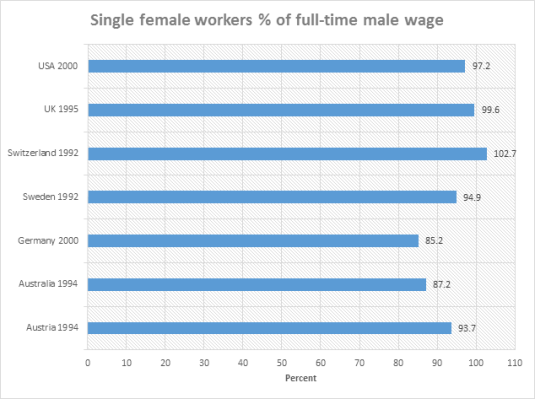
If victory is a zero gender wage gap, some countries have achieved it already for single female workers and long ago according to the data charted below is from the Luxembourg Income Study.
Source: IZA World of Labor – Equal pay legislation and the gender wage gap from the Luxembourg Income Study.
Discrimination cannot explain why the gender wage gap for single female is tiny relative to the family wage gap. As Solomon Polachek explains:
…the wage gap for married workers is between three and 30 times greater compared with single workers.
Employers cannot be to blame for the large difference between the single female worker gender wage gap and the family wage gap.
Aside from explaining why employers only discriminate against married women, you must explain how employers managed to find out which female applicants are married so they can discriminate against them.
Without that vital information on the marital status of female applicants and the presence and number of children as well is their spacing, the vast male chauvinistic conspiracy responsible for the glass ceiling and the sticky floors against promotion does not get off the ground.
How do employers actually pay married women less? Advertising jobs that pay women less has been unlawful for decades. Yet another hurdle to overcome for the vast male chauvinistic conspiracy.
Women move between the large number of jobs as do men accumulating human capital as they go? Somehow employers, including female owned firms, must sabotage the accumulation of human capital by married women as soon as they have children but without paying them lessen in their current jobs or advertising jobs that pay married women less.
The main drivers of the gender wage gap are unknown to employers such as:
These are the main drivers of the gender wage gap – all of which are factors totally unknown to employers and of no relevance to them in making a profit.
Most explanations of the gender wage gap centre around human capital. In anticipation of time outside of the workforce for motherhood, women self-selecting to occupations that penalise career interruptions less.
Women invest in human capital that is more general, human capital that is more mobile between jobs and into spells of part-time work. Women anticipate home time after they have children so they invest in human capital that depreciations at a slower rate during career interruptions. Women also invest less overall in new capital because they expect to spend less time in the labour market.
All of these investments are made by women themselves in anticipation of motherboard rather than employers somehow paying them less after they marry and have children.
The solution to closing the family wage gap requires radical biological changes in who has children. There are more radical changes required than this because mothers actually like babies and enjoy spending time with them rather than going to work.
Equally challenging is the required changes in the dating market. There is an average age difference between boyfriends and girlfriends and husbands and wives of 2 to 3 years. As the husband or boyfriend is a few years older, he has usually accumulated more human capital and is more likely to be at a critical career point for promotion.

Because the husband or boyfriend is 2 to 3 years older, it pays off well in terms of the father investing more in market-related human capital and the mother devoting more time to childcare.
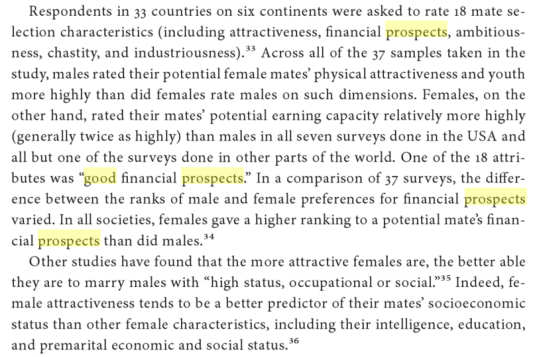
Another major driver of the gender pay gap is the dating market as identified by Richard McKenzie. He pointed out that evolutionary psychology has found that in every culture one of the factors of influencing pairing off in the dating market is that the boyfriend or husband must have good prospects although this preference is weakening over this last century.
One of the reasons for the increase in single parents is that low-paid men are not as inviting prospects as long-term boyfriends or husbands is a few generations ago. There are too few good men.
University educated couples are not called power couples for nothing – their earning power is this stunning compared to going it on your own. The emergence of power couples means that less educated women may prefer to stay single and raise children on their own rather than marry what is left in the marriage pool.
Because of the requirement among women across all cultures that husbands to be must have good prospects, men have an extra incentive to invest in human capital and work harder and longer hours because of the gender specific payoff in the marriage market.
Men will also take more risks than women because risky jobs carry wage premiums. That risk premium is topped up in the mating market terms are marriage prospects because of the higher wages. Women get a wage premium for taking risky jobs but less of a payoff in the mating market for the higher wages. There is an evolutionary psychology explanation for the family wage gap.

All in all, a key requirement for the closing of the family wage gap and what little is left of the gender wage gap is women drop their standards in terms of who they choose as boyfriends and husbands. Not very likely.

19 Jan 2016 Leave a comment
in applied price theory, applied welfare economics, economics of regulation, entrepreneurship, health and safety, industrial organisation, labour economics, law and economics, occupational choice, politics - New Zealand, survivor principle, theory of the firm Tags: job safety, workers compensation
Unharnessed painters work amid the Eiffel Tower. Circa 1910. http://t.co/N7yE7OaKGm—
Old Pics Archive (@oldpicsarchive) June 13, 2015
Workplace safety arises as a by-product of economic growth. Risks in the workplace and outside that would not countenance now were routine a few decades ago because the risk of eliminating them was high.
The soon to take effect New Zealand health workplace safety legislation makes it much more difficult to have independent directors and part-time directors of companies. That will both weaken the ability of shareholders to prevent insider control as well as introduce a diversity of views onto boards of directors.

The resignation of Sir Peter Jackson is an example of this. Talented entrepreneurs are no longer able to run large numbers by sitting on the board and intervening on a management by exception basis.
Rupert Murdoch as an example of an executive able to run a global empire. He would ring up the chief executives of his subsidiaries for one minute to month. If they are talking about something interesting, he would listen for longer. He was the ultimate one-minute manager who built a global empire around his supreme entrepreneurial talent.
The new legislation on workplace safety will increase the cost of building a successful business from the ground up. Entrepreneurs will not be able to quickly intervene in the company and dismiss underperforming executives who look after things while they are away. This is because they are not on the Board of Directors.
One constraint on the growth of any firm is entrepreneurs have a limited span of control (Coase 1937; Williamson 1967, Lucas 1978; Oi 1983a, 1983b). A span of control is the number of subordinates that an individual supervisor has to control and lead either directly or through a hierarchical managerial chain (Fox 2009). There are only so many tasks that even the most able of entrepreneurs can carry out in one day. Over-stretched spans of control motivate entrepreneurs to hire professional managers and delegate to them a wide range of decision-making rights over the firms they own (Williamson 1975; Foss, Foss and Klein 2008).
Entrepreneurs and the professional managers they hired to assist them must divide their respective time between monitoring employees, identifying new business opportunities, forecasting buyer demand and running the other aspects of their business (Lucas, 1978; Oi 1983, 1983b, 1988; Foss, Foss, and Klein 2008). The larger is the firm, the more employees there are for the entrepreneur to direct, monitor and reward. These costs of directing and monitoring employees will increase with the size of the firm and larger firms will encounter information problems not present in smaller firms (Alchian and Demsetz 1972; Stigler 1962)
The time of the more talented entrepreneurs is more valuable because they had the superior managerial skills and entrepreneurial alertness to make their firms large in the first place and remain deft enough to survive in competition. Time spent on the supervision of employees is time that is spent away from other uses of the talents that got these more able entrepreneurs to the top and keeps them there (Williamson 1967; Lucas 1978; Oi 1983b, 1988, 1990; Idson and Oi 1999; Black et al 1999).
Firms in the same industry tend to exhibit systematic differences in their organization of production and the structure of their workforces because entrepreneurial ability is the specific and scarce production input that limits the size of a firm (Lucas, 1978; Oi 1983b). The less able entrepreneurs tend to run the smaller firms while the better entrepreneurs tend to lead both the currently large firms and the smaller firms that are growing at the expense of market rivals (Lucas 1978, Oi 1983b; Stigler 1958; Alchian 1950).
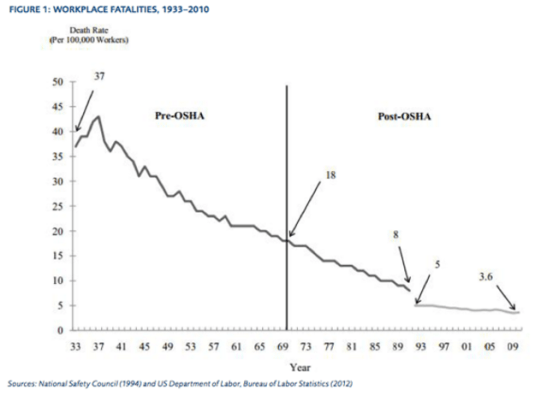
There has been a tremendous improvement in the working conditions over the 20th century. The main driver was the incentive and employers to provide safe workplaces as real wages grew. Adam Smith noted that more dangerous and unpleasant jobs always attracted a wage premium as he explains in the Wealth of Nations:
The five following are the principal circumstances which, so far as I have been able to observe, make up for a small pecuniary gain in some employments, and counterbalance a great one in others: first, the agreeableness or disagreeableness of the employments themselves; secondly, the easiness and cheapness, or the difficulty and expense of learning them; thirdly, the constancy or inconstancy of employment in them; fourthly, the small or great trust which must be reposed in those who exercise them; and, fifthly, the probability or improbability of success in them.
First, the wages of labour vary with the ease or hardship, the cleanliness or dirtiness, the honourableness or dishonourableness of the employment. Thus in most places, take the year round, a journeyman tailor earns less than a journeyman weaver. His work is much easier. A journeyman weaver earns less than a journeyman smith. His work is not always easier, but it is much cleanlier. A journeyman blacksmith, though an artificer, seldom earns so much in twelve hours as a collier, who is only a labourer, does in eight. His work is not quite so dirty, is less dangerous, and is carried on in daylight, and above ground.
Honour makes a great part of the reward of all honourable professions. In point of pecuniary gain, all things considered, they are generally under-recompensed, as I shall endeavour to show by and by. Disgrace has the contrary effect.
The trade of a butcher is a brutal and an odious business; but it is in most places more profitable than the greater part of common trades. The most detestable of all employments, that of public executioner, is, in proportion to the quantity of work done, better paid than any common trade whatever.
Hunting and fishing, the most important employments of mankind in the rude state of society, become in its advanced state their most agreeable amusements, and they pursue for pleasure what they once followed from necessity. In the advanced state of society, therefore, they are all very poor people who follow as a trade what other people pursue as a pastime. Fishermen have been so since the time of Theocritus. A poacher is everywhere a very poor man in Great Britain. In countries where the rigour of the law suffers no poachers, the licensed hunter is not in a much better condition. The natural taste for those employments makes more people follow them than can live comfortably by them, and the produce of their labour, in proportion to its quantity, comes always too cheap to market to afford anything but the most scanty subsistence to the labourers.
Disagreeableness and disgrace affect the profits of stock in the same manner as the wages of labour. The keeper of an inn or tavern, who is never master of his own house, and who is exposed to the brutality of every drunkard, exercises neither a very agreeable nor a very creditable business. But there is scarce any common trade in which a small stock yields so great a profit…
The wages in any particular job will vary with the risks that are known to the worker in that job. That is an important qualification.
Competition in labour markets ensures that the net advantages of different jobs will tend to equality. This theory of the labour market originating in Adam Smith, which drives much of modern labour economics became to be known as the theory of compensating differentials.

Firms can choose their production technology to offer workers greater safety or they can economize on safety and offer the savings to workers in the form of higher wages. There is a trade-off in offering more safety or higher wages, holding constant the level of profits. As Kip Viscusi explains:
Wage premiums paid to U.S. workers for risking injury are huge—in 1990 they amounted to about $120 billion annually, which was over 2 percent of the gross national product, and over 5 percent of total wages paid.
These wage premiums give firms an incentive to invest in job safety because an employer who makes his workplace safer can reduce the wages he pays. Employers have a second incentive because they must pay higher premiums for workers’ compensation if accident rates are high.
One of the effects of safety regulation is the employers no longer have to pay this wage premium in more dangerous or disagreeable jobs but as Fishback wrote:
Studies of wages before and after the introduction of workers’ compensation show, however, that non-union workers’ wages were reduced by the introduction of workers’ compensation. In essence, the non-union workers “bought” these improvements in their benefit levels.
Even though workers may have paid for their benefits, they still seem to have been better off as a result of the introduction of workers’ compensation. Many workers had faced problems in purchasing accident insurance at the turn of the century. Workers’ compensation left them better insured, and allowed many of them to spend some of their savings that they had set aside in case of an accident.
What literature there is about suggest that workers overestimate small risks and underestimate large risks. Surveys of manufacturing employment show that one third of workers quit because they found out the job they accepted was more dangerous than they expected.
Source: Evaluating OSHA’s Effectiveness and Suggestions for Reform | Mercatus
One clear trend of the 20th century is as countries got richer, workers demanded more safety at work and larger wage premiums. Market incentives for better worker safety dwarf legal incentives such as from being sued, which in turn dwarf regulatory incentives.
There is also evidence of a glass coffin effect. About 95% of workplace deaths of men. Indeed, there are some interesting journal papers about how occupational choice is affected by motherhood, sole motherhood and sole fatherhood. Single parents are more cautious about their occupational choices.
It is unfortunate that the unions in New Zealand opposes a risk based system of workers’ compensation. The current system is not only no fault, employers pay premiums based on the risks of their industry, not of their individual workplace. There is plenty of evidence to show the charging premiums based on the risks of an accident and the previous record of workplace safety greatly reduces workplace deaths and injuries as Viscusi explains:
The workers’ compensation system that has been in place in the United States throughout most of this century also gives companies strong incentives to make workplaces safe. Premiums for workers’ compensation, which employers pay, exceed $50 billion annually. Particularly for large firms, these premiums are strongly linked to their injury performance.
Statistical studies indicate that in the absence of the workers’ compensation system, workplace death rates would rise by 27 percent. This estimate assumes, however, that workers’ compensation would not be replaced by tort liability or higher market wage premiums.
15 Jan 2016 Leave a comment
in discrimination, gender, human capital, labour economics, labour supply, occupational choice Tags: gender wage gap
10 Jan 2016 Leave a comment
in discrimination, economic history, gender, human capital, labour economics, labour supply, occupational choice, politics - USA Tags: gender wage gap, middle class stagnation, reversing gender gap, wage stagnation
08 Jan 2016 Leave a comment
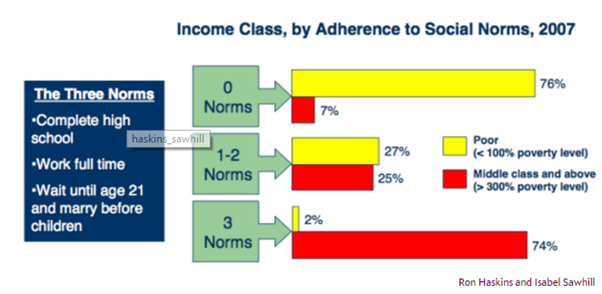
in economics of education, labour economics, labour supply, occupational choice, politics - USA, poverty and inequality, welfare reform Tags: child poverty, family poverty, high school dropouts, marriage and divorce, single parents, success sequence
Source: The success sequence: Conservatives think they have a formula for raising people out of poverty.
.
Celebrating humanity's flourishing through the spread of capitalism and the rule of law
Scholarly commentary on law, economics, and more
Beatrice Cherrier's blog
Celebrating humanity's flourishing through the spread of capitalism and the rule of law
Celebrating humanity's flourishing through the spread of capitalism and the rule of law
Celebrating humanity's flourishing through the spread of capitalism and the rule of law
Why Evolution is True is a blog written by Jerry Coyne, centered on evolution and biology but also dealing with diverse topics like politics, culture, and cats.
Celebrating humanity's flourishing through the spread of capitalism and the rule of law
Celebrating humanity's flourishing through the spread of capitalism and the rule of law
A rural perspective with a blue tint by Ele Ludemann
DPF's Kiwiblog - Fomenting Happy Mischief since 2003
Celebrating humanity's flourishing through the spread of capitalism and the rule of law
The world's most viewed site on global warming and climate change
Tim Harding's writings on rationality, informal logic and skepticism
A window into Doc Freiberger's library
Let's examine hard decisions!
Commentary on monetary policy in the spirit of R. G. Hawtrey
Thoughts on public policy and the media
Celebrating humanity's flourishing through the spread of capitalism and the rule of law
Politics and the economy
A blog (primarily) on Canadian and Commonwealth political history and institutions
Reading between the lines, and underneath the hype.
Economics, and such stuff as dreams are made on
"The British constitution has always been puzzling, and always will be." --Queen Elizabeth II
Celebrating humanity's flourishing through the spread of capitalism and the rule of law
Celebrating humanity's flourishing through the spread of capitalism and the rule of law
WORLD WAR II, MUSIC, HISTORY, HOLOCAUST
Undisciplined scholar, recovering academic
Celebrating humanity's flourishing through the spread of capitalism and the rule of law
Res ipsa loquitur - The thing itself speaks
In Hume’s spirit, I will attempt to serve as an ambassador from my world of economics, and help in “finding topics of conversation fit for the entertainment of rational creatures.”
Researching the House of Commons, 1832-1868
Articles and research from the History of Parliament Trust
Reflections on books and art
Posts on the History of Law, Crime, and Justice
Celebrating humanity's flourishing through the spread of capitalism and the rule of law
Exploring the Monarchs of Europe
Cutting edge science you can dice with
Small Steps Toward A Much Better World
“We do not believe any group of men adequate enough or wise enough to operate without scrutiny or without criticism. We know that the only way to avoid error is to detect it, that the only way to detect it is to be free to inquire. We know that in secrecy error undetected will flourish and subvert”. - J Robert Oppenheimer.
The truth about the great wind power fraud - we're not here to debate the wind industry, we're here to destroy it.
Celebrating humanity's flourishing through the spread of capitalism and the rule of law
Celebrating humanity's flourishing through the spread of capitalism and the rule of law
Economics, public policy, monetary policy, financial regulation, with a New Zealand perspective
Celebrating humanity's flourishing through the spread of capitalism and the rule of law
Restraining Government in America and Around the World
 Utopia, you are standing in it!
Recent Comments