Crime way down in NYC
28 Dec 2015 Leave a comment
in economics of crime, law and economics, occupational choice Tags: law and order, New York City
A surprising number of clergy are not working on Christmas Day
25 Dec 2015 Leave a comment
in economics of religion, labour economics, labour supply, occupational choice Tags: Christmas Day, compensating differentials
How many people in the UK work on Christmas day? gu.com/p/44baf/stw http://t.co/EjdUEFSbr7—
Guardian Data (@GuardianData) December 22, 2014
Do they have academic tenure anymore?
23 Dec 2015 Leave a comment
in economics of education, human capital, labour economics, managerial economics, occupational choice, organisational economics, personnel economics Tags: academic tenure, compensating differentials, occupational choice
https://twitter.com/mileskimball/status/541219532032212993/photo/1
Academic Deadlines phdcomics.com/comics.php?f=1… http://t.co/tazByBNUzI—
Jorge Cham (@phdcomics) August 01, 2015
Time spent writing your thesis.
**Need a graduation gift? Visit phdcomics.com/store http://t.co/PJNbG3C7PY—
Jorge Cham (@phdcomics) May 01, 2015
Education and the risk of criminality
22 Dec 2015 Leave a comment
in economics of crime, economics of education, labour economics, labour supply, law and economics, occupational choice, politics - USA Tags: crime and punishment
Earning power by personality type
22 Dec 2015 Leave a comment
in human capital, labour economics, labour supply, occupational choice Tags: economics of personality traits
Which occupations are up and which are down
21 Dec 2015 Leave a comment
in economic history, human capital, industrial organisation, labour economics, labour supply, occupational choice, survivor principle Tags: creative destruction, skill biased technical change
@CHSommers More reasons for women to avoid STEM careers @stevenljoyce @GreenCatherine
19 Dec 2015 Leave a comment
in discrimination, gender, labour economics, labour supply, law and economics, occupational choice
Many young women choose to not pursue science, technology, engineering and maths (STEM) careers because there are other career options that allow them to better use their superior verbal and reading abilities.
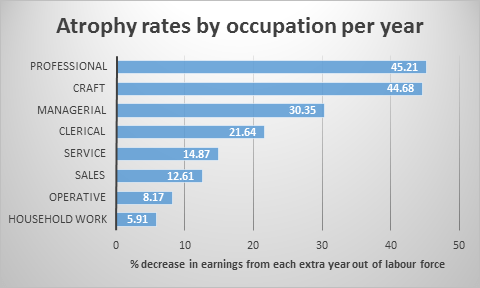
Further reasons for women to hesitate entering STEM occupations is their faster rate of human capital depreciation. It has been well known for a long time that human capital atrophy rates differ greatly by occupation and are much higher in professional, managerial and craft occupations.
Source: Polachek (1981).
Even a year out of the workforce can greatly reduce earning power because of a rapid depreciation of the human capital accumulated from certain occupations. Women make education and career choices that minimise these losses in light of periods away from work because of motherhood.
Women self-selecting to those occupations with low rates of human capital depreciation. As De Grip explains using German data:
…women who anticipate career interruptions for family reasons take account of the wage penalties related to such a break when they choose their occupational field, i.e. women select occupations where human capital deprecation during a career interruption is the lowest…
Our estimation results have important implications for public policies which attempt to encourage the interest of female students in technical studies and occupations. Obviously, the higher human-capital depreciation rates for workers with family-related career breaks in these male occupations can be a serious threshold for women to choose these occupations
Women choose the occupations that maximise the returns from their skills. Occupations that neither well-reward superior verbal and reading skills and have rapid rates of depreciation on occupational human capital are not a good investment for many of the women anticipating spells out of the workforce because of motherhood.
Rendall and Rendall (2015) recently investigated differential depreciation rates on verbal and maths skills in competing occupational choices for college educated women. Not surprisingly, they found that in the USA verbal skills suffered only minor depreciation during career interruptions but maths skills experience costly depreciation. They found that:
…college educated women avoid occupations requiring significant math skills due to the costly skill atrophy experienced during a career break. In contrast, verbal skills are very robust to career interruptions. The results support the broadly observed female preference for occupations primarily requiring verbal skills – even though these occupations exhibit lower average wages.
Thus, skill-specific atrophy during employment leave and the speed of skill repair upon returning to the labour market are shown to be important factors underpinning women’s occupational outcomes. This research suggests that a substantial portion of female occupational sorting could be determined by skill-specific atrophy-repair characteristics.
This is no surprise as verbal skills improve with age because of expanding vocabularies and better judgement based on accumulated experience. Maths skills tend to be the type of skills where your best years in your 20s and after that things fall away.
These findings by Rendall and Rendall reinforce the initial bias women have against STEM occupations because of their superior reading and verbal skills. STEM occupations are a poor career choice for women because they undervalue their innate skills and heavily penalise career interruptions.
Such is the fatal conceit of politicians is they want to encourage women to make poor education and occupational investments. Women self-selecting into vastly different occupations to men because they are smarter than the average politician about what is the best of them.
Differential atrophy rates on human capital as drivers of the gender wage gap and occupational segregation have nothing to do with the choices of employers – nothing to do with blameworthy behaviour on their part. The blameworthy behaviour can be explicit prejudice, implicit bias or statistical discrimination.
Much of occupational segregation is the result from self-selection by women into occupations on the basis of superior innate skills and the slow rates at which these verbal and reading skills depreciate with time both in general and with time away from the workforce.
The gender gap among the top 1%
19 Dec 2015 Leave a comment
in discrimination, gender, human capital, labour economics, occupational choice Tags: gender wage gap, superstar wages, superstars, top 1%
Why study science?
16 Dec 2015 Leave a comment
in economics, labour economics, occupational choice Tags: STEM
The average age of managers as a cause of the 1970s productivity slowdown
16 Dec 2015 Leave a comment
in applied price theory, business cycles, labour economics, labour supply, macroeconomics, occupational choice, personnel economics, theory of the firm
Jim Feyrer put forward a clever hypothesis about the sudden decline in the average quality of managers as a major contributor to the 1970s productivity slowdown. His hypothesis is a good contribution to real business cycle theory because what could be more random a shock than a demographic shock arising from the baby boom.
Feyrer’s hypothesis builds on Robert Lucas’s theory of the entrepreneur and the optimal size of the firm. The better entrepreneurs can manage larger spans of control.
Specifically, these more talented entrepreneurs can spread their skills and vision over a larger workforce thereby raising its productivity and that of the firm. Better quality managers are better trainers, better leaders, better problem solvers and better at recruiting and retaining staff.
If managerial skill and talent accumulates with experience, an influx of young workers into the workforce with the influx of the baby boomers into the workforce will lower the average quality of entrepreneurs. This will show up empirically as a decrease in the average age of managers and with that their experience and skills.
With the average age of the labour force lower during the influx of the baby boomers, more marginal managers have to be promoted into managerial positions to supervise younger employees. Lower managerial quality will lower the productivity of the workforce as a whole.
If managerial talent and skill is to have any meaning, a more talented manager should be able to extract greater productivity from the same quality labour force. Lazear points out that
Supervision and management are fundamental in personnel economics and in the theory of the firm… Boss effects are large and significant. Most important, bosses vary substantially in their quality. A very good boss increases the output of the supervised team over that supervised by a very bad boss by about as much as adding one member to the team.
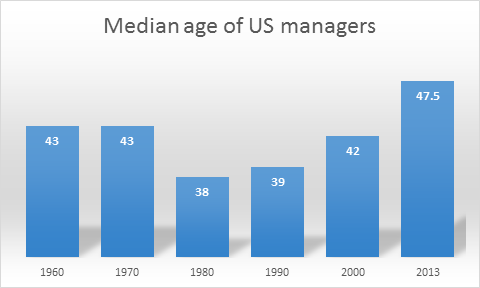
The influx of less able managers in the 1970s, as shown by a five-year reduction in the median age of US managers in the chart below, accounted for 20% of the observed productivity slowdown and resurgence in the 1970s and 1980s according to Feyrer. To fill vacancies, employers had to drop their hiring standards for managers.
Source: Jim Feyrer The US Productivity Slowdown, the Baby Boom, and Management Quality, Journal of Population Economics (2011) and Bureau of Labor Statistics Employed persons by detailed occupation and age (2013).
When the median age of managers rose in the 1990s, and along with it the average of quality of management, this productivity slowdown was reversed. Both the increase in the decrease in the age of managers are random productivity shocks in the tradition of real business cycle theory.
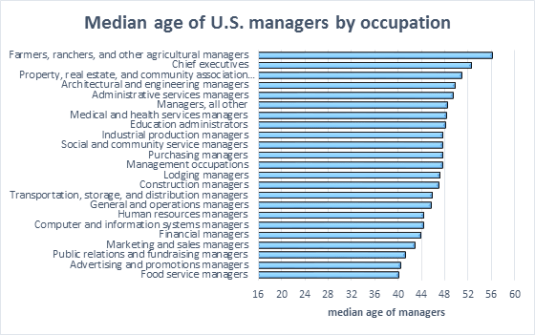
The average age of the US manager was 38 in 1980 and 39 in 1990. There is no US managerial occupation with an average age of less than 40 in 2013. The fifth managerial occupation with the lowest managing age is food service managers. The highest outside of agriculture is chief executives,
Source: Bureau of Labour Statistics Employed persons by detailed occupation and age (2013).
One of the mocking tones directed at real business cycle theory is it was supposed to require a regular forgetting of technologies so that productivity fell and then the loss technologies were remembered a few years later to have a business cycle.
That forgetting and remembering is what happened with the average age of managers and labour productivity in the 1970s. Management quickly lost five years of experience then slowly regained it with matching productivity swings and roundabouts.
Feyrer is another addition to a long line showing that business cycles can arise from the sum of random shocks, rather than one big shock, as Prescott suggested in 1986:
Another Summers question is, Where are the technology shocks? Apparently, he wants some identifiable shock to account for each of the half dozen postwar recessions. But our finding is not that infrequent large shocks produce fluctuations; it is, rather, that small shocks do, every period.
Are CEOs denied their labour surplus?
11 Dec 2015 Leave a comment
in applied price theory, entrepreneurship, fisheries economics, human capital, industrial organisation, labour economics, labour supply, managerial economics, occupational choice, organisational economics, personnel economics, survivor principle Tags: CEO pay, moral hazard, promotion tournaments, superstar, superstar wages
Bang Dang Nguyen and Kasper Meisner Nielsen looked at how share prices reacted to 149 cases of the chief executive or another prominent manager dying suddenly in American companies between 1991 and 2008.
If the shares rise on an executive’s death, he was overpaid; if they fall, he was not. Only 42% of the bosses studied were overpaid. Those with the bigger pay packages gave the best value for money as measured by the share-price slump when they passed away unexpectedly.
Share prices do speak to the value of the company and the contribution of its CEO. The share price of Apple went up and down by billions on the back of rumours about the health of Steve Jobs.

In terms of splitting of what some call the labour surplus increase from a firm hiring an executive, these employees retain on average about 71% and their employer keeps 29%. Others call this rent sharing.

71% going to the CEO might initially sound high, “but it’s not like he’s taking home more than he produced for the company,” says Nguyen.

The exploitation of CEOs gets worse when you consider the extensive use of promotion tournaments by their employers when setting their wages. They are thrust into rat races. Promotion tournaments are an integral and often invisible part of their workplaces.
Executive level employees are often ranked by their employers relative to each other and promoted not for being good at their jobs but for being better than their rivals. These promotion tournaments sent one employee against another – one worker against another – to the profit of the owners of the firm.
The rat race set up by the owners of the firm are so cutthroat that in competitions to determine promotions the capitalists who own the firm may find that their employees discover that the most efficient way of winning a promotion is by sabotaging the efforts of their rivals.
Lazear and Rozen’s tournament theory of executive pay has stood the test of time. The key to this rat race is the larger is your boss’s pay, the bigger the motivation for you as an underling to work for a promotion. As Lazear wrote in his book, Personnel Economics for Managers
The salary of the vice president acts not so much as motivation for the vice president as it does as motivation for the assistant vice presidents.

Are women just too smart to be computer scientists?
08 Dec 2015 Leave a comment
in applied price theory, discrimination, economics of education, gender, human capital, labour economics, managerial economics, occupational choice, organisational economics, personnel economics, politics - Australia, politics - New Zealand, politics - USA Tags: economics of personality traits, gender wage gap, reversing gender gap


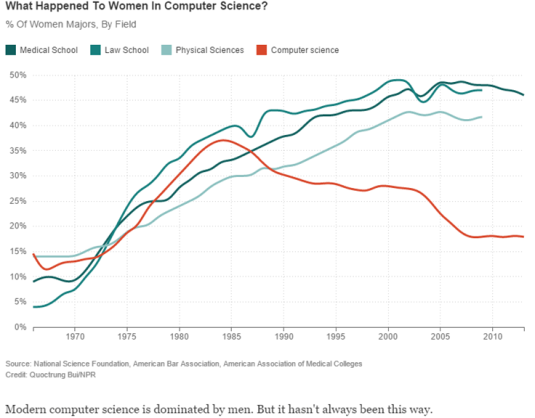
Women started drifting away from computer science in the mid-1980s. The interpretation put forward by the professional grievance industry, that is, by National Public Radio in the USA is:
The share of women in computer science started falling at roughly the same moment when personal computers started showing up in U.S. homes in significant numbers.
These early personal computers weren’t much more than toys. You could play pong or simple shooting games, maybe do some word processing.
And these toys were marketed almost entirely to men and boys. This idea that computers are for boys became a narrative. It became the story we told ourselves about the computing revolution. It helped define who geeks were, and it created techie culture.
 Source: NPR
Another interpretation is there are systematic differences between teenage boys and teenage girls in verbal and written skills. Young women moved away from enrolling in computer…
View original post 224 more words
@suemoroney more generous maternity leave increases the gender wage gap @JanLogie
07 Dec 2015 Leave a comment
in applied price theory, discrimination, economics of love and marriage, gender, labour economics, labour supply, law and economics, occupational choice, politics - New Zealand Tags: do gooders, expressive voting, female labour force participation, gender wage gap, maternal labour supply, maternity leave, The fatal conceit, unintended consequences

Source: Why Are Women Paid Less? – The Atlantic.
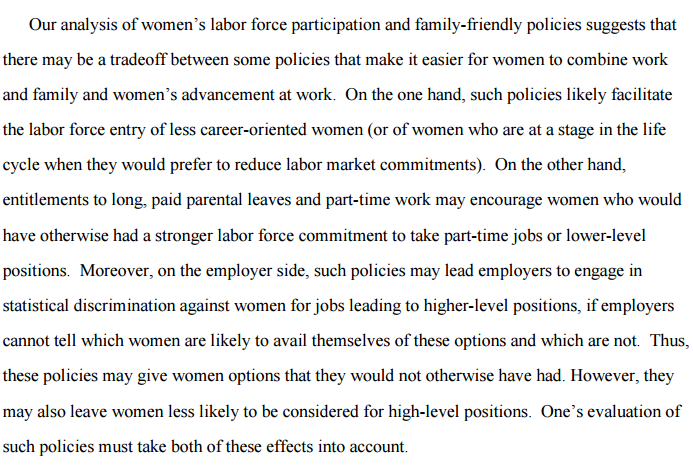
Source: AEAweb: AER (103,3) p. 251 – Female Labor Supply: Why Is the United States Falling Behind?
The role of the six-day working week in Japanese sexism and the gender wage gap
02 Dec 2015 Leave a comment
in applied price theory, discrimination, economic history, economics, economics of love and marriage, gender, human capital, labour economics, occupational choice, personnel economics Tags: asymmetric marriage premium, compensating differentials, entrepreneurial alertness, gender wage gap, marital division of labour
When I was studying in Japan, they were at the end of phasing out working on Saturdays. The staff at my university work on Saturday mornings for four hours and then went home.
The Japanese working week was reduced by law from 48 to 44 hours per week in 1988 and to 40 hours per week from 1993 (Prescott 1999; Hayashi and Prescott 2002). The Japanese stopped routinely working on Saturdays over the 1990s. The number of national holidays was increased by three and an extra day of annual leave was also prescribed by law.
While feuding with strangers on an unrelated matter about the gender wage gap, it somehow occurred to me that the six-day working week might have something to do with what is on the face of a large amount of sexism in Japan and a large gender wage gap.
That feud with strangers was about unconscious bias as a driver of the gender wage gap in New Zealand. The gender wage gap Japan is attributed to conscious prejudice.
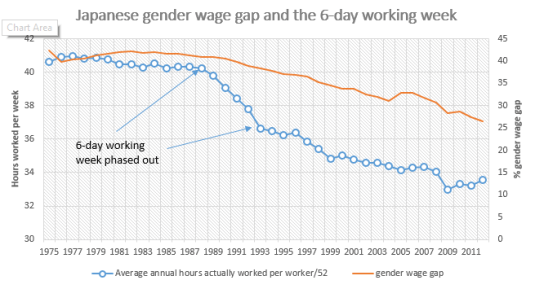
Source: OECD Stat.
In the above chart I have plotted the average weekly hours worked of Japanese workers and the Japanese gender wage gap. Two things can be noticed from the above chart:
- there is a sharp reduction in the number of hours worked per week by Japanese workers when they stopped working on Saturdays; and
- the gender wage gap started declining after the introduction of a five-day working week in Japan.
In a country where it is standard to work six days a week, the price of motherhood would be much higher than in other countries industrialised countries that phased out the 48-hour week decades previous. The asymmetric marriage premium would also be much higher if one partner to the marriage worked a six-day week while the other looked after the children.
Other drivers of the gender wage gap that arise from human capital specialisation and depreciation and from the differences of a few years in the marrying ages of men and women would be intensified if people worked another day per week. The payoff from a marital division of labour and human capital specialisation where one worked long hours and the other focused on investing in human capital that allow them to care for the children and move in and out of the workforce with less human capital depreciation would be much larger.
Much is made of the distinctiveness of Japanese culture and its sexism. In my time in Japan, the thing I notice most distinctively about Japanese culture was its extraordinary pragmatism and willingness to change rapidly. The Japanese economic miracle was founded on rapid industrialisation, innovation and repeated renewal of human capital. That requires an entrepreneurial spirit and open-mindedness.
Cultural and preference based explanations of the gender wage Including that in Japan underrate the rapid social change in the role of women in the 20th century in all countries in all cultures. As Gary Becker explains:
… major economic and technological changes frequently trump culture in the sense that they induce enormous changes not only in behaviour but also in beliefs. A clear illustration of this is the huge effects of technological change and economic development on behaviour and beliefs regarding many aspects of the family.
Attitudes and behaviour regarding family size, marriage and divorce, care of elderly parents, premarital sex, men and women living together and having children without being married, and gays and lesbians have all undergone profound changes during the past 50 years. Invariably, when countries with very different cultures experienced significant economic growth, women’s education increased greatly, and the number of children in a typical family plummeted from three or more to often much less than two.
A good explanation of this rapid social change is in Timur Kuran’s “Sparks and Prairie Fires: A Theory of Unanticipated Political Revolutions” and “Now Out of Never: The Element of Surprise in the East European Revolution of 1989“.
Kuran suggests that political revolutions and large shifts in political opinion will catch us by surprise again and again because of people’s readiness to conceal their true political preferences under perceived social pressure:
People who come to dislike their government are apt to hide their desire for change as long as the opposition seems weak. Because of the preference falsification, a government that appears unshakeable might see its support crumble following a slight surge in the opposition’s apparent size, caused by events insignificant in and of themselves.
Kuran argues that everyone has a different revolutionary threshold where they reveal their true beliefs, but even one individual shift to opposition leads to many others to come forward and defy the existing order. Small concessions embolden the ground-swell of revolution.
Those ready to oppose social intolerance or who are lukewarm in their intolerance keep their views private until a coincidence of factors gives them the courage to bring their views into the open. They find others share their views and there is a revolutionary bandwagon effect.
Plenty of people have had personal experiences of this in the 1980s and the 1990s when there were rapid changes in social and political attitudes about racism, sexism and gay rights. This includes Japan.
In the case of the Japanese gender wage gap, the move from a six-day to a five-day working week radically changed the asymmetric marriage premium and the payoff from investing in both specialised human capital and in human capital that depreciates quickly when away from work.
This large shift in incentives to work and invest in human capital would embolden a change in social attitudes. This is because the previous views were no longer profitable and many would gain from the change. Others who prefer just to go along with crowd would quickly follow them in to stay in tune with whatever is now popular.
Much of Japanese sexism may be the preference falsification that was low-cost when there was a six-day working week. The move to a five-day working week greatly increased the cost of that sexism and the profits from finding new ways of organising the workplace that better matched motherhood and career in Japan.
Undervalued workers are an untapped business opportunity for more alert entrepreneurs to hire these undervalued workers. In the case of Japan, with a five-day working week, hiring women for jobs that involved considerable investment in firm-specific human capital became more profitable. Previously under a six-day working week it was more profitable to invest in men because they undertook few childcare responsibilities. Under a five-day working week, that payoff matrix favours women more than in the past.
 Utopia, you are standing in it!
Recent Comments