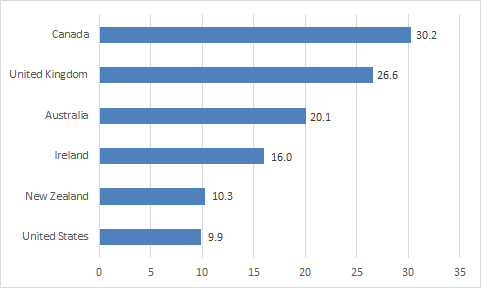
Figure 1: Proportion of births out of wedlock, 2011, Anglo-Saxon countries
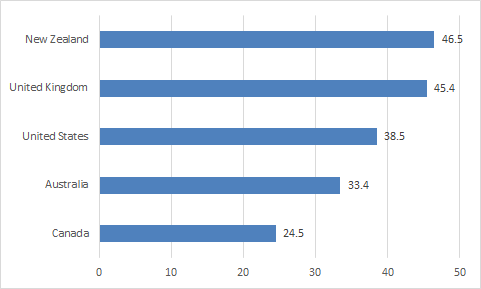
Source: OECD family database; no data for Ireland.
Celebrating humanity's flourishing through the spread of capitalism and the rule of law
20 Jun 2015 Leave a comment
in gender, labour economics, labour supply, occupational choice, politics - Australia, politics - New Zealand, politics - USA, population economics Tags: economics of fertility, economics of the family, single mothers, single parents
Figure 1: Proportion of births out of wedlock, 2011, Anglo-Saxon countries
Source: OECD family database; no data for Ireland.
19 Jun 2015 Leave a comment
in labour economics, occupational choice Tags: economics of identity, war against terror
18 Jun 2015 Leave a comment
in economics of education, human capital, labour economics, labour supply, occupational choice Tags: educational attainment
Average years of schooling in US over time. Rise slowed in the 1970s. brook.gs/14C4Kmo http://t.co/abs2A8BvAx—
Richard V. Reeves (@RichardvReeves) January 09, 2015
18 Jun 2015 Leave a comment
in economics of education, labour economics, labour supply, law and economics, managerial economics, occupational choice, organisational economics, personnel economics, rentseeking, unions Tags: employment protection laws
18 Jun 2015 Leave a comment
in economics of education, gender, labour economics, labour supply, occupational choice, politics - Australia, politics - New Zealand, politics - USA, welfare reform Tags: single mothers
There's a clear increase in single-parent households for parents who haven’t gone to college: on.wsj.com/1B1Xeuq http://t.co/eW2fH8bX5O—
Real Time Economics (@WSJecon) May 17, 2015
18 Jun 2015 1 Comment
in labour economics, labour supply, occupational choice Tags: compensating differentials, taxation and the labour supply
Figure 1: % of workers working more than 50 hours per week, OECD, 2013

Source: OECD Better Life Index 2015.
17 Jun 2015 Leave a comment
in economics of education, entrepreneurship, human capital, industrial organisation, labour economics, labour supply, occupational choice, Public Choice, rentseeking, survivor principle Tags: antimarket bias, creative distraction, expressive voting, make-work bias, rational ignorance, rational irrationality, technological unemployment
Every 20 years we worry about losing jobs to tech. books.google.com/ngrams/graph?c… http://t.co/KW47Iwzsp9—
James Bessen (@JamesBessen) August 10, 2014
17 Jun 2015 Leave a comment
in economics of education, human capital, labour economics, labour supply, occupational choice, poverty and inequality Tags: College premium, education premium, graduate premium, high school dropouts
http://t.co/t1Pym23Wgv—
EPI Chart Bot (@epichartbot) May 27, 2015
16 Jun 2015 Leave a comment
in economics of education, human capital, labour economics, occupational choice, politics - Australia, politics - New Zealand, politics - USA Tags: economics of personality traits, gender gap, PISA, reversing gender gap
Boys’ dominance just about endures in maths: at age 15 they are, on average, the equivalent of three months’ schooling ahead of girls. In science the results are fairly even.
But in reading, where girls have been ahead for some time, a gulf has appeared. In all 64 countries and economies in the study, girls outperform boys. The average gap is equivalent to an extra year of schooling.
Figure 1: : Gender differences (boys – girls) in student performance in reading, mathematics and science in PISA 2012

Source: OECD family database.
14 Jun 2015 Leave a comment
in discrimination, economics of education, gender, human capital, labour economics, labour supply, occupational choice, politics - Australia, politics - New Zealand, politics - USA Tags: Australia, British economy, Canada, College premium, education premium, gender wage gap, Ireland
Figure 1: % population who have attained at least tertiary education, age 25 – 34 by gender (2012)
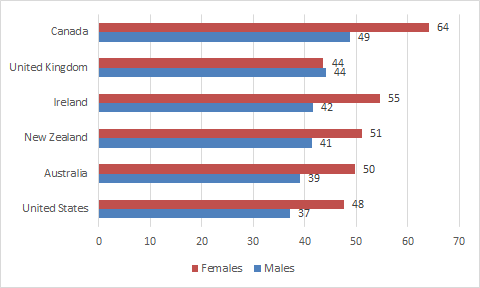
Source: OECD family database.
Figure 2 shows that the stark reversing of the gender gap in educational attainment shown in figure 1 was somewhat more recent in the US, UK and to a lesser extent in Ireland and Australia. In the UK and USA, educational attainment by gender was pretty equal for the earlier generation of graduates as compared to today’s 25 to 34-year-olds. The reversing of the gender gap in educational attainment dates back several decades in Canada and New Zealand.
Figure 2: % population who have attained at least tertiary education, age 45 – 54 by gender (2012)
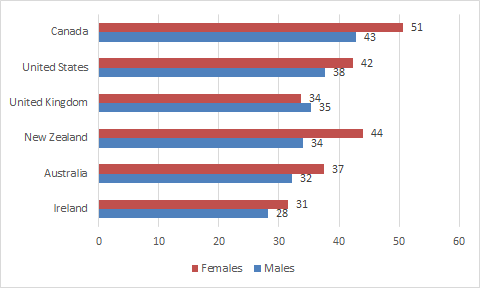
Source: OECD family database.
14 Jun 2015 Leave a comment
in economics of education, human capital, labour economics, occupational choice, politics - USA Tags: College premium, education premium, graduate premium
13 Jun 2015 Leave a comment
in discrimination, gender, human capital, labour economics, labour supply, occupational choice, politics - Australia, politics - New Zealand, politics - USA, poverty and inequality Tags: asymmetric marriage premium, Australia, British economy, Canada, gender wage gap, Ireland, labour demographics, maternal labour supply
In another blow for the inherent inequality of bargaining power between workers and employers, and for the patriarchy, the wage gap is larger for tertiary educated female full-time workers aged 35-44 than it is for female full-time workers who just finished high school.
Figure 1: gender wage gap for mean full-time, full-year earnings for tertiary educated workers aged 35 – 44, 2012
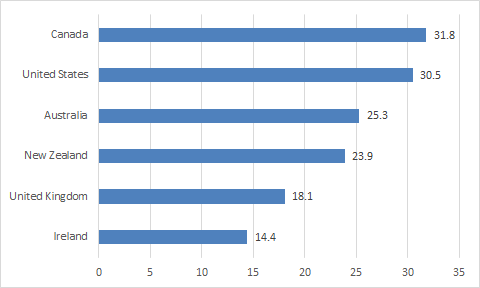
Source: OECD family database.
To add insult to injury, the gender wage gap further tertiary educated female workers is quite large in the USA but quite small for high school graduates.
Figure 2: gender wage gap for mean full-time, full-year earnings for below upper secondary educated workers aged 35 – 44, 2012
Source: OECD family database.
Canada seems to be a bit of a patriarchal hellhole while New Zealand does pretty well in gender wage gaps.
The gender gap in figure 1 and in figure 2 are unadjusted and calculated as the difference between mean average annual full-time, full-year earnings of men and of women as a percentage of men’s earnings.
13 Jun 2015 Leave a comment
in applied price theory, applied welfare economics, economic growth, economic history, health and safety, income redistribution, industrial organisation, labour economics, labour supply, macroeconomics, Milton Friedman, occupational choice, politics - Australia, politics - New Zealand, politics - USA, Public Choice, rentseeking, unions Tags: competition and monopoly, The Great Enrichment, union power, union wage premium
12 Jun 2015 Leave a comment
in discrimination, gender, human capital, labour economics, labour supply, occupational choice, politics - Australia, politics - New Zealand, politics - USA Tags: Australia, British economy, Canada, gender wage gap, Ireland
If there is an inherent inequality of bargaining power between workers and employers, as we are so frequently lectured by those in the self appointed know, why is the gender wage gap so small at the bottom of the earnings distribution?
Figure 1: % Gender gap in full-time earnings at the bottom decile of earnings distribution, 2012

Source: OECD family database
Figure 2: % Gender gap in full-time earnings at the median decile of earnings distribution, 2012

Source: OECD family database
Figure 3: % Gender gap in full-time earnings at the top decile of earnings distribution, 2012

Source: OECD family database
The gender gaps are unadjusted, and are calculated as the difference between the earnings of men and women for their respective earnings percentile.
12 Jun 2015 Leave a comment
in discrimination, economics of love and marriage, gender, labour economics, labour supply, law and economics, occupational choice Tags: economics of the family, home production, household division of labour, marriage and divorce
#Dailychart: How the average day of American mums and dads has changed since 1965 econ.st/1Hi43yt http://t.co/tY5DSpdVKN—
The Economist (@EconBizFin) June 08, 2015
Celebrating humanity's flourishing through the spread of capitalism and the rule of law
Scholarly commentary on law, economics, and more
Beatrice Cherrier's blog
Celebrating humanity's flourishing through the spread of capitalism and the rule of law
Celebrating humanity's flourishing through the spread of capitalism and the rule of law
Celebrating humanity's flourishing through the spread of capitalism and the rule of law
Why Evolution is True is a blog written by Jerry Coyne, centered on evolution and biology but also dealing with diverse topics like politics, culture, and cats.
Celebrating humanity's flourishing through the spread of capitalism and the rule of law
Celebrating humanity's flourishing through the spread of capitalism and the rule of law
A rural perspective with a blue tint by Ele Ludemann
DPF's Kiwiblog - Fomenting Happy Mischief since 2003
Celebrating humanity's flourishing through the spread of capitalism and the rule of law
The world's most viewed site on global warming and climate change
Tim Harding's writings on rationality, informal logic and skepticism
A window into Doc Freiberger's library
Let's examine hard decisions!
Commentary on monetary policy in the spirit of R. G. Hawtrey
Thoughts on public policy and the media
Celebrating humanity's flourishing through the spread of capitalism and the rule of law
Politics and the economy
A blog (primarily) on Canadian and Commonwealth political history and institutions
Reading between the lines, and underneath the hype.
Economics, and such stuff as dreams are made on
"The British constitution has always been puzzling, and always will be." --Queen Elizabeth II
Celebrating humanity's flourishing through the spread of capitalism and the rule of law
Celebrating humanity's flourishing through the spread of capitalism and the rule of law
WORLD WAR II, MUSIC, HISTORY, HOLOCAUST
Undisciplined scholar, recovering academic
Celebrating humanity's flourishing through the spread of capitalism and the rule of law
Res ipsa loquitur - The thing itself speaks
In Hume’s spirit, I will attempt to serve as an ambassador from my world of economics, and help in “finding topics of conversation fit for the entertainment of rational creatures.”
Researching the House of Commons, 1832-1868
Articles and research from the History of Parliament Trust
Reflections on books and art
Posts on the History of Law, Crime, and Justice
Celebrating humanity's flourishing through the spread of capitalism and the rule of law
Exploring the Monarchs of Europe
Cutting edge science you can dice with
Small Steps Toward A Much Better World
“We do not believe any group of men adequate enough or wise enough to operate without scrutiny or without criticism. We know that the only way to avoid error is to detect it, that the only way to detect it is to be free to inquire. We know that in secrecy error undetected will flourish and subvert”. - J Robert Oppenheimer.
The truth about the great wind power fraud - we're not here to debate the wind industry, we're here to destroy it.
Celebrating humanity's flourishing through the spread of capitalism and the rule of law
Celebrating humanity's flourishing through the spread of capitalism and the rule of law
Economics, public policy, monetary policy, financial regulation, with a New Zealand perspective
Celebrating humanity's flourishing through the spread of capitalism and the rule of law
Restraining Government in America and Around the World
 Utopia, you are standing in it!
Recent Comments