Does Israel Discriminate Against Arabs?
26 Oct 2017 1 Comment
in constitutional political economy, defence economics, discrimination, law and economics Tags: Gaza Strip, Israel, Palestine
What Was the Industrial Revolution? Robert E. Lucas Jr.
25 Oct 2017 Leave a comment
in development economics, economic growth, economic history, labour economics, labour supply, macroeconomics, occupational choice Tags: industrial revolution
Job ad that employs screening and self-selection
25 Oct 2017 Leave a comment
in defence economics, labour economics, labour supply, occupational choice, personnel economics Tags: moral hazard, screening, self-selection


But is a living wage policy still worth a try?
24 Oct 2017 Leave a comment
in applied price theory, applied welfare economics, minimum wage, politics - New Zealand, politics - USA
https://twitter.com/EconBizFin/status/626687442834300928
Demands for massive pay rises for the low-paid are not just confined to New Zealand. The US debate is worth reviewing because their living wage advocates are so upfront about the job losses.
US living wage activists such as Fight for $15 want to double their federal minimum wage from $7.25 per hour to $15 per hour. California, New York, San Francisco and Seattle are among the states and cities increasing their local minimum wages, currently of up to $12, to $15 by 2021 or 2022.
Some such as Arindrajit Dube say that these very large wage increases by cities and states in their federal system are experiments “worth running and monitoring” (Lane 2016). As Dube said recently:
“… 30 to 40 percent of the California workforce will get a raise … This will be a big experiment. It’s far outside of our evidence base…
If you’re risk-averse, this would not be the scale at which to try things. On the other hand, if you think that wages are really low and they’ve been low for a really long time and we can afford to take some risks, doing things at this scale will get us more evidence” (Lee 2016).
Noah Smith (2016) concluded that the empirical literature on minimum wages suggests that a 10% minimum wage increase would reduce employment by about 2% so doubling the federal minimum wage would see the employment of young people go down by one-fifth. Smith (2016) said this is a “small but real effect — a $15 federal minimum wage might throw a million kids out of work”.
Should activists use minimum wage breadwinners for policy experiments? Noah Smith (2016) considers balancing the one million unemployed teenagers against the wage gains for adults as “necessary for a decision”.
Smith suggests that the large minimum wage increases in some US states and cities will tell us how big this welfare trade-off between jobs and wage rises is:
We don’t really know what happens when you raise the minimum wage to $15 — but soon, we will know. We will be able to see whether employment rates fall in L.A., Seattle, and San Francisco. We will be able to see whether people who can’t get work migrate from these cities to cities with lower minimum wages.
We will be able to see if employment growth suddenly slows after the enactment of the policy. In other words, federalism will do its job, by allowing cities to act as policy laboratories for the rest of the country (Smith 2015).
“Big experiments” involving large minimum wage increases to “provide clear evidence” to quote Dube’s words (Scheiber and Lovett 2016) are wrongheaded as Robert Lucas has explained:
I want to understand the connection between in the money supply and economic depressions. One way to demonstrate that I understand this connection–I think the only really convincing way–would be for me to engineer a depression in the United States by manipulating the U.S. money supply.
I think I know how to do this, though I’m not absolutely sure, but a real virtue of the democratic system is that we do not look kindly on people who want to use our lives as a laboratory. So I will try to make my depression somewhere else (Lucas 1988).
Leading reasons for economic theory, empirical research and the study of economic history are to warn the present against repeating past errors and not try experiments that are folly (Rosen 1993). There is too much group think and not enough courage of your vocation (see Dylan Matthew’s tweet below).
https://twitter.com/dylanmatt/status/720786520509165568
Australian-born economist Justin Wolfers is frank about the wishful thinking in the US debate:
But if you are interested in what level to set the minimum wage, the existing literature is nearly hopeless. Plausible reforms lie far outside the bounds of historical experience.
We don’t have useful estimates of the extent to which employment effects vary with the minimum wage. Since policymakers tend to implement short-run fixes, we know a lot about the effects of temporary reforms, but very little about the consequences of lasting reform (Wolfers 2016).
Most of the empirical studies are of the jobs lost over the next few years. When estimates have a 10 to 15-year horizon with time enough for entry, exit and technological adaptation and automation, a “long-run disemployment effect that is five times larger than the short-run effect” is in evidence (Aaronson, French, Sorkin 2016; Aaronson, French, Sorkin and To forthcoming; Sorkin 2015).
More on down and out in America
23 Oct 2017 Leave a comment
in politics - USA, poverty and inequality

Living Space: Europeans Versus Poor Americans
23 Oct 2017 Leave a comment
in politics - USA, poverty and inequality

Feeling of powerlessness and voicelessness was a much better predictor of Trump support than age, race, college attainment, income, attitudes towards Muslims, illegal immigrants, or Hispanic identity
23 Oct 2017 Leave a comment
in discrimination, politics - USA, Public Choice

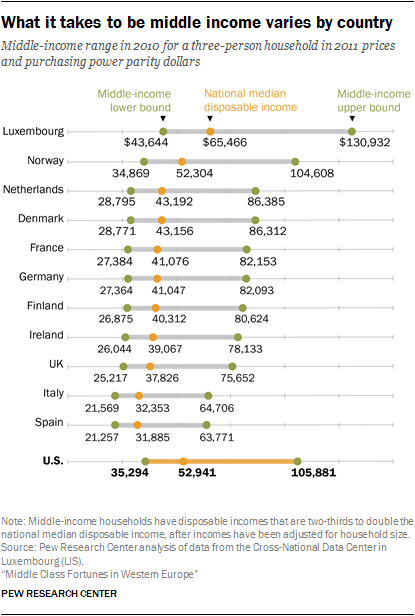
A lot of Europe’s middle class would be poor in the USA
23 Oct 2017 Leave a comment
in applied welfare economics, poverty and inequality Tags: family poverty
Video tape industry is still going!!
21 Oct 2017 Leave a comment
in economic history, industrial organisation, labour supply, survivor principle Tags: creative destruction
Has @WJRosenbergCTU shown @jacindaardern’s first lie in office?
21 Oct 2017 Leave a comment
in economic history, politics - New Zealand, poverty and inequality
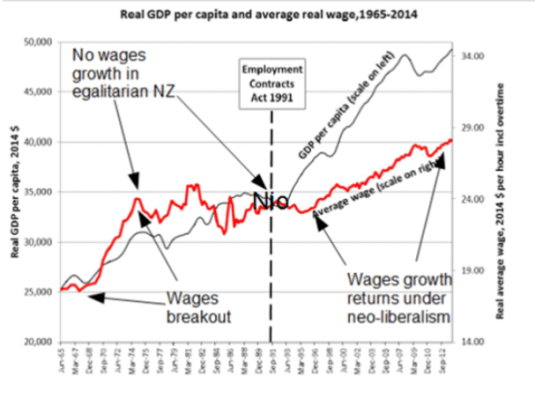
Ardern said there had been market failures in New Zealand such as … most people’s incomes not keeping up with inflation…
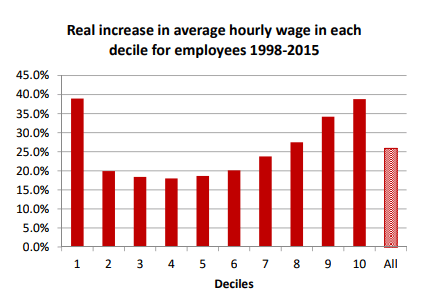
New work by Chris Ball and John Creedy shows substantial *declines* in NZ inequality.
initiativeblog.com/2015/06/24/ine… http://t.co/f94fw4Bhae—
Eric Crampton (@EricCrampton) June 24, 2015
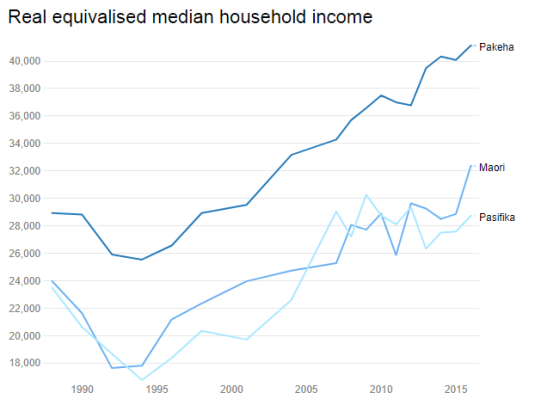
#moreinclusivenz @povertymonitor Killer graphs & #infographics by NZ Children's Commissioner. Shameful content, NZ http://t.co/mG987C5kh0—
Isabella Cawthorn (@fixiebelle) July 26, 2015
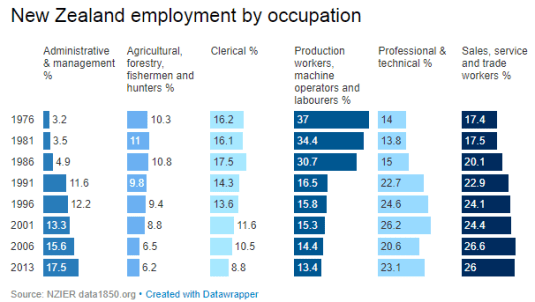
The robots are coming but innovation is getting harder too! What gives?
14 Oct 2017 Leave a comment
in economic history, entrepreneurship, industrial organisation, labour economics
What is novel in the latest bout of technology anxiety is the public intellectuals are arguing not only that the robots are coming, but we have also at the end of growth.
This pessimism bias normally cycles from the robots are coming to stagnation is ahead but with a merciful interval in between that allows us sceptics to get back to our lives. It is unusual for so conflicting doomsday predictions to be in the headlines at the same time but they are.
The seeds of my renewed technology optimism is in of all places The End of Growth by American economist Robert Gordon. Reminiscent of Joseph Schumpeter, Gordon argues that technology comes in waves. Each wave is one big invention with ripples of secondary innovations to make each great invention into practical products. Economic growth slows between these waves of great innovation.
My digression is labour markets coped with the disruption from past waves of great innovation: steam and railroads, the telegraph, electricity, internal combustion engine, indoor plumbing, air conditioning, telephones, mass communications, aircraft, petrochemicals, antibiotics, computers, and now PCs, the web and smart-phones.
The labour market finessed the many past industrial revolutions despite most of the affected workers not finishing high school. Labour markets coped with growth miracles in Japan, Singapore, Hong Kong, Taiwan and now in China with ease with even less educated work-forces. Japan moved workers off the farm into factories and then offices and shops in one working life. China cruised through these same gales of creative destruction in half that time.
Workers displaced by robots are business opportunities. Innovation is not manna from heaven; it is a profit-seeking quest for untapped markets. The first industrial revolution was about profiting from moving ill-educated workers off the land into factories. An under-utilised worker is a profit opportunity to the entrepreneurs who discover how to employ them better.
The idea that innovation is getting harder has more legs than the robots are finally coming. American economist Ben Jones found that the age when Nobel prize winners made their great discoveries increased by 6 years in the 20th century. He also showed that scientists are spending longer at university and work in larger and larger teams because so much more must be learnt before getting started. The best years of our creative lives start later but finish just as early.
Jones called this rising educational burden of progress the death of the Renaissance Man. This narrowing of expertise and longer periods of initial study can slow the pace of innovation. There is a fishing-out effect too. All the easy inventions were discovered first. The next invention is more complex than the last and require more skill, effort and greater detail to master. Rising technological complexity retards technology diffusion because human capital, R&D efforts and on-the-job learning are spread thinner over a growing proliferation of new products.
Then there is the trend rate of GDP growth in the 20th century not increasing despite many more graduates and R&D workers joining the workforce. It is still about 2% per year in the US despite spending on intellectual property products rising from 1% of GDP in 1950 to 5% now. Robert Gordon and Tyler Cowen (in his Average is Over) both say that we will eventually tap out on increasing the number of graduates as a way to maintaining GDP growth at 2%.
But peak innovation is not upon us. As in the past, we are in a race with the machines, not against them. Electrification and mechanisation were far greater technology disruptions than anything ahead of us. The next great inventions will come as much as a surprise as always. The big difference is we have a more educated workforce able to speed their diffusion. As for low-skilled workers, there are plenty of jobs for them as long as they are friendly and reliable. That is what employers look for.
Open markets, a lower company tax rate and less labour market regulation are the biggest contributions governments can make to maintaining the capacity to grow. Higher after-tax returns and the ability to easily hire and let workers go without legal fuss emboldens entrepreneurs to chance their arm on new-fangled technologies and untried market and catch-up with the disruptive technologies pioneered by entrepreneurs faster footed than them.
These used to be a hell of a lot of railway workers
14 Oct 2017 Leave a comment
in economic history, labour economics, unemployment
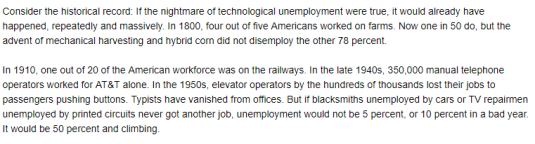
Source: Deirdre McCloskey, The Myth of Technological Unemployment – Reason.com


Recent Comments