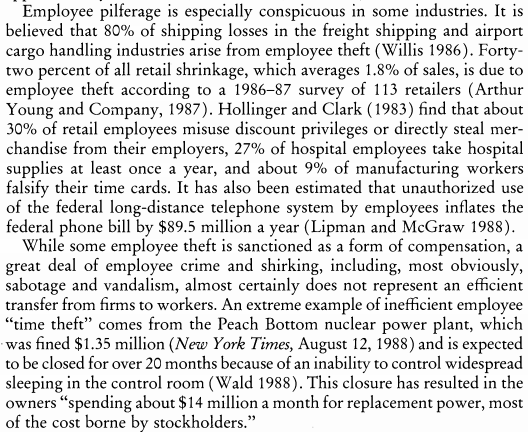
Thomas Sowell – The Real World Effects of Preferential Policies
03 Nov 2016 Leave a comment
in applied price theory, applied welfare economics, development economics, economic history, economics of education, labour economics Tags: affirmative action, racial discrimination, Thomas Sowell
Baumol’s disease explained
01 Nov 2016 Leave a comment
in economics of education, labour economics, labour supply Tags: Baumol's disease
Voltaire on the 1734 London Stock Exchange:
31 Oct 2016 Leave a comment
in discrimination, economic history, entrepreneurship, financial economics, labour economics Tags: customer discrimination, market process, The meaning of competition

Don Bordeaux was right! Monopsony is a great business opportunity
27 Oct 2016 Leave a comment
in industrial organisation, labour economics, labour supply, unions Tags: inequality of bargaining power, job search, monotony power, search and matching
What would you do if you could cut your prices by 25% and still make a profit? Suppose you could pay your workers 25% more, recruit the best and brightest, still make a profit and greatly expand your business and bottom line?
A survey on monopsony power of employers by the Council of Economic Advisors at the White House suggests that this is so. Employers are paying up to 25% below the competitive wage.
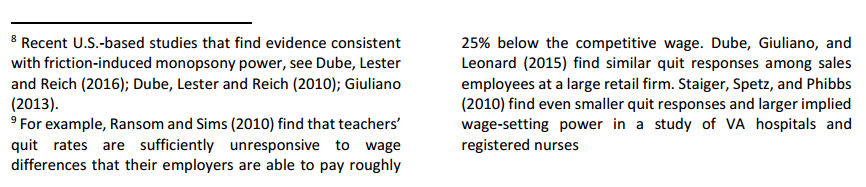
Don Bordeaux has repeatedly pointed out that monopsony power is a marvellous business opportunity:
whenever I encounter the assertion that minimum-wage legislation is justified because employers of low-skilled workers allegedly possess monopsony power, I point out to those who assert the existence in reality of monopsony power as a reason to impose a minimum wage that their assertion implies the existence of profit opportunities for anyone who enters the market to hire away these allegedly underpaid workers.
So I ask those who assert that monopsony power is real and relevant to start their own businesses to give solid evidence of the strength of their belief.
The best and brightest in many occupational labour markets underpaid by a 25% according to the literature survey by the Council of Economic Advisors. This means a budding entrepreneur could recruit a top-quality labour force and still make a big profit by paying a bit more than the current wage in his industry
Just in case you are a novice at starting a business, Bordeaux was good enough to identify a consultant willing to provide advice on how you can seize this resistant, no but untapped opportunity for long run super-normal profits:
I know a very successful and savvy businessman in California, Mike Long – a man of enormous integrity and experience – who stands ready to share with you his time, expertise, and counsel in order to guide you in starting and operating your own businesses. All you need do is to supply some of your own seed capital – say, a minimum of $25,000 – and Mike will help guide you to launch and run your business in order to take advantage of the profit opportunity that your identification of monopsony power implies is available for the taking.
Mike can even share with you his knowledge of how to get from the capital markets any additional financing you might need.
Almost every market failure is a business opportunity including market power of employers over workers as Bordeaux explains
In short, monopsony power in labor markets keep workers underpaid. With all those underpaid workers out there – and because there are no government-enforced prohibitions on starting companies that employ low-skilled workers – a true believer that monopsony power is a prevalent reality can profit by exploiting this pool of underpaid workers. Yet they do not. They remain in their faculty offices writing papers and issuing commentary. I continue to insist that this inaction is sufficient evidence against the proposition that monopsony power prevails in the market for low-skilled workers – and, hence, conclusive evidence that the higher the minimum wage, the worse are the job prospects of low-skilled workers.
If an academic tells you that his research finds that the price of Acme Corp. stock – a stock traded, say, on the NYSE – is too low, what would be the first question you ask this scholar? The first question I would ask him is “How much of that stock are you buying?” If the scholar tells me “none,” or looks at me befuddled as he explains that he’s an academic and not an investor, I would dismiss his research on this front. That person, as I see him here, offers proof as good as it gets that he does not believe what he asserts.
Just as identifying systematically undervalued shares as an opportunity for critics of the efficient markets hypothesis to profit, those who believe the competition in the labour market is less than it should jump in and exploit those walkers for themselves.
They can assuage their consciousness by knowing that they are exploiting these workers by paying them more than the other exploiting employers currently do.This is no more than a variation of the argument that if workers are underpaid, they can establish a workers co-operative to buy out their employer, pay themselves more and still profit.
One of the curios of the monopsony argument is it was originally based on company towns exploiting the captive labour market in the old mining days.
Trouble is that modern research showed the company towns where the employer owned the houses and rented them to employees was a way of showing would-be recruits that they would not exploit them. Because the worker did not have to buy a house or sign a lease to go to the company town, he could quit at any time and not be trapped in a lease or mortgage that locked him into his current job. Tabarrok explains
On the one hand, this did mean that during a lengthy strike the firm could evict the workers from their housing. On the other hand, would you want to buy a house in an isolated town dependent on a single industry? Would you want to own a major asset that was likely to fall in price at the same time that you were likely to lose your job? Probably not.
Rental housing meant that workers had the freedom to leave town easily when better work opportunities were available elsewhere – i.e., it meant that the workers were less isolated from the national labor market than they would be if they owned their homes and were tied down to a single place and a single employer
What brought company towns to their knees were something as simple as the widespread ownership of an automobile. These days, employers have to offer large inducements to get workers to move to isolated places to work. That includes accommodation and various other premiums over the going rate in the industry.
Labour economics is falling to the same trap industrial organisation fell into in the mid-20th century when it encounters phenomena which it has trouble explaining as Coase said at the time:
One important result of this preoccupation with the monopoly problem is that if an economist finds something—a business practice of one sort or other—that he does not understand, he looks for a monopoly explanation. And as in this field we are very ignorant, the number of ununderstandable practices tends to be rather large, and the reliance on a monopoly explanation, frequent.
Economists’ understanding of industrial organisation improved greatly when it started studying contracting in greater detail, especially long-term contracting. Labour economists are doing the same when they consider search and matching as a better explanation of how the labour market works. The monopsony argument is fragile when closely examined as Kuhn said:
… as Manning himself acknowledges, if matching is balanced (which effectively amounts to constant returns to scale in the technology for recruiting new workers), all elements of monopsony disappear from the model and the neoclassical equilibrium again prevails: in the long run firms can expand without limit without needing to raise their wages.
Thus it is absolutely critical to the search-based monopsony model at the core of this book that there be diminishing returns to scale in the technology for recruiting new workers. In other words, for the theory to apply, firms must find it harder to recruit a single new worker the larger the absolute number of workers they currently employ.
Alan Manning wrote a great book called Monopsony in Motion: Imperfect Competition in Labor Markets but in a great review of it, Peter Kuhn said
The key point seems to be that the title Search Models with Ex-Ante Posted Wages in Motion, while considerably more accurate than Manning’s, is certainly less catchy.

Was the #SpiritLevel discredited (self-refuted?) @JenesaJeram @MaxRashbrooke @nzinitiative
20 Oct 2016 Leave a comment
in applied welfare economics, labour economics
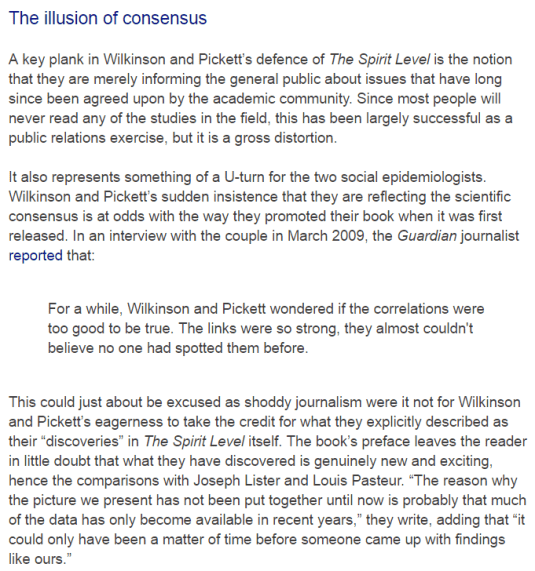
Source: The Spirit Level Delusion.
Why Do People Become Islamic Extremists?
18 Oct 2016 Leave a comment
in defence economics, economics of crime, economics of religion, labour economics, law and economics, occupational choice Tags: economics of oppositional identities, war on terror
Top 10 Hardest LANGUAGES to Master
18 Oct 2016 Leave a comment
in economics of education, human capital, labour economics Tags: economics of languages
Baumol’s cost disease
17 Oct 2016 Leave a comment
in applied price theory, labour economics, labour supply Tags: Baumol's disease

Glenn Loury and David Neumark on the minimum wage – Bloggingheads.tv
15 Oct 2016 Leave a comment
in labour economics, minimum wage Tags: David Neumark
What economists know about the minimum wage 6:57
Is Paul Krugman dead wrong about the minimum wage? 3:32
Measuring the disemployment effect 6:43
David’s critique of a famous pro–minimum wage study 12:50
Do workers earn what they’re worth? 6:47
David: Target aid to low-income families, not low-wage workers 7:56
Fact checking @leerhiannon on John Howard and @PaulineHansonOz
15 Oct 2016 Leave a comment
in discrimination, politics - Australia
Leading up to the 1996 election, Hanson advocated the abolition of special government assistance for Aborigines, and she was disendorsed by the Liberal Party. Ballot papers had already been printed listing Hanson as the Liberal candidate, and the Australian Electoral Commission had closed nominations for the seat.
Hanson was still listed as the Liberal candidate when votes were cast, even though Liberal leader John Howard had declared she would not be allowed to sit with the Liberals if elected.
On election night, Hanson took a large lead on the first count and picked up enough Democrat preferences to defeat Scott on the sixth count. She won 54 percent of the two-candidate preferred vote. Had she still been running as a Liberal, the 19.3 percent swing would have been the largest two-party swing of the election. Hanson won the safest Labour Party seat in Queensland.


Recent Comments