Earning power by personality type
22 Dec 2015 Leave a comment
in human capital, labour economics, labour supply, occupational choice Tags: economics of personality traits
The middle class is starting to wither away
21 Dec 2015 Leave a comment
in economic history, economics of media and culture, labour economics Tags: middle class stagnation
Which occupations are up and which are down
21 Dec 2015 Leave a comment
in economic history, human capital, industrial organisation, labour economics, labour supply, occupational choice, survivor principle Tags: creative destruction, skill biased technical change
@GarethMorgannz the universal basic income is inferior to the minimum family tax credit
20 Dec 2015 4 Comments
in labour economics, labour supply, politics - New Zealand, poverty and inequality, public economics, welfare reform Tags: Aaron Director, Director's Law, Gareth Morgan, negative income tax, social insurance, universal basic income, welfare state
Gareth Morgan’s universal basic income appears to make everybody better off except those for whom the modern welfare state was established to protect. Examples of these from his online calculator are single mothers and retirees.
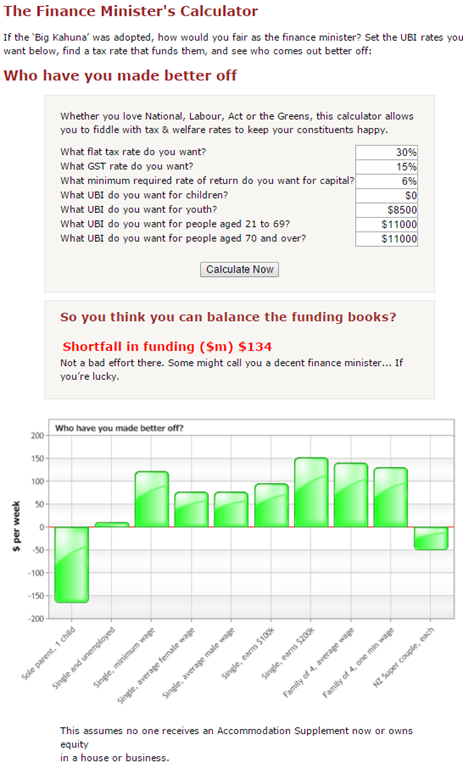
Source: The Big Kahuna – Tax and Welfare.
To stay even just with single mothers blows a good $10 billion hole in the budget deficit according to the online calculator provided by Gareth Morgan. Retirees are still worse off.
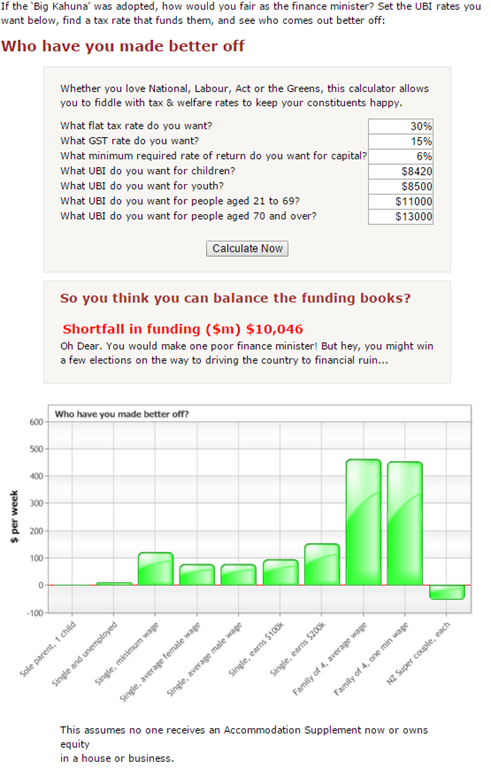
Source: The Big Kahuna – Tax and Welfare.
Central to the package is a comprehensive capital gains tax despite evidence growing with each day that the optimal tax rates on income from capital and on capital gains are zero.
A universal basic income for New Zealand is a long trip to where we are now. There is already a guaranteed minimum family income in New Zealand.
The minimum family tax credit makes sure that a family’s annual income (net income after tax has been deducted) doesn’t fall below $23,036 a year ($443 per week). To qualify, you must work for a salary or wage for at least 30 hours each week as a couple, or 20 hours each week as a single parent, and receive a family tax credit.
The Treasury modelled a Guaranteed Minimum income at the request of the Welfare Working Group in 2010. A guaranteed minimum income of $300 per week – the mean benefit income among those on benefits – would cost $44.5 billion or $52.6 billion if we extended it to super annuitants as a replacement for NZ Superannuation or old age pension. The former could be covered by a flat personal income tax rate of 45.4%; the latter, 48.6%. Full fiscal neutrality would require tax rates of 50.6% and 54.4%.
The universal basic income seems to be a big day out for Director’s Law of Public Expenditure. Director’s Law is public expenditure is used primary for the benefit of the middle class, and is financed with taxes which are borne in considerable part by the poor and the rich.
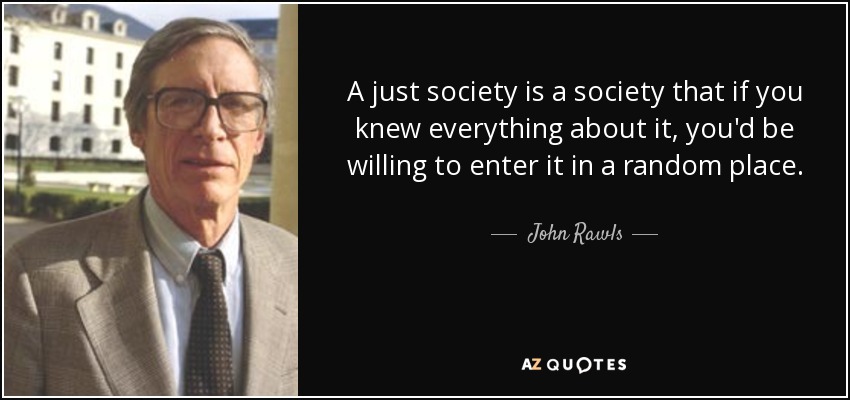
The universal basic income and a comprehensive capital gains tax seems to cause a lot of economic upheaval but still struggles to make the worse off groups in society even break-even on this throwing of all the cards in the air. Brian Easton put it well the other day when he said:
Many advocates put the UMI forward without doing the sums. Those who do, find that the required tax rates are horrendous or the minimum income is so low that it is not a viable means of eliminating poverty. Among the latter are New Zealanders Douglas, Gareth Morgan and Keith Rankin.
Roland Fryer on Education, Inequality, & Incentives
19 Dec 2015 1 Comment
in applied price theory, discrimination, economics of education, gender, human capital, labour economics, labour supply, politics - New Zealand, politics - USA, poverty and inequality Tags: charter schools, racial discrimination, Roland Fryer

@CHSommers More reasons for women to avoid STEM careers @stevenljoyce @GreenCatherine
19 Dec 2015 Leave a comment
in discrimination, gender, labour economics, labour supply, law and economics, occupational choice
Many young women choose to not pursue science, technology, engineering and maths (STEM) careers because there are other career options that allow them to better use their superior verbal and reading abilities.
Further reasons for women to hesitate entering STEM occupations is their faster rate of human capital depreciation. It has been well known for a long time that human capital atrophy rates differ greatly by occupation and are much higher in professional, managerial and craft occupations.
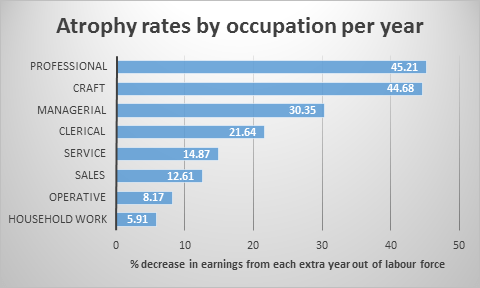
Source: Polachek (1981).
Even a year out of the workforce can greatly reduce earning power because of a rapid depreciation of the human capital accumulated from certain occupations. Women make education and career choices that minimise these losses in light of periods away from work because of motherhood.
Women self-selecting to those occupations with low rates of human capital depreciation. As De Grip explains using German data:
…women who anticipate career interruptions for family reasons take account of the wage penalties related to such a break when they choose their occupational field, i.e. women select occupations where human capital deprecation during a career interruption is the lowest…
Our estimation results have important implications for public policies which attempt to encourage the interest of female students in technical studies and occupations. Obviously, the higher human-capital depreciation rates for workers with family-related career breaks in these male occupations can be a serious threshold for women to choose these occupations
Women choose the occupations that maximise the returns from their skills. Occupations that neither well-reward superior verbal and reading skills and have rapid rates of depreciation on occupational human capital are not a good investment for many of the women anticipating spells out of the workforce because of motherhood.
Rendall and Rendall (2015) recently investigated differential depreciation rates on verbal and maths skills in competing occupational choices for college educated women. Not surprisingly, they found that in the USA verbal skills suffered only minor depreciation during career interruptions but maths skills experience costly depreciation. They found that:
…college educated women avoid occupations requiring significant math skills due to the costly skill atrophy experienced during a career break. In contrast, verbal skills are very robust to career interruptions. The results support the broadly observed female preference for occupations primarily requiring verbal skills – even though these occupations exhibit lower average wages.
Thus, skill-specific atrophy during employment leave and the speed of skill repair upon returning to the labour market are shown to be important factors underpinning women’s occupational outcomes. This research suggests that a substantial portion of female occupational sorting could be determined by skill-specific atrophy-repair characteristics.
This is no surprise as verbal skills improve with age because of expanding vocabularies and better judgement based on accumulated experience. Maths skills tend to be the type of skills where your best years in your 20s and after that things fall away.
These findings by Rendall and Rendall reinforce the initial bias women have against STEM occupations because of their superior reading and verbal skills. STEM occupations are a poor career choice for women because they undervalue their innate skills and heavily penalise career interruptions.
Such is the fatal conceit of politicians is they want to encourage women to make poor education and occupational investments. Women self-selecting into vastly different occupations to men because they are smarter than the average politician about what is the best of them.
Differential atrophy rates on human capital as drivers of the gender wage gap and occupational segregation have nothing to do with the choices of employers – nothing to do with blameworthy behaviour on their part. The blameworthy behaviour can be explicit prejudice, implicit bias or statistical discrimination.
Much of occupational segregation is the result from self-selection by women into occupations on the basis of superior innate skills and the slow rates at which these verbal and reading skills depreciate with time both in general and with time away from the workforce.
The gender gap among the top 1%
19 Dec 2015 Leave a comment
in discrimination, gender, human capital, labour economics, occupational choice Tags: gender wage gap, superstar wages, superstars, top 1%
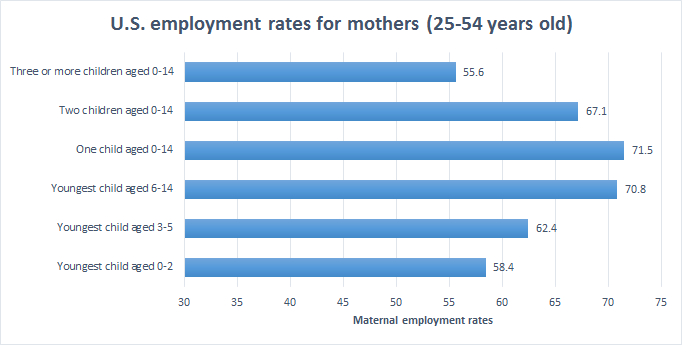
US maternal employment rates by number and age of children
18 Dec 2015 Leave a comment
in discrimination, gender, labour economics, labour supply, politics - USA, poverty and inequality, welfare reform Tags: economics of fertility, female labour force participation, maternal labour force participation, single mothers
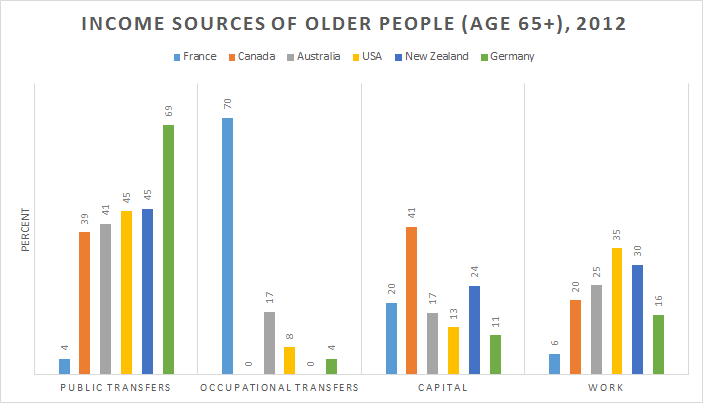
Income sources of older people in USA, Canada, France, Germany, Australia and New Zealand
18 Dec 2015 Leave a comment
in labour economics, labour supply, public economics Tags: economics of retirement, old-age pension, older workers, social insurance, welfare state
Tourism as % of employment across the OECD
17 Dec 2015 Leave a comment
in industrial organisation, international economics, labour economics, labour supply Tags: economics of tourism, labour market demographics

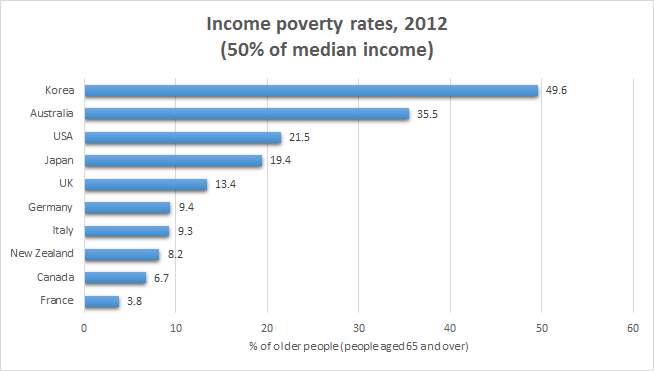
Old age poverty rates in the G7, Australia, New Zealand and Korea
17 Dec 2015 Leave a comment
in labour economics, politics - Australia, politics - New Zealand, politics - USA, poverty and inequality, public economics Tags: old age poverty, old-age pension, social insurance, welfare state
The gap between black and white students appears as early as kindergarten and grows with time
17 Dec 2015 Leave a comment
in discrimination, economics of education, labour economics, politics - USA Tags: early childhood education, racial discrimination
Why study science?
16 Dec 2015 Leave a comment
in economics, labour economics, occupational choice Tags: STEM
@jacindaardern the role of drug addiction in poverty and unemployment
16 Dec 2015 Leave a comment
in applied price theory, labour economics, labour supply, politics - New Zealand, poverty and inequality, unemployment
Jacinda Adern does have a point that the Prime Minister overplayed the role of drug dependency in child poverty, but he is not completely off the mark. A whole bunch of self-destructive behaviours play a role in family poverty.

Source: Minister of Social Development Cabinet Paper on Pre-employment Drug Testing Requirements.
Too many children have irresponsible parents. Caplan along with Charles Murray point out that a number of pathologies are particularly prevalent among poor:
-
alcoholism: Alcohol costs money, interferes with your ability to work, and leads to expensive reckless behaviour.
-
drug addiction: Like alcohol, but more expensive, and likely to eventually lead to legal troubles you’re too poor to buy your way out of.
-
single parenthood: Raising a child takes a lot of effort and a lot of money. One poor person rarely has enough resources to comfortably provide this combination of effort and money.
-
unprotected sex: Unprotected sex quickly leads to single parenthood. See above.
-
dropping out of high school: High school drop-outs earn much lower wages than graduates. Kids from rich families may be able to afford this sacrifice, but kids from poor families can’t.
-
being single: Getting married lets couples avoid a lot of wasteful duplication of household expenses. These savings may not mean much to the rich, but they make a huge difference for the poor.
-
non-remunerative crime: Drunk driving and bar fights don’t pay. In fact, they have high expected medical and legal expenses. The rich might be able to afford these costs. The poor can’t.
Caplan is disputing that healthy adults who are poor are victims. That is central to the poverty is not a choice movement: the poor are victims.
The New Zealand experience with work testing of beneficiaries for drugs is most of them quickly stopped using dope. Many jobs have tests for drug-taking.


Recent Comments