
Best Anti-Stimulus Argument in 2009 was from Kevin Murphy @TaxpayersUnion @JordNZ
16 Aug 2020 Leave a comment
in applied price theory, applied welfare economics, business cycles, fiscal policy, macroeconomics, politics - USA, Public Choice, public economics, unemployment
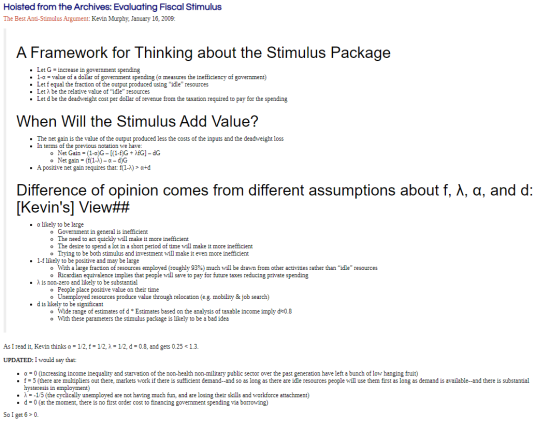
From https://www.bradford-delong.com/2011/10/hoisted-from-the-archives-evaluating-fiscal-stimulus.html and see too https://www.wsj.com/articles/SB123423402552366409
At https://www.chicagobooth.edu/research/igm/events-forums/myron-scholes-forum/speaker-series/2009-01-16 Murphy says
Kevin Murphy sketched out a simple equation—into which anyone could easily plug their own assumptions—to compare the benefits and costs of stimulus spending. The advantage, he argued, is the equation helps everyone to be clear about exactly what they are assuming and why it supports their approach to the stimulus. According to Murphy, the main items everyone should be clear about are: the fraction of the economy’s resources that are idle; the value of keeping those resources idle (e.g., most people value their time, and will not work without compensation); the deadweight loss from raising taxes in the future to pay for the spending; and the cost of allocating spending through government, if it is allocated less efficiently as a result (this can be negative —i.e., a benefit—if government is better than the private sector at allocating resources).
Murphy did not consider the stimulus a good proposal, but he explained how his assumptions about each element of his framework differed from those of president-elect Obama’s team. “It’s easy to see what you have to assume in order to make the stimulus make sense,” Murphy said. Regarding the tax cut measures in the stimulus plan, Murphy thought they were designed in an especially inefficient way. Since marginal tax rates are what matter for incentives, he argued, it was not helpful that the Obama plan would give tax cuts in the form of direct credits to certain taxpayers without lowering rates. That the president would likely address the resulting deficit by raising rates in the future would exacerbate the problem.
And Robert Lucas adds
Robert Lucas pointed out that the US economy was already 4 percent below its long-term trend level in January 2008. In addition, consensus forecasts—which “mean a lot” over short horizons such as a year—suggested the economy would be 8 percent below after another year. This would be larger than any other postwar recession, though nowhere near as bad as the 30 percent gap in the 1930s. “It’s not the worst in my lifetime, but it’s the worst in Obama’s,” Lucas said, “and it would be foolish not to take some actions to deal with it.”
Monetary measures to deal with the recession make a lot of sense, said Lucas, who added that many of the Fed’s actions were beneficial. The trouble was the fiscal stimulus did not seem designed to deal with the real problem. A good approach, Lucas said, would be to use the fiscal stimulus “as another way of getting cash into circulation in the private sector.” He mentioned hypothetical examples that Milton Friedman—dropping money from helicopters—and John Maynard Keynes—paying people to dig and refill ditches—had posed as ways of achieving this. “If fiscal stimuli are designed to be effective, they’re going to be effective because they carry along a monetary policy of the sort that raises the dollar spending level,” Lucas said. Based on the plans and information he had seen from president-elect Obama’s advisors, however, Lucas said that this did not seem to be what the new administration was planning. Instead, he said, “all they’re talking about is transferring resources, additional levels of spending, from one use to another,” which, he argued, would have no substantial effect on the average level of spending and thus would not help fight the recession.
Glenn C. Loury on Ethics of Affirmative Action in Higher Education
15 Aug 2020 Leave a comment
in discrimination, economics of education, human capital, income redistribution, labour economics, law and economics, occupational choice, politics - USA, poverty and inequality, Public Choice, rentseeking Tags: affirmative action, racial discrimination, regressive left
Thomas Sowell – Wealth Disparity
14 Aug 2020 Leave a comment
in discrimination, economics of education, entrepreneurship, gender, human capital, income redistribution, industrial organisation, labour economics, labour supply, law and economics, occupational choice, occupational regulation, poverty and inequality, property rights, survivor principle, Thomas Sowell, unemployment, welfare reform Tags: child poverty, family poverty, pessimism bias
Gender Is Not Fluid: Dr. Debra Soh Debunks Popular Claims Of Leftist Science Deniers
11 Aug 2020 Leave a comment
in discrimination, economics of education, economics of media and culture, gender, law and economics, politics - Australia, politics - New Zealand, politics - USA Tags: political correctness, regressive left, sex discrimination
Joe Rogan Experience #1520 – Dr. Debra Soh
09 Aug 2020 Leave a comment
in discrimination, economics of education, gender, politics - Australia, politics - New Zealand, politics - USA Tags: political correctness, regressive left, sex discrimination
Kamala Harris attacks sleepy @JoeBiden’s record on race
08 Aug 2020 Leave a comment
in discrimination, economics of bureaucracy, economics of education, law and economics, politics - USA, Public Choice Tags: 2020 presidential election, affirmative action, racial discrimination
The IQ Taboo | Glenn Loury & Amy Wax
03 Aug 2020 Leave a comment
in discrimination, economics of education, gender, health economics, human capital, labour economics, law and economics, politics - USA, poverty and inequality Tags: political correctness, regressive left
Every billionaire is a failure says @AOC
31 Jul 2020 Leave a comment
in economic history, economics of love and marriage, entrepreneurship, financial economics, human capital, industrial organisation, labour economics, labour supply, law and economics, Marxist economics, occupational choice, politics - USA, poverty and inequality, survivor principle Tags: envy, regressive left, top 1%

Aldred Marshall and the grapes of wrath
25 Jul 2020 Leave a comment
in Alfred Marshall, applied price theory, labour economics
Debunking Systemic Racism & Having Common Decency (Pt. 2) | Thomas Sowell
21 Jul 2020 Leave a comment
in constitutional political economy, defence economics, discrimination, economic history, economics of bureaucracy, economics of crime, economics of education, economics of information, human capital, income redistribution, labour economics, labour supply, law and economics, Marxist economics, minimum wage, occupational choice, occupational regulation, politics - USA, poverty and inequality, property rights, Public Choice, rentseeking, Thomas Sowell, unemployment, unions, welfare reform Tags: political correctness, racial discrimination, regressive left

 Utopia, you are standing in it!
Recent Comments