Australia’s top income earners are a lazy lot. The top 0.1% only ever had a rising income share under a Labor government in the 1980s. Even the top 1% had a pretty lean time until the 1990s.

Source: The World Wealth and Income Database.
Celebrating humanity's flourishing through the spread of capitalism and the rule of law
09 Oct 2016 Leave a comment
in economic history, industrial organisation, politics - Australia, poverty and inequality, survivor principle Tags: antimarket bias, entrepreneurial alertness, superstar wages, superstars, top 1%, top incomes
Australia’s top income earners are a lazy lot. The top 0.1% only ever had a rising income share under a Labor government in the 1980s. Even the top 1% had a pretty lean time until the 1990s.
Source: The World Wealth and Income Database.
26 Sep 2016 Leave a comment
in applied welfare economics, economic history, politics - New Zealand, poverty and inequality Tags: family poverty, job poverty, social insurance, The Great Enrichment
24 Sep 2016 Leave a comment
in applied welfare economics, economic history, politics - New Zealand, poverty and inequality
22 Sep 2016 Leave a comment
in applied welfare economics, politics - USA, population economics, poverty and inequality Tags: top 1%
12 Sep 2016 Leave a comment
in labour economics, labour supply, poverty and inequality, welfare reform Tags: economics of retirement, French law, old age pensions, property law, reverse mortgages, social insurance
A Viager is a French way of buying and selling property. We just watched the Kelvin Klein – Maggie Smith movie about it.
Not only does the seller remain as a life tenant of the property they sold, the buyer pays them an annuity as well as a down payment. The buyer gambles as all annuity providers do on the life expectancy of the vendor. One such vendor lived to 123 in France.
Back in 1965, when Mrs Calment was aged 90, she sold her apartment in Arles to a 44-years old man, on contract-conditions that seemed reasonable given the value of the apartment and the life-expectancy statistics that prevailed at the time.
The man turned out to be unlucky since Jeanne Calment lived a very long life. He died in 1995, two years before Mrs Calment, after having paid about FFr900,000 (twice the market value) for an apartment he never lived in.
The viager system is similar to the equity release and reverse mortgage systems more familiar in Anglo-Saxon countries. The viager shares the risk of running out of equity with the buyer. The contract is between two private parties and does not involve banks or insurance companies.

Sellers are typically widows, or widowers, who want to cash out the value of their property with a lump sum – the bouquet – and a monthly payment from the buyer for the rest of their lives. The seller remains as a life tenant. The bouquet is normally 15-30% of the value of the property.
French viager investors tend to be in their late 40s and early 50s wanting to set themselves up with a retirement home and hopefully get a good deal. If the buyer dies before the seller his children will be obliged to carry on paying the viager if they want to maintain the deal. In that sense, the vendor is gambling on the buyer’s life expectancy is well.
I have no information on who is responsible for payment of rates and the maintenance of the property. The maintenance of the property would be a bigger moral hazard problem than with tenants because of the difficulties with eviction and repair. The market for Viagers is fairly small.
Should the buyer default on the monthly instalments, he is warned to pay up. After a second warning, normally within weeks, he will get a further warning and one month to get up to date with payments. If this does not happen the seller keeps keeps the bouquet, all money received so far and gets back absolute ownership of the property they sold.
This home annuity option for selling the house could be away of getting around the rather small to non-existent annuity market in New Zealand for retirees. They have the advantage of sharing the risk of exhausting the equity of the property at the price of the buyer sometimes gets a really good deal. Sellers have on average shorter survival times than the general French population.
12 Sep 2016 Leave a comment
in applied welfare economics, economics, labour economics, poverty and inequality Tags: middle class stagnation, top 1%
09 Sep 2016 Leave a comment
in labour economics, politics - New Zealand, poverty and inequality Tags: homelessness, social insurance, social safety net, welfare state
I cherry picked data again by plotting it in full using the data labels and headings in the data tables at the original data source. I stand accused.
Max Rashbrooke is the latest to spit the dummy when reminded that the Otago report on homelessness actually was about the seriously housing deprived; their words, not mine.
UOW researcher Dr Kate Amore, from the Health Research Council-funded He Kainga Oranga/Housing and Health Research Programme, measured the “severely housing deprived” population.
Table 2 below is from the media release Rashbrooke suggested I read to enlighten myself as to what homelessness is and is not. I am going to commit my third strike at cherry picking with snap-shots of the tables from the original source. I am a recidivist cherry picker.
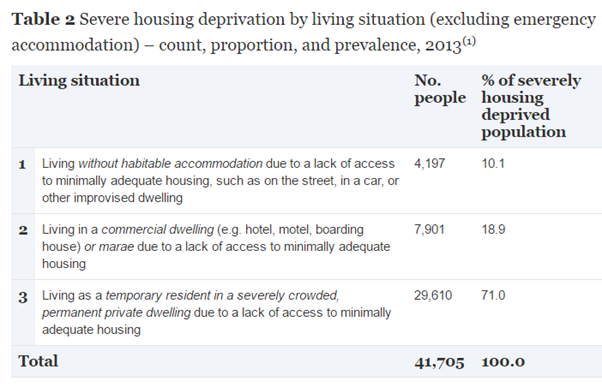
Source: 3 June 2016, Homelessness accelerates between censuses, News, University of Otago, New Zealand.
Labour, the Greens and Max Rashbrooke all conflated living with friends and family or in commercial accommodation with homelessness. Saying that serious housing deprivation has gone up is not much of a sound bite compared to claiming homelessness is up with the associated images of people living rough or in cars. Who is spinning, who is cherry picking and who just can’t handle the truth? Homelessness has not increased under the National party government.
A statistical definition of homelessness that includes 70% of data observations as people living with friends and relatives on a temporary basis is miles away from sleeping rough, in a car or emergency accommodation such as a shelter or refuge run by an NGO. But at one point the Otago study does include these vastly different social situations under the same heading
“If the homeless population were a hundred people, 70 are staying with extended family or friends in severely crowded houses, 20 are in a motel, boarding house or camping ground, and 10 are living on the street, in cars, or in other improvised dwellings. They all urgently need affordable housing.”
Definitions are supposed to clarify, not confuse but the Statistics New Zealand definition does
Homelessness is defined as a living situation where people with no other options to acquire safe and secure housing are: without shelter, in temporary accommodation, sharing accommodation with a household, or living in uninhabitable housing.
The Oxford dictionary definition of homeless is “ (Of a person) without a home, and therefore typically living on the streets”.
Homelessness is different from those living in a hotel paid for by WINZ pending rehousing. Sleeping in the streets, in a car or living in emergency accommodation and waiting in a hotel for social housing are separate policy problems.
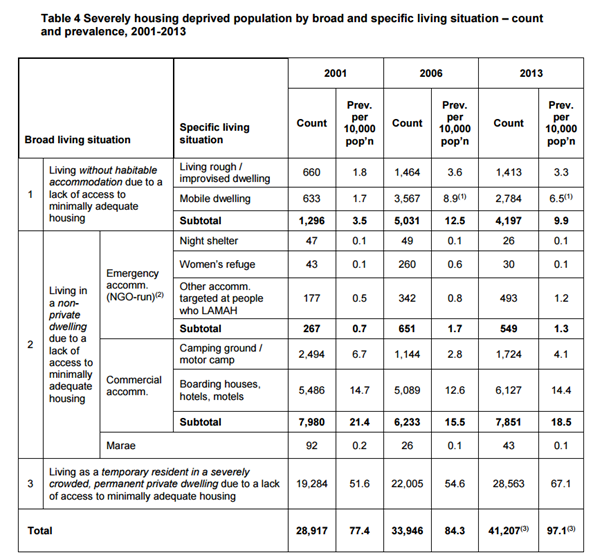
Source: Severe housing deprivation in Aotearoa/New Zealand 2001-2013 Kate Amore (2016).
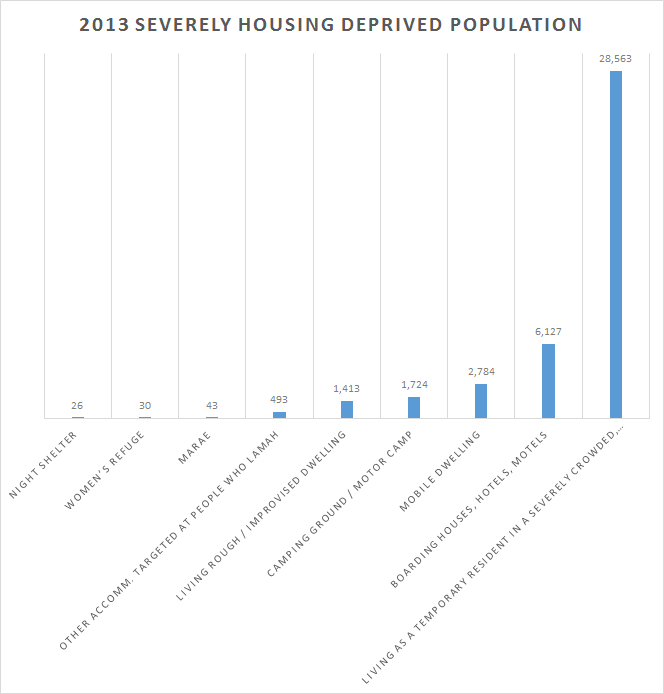
Some of the seriously housing deprived data from the Otago study show the system failing, such as sleeping rough or in a car. Other parts of the data shows the social safety net working when people are in a hotel or emergency accommodation pending a move to better quarters.
Including in the same definition of homelessness someone who is sleeping in the street or in a car with someone who is in the queue for social housing but booked into a hotel insults those who are homeless. This spin mixes up situations where the social safety net has failed with situations where it is working to help those down on their luck but perhaps not to our full satisfaction.
06 Sep 2016 Leave a comment
in applied price theory, applied welfare economics, economics of media and culture, labour economics, poverty and inequality Tags: child poverty, family poverty, intergenerational poverty, Tracey Chapman
31 Aug 2016 Leave a comment
in labour economics, politics - New Zealand, poverty and inequality, urban economics Tags: homelessness, social insurance, social safety net, welfare state
Source: 24 August 2016, Most homeless people working or studying, News, University of Otago, New Zealand, table 4.
30 Aug 2016 Leave a comment
in labour economics, politics - New Zealand, poverty and inequality, urban economics Tags: child poverty, family poverty, homelessness, New Zealand Greens, New Zealand Labour Party, social insurance, welfare state
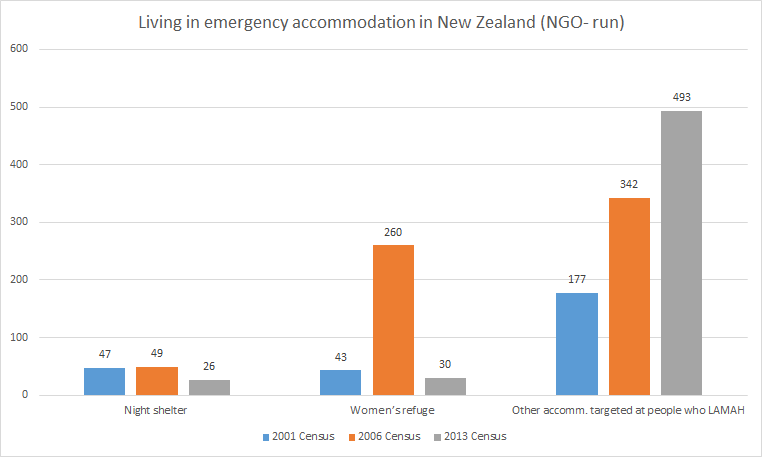
I cherry picked my previous data on homelessness if the New Zealand sub-Reddit is to be believed and from which I am banned and cannot reply. Plotting the data in full is to cherry pick it. The chart below is simply the first two rows of the source data. The subsequent rows deal with those in emergency accommodation and in temporary accommodation.
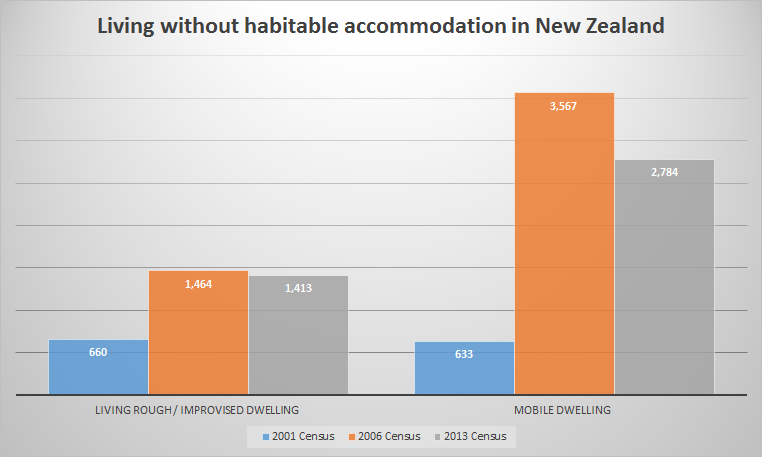
Source: 24 August 2016, Most homeless people working or studying, News, University of Otago, New Zealand, table 4.
When I shared this data on Carmel Sepuloni MP’s Facebook page, she rightly and constructively said
Thanks for your comment Jim. Unfortunately the number living rough has increased since 2001. We want to focus on improving the future, which is why we are holding our homeless inquiries so we can best understand and address this issue:
Rather than pointscoring, the issue is what to do to fix the problem. How desperate is much of the rest of the Left to beat up this issue as the fault of John Key. This is an an important issue that should not be used for point scoring by sufferers of John Key derangement syndrome.
Homeless people are those who I charted above. They are sleeping rough or in a car. They have slipped through the social safety net which is obviously not working for them. If you are in emergency accommodation, the social safety net is working. The issue is making that safety net work better in terms of moving quickly into more permanent accommodation..
28 Aug 2016 Leave a comment
in discrimination, economics of love and marriage, gender, human capital, labour economics, labour supply, occupational choice, poverty and inequality, transport economics Tags: asymmetric marriage premium, commuting times, compensating differentials, female labour force participation, gender gap, gender wage gap
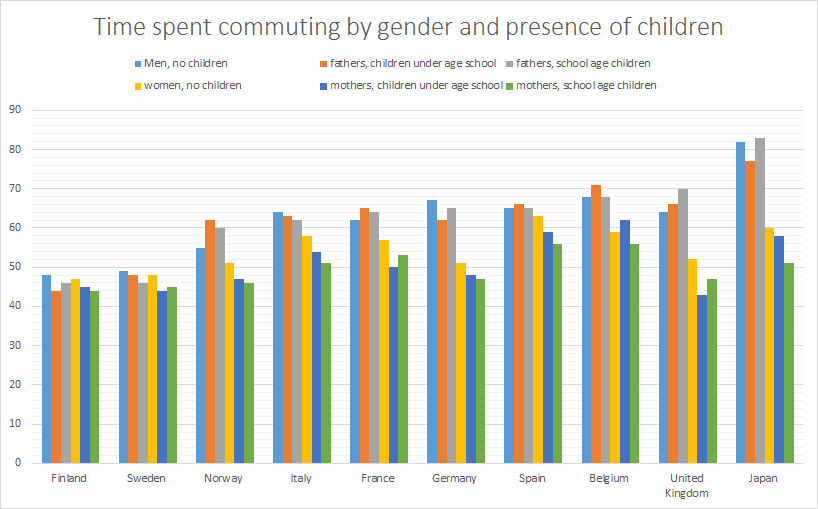
The first three bars in each cluster of bars are for men. in almost all countries mothers with dependent children spend less time commuting than childless women. This might suggest that working mothers have found workplaces closer to home than women without children. The gender gap in commuting where it is present in the country is larger than the gap between mothers and other women in their commuting time.
Source: OECD Family Database – OECD, Table LMF2.6.A.
27 Aug 2016 Leave a comment
in economic history, labour economics, labour supply, politics - USA, poverty and inequality, welfare reform Tags: 1996 US welfare reforms, child poverty, family poverty, single parents, social insurance, welfare state
Source: Poverty Has Declined a Lot Over the Past 30 Years | Mother Jones from Poverty After Welfare Reform | Manhattan Institute.
26 Aug 2016 2 Comments
in applied welfare economics, economic history, labour economics, politics - New Zealand, poverty and inequality Tags: homelessness, neoliberalism, social insurance, vast right-wing conspiracy, welfare state
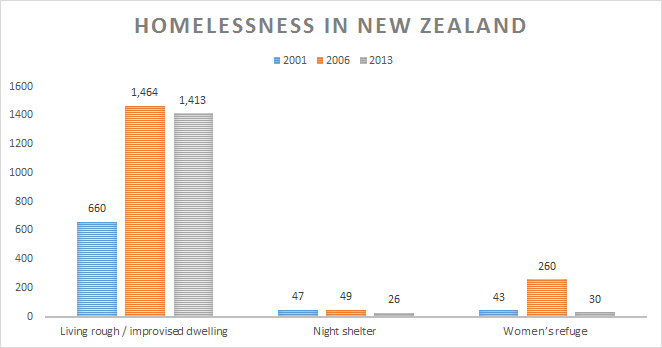
People living rough doubled under Labour! Fell under the National Party led government despite the global financial crisis and the return of neoliberal oppression.
Source: 24 August 2016, Most homeless people working or studying, News, University of Otago, New Zealand, table 4.
25 Aug 2016 Leave a comment
in applied welfare economics, labour economics, politics - New Zealand, poverty and inequality Tags: child poverty, family poverty, homelessness, social housing, social insurance, welfare state
There is a difference between not having a roof over your head and being in emergency or temporary accommodation. It disrespects those who lack a roof over their head tonight to equate their grave misfortune with those fortunate enough to already be in emergency accommodation. Once they are in emergency accommodation, that shows that the system is working. Finding them somewhere to stay pending finding something more permanent.
Source: 24 August 2016, Most homeless people working or studying, News, University of Otago, New Zealand, table 4.
https://twitter.com/childpovertynz/status/768631393459040256
https://twitter.com/PhilTwyford/status/768672477807456256
.
25 Aug 2016 Leave a comment
in applied price theory, applied welfare economics, economics of regulation, industrial organisation, labour economics, politics - New Zealand, poverty and inequality, survivor principle Tags: expressive voting, market process, New Zealand Greens, price signals, rational irrationality, The meaning of competition
The Greens are most upset that a Labour party private members bill to specify a minimum wage for contractors was voted down by one vote in parliament yesterday.
If you earn than the minimum wage as a contractor, that is a signal wrapped in an incentive. Your poor hourly earnings is a signal to you that maybe you should get out of that contracting business and go back to being an employee where you will be paid at least the minimum wage.
Many small businesses make no profits at all in the first year or so as they build the business. The founders of the business get by on savings, which they anticipated when they drew up their business plan. No one expects a business to make an immediate profit or always be profitable.
Contractors are entrepreneurs chancing their arm. They need crisp signals about whether they are succeeding, failing or could succeed if they try harder or do something different. A minimum wage for contractors masks those important market signals of success and failure.
If your dream of owning your own business is not even paying the minimum wage, maybe it is time to get out of the contracting business.
Celebrating humanity's flourishing through the spread of capitalism and the rule of law
Scholarly commentary on law, economics, and more
Beatrice Cherrier's blog
Celebrating humanity's flourishing through the spread of capitalism and the rule of law
Celebrating humanity's flourishing through the spread of capitalism and the rule of law
Celebrating humanity's flourishing through the spread of capitalism and the rule of law
Why Evolution is True is a blog written by Jerry Coyne, centered on evolution and biology but also dealing with diverse topics like politics, culture, and cats.
Celebrating humanity's flourishing through the spread of capitalism and the rule of law
Celebrating humanity's flourishing through the spread of capitalism and the rule of law
A rural perspective with a blue tint by Ele Ludemann
DPF's Kiwiblog - Fomenting Happy Mischief since 2003
Celebrating humanity's flourishing through the spread of capitalism and the rule of law
The world's most viewed site on global warming and climate change
Tim Harding's writings on rationality, informal logic and skepticism
A window into Doc Freiberger's library
Let's examine hard decisions!
Commentary on monetary policy in the spirit of R. G. Hawtrey
Thoughts on public policy and the media
Celebrating humanity's flourishing through the spread of capitalism and the rule of law
Politics and the economy
A blog (primarily) on Canadian and Commonwealth political history and institutions
Reading between the lines, and underneath the hype.
Economics, and such stuff as dreams are made on
"The British constitution has always been puzzling, and always will be." --Queen Elizabeth II
Celebrating humanity's flourishing through the spread of capitalism and the rule of law
Celebrating humanity's flourishing through the spread of capitalism and the rule of law
WORLD WAR II, MUSIC, HISTORY, HOLOCAUST
Undisciplined scholar, recovering academic
Celebrating humanity's flourishing through the spread of capitalism and the rule of law
Res ipsa loquitur - The thing itself speaks
In Hume’s spirit, I will attempt to serve as an ambassador from my world of economics, and help in “finding topics of conversation fit for the entertainment of rational creatures.”
Researching the House of Commons, 1832-1868
Articles and research from the History of Parliament Trust
Reflections on books and art
Posts on the History of Law, Crime, and Justice
Celebrating humanity's flourishing through the spread of capitalism and the rule of law
Exploring the Monarchs of Europe
Cutting edge science you can dice with
Small Steps Toward A Much Better World
“We do not believe any group of men adequate enough or wise enough to operate without scrutiny or without criticism. We know that the only way to avoid error is to detect it, that the only way to detect it is to be free to inquire. We know that in secrecy error undetected will flourish and subvert”. - J Robert Oppenheimer.
The truth about the great wind power fraud - we're not here to debate the wind industry, we're here to destroy it.
Celebrating humanity's flourishing through the spread of capitalism and the rule of law
Celebrating humanity's flourishing through the spread of capitalism and the rule of law
Economics, public policy, monetary policy, financial regulation, with a New Zealand perspective
Celebrating humanity's flourishing through the spread of capitalism and the rule of law
Restraining Government in America and Around the World
 Utopia, you are standing in it!
Recent Comments