Fast Car – Tracy Chapman: the trap of intergenerational poverty
06 Sep 2016 Leave a comment
in applied price theory, applied welfare economics, economics of media and culture, labour economics, poverty and inequality Tags: child poverty, family poverty, intergenerational poverty, Tracey Chapman
Fewer in emergency accommodation under @NZNationalParty? @PhilTwyford @cjsbishop
31 Aug 2016 Leave a comment
in labour economics, politics - New Zealand, poverty and inequality, urban economics Tags: homelessness, social insurance, social safety net, welfare state
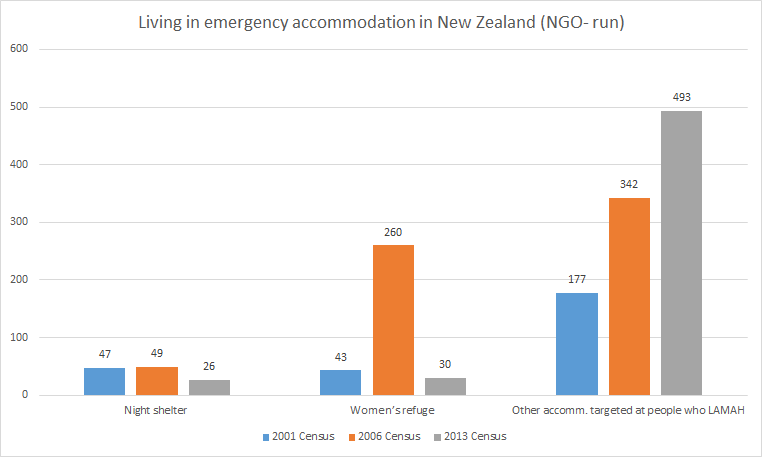
Source: 24 August 2016, Most homeless people working or studying, News, University of Otago, New Zealand, table 4.
More on homelessness fell under @NZNationalParty? @CarmelSepuloni @cjsbishop
30 Aug 2016 Leave a comment
in labour economics, politics - New Zealand, poverty and inequality, urban economics Tags: child poverty, family poverty, homelessness, New Zealand Greens, New Zealand Labour Party, social insurance, welfare state
I cherry picked my previous data on homelessness if the New Zealand sub-Reddit is to be believed and from which I am banned and cannot reply. Plotting the data in full is to cherry pick it. The chart below is simply the first two rows of the source data. The subsequent rows deal with those in emergency accommodation and in temporary accommodation.
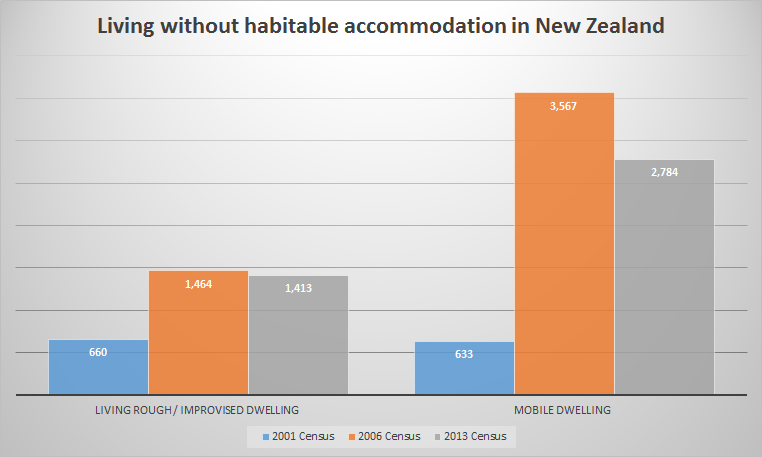
Source: 24 August 2016, Most homeless people working or studying, News, University of Otago, New Zealand, table 4.
When I shared this data on Carmel Sepuloni MP’s Facebook page, she rightly and constructively said
Thanks for your comment Jim. Unfortunately the number living rough has increased since 2001. We want to focus on improving the future, which is why we are holding our homeless inquiries so we can best understand and address this issue:
Rather than pointscoring, the issue is what to do to fix the problem. How desperate is much of the rest of the Left to beat up this issue as the fault of John Key. This is an an important issue that should not be used for point scoring by sufferers of John Key derangement syndrome.
Homeless people are those who I charted above. They are sleeping rough or in a car. They have slipped through the social safety net which is obviously not working for them. If you are in emergency accommodation, the social safety net is working. The issue is making that safety net work better in terms of moving quickly into more permanent accommodation..
The gender commuting gap between mothers and fathers
28 Aug 2016 Leave a comment
in discrimination, economics of love and marriage, gender, human capital, labour economics, labour supply, occupational choice, poverty and inequality, transport economics Tags: asymmetric marriage premium, commuting times, compensating differentials, female labour force participation, gender gap, gender wage gap
The first three bars in each cluster of bars are for men. in almost all countries mothers with dependent children spend less time commuting than childless women. This might suggest that working mothers have found workplaces closer to home than women without children. The gender gap in commuting where it is present in the country is larger than the gap between mothers and other women in their commuting time.
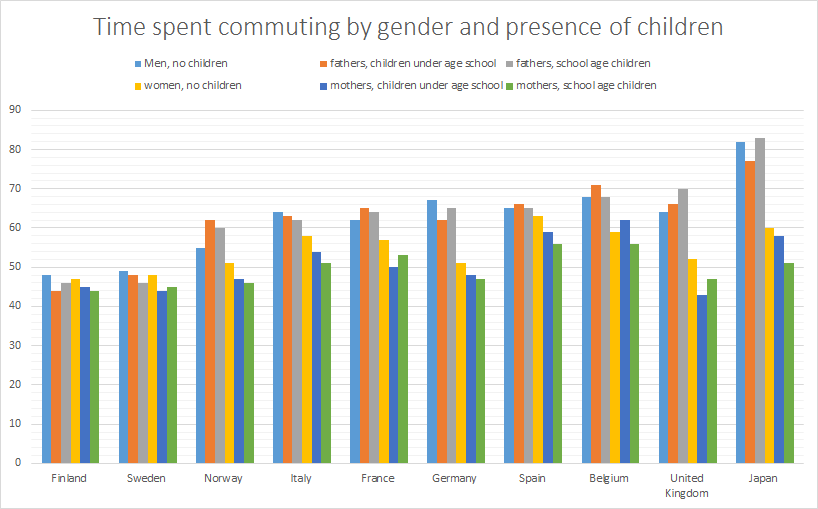
Source: OECD Family Database – OECD, Table LMF2.6.A.
Poverty Has Declined a Lot Over the Past 30 Years in the USA
27 Aug 2016 Leave a comment
in economic history, labour economics, labour supply, politics - USA, poverty and inequality, welfare reform Tags: 1996 US welfare reforms, child poverty, family poverty, single parents, social insurance, welfare state
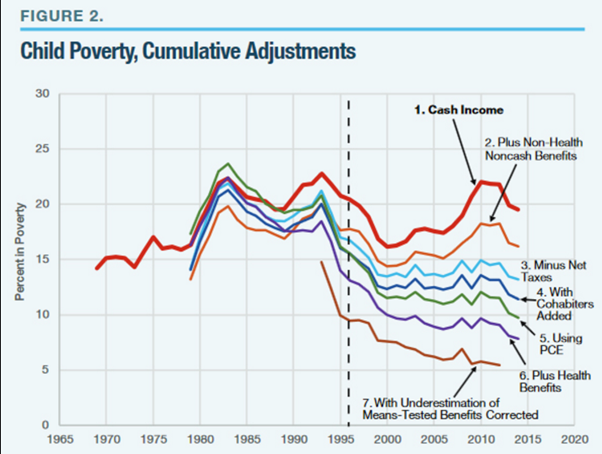
Source: Poverty Has Declined a Lot Over the Past 30 Years | Mother Jones from Poverty After Welfare Reform | Manhattan Institute.
Homelessness fell under @NZNationalParty? @PhilTwyford @metiria @cjsbishop
26 Aug 2016 2 Comments
in applied welfare economics, economic history, labour economics, politics - New Zealand, poverty and inequality Tags: homelessness, neoliberalism, social insurance, vast right-wing conspiracy, welfare state
People living rough doubled under Labour! Fell under the National Party led government despite the global financial crisis and the return of neoliberal oppression.
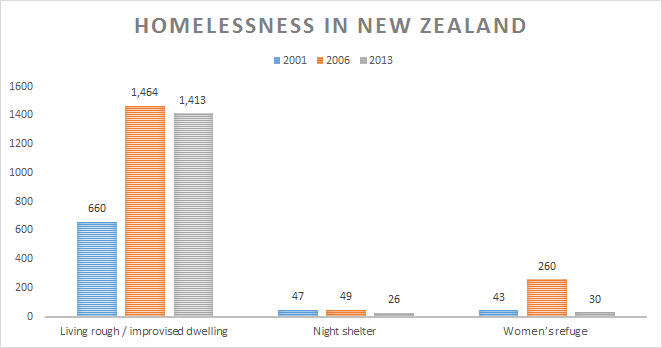
Source: 24 August 2016, Most homeless people working or studying, News, University of Otago, New Zealand, table 4.
How many of the 41,000 homeless don’t have a roof over their heads? @metiria @PhilTwyford
25 Aug 2016 Leave a comment
in applied welfare economics, labour economics, politics - New Zealand, poverty and inequality Tags: child poverty, family poverty, homelessness, social housing, social insurance, welfare state
There is a difference between not having a roof over your head and being in emergency or temporary accommodation. It disrespects those who lack a roof over their head tonight to equate their grave misfortune with those fortunate enough to already be in emergency accommodation. Once they are in emergency accommodation, that shows that the system is working. Finding them somewhere to stay pending finding something more permanent.
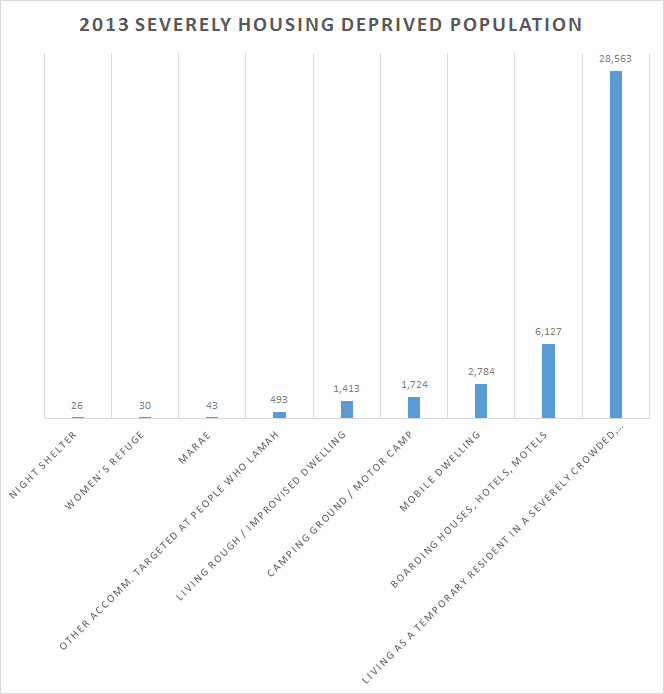
Source: 24 August 2016, Most homeless people working or studying, News, University of Otago, New Zealand, table 4.
https://twitter.com/childpovertynz/status/768631393459040256
https://twitter.com/PhilTwyford/status/768672477807456256
.
.@NZGreens do not understand business: minimum wage for contractors version
25 Aug 2016 Leave a comment
in applied price theory, applied welfare economics, economics of regulation, industrial organisation, labour economics, politics - New Zealand, poverty and inequality, survivor principle Tags: expressive voting, market process, New Zealand Greens, price signals, rational irrationality, The meaning of competition
The Greens are most upset that a Labour party private members bill to specify a minimum wage for contractors was voted down by one vote in parliament yesterday.
If you earn than the minimum wage as a contractor, that is a signal wrapped in an incentive. Your poor hourly earnings is a signal to you that maybe you should get out of that contracting business and go back to being an employee where you will be paid at least the minimum wage.
Many small businesses make no profits at all in the first year or so as they build the business. The founders of the business get by on savings, which they anticipated when they drew up their business plan. No one expects a business to make an immediate profit or always be profitable.
Contractors are entrepreneurs chancing their arm. They need crisp signals about whether they are succeeding, failing or could succeed if they try harder or do something different. A minimum wage for contractors masks those important market signals of success and failure.
If your dream of owning your own business is not even paying the minimum wage, maybe it is time to get out of the contracting business.
But @EleanorAingeRoy child poverty has not changed much in 20 years
16 Aug 2016 Leave a comment
in applied welfare economics, labour economics, labour supply, politics - New Zealand, poverty and inequality, urban economics, welfare reform Tags: child poverty, family poverty, housing affordability, RMA
Today in the Guardian writing on trends in family poverty New Zealand, Eleanor Roy said that
The fact that twice as many children now live below the poverty line than did in 1984 has become New Zealand’s most shameful statistic.
Roy goes back to the 1980s as her base because child poverty has not gone up or down by that much since that sharp rise in the late 1980s.
Child poverty among single-parent households has doubled since 1990 and tripled since 1988. Poverty in families with two parents present is not much higher now than it was in 1988.

Source: Bryan Perry, Household Incomes in New Zealand: trends in indicators of inequality and hardship 1982 to 2014 – Ministry of Social Development, Wellington (August 2015), Table H.4.
Child poverty rates among single-parent families that live with other adults is one-quarter that of single-parent families who live alone. The reasons behind that should be explored more by those concerned with child poverty.

Source: Bryan Perry, Household Incomes in New Zealand: trends in indicators of inequality and hardship 1982 to 2013 – Ministry of Social Development, Wellington (2014), Tables F.6 and F.7.
The evidence is overwhelming that the main driver of the increases in the child poverty since the 1980s is rising housing costs.
In the longer run, after housing costs child poverty rates in 2013 were close to double what they were in the late 1980s mainly because housing costs in 2013 were much higher relative to income than they were in the late 1980s.
– Bryan Perry, 2014 Household Incomes Report – Key Findings. Ministry of Social Development (July 2014).
Any policy to reduce child poverty must increase the supply of houses by reducing regulatory restrictions on the supply of land.
Rather than blame the callousness of government in accepting higher rates of child poverty, Roy should blame its inability to take on the restrictions on land supply in the Resource Management Act that drive up housing costs for the poor. Increased child poverty in New Zealand is a by-product of housing unaffordability.
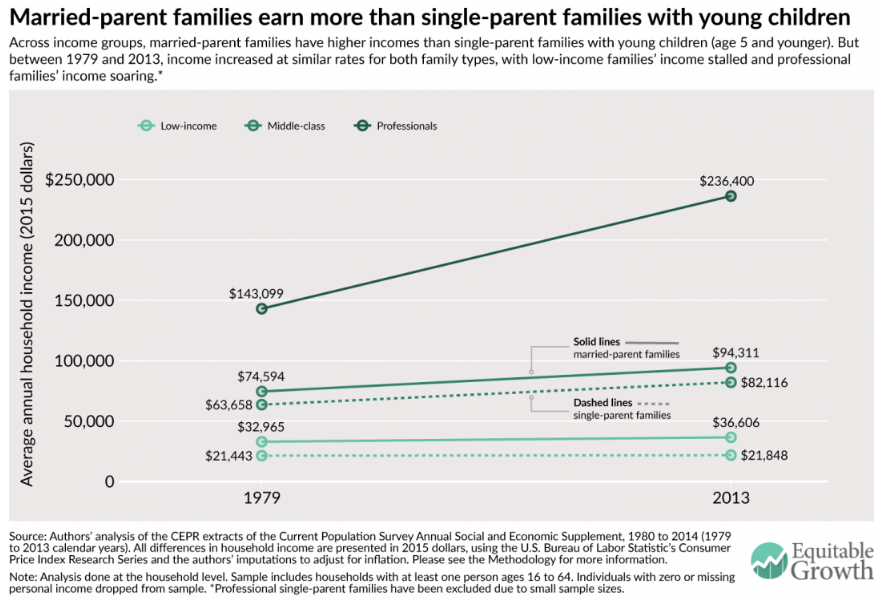
The ‘hollowing’ of the American middle class
04 Aug 2016 Leave a comment
in economic history, labour economics, politics - USA, poverty and inequality Tags: child poverty, family poverty, technology diffusion, The Great Enrichment


The present rate of technology adoption is nearly a vertical line —@blackrock https://t.co/3oS3YAI4ld—
Vala Afshar (@ValaAfshar) January 22, 2016
Brad de Long on Marx and adapting to The Great Enrichment
30 Jul 2016 Leave a comment
in applied welfare economics, constitutional political economy, development economics, economic history, poverty and inequality
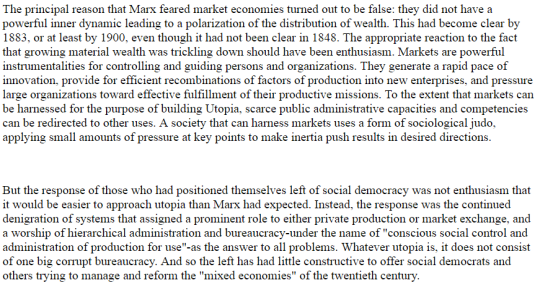
Source: Brad de Long, The Fall of the Soviet Union
% Australian top incomes from wages, salaries and pensions since 1954
19 Jul 2016 Leave a comment
in economic history, human capital, industrial organisation, labour economics, occupational choice, politics - Australia, poverty and inequality Tags: Australia, CEO pay, superstar wages, superstars, top 1%, top incomes
Australia has had a working rich for a long time now. Australian top income earners are top wage earners. They are athletes, celebrities, business executives and in the professions.
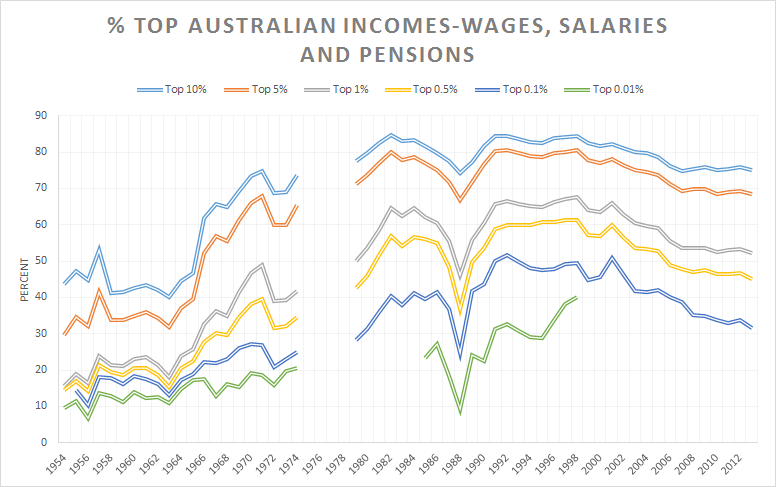
Source: The World Wealth and Income Database.
% US top incomes from wages, salaries and pensions, 1913 – 2015,
18 Jul 2016 Leave a comment
in applied welfare economics, economic history, human capital, industrial organisation, labour economics, occupational choice, politics - USA, poverty and inequality, survivor principle Tags: CEO pay, entrepreneurial alertness, superstar wages, superstars, top 1%, top incomes
The rich in the USA long ago became a working rich; most top incomes are from wages and salaries.
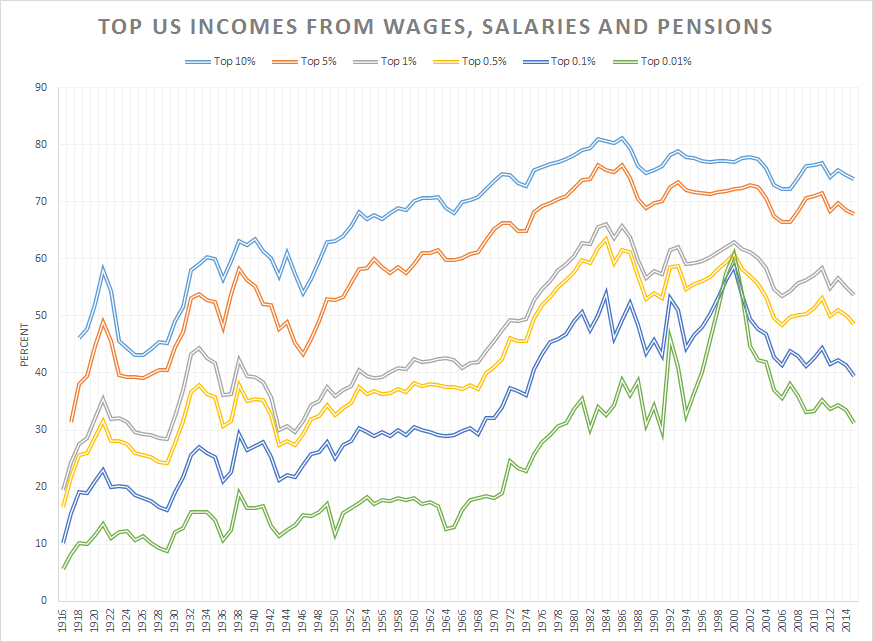
Source: The World Wealth and Income Database.


Recent Comments