
The slums of Jebson Pl – down and out in New Zealand includes Sky TV
08 Nov 2014 Leave a comment
in poverty and inequality, welfare reform Tags: poverty and inequality, The Great Erichment, welfare reform

via Whale Oil Beef Hooked and waikato-times
Occupy Wall Street protesters didn’t like what they found when they actually met the bottom 1%
06 Nov 2014 Leave a comment
in labour economics, poverty and inequality, welfare reform Tags: bottom 1%, economics of personality traits, Occupy Wall Street, poverty and inequality, top 1%

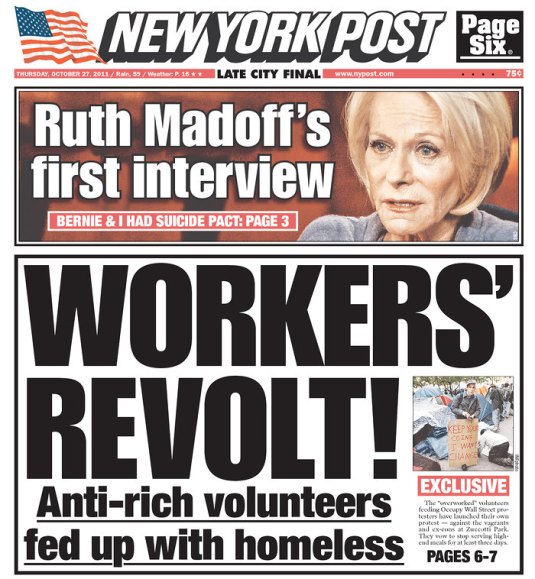
The Occupy Wall Street protesters had free food provided by kitchens staffed by volunteers.

These self appointed representatives of the bottom 99% didn’t appreciate brushing shoulders with the bottom 1 percent of the social stratum:
The Occupy Wall Street volunteer kitchen staff launched a “counter” revolution yesterday — because they’re angry about working 18-hour days to provide food for “professional homeless” people and ex-cons masquerading as protesters.
For three days beginning tomorrow, the cooks will serve only brown rice and other spartan grub instead of the usual menu of organic chicken and vegetables, spaghetti bolognese, and roasted beet and sheep’s-milk-cheese salad.
They will also provide directions to local soup kitchens for the vagrants, criminals and other freeloaders who have been descending on Zuccotti Park in increasing numbers every day.
To show they mean business, the kitchen staff refused to serve any food for two hours yesterday in order to meet with organizers to air their grievances, sources said…
Overall security at the park had deteriorated to the point where many frightened female protesters had abandoned the increasingly out-of-control occupation, security- team members said.
Bryan Caplan on the pathologies of poverty
05 Nov 2014 Leave a comment
in labour economics, poverty and inequality, welfare reform Tags: Bryan Caplan, do gooders, Occupy Wall Street, poverty and inequality, top 1%

Bryan Caplan drew up a nice list of factors that contribute to poverty
- alcoholism: Alcohol costs money, interferes with your ability to work, and leads to expensive reckless behaviour.
- drug addiction: Like alcohol, but more expensive, and likely to eventually lead to legal troubles you’re too poor to buy your way out of.
- single parenthood: Raising a child takes a lot of effort and a lot of money. One poor person rarely has enough resources to comfortably provide this combination of effort and money.
- unprotected sex: Unprotected sex quickly leads to single parenthood. See above.
- dropping out of high school: High school drop-outs earn much lower wages than graduates. Kids from rich families may be able to afford this sacrifice, but kids from poor families can’t.
- being single: Getting married lets couples avoid a lot of wasteful duplication of household expenses. These savings may not mean much to the rich, but they make a huge difference for the poor.
- non-remunerative crime: Drunk driving and bar fights don’t pay. In fact, they have high expected medical and legal expenses. The rich might be able to afford these costs. The poor can’t.
Caplan argues that there is an undeserving poor if they fail to follow the following reasonable steps to avoid poverty and hardship:
- Work full-time, even if the best job you can get isn’t fun.
- Spend your money on food and shelter before getting cigarettes and cable t.v.
- Use contraception if you can’t afford a child
The Feed the Kids Bill still leaves their parents to go hungry!
05 Nov 2014 Leave a comment
in applied price theory, economics of education, politics - New Zealand, poverty and inequality, welfare reform Tags: Heartless Left, Leftover Left, school breakfast programmes
The Feed the Kids Bill that has been reintroduced into the new New Zealand Parliament still contains no provision to feed the parents who are too poor to make their children breakfast.

Why are these hungry parents not invited for breakfast as well? No parent would have breakfast if their children was to go hungry. Both the parent and child must have gone hungry that morning, perhaps morning after morning. There is no other charitable explanation.
The Bill aims to set up government funded breakfast and lunch programmes in all decile 1-2 schools. The cost is $100 million a year – including food, staffing, administration, monitoring and evaluation.
Lindsay Mitchell was on the money when she wrote:
Even parents reliant on a benefit are paid enough to provide some fruit and modest sandwiches daily.
An inability to do so is a symptom of a greater problem requiring scrutiny – for the sake of their child.
“The ‘income management’ regime provides a response to genuinely hungry children.
It may interest you that even Labour advocated for extended income management in its election manifesto.
Their 2014 ‘Social Development’ policy paper proposed, “…allow[ing] income management to be used as a tool by social agencies where there are known child protection issues and it is considered in the best interests of the child, especially where there are gambling, drug and alcohol issues involved.”
Hungry children is a child protection issue. Parents who fail to feed their children should come to the attention of the child protection authorities. Those on the benefit should be subject to income management because they clearly are spending their money elsewhere.
On the Left, there is a refusal to discuss the role of addiction and incompetent parenting in child poverty. The 2014 election manifesto of the Labour Party is a welcome departure from that tradition of denial.
 Utopia, you are standing in it!
Recent Comments