Was @MBIEgovtnz misreported on the effects of job protection laws and unions? @EricCrampton

News reports have it that the regulatory impact statement on the new employment law amendments by the new government says that:

The bill aims to strengthen collective bargaining through a range of measures, including guaranteed rest and meal breaks, reasonable union access to a workplace, and bringing back the 30-day rule where a new worker has to be given the same conditions as a collective agreement.

MBIE officials found that the cost of the proposals would mainly fall on employers, including from higher wages and compliance costs, and from a potential fall in productivity.

The MBIE papers identified the following risks associated with the bill:
• reduced employment due to changed incentives on employers to hire new workers • an increase in industrial action and protracted bargaining due to the need to conclude agreements and include pay rates in collective agreements
• an increase in partial strikes by removing an employer’s ability to deduct pay for partial striking
• lower productivity due to less flexibility (mainly from the need for guaranteed meal breaks)

These predictions must be a misreporting of an earlier draft by a junior analyst, perhaps they were not a recruit with a background in economics. The predictions of the effects of employment protection laws and union bargaining seem to be wrong for the former and seriously out of date for the latter.

Let us begin with what are the standard predictions of the effect of employment protection laws. They lower wages and have an ambiguous effect on employment because there is both less hiring and less firing. The only unambiguous effect is on the duration of unemployment because fewer vacancies are posted but once you get a job, you keep it for longer.

To give a summary of the literature that appears to be unknown to the junior analyst writing this early draft, graduate textbooks in labour economics show that a wide range of studies have found that:

1. Employment law protections make it more costly to both hire and fire workers.

2. The rigour of employment law has no great effect on the rate of unemployment. That being the case, stronger employment laws do not affect unemployment by much.

3. What is clear is that is more rigourous employment law protections increase the duration of unemployment spells. With fewer people hired, it takes longer to find a new job.

4. Stronger employment law protections also reduce the number of young people and older workers who hold a job. They are outside looking in on a privileged subsection of insiders in the workforce who have stable, long-term jobs and who change jobs infrequently.

The impact of the introduction of trial periods on employment will be ambiguous because the lack of a trial period can be undone by wage bargaining.

  • If you have to hire a worker with full legal protections against dismissal, you pay them less because the employer is taking on more of the risk if the job match goes wrong. If they work out, you promote them and pay them more.
  • If you hire a worker on a trial period, they may seek a higher wage to compensate for taking on more of the risks if the job match goes wrong and there is no requirement to work it out rather than just sack them.

The twist in the tail is whether there is a binding minimum wage. If there is a binding minimum wage,  either the legal minimum or in a collective bargaining agreement, the employer cannot reduce the wage offer to offset the hiring risk so fewer are hired. The introduction of trial periods will affect both wages and employment and employment more in industries that has low pay or often pay the minimum wage.

Trial periods are common in OECD countries. There is plenty of evidence that increased job security leads to less employee effort and more absenteeism. Some examples are:

  • Sick leave spiking straight after probation periods ended;
  • Teacher absenteeism increasing after getting tenure after 5-years; and
  • Academic productivity declining after winning tenure.

Jacob (2013) found that the ability to dismiss teachers on probation – those with less than five years’ experience – reduced teacher absences by 10% and reduced frequent absences by 25%.

Studies also show that where workers are recruited on a trial, employers have to pay higher wages. For example, teachers that are employed with less job security, or with longer trial periods are paid more than teachers that quickly secure tenure.

If employers take on more of the risk of a job match going wrong, they will pay recruits less. They can have a promotion round 6 or 12 months where pay is topped up if there is a good match. If minimum wage laws prevent starting salaries going low enough, there will be fewer job vacancies. But higher up the wage scales, the main effect of employment protection laws is to lower wages because the employer expects a wage discount to compensate for taking on more risk of an unsuccessful job match.

Consider, as an example, if there is a requirement to pay redundancy pay. Employers can easily undo this legal requirement by reducing wages. Another similarity is where employers pay completion bonuses on an offshore posting. They back-load compensation to make up for uncertainties about the willingness of the worker to last the posting. Because wages are lower for the duration of the posting, employees expect a big bonus. Also, there is self-selection, recruits are more likely to be those intending to stay for the whole posting. Both the employer and the employee split the greatest surplus from higher quality and longer lasting job matches arising from offering a completion bonus.

The analysis by the Ministry of the potential effects of unions is out of date. There are now doubts as to whether there is any union wage premium at all. The union wage premium is certainly withering away.

John DiNardo and David Lee compared business establishments from 1984 to 1999 where US unions barely won the union certification election (e. g., by one vote) with workplaces where the unions barely lost. If 50% plus 1 workers vote in favour of the union proposing to organise them, management has to bargain for a collective agreement in good faith with the certified union, if the union loses, management can ignore that union.

Most winning union certification elections resulted in the signing of a collective agreement not long after. Unions who barely win have as good a chance of securing a collective agreement as those unions that win these elections by wide margins.

Importantly, few firms subsequently bargained with a union that just lost the certification election. Employers can choose to recognise a union. Because the vote is so close, a particular workplace becoming unionised was close to a random event.

This closeness of the union certification election may disentangle unionisation from just being coincident with well-paid workplaces, more skilled workers and well-paid industries. Unions could be organising at highly profitable firms that are more likely to grow and pay higher wages independent of any collective bargaining. The unions are possibly claiming credit for wage rises that would have happened anyway.

DiNardo and Lee found only small impacts of unionisation on all outcomes they examined:

  • The estimated changes for wages of unionisation are close to zero.
  • Impacts on survival rates of the unionised business and their profitability were equally tiny.

This evidence of DiNardo and Lee suggests that in recent decades in the USA, requiring an employer to bargain with a certified union has had little impact because unions have been unsuccessful in winning significant wage gains after unionisation. These findings by DiNardo and Lee suggests that there may not be a union wage premium at all since the early 1980s, at least in the USA.

In another paper DiNardo found a substantial union wage premium before the Second World War by studying the share price effects of unionisation. One of the differences back them that there was far more violence associated with strikes.

We find that strikes had large negative effects on industry stock valuation. In addition, longer strikes, violent strikes, strikes won by the union, strikes leading to union recognition, industry-wide strikes, and strikes that led to wage increases affected industry stock prices more negatively than strikes with other characteristics.

New Zealand and U.S. unions are similar in that both are on their own in bargaining with employers for a wage rise. Options for outside arbitration do not exist in New Zealand; there are some forms of compulsory arbitration in the USA. These US result sends a message to New Zealand that unions are a bit of a relic in terms of wage bargaining. MBIE seems to have missed that literature?

In summary, job protection laws reduce wages. For the low paid, they may also reduce employment rates if minimum wage rates are binding. Unions are a dinosaur that do not matter much anymore.
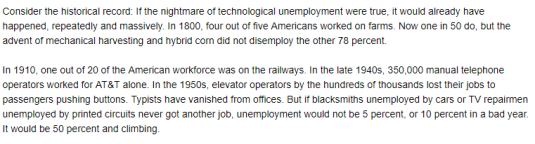
 

Yesteryear’s robots came for many more jobs

These used to be a hell of a lot of railway workers

Source: Deirdre McCloskey, The Myth of Technological Unemployment – Reason.com

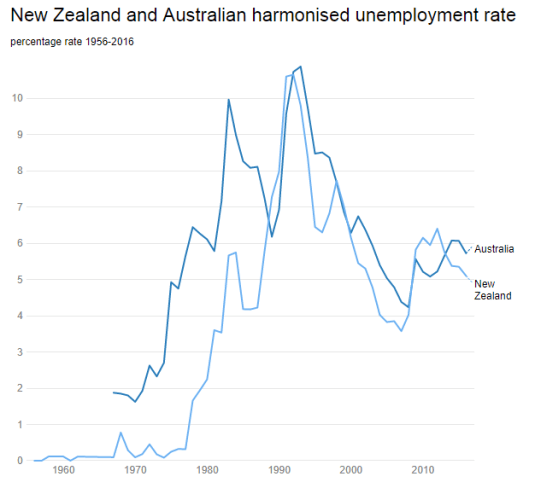
New Zealand and Australian unemployment rates since 1956

Data extracted on 27 Aug 2017 11:37 UTC (GMT) from OECD.Stat.

Image

PRECARIOUS WORK AS THE FLIP SIDE OF EFFICIENCY WAGES

Efficiency wages were put forward as a cause of what is now called precarious work. The efficiency wage hypothesis breathed considerable new life into the old theory of dual labour markets (Katz 1986; Dickens and Lang 1985).

article-2303333-190f447b000005dc-765_964x621

The notion of a segmented labour market, of a primary and a secondary labour market, each with distinctly different wage setting mechanisms, was very much a fringe idea prior to the 1980s:

Efficiency wage theory provides a rare common meeting ground for mainstream and radical economists, because the far left in U.S. economics has taken the lead in developing theories of dual labor markets and for setting-out policy proposals for higher minimum wages based on the assumed validity of the efficiency wage approach (Gordon 1990, p. 1157).

The workers privileged enough to hired by firms paying an efficiency wage would enjoy job security, low job quit rates, good working conditions, career advancement, training and higher pay (Akerlof 1982, 1984; Bulow and Summers 1986; Dickens and Lang 1993). The remaining equally productive workers who were unlucky enough to be priced out of these good jobs by the job rationing implicit in an efficiency wage must fend for themselves in a secondary labour market; in precarious work with high quit rates, harsh workplace discipline, few promotions, little training and poor pay (Akerlof 1982, 1984; Katz 1986; Dickens and Lang 1985). Efficiency wages do not motivate greater employee effort unless the prospect of precarious work in this secondary labour market looms large in the back of their minds as their main alternative source of employment for those lucky enough to be employed in the good jobs in the primary labour market (Katz 1986; Bulow and Summers 1986).

Those workers crowded into these bad jobs in the secondary labour market find it to be a slow and difficult process to break into these better paying good jobs in the primary labour market. There are queues for the good jobs because they are paying above-market wages; many of those crowded into the bad jobs are women and minorities (Bulow and Summers 1986; Dickens and Lang 1985, 1993).

Akerlof, in his Nobel Prize lecture on behavioural macroeconomics, contended that the good and bad jobs caused by paying efficiency wages is central to explaining involuntary mass unemployment:

The existence of good jobs and bad jobs makes the concept of involuntary unemployment meaningful: unemployed workers are willing to accept, but cannot obtain, jobs identical to those currently held by workers with identical ability. At the same time, involuntarily unemployed workers may eschew the lower-paying or lower-skilled jobs that are available. The definition of involuntary unemployment implicit in efficiency wage theory accords with the facts and agrees with commonly held perceptions. A meaningful concept of involuntary unemployment constitutes an important first step forward in rebuilding the foundations of Keynesian economics (Akerlof 2002, p. 415).

Living wage activists already doubt that the market can provide steady wages growth and stable employment. Efficiency wages are a leading New Keynesian macroeconomic explanation for that. The living wage movement cannot pick and choose from what the efficiency wage hypothesis says about how well the labour market functions for those who are and are not in efficiency wage jobs.

Living wage activists are unwittingly following a course of action that leads to more job rationing, more precarious work and more unemployment. Those priced out of council jobs by a living wage such as the 17 parking wardens are left to take their chances in the rest of the local labour market. These workers must take bad jobs while queueing for the good jobs in the primary labour market. Instead of being sources of opportunity in their communities, councils through a living wage policy risk becoming drivers of labour market segmentation and the fostering of a precariat.

The fair-wage effort hypothesis is a theory of mass low-skilled unemployment

image

Living wage advocates make much of the demoralising effects of pay inequality on workplace productivity. In common with the efficiency wage hypothesis, this is another example of what Nozick (1974) called normative sociology; the study of what the causes of social problems ought to be. Again, living wage activists misconstrue what the fair-wage effort hypothesis was seeking to explain.

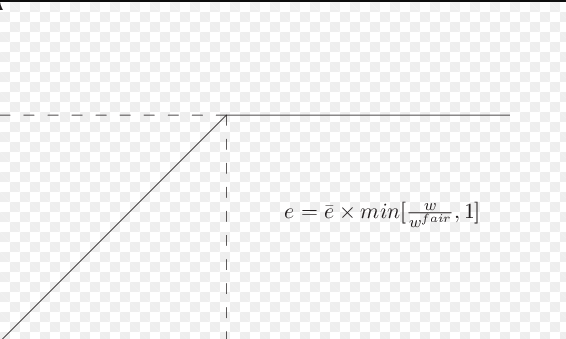
The fair-wage effort hypothesis aimed to fill gaps in the efficiency wage hypothesis by explaining why unemployment is so much higher among the lower skilled (Akerlof and Yellen 1988, 1990). Under the fair-wage effort hypothesis, workers slack off if paid less than they think they deserve:

The motivation for the fair wage-effort hypothesis is a simple observation concerning human behavior: when people do not get what they deserve, they try to get even (Akerlof and Yellen 1990, p. 256).

Lazear (1989, 1991) contends that employers too may want greater pay equity to temper over-competitiveness in teams. If pay and promotions in a team are linked to the relative performance of its members, large pay differentials may undermine co-operation and might encourage sabotage:

Very large pay spreads induce high effort, but they also create a work environment in the firm that is not very pleasant… individuals who are competing with one another can either seek to outperform others, or they can contribute to the failure of others. Such incentives can result in collusion (Dye, 1984) or in sabotage (Lazear, 1989). Thus, pay structure must strike a balance between providing incentives for effort and reducing the adverse consequences associated with this kind of industrial politics (Lazear and Shaw 2007, p. 95).

Lazear’s (1989, 1991) theory about the industrial politics arising from pay inequality stressed how sizable rewards to individual members of a team could lead to a lack of team play and lower team output. If the prizes were smaller for superior relative performance, the pay rise after a promotion or the annual performance bonus, there may be more teamwork (Lazear 1989, 1991). Akerlof and Yellen (1990) were correct in their insight that their hypothesis about fair-wage effort applies more to workers on lower wages with fewer chances of moving up promotion ladders and pay scales.

The fair-wage effort hypothesis is but another Keynesian macroeconomic theory of unemployment:

The hypothesis explains the existence of unemployment. Unemployment occurs when the fair wage w* exceeds the market-clearing wage. With natural specifications of the determination of w*, this hypothesis may explain why skill and unemployment are negatively correlated. In addition, it potentially explains wage differentials and labor market segmentation (Akerlof and Yellen 1990, p. 256).

The fair-wage effort hypothesis was developed as a descendant of the efficiency wage hypothesis because the latter cannot explain why wages are high for everyone working in high-paid industries:

All workers in better-paid industries tend to receive positive wage premia. That is, the wages of secretaries and engineers are highly correlated across industries. Ease of supervision and the magnitude of turnover costs might well be correlated across industries for a given occupation explaining, for example, why, say, skilled machinery operators receive positive wage premia in most industries. But there is no obvious reason why, say, secretaries, should be harder to supervise in the chemical industry where pay is high, than in the apparel industry where pay is low (Akerlof and Yellen 1988, p. 44).

The efficiency wage hypothesis also offered “no natural explanation” for why unemployment rates [JC1] are much higher among the lower-skilled (Akerlof and Yellen 1990). Skilled workers are probably more difficult to monitor than the unskilled so their unemployment rates should be higher than for the low-skilled as a worker discipline device but the contrary is the case (Akerlof and Yellen 1990).

The fair-wage effort hypothesis aimed to fill gaps in the efficiency wage theory of unemployment by explaining why low skilled unemployment is much higher both in recessions and in better times. Living wage activists must accept that their demands for workplace pay equity increase low-skilled unemployment under a Keynesian theory which they embrace with considerable enthusiasm.

If high wages are paid to the more skilled to attract the best applicants, demands for pay equity by their less skilled co-workers could price some of them out of the market leading to unemployment (Akerlof and Yellen 1988, 1990). In addition, pay equity norms are unlikely to respond quickly enough to fluctuations in aggregate demand so wages can be too high in recessions causing mass unemployment of the low skilled (Akerlof and Yellen 1988, 1990; Summers 1988). The unemployed cannot successfully offer to work for less than existing workers do in a recession because they cannot make a credible commitment to eschew fairness considerations once hired (Akerlof 2002).

An important premise of New Keynesian macroeconomics is demands for pay equity come at a price. At a price that is high enough for the efficiency wage and fair-wage effort hypotheses to be put as a comprehensive New Keynesian explanations of involuntary mass unemployment (Gordon 1990).

Both the efficiency wage hypothesis and the fair-wage effort hypothesis are attempts to flesh out a theory of extensive labour market dysfunction leading to mass unemployment. Living wage activists are using Keynesian theories of why wages are too high to argue for even higher wages.

An efficiency wage is a theory of persistent mass unemployment

image

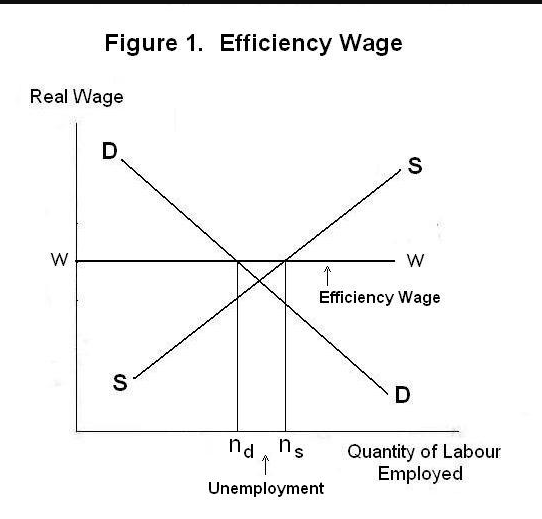
Shapiro and Stiglitz (1984) first put forward their theory of an efficiency wage to explain large-scale involuntary unemployment. It was the very real threat of a prolonged spell of unemployment (rather than a morale boosting pay rise) that motivated employees to put in more effort to keep their jobs:

To induce the worker not too shirk, the firm attempts to pay more the “going rate”; then, if the worker is caught shirking and is fired, he will pay a penalty. If it pays one firm to raise its wage, it pays all firms to raise their wages. When they all raise their wages, the incentive to shirk again disappears. But as all firms raise their wages, the demand for labour decreases, and unemployment results. With unemployment, even if all firms pay the same wage, a worker has an incentive not to shirk. For, if he is fired, an individual will not immediately obtain another job. The equilibrium unemployment rate must be sufficiently large that it pays the workers to work rather than take the risk of being caught shirking (Shapiro and Stiglitz 1984, p. 435).

The unemployed offer to work for less pay than existing employees but they are not hired because their labour productivity is not assured at this lower pay (Akerlof 1982, 1984; Katz 1986, 1988; Yellen 1984). There is involuntary mass unemployment because of the prevalence of efficiency wages:

If there is involuntary unemployment in an equilibrium situation, it must be that firms, for some reason or other, wish to pay more than the market-clearing wage. And that is the heart of any efficiency-wage theory (Akerlof 1984, p. 79).

Direct parallels were quickly drawn between the efficiency wage hypothesis as a worker discipline device eliciting greater effort and the old Marxist concept of the reserve army of the unemployed:

… it pays each firm to increase its wage to eliminate shirking. When all firms do this, the average wage rises and employment is reduced. In equilibrium, all firms pay a wage above the market clearing level, creating unemployment. Since jobs are scarce and rationed, the loss of a job can involve a lengthy spell of unemployment. The reserve army of the unemployed acts as a discipline device making shirking costly (Katz 1986, pp. 240-41).

It is misconceived for living wage activists to use a theory of lengthy unemployment to justify a large living wage rise but argue that there will be little unemployment because of the efficiency wage effects. This is the exact opposite of what the efficiency wage hypothesis is about. The leading Keynesian macroeconomists of their generation were striving to explain mass unemployment:

… the economists who developed the theory of efficiency wages (including Shapiro and Stiglitz, Akerlof and Yellen and Yellen) had no illusions that they were helping business firms to discover a new way to increase profits. The economists who developed efficiency wage theory were trying to explain persistent unemployment. Hence the title of Janet Yellen’s famous survey, Efficiency Wage Models of Unemployment.

The question that motivated efficiency wage theory was not why firms should raise wages but why firms don’t cut wages when they should. The answer they gave was that firms don’t cut wages despite unemployment because they fear that workers will respond to lower wages with reduced productivity …

In the original efficiency wage literature, there is no wishful thinking–no idea that we can have more of everything that we want without trade-offs. Instead of being desirable, the efficiency wage is a problem because lower wages would reduce unemployment and be better for the economy … the efficiency wage theorists took it for granted that to the extent that firms can increase profits by raising wages they have already done so (hence the persistent unemployment) (Tabarrok 2015).

Gordon was blunt about why efficiency wage arguments were popular and with whom

If any development in the microeconomics of labor markets could be called the “rage of the 80s,” it is efficiency wage theory, based on the hypothesis that worker productivity depends on the level of the real wage. When there is such a link between the wage rate and worker efficiency, firms may rationally pay a real wage rate that exceeds the market-clearing level. Firms may refuse to reduce the wage to hire members of a pool of unemployed workers who may be available at a lower wage, fearful that a reduction in real wages for existing workers may reduce productivity by more than the gain in lower wages (Gordon 1990, p. 1157).

Living wage activists have it the wrong way around about the social benefits of paying an efficiency wage. The efficiency wage hypothesis is a theory of why wages are too high and employment is too low (Akerlof 1982, 1984, 2002; Yellen 1984; Katz 1986, 1988; Stiglitz 2002). Living wage activists are using a well-respected theory of why wages are too high to argue that wages are too low.

The compassion of unions towards the minimum waged

image

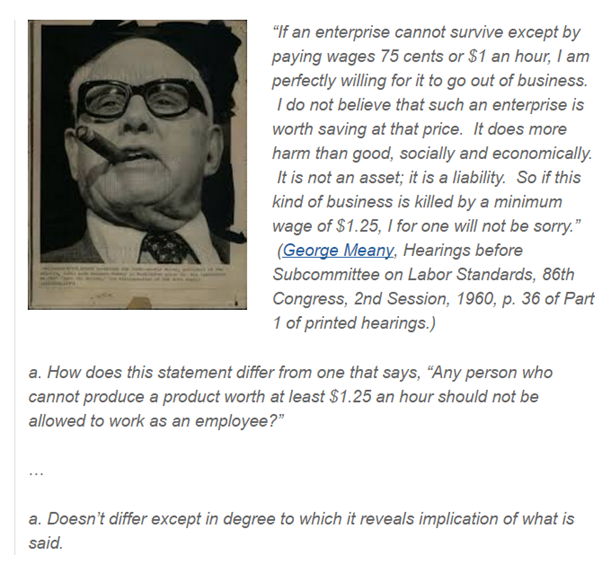
Source: page 451 and page 828 of the 3rd edition (1972) of University Economics by Armen Alchian and William Allen; the first part of the quotation is Question #30 at the end of Chapter 22. via Bonus Quotation of the Day… – Cafe Hayek

The robots have been coming from longer than you think

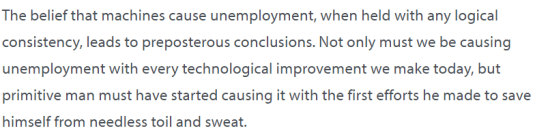
Source: Henry Hazlitt, Economics in One Lesson.

Source: Against Robotic Panic, Bryan Caplan | EconLog | Library of Economics and Liberty.

Thomas Sowell – Black Lives and Social Policy

Why is there unemployment with vacant jobs? | Christopher A. Pissarides

Video

Generosity of unemployment benefits

Image

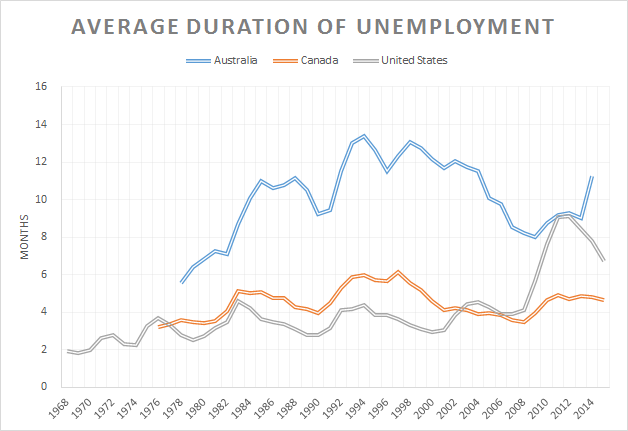
Average duration of US, Canadian and Australian unemployment since 1968

image

Data extracted on 10 Oct 2016 05:17 UTC (GMT) from OECD.Stat.

Robert Lucas on the voluntary and involuntary unemployment distinction

Robert Lucas in a famous 1978 paper argued that all unemployment was voluntary because involuntary unemployment was a meaningless concept:

“The worker who loses a good job in prosperous time does not volunteer to be in this situation: he has suffered a capital loss. Similarly, the firm which loses an experienced employee in depressed times suffers an undesirable capital loss.

Nevertheless the unemployed worker at any time can always find some job at once, and a firm can always fill a vacancy instantaneously. That neither typically does so by choice is not difficult to understand given the quality of the jobs and the employees which are easiest to find.

Thus there is an involuntary element in all unemployment, in the sense that no one chooses bad luck over good; there is also a voluntary element in all unemployment, in the sense that however miserable one’s current work options, one can always choose to accept them.”

I agree that we all make choices subject to constraints. To say that a choice is involuntary because it is constrained by a scarcity of job-opportunities information is to say that choices are involuntary because there is scarcity. Alchian said there are always plenty of jobs because to suppose the contrary suggests that scarcity has been abolished.

Lucas elaborated further in 1987 in Models of Business Cycles:

A theory that does deal successfully with unemployment needs to address two quite distinct problems. One is the fact that job separations tend to take the form of unilateral decisions – a worker quits, or is laid off or fired – in which negotiations over wage rates play no explicit role.

The second is that workers who lose jobs, for whatever reason, typically pass through a period of unemployment instead of taking temporary work on the ‘spot’ labour market jobs that are readily available in any economy.

Of these, the second seems to me much the more important: it does not ‘explain’ why someone is unemployed to explain why he does not have a job with company X. After all, most employed people do not have jobs with company X either. To explain why people allocate time to a particular activity – like unemployment – we need to know why they prefer it to all other available activities: to say that I am allergic to strawberries does not ‘explain’ why I drink coffee.

Neither of these puzzles is easy to understand within a Walrasian framework, and it would be good to understand both of them better, but I suggest we begin by focusing on the second of the two.

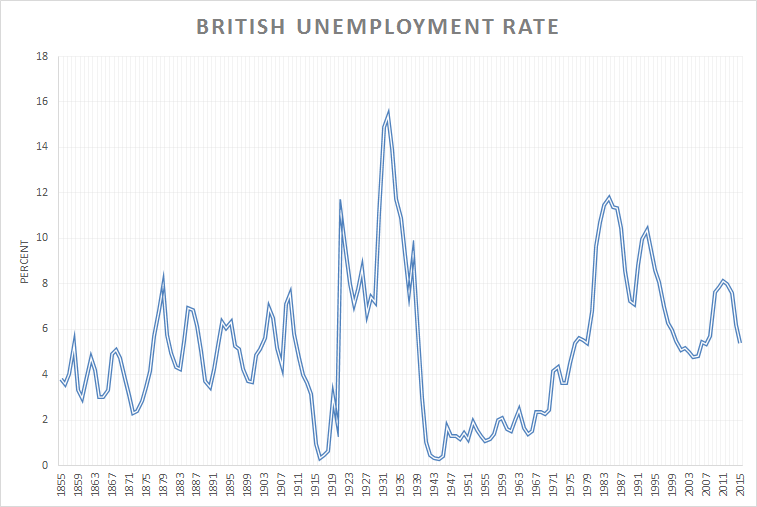
British unemployment rate since 1855

image

Source: Three centuries of macroeconomic data | Bank of England Table A28.

Previous Older Entries Next Newer Entries

David Andolfatto

Celebrating humanity's flourishing through the spread of capitalism and the rule of law

Monetary Non-Neutrality

Celebrating humanity's flourishing through the spread of capitalism and the rule of law

Reason Magazine

Celebrating humanity's flourishing through the spread of capitalism and the rule of law

Coyote Blog

Celebrating humanity's flourishing through the spread of capitalism and the rule of law

Thoughts from the North

Celebrating humanity's flourishing through the spread of capitalism and the rule of law

Fardels Bear

A History of the Alt-Right

Vincent Geloso

Econ Prof at George Mason University, Economic Historian, Québécois

Bassett, Brash & Hide

Celebrating humanity's flourishing through the spread of capitalism and the rule of law

Truth on the Market

Scholarly commentary on law, economics, and more

The Undercover Historian

Beatrice Cherrier's blog

Matua Kahurangi

Celebrating humanity's flourishing through the spread of capitalism and the rule of law

Temple of Sociology

Celebrating humanity's flourishing through the spread of capitalism and the rule of law

Velvet Glove, Iron Fist

Celebrating humanity's flourishing through the spread of capitalism and the rule of law

Why Evolution Is True

Why Evolution is True is a blog written by Jerry Coyne, centered on evolution and biology but also dealing with diverse topics like politics, culture, and cats.

NoTricksZone

Celebrating humanity's flourishing through the spread of capitalism and the rule of law

Homepaddock

A rural perspective with a blue tint by Ele Ludemann

Kiwiblog

DPF's Kiwiblog - Fomenting Happy Mischief since 2003

The Dangerous Economist

Celebrating humanity's flourishing through the spread of capitalism and the rule of law

Watts Up With That?

The world's most viewed site on global warming and climate change

The Logical Place

Tim Harding's writings on rationality, informal logic and skepticism

Doc's Books

A window into Doc Freiberger's library

The Risk-Monger

Let's examine hard decisions!

Uneasy Money

Commentary on monetary policy in the spirit of R. G. Hawtrey

Barrie Saunders

Thoughts on public policy and the media

Liberty Scott

Celebrating humanity's flourishing through the spread of capitalism and the rule of law

Point of Order

Politics and the economy

James Bowden's Blog

A blog (primarily) on Canadian and Commonwealth political history and institutions

Science Matters

Reading between the lines, and underneath the hype.

Peter Winsley

Economics, and such stuff as dreams are made on

A Venerable Puzzle

"The British constitution has always been puzzling, and always will be." --Queen Elizabeth II

The Antiplanner

Celebrating humanity's flourishing through the spread of capitalism and the rule of law

Bet On It

Celebrating humanity's flourishing through the spread of capitalism and the rule of law

History of Sorts

WORLD WAR II, MUSIC, HISTORY, HOLOCAUST

Roger Pielke Jr.

Undisciplined scholar, recovering academic

Offsetting Behaviour

Celebrating humanity's flourishing through the spread of capitalism and the rule of law

JONATHAN TURLEY

Res ipsa loquitur - The thing itself speaks

Conversable Economist

In Hume’s spirit, I will attempt to serve as an ambassador from my world of economics, and help in “finding topics of conversation fit for the entertainment of rational creatures.”

The Victorian Commons

Researching the House of Commons, 1832-1868

The History of Parliament

Articles and research from the History of Parliament Trust

Books & Boots

Reflections on books and art

Legal History Miscellany

Posts on the History of Law, Crime, and Justice

Sex, Drugs and Economics

Celebrating humanity's flourishing through the spread of capitalism and the rule of law

European Royal History

Exploring the Monarchs of Europe

Tallbloke's Talkshop

Cutting edge science you can dice with

Marginal REVOLUTION

Small Steps Toward A Much Better World

NOT A LOT OF PEOPLE KNOW THAT

“We do not believe any group of men adequate enough or wise enough to operate without scrutiny or without criticism. We know that the only way to avoid error is to detect it, that the only way to detect it is to be free to inquire. We know that in secrecy error undetected will flourish and subvert”. - J Robert Oppenheimer.