Dead Man Walking made the best case I know for the death penalty while trying to argue the opposite through a trauma bond with the murderer
21 Jan 2018 Leave a comment
in economics of crime, law and economics, movies Tags: capital punishment, death penalty
Corruption in driver’s licenses
21 Jan 2018 Leave a comment
in development economics, economics of bureaucracy, economics of crime, economics of regulation, growth disasters, law and economics, Public Choice, transport economics Tags: economics of corruption, India
Corruption and Parking Tickets
20 Jan 2018 1 Comment
in applied price theory, comparative institutional analysis, development economics, economics of bureaucracy, economics of crime, growth disasters, law and economics, Public Choice Tags: economics of corruption
Feel safe to walk alone at night by gender in the OECD countries
18 Jan 2018 1 Comment
Australian and New Zealand women seem to think they live in a rather crime ridden country. Japanese women are as nervous as American women despite vast differences in crime rates and muggings.
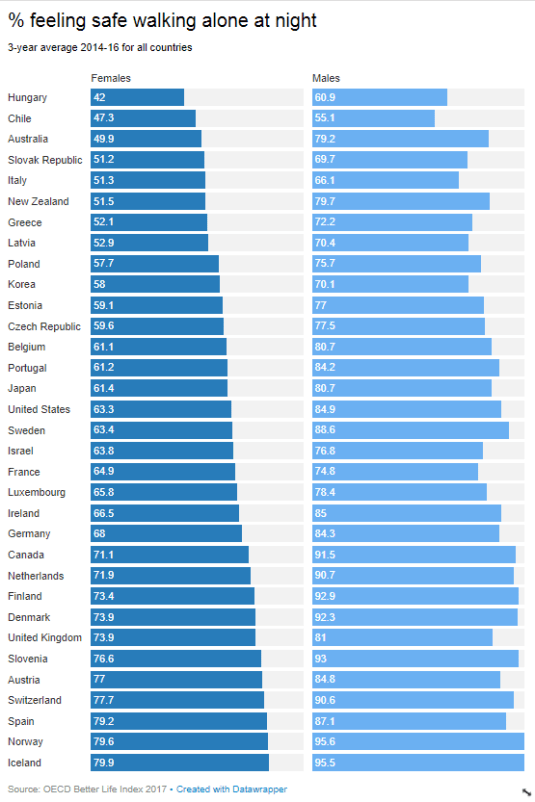
Data extracted on 17 Jan 2018 07:18 UTC (GMT) from OECD.Stat
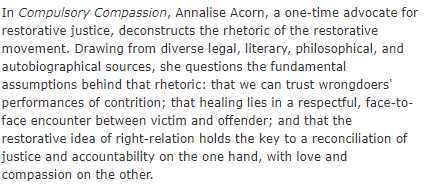
I hate restorative justice. The victim owes the offender nothing, much less enabling a trauma bond to get them a lighter sentence
17 Jan 2018 Leave a comment
How to Survive a Dog Attack
15 Jan 2018 Leave a comment
in economics of crime, law and economics Tags: dogs
The top 5 world doping champions?
07 Jan 2018 Leave a comment
in economics of crime, sports economics

The economic incentives for criminal behaviour
31 Dec 2017 Leave a comment
in economics of crime, labour economics, law and economics, occupational choice Tags: crime and punishment
More reasons why sociology is unsafe for campuses
31 Dec 2017 Leave a comment
in defence economics, economics of crime, economics of education, economics of natural disasters, law and economics
A lot of Kiwis think corruption is about
26 Dec 2017 Leave a comment
in economics of crime, law and economics Tags: economics of corruption
Re:scam.This Hilarious Chatbot Messes with Scammers for You
26 Dec 2017 Leave a comment
in economics of crime, entrepreneurship Tags: entrepreneurial alertness, spam
Hard cases make bad employment case law
21 Dec 2017 Leave a comment
in economics of crime, law and economics
Employment at will in most American states can easily be summarised as “you’re fired, I quit”. That law could not be simpler to understand, administer or add additional contractual provisions and protections.
An employee can be fired for a good reason, a bad or malicious reason or no reason at all. Employee can quit without notice as they dramatically do in many American movies and TV shows. The main exception to employment at will is from antidiscrimination laws.
Naturally, some extreme cases came forward to create the first public policy exceptions to this rule. In the USA, the first exception was for an employee was fired for refusing to perjure himself in a court case.
The British common law was similar. The first implied term of employment that built into the implied term of mutual trust and confidence was an implied term of employment that your employer will not run the corrupt and illegal business.
The BCCI bank was the bank of choice of drug traffickers and autocrats in the 1980s. It is private banking division ran a bespoke service for each one of its high-rolling clients. Bryan Cranston stared in a great film about this.
Naturally, after the police and customs raided the bank, the thousands of employees of that bank who did not work in the private banking division were also tainted in their future employment chances.
They sued the bankruptcy trustee managing the BCCI bank arguing that there is an implied term of every employment contract that the employer will not run a corrupt and illegal business. They won. Was this a hard case that made good law or bad?
If I was working for someone who asked me to perjure myself in a criminal case, that should be a strong incentive to quit. Likewise, sticking around in a bank that has a dubious reputation should not be rewarded by employment law. The House of Lords mentioned this in its judgement:
It is against this background that the position of an innocent employee has to be considered. In my view, when an innocent employee of the bank learned the true nature of the bank’s business, from whatever source, he was entitled to say: “I wish to have nothing more to do with this organisation. I am not prepared to help this business, by working for it. I am leaving at once.” This is my intuitive response in the case of all innocent employees of the business, from the most senior to the most junior, from the most long serving to the most recently joined. No one could be expected to have to continue to work with and for such a company against his wish.
The House of Lords did go on to reason that the employer was liable for damaging the future employment prospects of an employee by running a corrupt business because this breached a mutual obligation of trust.
I disagree. The least cost avoiders are unfortunately the employees in each of these cases. Allowing them to sue because the employer runs an illegal and corrupt business does not create much of an incentive to quit such a business when you start sniffing something bad.
Under the Coase theorem, the least-cost avoider in any situation is the party that can achieve a given reduction in damage or risk of damage at the lowest cost (in dollar terms). Guido Calabresi in his book The Costs of Accidents (1970) argues that it is still efficient to hold companies liable that produce greater wealth:
In the real world, where people cannot negotiate costlessly, there may be collective action problems of those who caused a nuisance, for instance by smoke emissions from a factory to many neighbouring farms, and so getting together to negotiate effectively can be difficult against a single polluter because of coordination problems. If it is efficient for the farmers to pay the factory to reduce its emissions, some of those farmers may hold off paying their fair share, hoping to get a free ride. The factory may be in a better position to know what measures to take to reduce harm, and can be the cheapest avoider, illustrating Coase’s argument.
Yes, some people will not know that there is a corrupt business out the back. Others will have suspicions and therefore should have reasons to move on. They should not be rewarded for sticking around when they can smell something amiss. Employees should pay attention.
Half of Hollywood now claims to not have understood this joke
17 Dec 2017 Leave a comment
in discrimination, economics of crime, gender, labour economics, law and economics Tags: Hollywood economics
I did not know about Harvey Weinstein is not a wise thing to say in an industry that lives on gossip.
https://twitter.com/rosemcgowan/status/942142777747496960
https://twitter.com/rosemcgowan/status/939118902809837569
 Utopia, you are standing in it!
Recent Comments