
'Only 1.6% of US gun deaths are from self-defence. The more guns, the looser the law, the more deaths' @nytimes charts https://t.co/1XTcC3hCYI pic.twitter.com/eTBJhy0iAu
— Paul Kirby (@paul1kirby) November 7, 2017
Celebrating humanity's flourishing through the spread of capitalism and the rule of law
01 Dec 2017 Leave a comment
in economics of crime, law and economics, politics - USA Tags: gun control
25 Nov 2017 Leave a comment
About 15 to 20% of New Zealand prisoners are in maximum security. The rest of these prisoners are in medium to low security prisons where it is much easier to escape.

Most New Zealand prisoners have about 40 to 50 previous convictions, with serious and violent assaults (21%), sexual offences (20%), home invasions and burglary (14%), aggravated robbery and robbery (9%), and homicide (7%) which together add to 71%. Drug traffickers make up another 12%.
My point is most New Zealand prisoners are serious offenders but most of them can be trusted not to escape even when in low security and prison farms. The threat of returning to maximum security upon recapture is incentive enough to keep them on the straight and narrow.
There is quite a serious literature on how variations in prison conditions, prison overcrowding and deaths of prisoners acts as a deterrent. You do not have to watch all that many American TV shows to notice they plea-bargain with promises of a prison near their family, in a warmer climate and lower security rating. Maximum-security, far away and surrounded by gang members is more than enough to keep most prisoners in line.
The strongest argument that prison deters crime is made by opponents of 3 strikes legislation. They claim that without the prospect of parole, prisoners are be more difficult to manage in prison. That is an incentive argument, that the dim prospect that parole perhaps decades hence has powerful incentive effects. QED
24 Nov 2017 Leave a comment
in defence economics, economics of crime, economics of regulation, television, welfare reform Tags: Yes Minister
14 Nov 2017 Leave a comment
in development economics, economics of crime
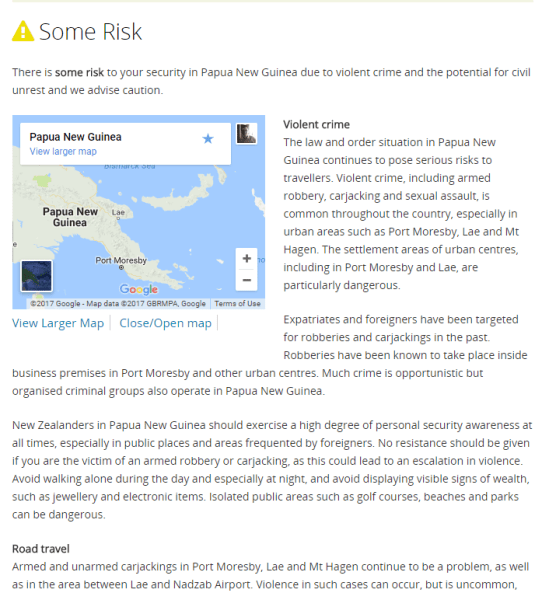
The Manus Island debates led me to notice I have travelled in far more dangerous places such as the Philippines. Also, if you are thinking are going to Bali, read its travel advisory.
When travelling to the Philippines, we make sure we are already outside of Manila because of the stray bullets on New Year’s Eve. There are guns everywhere. A M-16 looks a lot smaller in the flesh than on the telly.

Philippine banks have 3 security guards at the front with guns pointing horizontally ready to go at bank robbers. The Manila airport chief was assassinated a few years ago because she crackdown on corruption. The assassination was by a sniper.
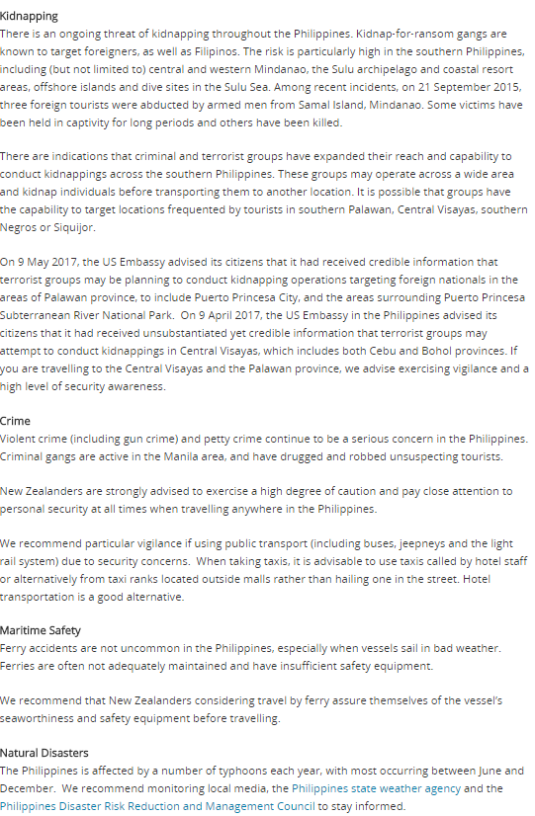
Everything from airports to discos in the Philippines have gun deposit booths so that you and your bodyguards can deposit your guns at the door and collected them on the way out.

In Leyte, where we holiday at Christmas with family, it is common for politicians to have private armies of several dozen. When I was in the Philippines for a presidential election, there is a murder every day often of a rival candidate
My point is that the PNG is not the only dangerous country in Asia. If the asylum seekers from Afghanistan, and some are, the travel advisory is you are not safe even if you bring your own bodyguards.

About 200 of the residents of that camp have been denied asylums because their claims were not deemed to have merit. I do not see why Australia has any responsibility for them now. They are free to travel anywhere in PNG and anywhere else that will give them a visa.
11 Nov 2017 Leave a comment
in economics of crime, economics of media and culture, entrepreneurship Tags: spam
09 Nov 2017 Leave a comment
in economics of crime, economics of media and culture Tags: con artists
01 Nov 2017 Leave a comment
in applied price theory, economics of crime, health economics
I found the chapter in Tullock and McKenzie’s book on token economies in mental hospitals to be most enlightening in regard to addictions and mental illness clouding judgement.
The tokens in a token economy were spending money at the hospital canteen and trips to town and other privileges. They were earned by keeping you and your area clean and helping out with chores at the mental asylum.

The first token economies were for chronic, treatment-resistant psychotic inpatients. In 1977, a major study, still considered a landmark, successfully showed the superiority of a token economy compared to the standard treatments of these type of psychotic inpatients.
Experiments which would now be unethical showed that the occupational choices and labour supply of certified lunatics responded to incentives in the normal, predictable way. For example, tokens were withdrawn for helping clean halls and common areas. The changes in occupational choice and reductions in labour supply was immediate and as predicted by standard economics.
Some patients would steal the tokens for other patients, so the tokens were individually marked. The thefts almost stopped. Crime must pay even for criminally insane inpatients. Kagel reported that:
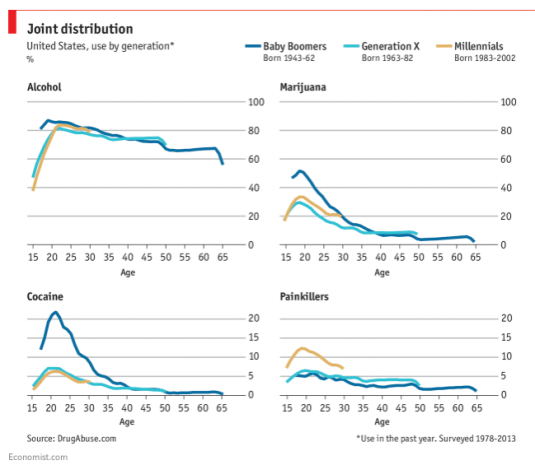
The results have not varied with any identifiable trait or characteristic of the subjects of the token economy – age, IQ, educational level, length of hospitalization, or type of diagnosis. Most people age out of addiction to drugs or to alcohol. By age 35, half of patients with active alcoholism or addiction diagnoses during their teens and 20s no longer take drugs or drink:
The average cocaine addiction lasts four years, the average marijuana addiction lasts six years, and the average alcohol addiction is resolved within 15 years. Heroin addictions tend to last as long as alcoholism, but prescription opioid problems, on average, last five years. In these large samples, which are drawn from the general population, only a quarter of people who recover have ever sought assistance in doing so (including via 12-step programs). This actually makes addictions the psychiatric disorder with the highest odds of recovery.
Studies of demand elasticity normally find that consumption of hard drugs is quite sensitive to price. Addicts respond to incentives, in particular, to price rises by cutting back on their drug taking.
At the beginning of this century, the Dutch government controlled the opium market in the Dutch East Indies–nowadays Indonesia–for several decades. This state monopoly was called the opiumregie. Using information gathered during the opiumregie, this paper estimates price elasticities of opium consumption. It appears that short-term price elasticities of opium use are about -0.7. Long-term price elasticities are about -1.0.
18 Oct 2017 Leave a comment
in constitutional political economy, economics of crime
Activists have ample opportunities seek redress for their grievances through normal democratic means. This is especially so when the activist mounting the greater good defence are recently resigned members of Parliament or the immediate past leader of political parties.
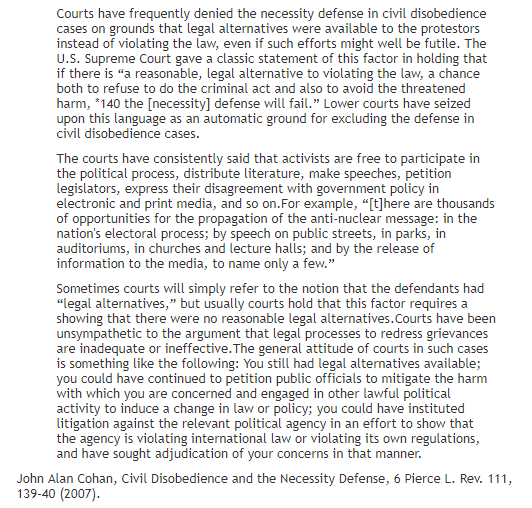
Source: The Case for Disallowing the Necessity Defense in Climate Change Cases – ProfessorBainbridge.com.
The necessity defence (or the defence for cannibalism on a lifeboat defence) exists only if
Left-wing activists will be happy to know that the defence is unavailable to anti-abortion protesters because there is no harm to be avoided if the practice under protest is specifically condoned by law. Mining and offshore drilling are also specifically authorised by law.
Most of all, the greater good defence will make no difference to what Greenpeace are protesting against. A one-day publicity stunt does not change the world, much less reduce the harm from climate change. Their protesting will never prevent a imminent harm.
The purpose of lawful, peaceful protest is to implore the majority to think again and perhaps change their mind. It is not the purpose of a lawful, peaceful protest to prevent another from going about their lawful occasions. Protests should never be a means of coercing or frightening others in a democracy into conforming to your wishes.
The great virtue of a democracy is it readily enables the people, over time, to be persuaded that what they took for granted is not so and change the law accordingly. Noisy protesters from across the political spectrum stage publicity stunts to catch the public’s eye in the hope of doing this.
17 Oct 2017 Leave a comment
in economics of crime, law and economics, liberalism Tags: Age of Enlightenment, political correctness
14 Oct 2017 Leave a comment
in economics of crime, health economics, labour economics, law and economics, occupational choice
12 Oct 2017 Leave a comment
in constitutional political economy, economics of crime, politics - New Zealand, Public Choice
By pleading not guilty to maritime safety charges from his offshore drilling protest, does Russel Norman think that his vote counts for more than mine on environmental policy? He is mounting a greater good defence. Does his views count for more than mine on what is the greater good?
We resolve our differences about what is the greater good on offshore drilling, on environmental policy, on any policy by normal democratic means. That is, by trying to persuade each other and elections. We just had an election which gave us a rich taste of the political views of New Zealanders.
By openly breaking the law non-violently, accepting arrest and pleading guilty, that act of peaceful defiance implores the majority to reconsider their position. Through their passion, their sacrifice, their willingness to risk a conviction on their record, protestors are pleading from the bottom of their heart with the majority to think again and contemplate the possibility that they may be wrong.
Central to political protests is the notion is by making a lot of noise and showing your passionate disagreement, your fellow voters will respect that passion and hear you out. Instead, Greenpeace is trying to impose its conception of the greater good by harassment and court room manoeuvring rather than by their side of the argument winning at the ballot box or on the floor of Parliament.
Greenpeace deserves the respect of taking them at their word; that they want to stop offshore drilling by their protesting alone making it too difficult to continue. They are not saying we are staging a publicity stunt that respects maritime safety laws to implore voters to think again.
Protests should not be attempts to impose views on others. Civil disobedience contributes to the democratic exchange of ideas by forcing the dominant opinion to defend their views. A willingness to accept a conviction is proof that the protest is a passionate, selfless attempt to persuade voters to join their side.
Protests should never be a means of coercing or frightening others in a democracy into conforming to your wishes. Greenpeace expects others to obey the laws for which it successfully lobbied. Why does Greenpeace think they can break laws that others secured through normal democratic means?
Some find democracy frustrating because they cannot win at the ballot box even under proportional representation. Environmentalists such as Greenpeace must be the last to complain so. Greenpeace activists and environmentally conscious voters were spoiled for choice at the most recent election.
Two parties were competing principally for their vote. The older of the two spent the last four weeks of the campaign desperately rebranding itself as principally an environmental party. The new party was an environmental party that was also at peace with the market economy. The two major parties were also campaigning strongly on many policies that might win over environment minded voters.
The great virtue of a democracy is it readily enables the people, over time, to be persuaded that what they took for granted is not so and change the law accordingly. Noisy protesters from across the political spectrum stage publicity stunts to catch the public’s eye in the hope of doing this.
What is holding up legislating in many areas is not that minorities are powerless and individuals are voiceless. It is exactly the opposite. By banding together, passionate minorities can resist the tyranny of the majority. They can trade off their support in other areas in return for policy concessions most dear to them. A small group of concerned and thoughtful citizens can band together and change things by mounting single issue campaigns that influence who wins. An MMP democracy is about building winning coalitions made up of a great many different policy agendas and several parties.
If you want to reform the world, Greenpeace should do what we ordinary folk must do: change our vote, write to an MP, protest, donate to or join a political party, or run for parliament. Sometimes you win, sometimes you lose, but you had your chance at the ballot box every 3 years so you must live with the peace of a fair defeat. By pleading guilty, protesters show that they are trying to win the majority over with their deep-felt passion for which they will willingly pay the price for in court.
Celebrating humanity's flourishing through the spread of capitalism and the rule of law
Celebrating humanity's flourishing through the spread of capitalism and the rule of law
Celebrating humanity's flourishing through the spread of capitalism and the rule of law
Celebrating humanity's flourishing through the spread of capitalism and the rule of law
Celebrating humanity's flourishing through the spread of capitalism and the rule of law
A History of the Alt-Right
Econ Prof at George Mason University, Economic Historian, Québécois
Celebrating humanity's flourishing through the spread of capitalism and the rule of law
Scholarly commentary on law, economics, and more
Beatrice Cherrier's blog
Celebrating humanity's flourishing through the spread of capitalism and the rule of law
Celebrating humanity's flourishing through the spread of capitalism and the rule of law
Celebrating humanity's flourishing through the spread of capitalism and the rule of law
Why Evolution is True is a blog written by Jerry Coyne, centered on evolution and biology but also dealing with diverse topics like politics, culture, and cats.
Celebrating humanity's flourishing through the spread of capitalism and the rule of law
A rural perspective with a blue tint by Ele Ludemann
DPF's Kiwiblog - Fomenting Happy Mischief since 2003
Celebrating humanity's flourishing through the spread of capitalism and the rule of law
The world's most viewed site on global warming and climate change
Tim Harding's writings on rationality, informal logic and skepticism
A window into Doc Freiberger's library
Let's examine hard decisions!
Commentary on monetary policy in the spirit of R. G. Hawtrey
Thoughts on public policy and the media
Celebrating humanity's flourishing through the spread of capitalism and the rule of law
Politics and the economy
A blog (primarily) on Canadian and Commonwealth political history and institutions
Reading between the lines, and underneath the hype.
Economics, and such stuff as dreams are made on
"The British constitution has always been puzzling, and always will be." --Queen Elizabeth II
Celebrating humanity's flourishing through the spread of capitalism and the rule of law
Celebrating humanity's flourishing through the spread of capitalism and the rule of law
WORLD WAR II, MUSIC, HISTORY, HOLOCAUST
Undisciplined scholar, recovering academic
Celebrating humanity's flourishing through the spread of capitalism and the rule of law
Res ipsa loquitur - The thing itself speaks
In Hume’s spirit, I will attempt to serve as an ambassador from my world of economics, and help in “finding topics of conversation fit for the entertainment of rational creatures.”
Researching the House of Commons, 1832-1868
Articles and research from the History of Parliament Trust
Reflections on books and art
Posts on the History of Law, Crime, and Justice
Celebrating humanity's flourishing through the spread of capitalism and the rule of law
Exploring the Monarchs of Europe
Cutting edge science you can dice with
Small Steps Toward A Much Better World
“We do not believe any group of men adequate enough or wise enough to operate without scrutiny or without criticism. We know that the only way to avoid error is to detect it, that the only way to detect it is to be free to inquire. We know that in secrecy error undetected will flourish and subvert”. - J Robert Oppenheimer.
 Utopia, you are standing in it!
Recent Comments