Trade-offs in an high-gun arms race equilibrium
28 Oct 2016 Leave a comment
in economics of crime, economics of regulation, law and economics, politics - USA Tags: game theory, gun control
Lawrence of Arabia on the economics of Albanian blood feuds
26 Oct 2016 Leave a comment
in constitutional political economy, David Friedman, economics of crime, law and economics Tags: economics of feuds
About 3000 Albanian families are caught up in blood feuds; the adult males hunt each other down; the reasons are long forgotten.
These blood feuds are common in rural Albania, which is rather lawless. Efforts to resolve them are largely futile because each family wants to be the last to get revenge.
Observers, of course, look upon these feuds with horror. For those involved, they are the down side of a Doomsday machine that keeps order in rural lawless areas.
Proper film buffs will remember the great scene in Lawrence of Arabia where Anthony Quinn and his son rode into the camp of a rival tribe on their own to demand payment for the water they were using.
Lawrence asked why did they go in because they could be so easily killed. Anthony Quinn said he was in no danger because if he was killed there would be a blood feud between his clan and the offending clan. This kept order. The linked clip is just fascinating rather than the actual clip.
Of course, film buffs also remember that a blood feud almost destroyed the entire Arab revolt. Lawrence resolved it by executing the murder so that he neither died at the hand of the rival clan but the rival clan felt vengeance had been satisfied.
David Friedman wrote on how feuds are common in many legal systems in their early days:
Feud is one of the mechanisms by which legal rules are enforced. Its essential logic is simple: If you wrong me, I threaten to harm you unless you compensate me for the wrong. The critical requirement for it to work is some mechanism that makes my threat more believable when you actually have wronged me than when you have not, some way of converting right into might, in order to prevent the enforcement mechanism from being used instead for extortion.
For a simple example, consider the feud system of the Rominchal gypsies, the largest gypsy population in England. If you wrong me, I threaten to beat you up. Both of us know that if you have wronged me, as judged by the norms of our community, my friends will back me and your friends won’t back you, making it in your interest to either compensate me or leave town.
Feud system have existed in many human societies. In addition to the Rominchal, well recorded examples include saga period Iceland and traditional Somali. In the Icelandic case, the mechanism for converting right into might was an explicit law code and a court system. You sued the person who wronged you. If you won, the verdict was a damage payment he owed you. If he failed to pay, he was outlawed and had two weeks to leave Iceland, after which it was legal to kill him and tortious for anyone to defend him. That system functioned for about a third of a millennium, producing substantial amounts of violence only in the final fifty year period of breakdown.
The Somali version was somewhere between the Icelandic and the Rominchal, with customary law and customary mechanisms for setting up courts to arbitrate disputes, along with a fascinating system of prefabricated coalitions to deal with both paying damages and enforcing their members’ claims.
Feuds work well as a deterrent mechanism, but if someone triggers a feud, there is a lot of mayhem. That is why third-party arbitration comes into play to prevent abuse and escalation.
I am not too sure how feuds work well if someone is murdered without a witness or is poisoned or in some other way surreptitiously done away with.
Why Do People Become Islamic Extremists?
18 Oct 2016 Leave a comment
in defence economics, economics of crime, economics of religion, labour economics, law and economics, occupational choice Tags: economics of oppositional identities, war on terror
.@JudithCollinsMP showed that @JacindaArdern does not know when to stop digging
13 Oct 2016 Leave a comment
in economics of crime, law and economics, politics - New Zealand, poverty and inequality, welfare reform Tags: crime and punishment, family poverty, law and order, New Zealand Labour Party
Judith Collins today in Question Time showed that Jacinda Ardern does not know when to stop digging. Ardern quoted a snippet of the question put to the police minister at the recent police conference.
That selectivity allowed Collins to right to quote the conference question in full and her full answer, which was not just about money poverty but also about
“… a poverty of ideas, a poverty of parental responsibility, a poverty of love, a poverty of caring …”.
Later Collins said she does not agree with Labour saying today that poverty causes crime.
The Labour Party showed that it is no longer rooted in working class values when it argues that poverty is not linked to a poverty of responsibility and of parental love.
There are plenty of poor people who do not resort to crime and who despise those that do, in part because they often make them the victims of their crimes including burglary.
Killed by police by threat level, January – September 2016
13 Oct 2016 Leave a comment
in economics of crime, law and economics, politics - USA Tags: crime and punishment, law and order, police shootings

Meet the Pink Pistols: slogan – armed Queers don’t get bashed
12 Oct 2016 1 Comment
in economics of crime, law and economics Tags: gun control
Crime victimisation rates of Maori compared
08 Oct 2016 Leave a comment
in economics of crime, law and economics, politics - New Zealand Tags: crime and punishment, law and order, Maori economic development, racial discrimination
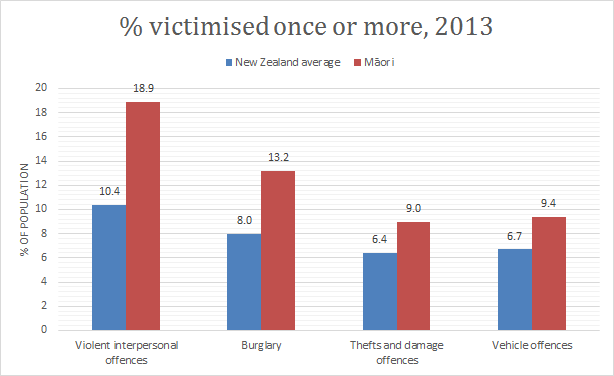
Source: New Zealand Crime and Safety Survey, Resources & downloads | New Zealand Ministry of Justice.
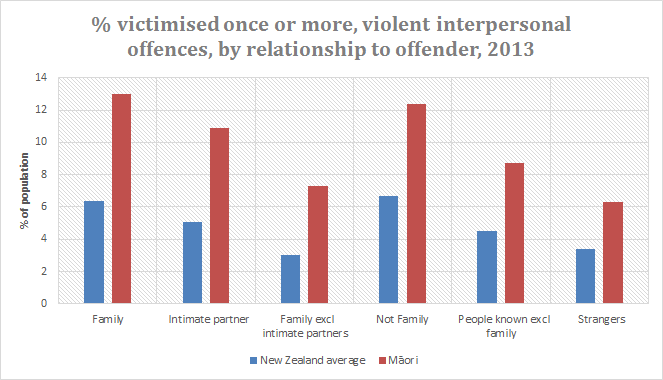
Source: New Zealand Crime and Safety Survey, Resources & downloads | New Zealand Ministry of Justice.
Blacks killed by police by threat level, January – September 2016
06 Oct 2016 Leave a comment
in economics of crime, law and economics, politics - USA Tags: crime and punishment, law and order, police shootings


The U.S. incarceration rate is more than six times that of many developed countries.
06 Oct 2016 Leave a comment
in economics of crime, law and economics, politics - USA Tags: crime and punishment, criminal deterrence, law and order
war against racks,
Blacks and whites killed by police by threat level by threat level, January – September 2016
01 Oct 2016 Leave a comment
in economics of crime, law and economics, politics - USA Tags: law and order, police shootings


Discharge without conviction is for offences more serious than argy-bargy after closing time
28 Sep 2016 Leave a comment
in economics of crime, politics - New Zealand
People get discharges without convictions for offences far more serious than a little bit too much argy-bargy after a few too many with friends after closing time.
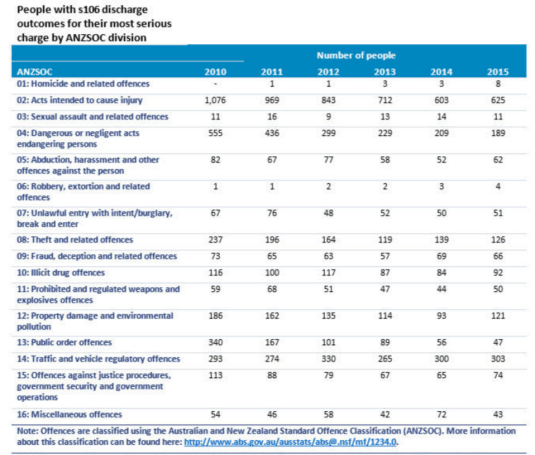
Source: Discharge without conviction numbers slump | Radio New Zealand News.
If an offences serious enough to jeopardise your job, an employer would sack you in any case because you are found guilty rather than the entry of a conviction. Allowing criminals to conceal their criminal convictions from future employers allows them to conceal their bad character. It puts law-abiding citizens at a disadvantage to criminals.
Nice members of the middle class are put off committing offences in the first place because of career concerns. In any case, the Spent Convictions Act allows a way out after 7 years.
A few years ago, the Court of Appeal tightened up the criteria to a conviction being all out of proportion of the offence. That means burglars, robbers, sex offenders and thugs got away with it still but less so in the past.
In the past, you just come to court and asked for discharge without conviction. Now you must produce a considerable amount of evidence of the undue career cost.
How many British burglaries are home invasions?
06 Sep 2016 Leave a comment
in economics of crime, law and economics Tags: Burglary, law and order
People are aware that their house has been invaded in 1/3rd of British burglaries and in a quarter of burglaries, they see the offender. No wonder that burglary and the threat of a burglary are regarded as invasive crimes. We never locked the house when we were young. That changed.
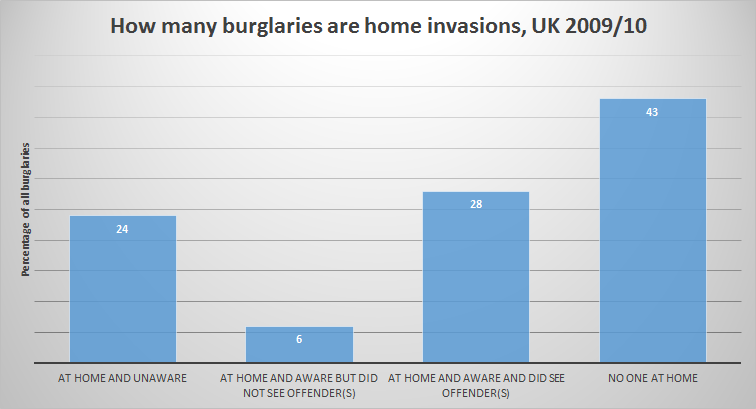
Source: Home Office via What burglars steal – and how they get in | News | theguardian.com.
How well do you know your local burglar?
05 Sep 2016 Leave a comment
in economics of crime, law and economics Tags: British economy, crime and punishment, law and order
Something is known about the burglar in 45% of cases. In this rather invasive crime, half of burglaries are betrayals of trust or familiarity. More than a few of these burglaries might be committed by family members and friends wanting money for drugs but that is speculation.

Source: Home Office via What burglars steal – and how they get in | News | theguardian.com.
What is stolen in British burglaries?
05 Sep 2016 Leave a comment
in economics of crime, law and economics Tags: burglaries, law and order
30% of British burglaries are completely unsuccessful. Many more are reliant on chancing across a wallet or a decent piece of electrical equipment. Back in the day, a TV or VCR was worth a week’s wages. Now the fencing value of these things would be quite minor. The data below is from 2010 so there has been plenty of time for cash to fade away as a item to steal.
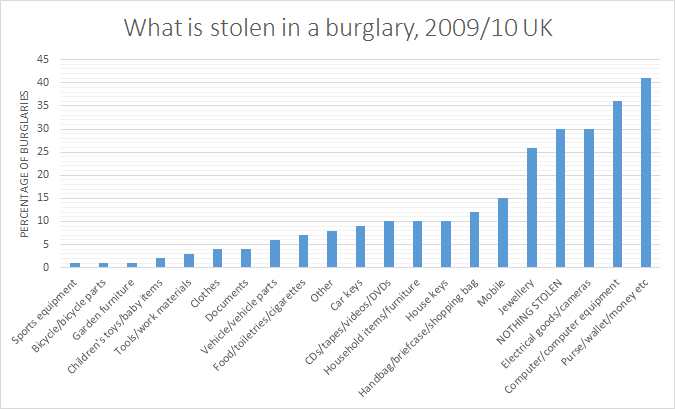
Source: Home Office via What burglars steal – and how they get in | News | theguardian.com.


Recent Comments