Source: Kowloon: City of anarchy – Vivid Maps.

Celebrating humanity's flourishing through the spread of capitalism and the rule of law
22 May 2016 Leave a comment
in economics of crime, international economics, International law, law and economics, property rights Tags: Hong Kong
16 May 2016 Leave a comment
in comparative institutional analysis, constitutional political economy, economics of crime, energy economics, environmental economics, global warming, law and economics, politics - New Zealand, Public Choice, Rawls and Nozick, rentseeking Tags: climate activists, climate alarmism, law and order, non-violent direct action, peaceful protest, reactionary left
In a letter to the editor today in the Dominion Post defending a climate change protest that closed a branch of the ANZ bank, one of the participants Jimmy Green said
Of course our intention wasn’t to intimidate individuals – our intention was to intimidate ANZ into shifting its investments after the bank ignored us asking.
This honesty about the willingness to intimidate to advance a political agenda shows that climate protesters are engaging in plain thuggery. Peaceful protest has its role in any democracy.
What these thuggish protesters forgot about is how we resolve our differences in a democracy. That is by trying to persuade each other and elections. Let the people decide.
These protesters are keen to pass laws to save the environment but they’re more than happy to break laws they disagree with. I wonder if they extend that same courtesy to others they regard as less enlightened than them? They expect others to obey the laws for which they successfully lobbied.
Why do these climate action protesters think they can break laws that others secured through lawful, peaceful democratic action? Is some direct action more equal than others? Why do these climate action protesters think their vote counts more than mine?
John Rawls makes the point that the purpose of civil disobedience is not to impose your will upon others but through your protest to implore others to reconsider their position and change the law or policy you are disputing.
Rawls argues that civil disobedience is never covert or secretive; it is only ever committed in public, openly, and with fair notice to legal authorities. Openness and publicity, even at the cost of having one’s protest frustrated, offers ways for the protesters to show their willingness to deal fairly with authorities.
Rawls argues: for a public, non-violent, conscientious yet political act contrary to law being done (usually) with the aim of bringing about a change in the law or policies of the government; that appeals to the sense of justice of the majority; which may be direct or indirect; within the bounds of fidelity to the law; whose protesters are willing to accept punishment; and although civil disobedience involves breaking the law, it is for moral rather than selfish reasons, and the willingness to accept arrest is proof of the integrity of the act of peaceful protest.
Rawls argues, and too many forget, that civil disobedience and dissent more generally contribute to the democratic exchange of ideas by forcing the dominant opinion to defend their views.
The civil disobedient is attempting to appeal to the “sense of justice” of the majority and their willingness to accept arrest is proof of the integrity of the act as a contribution to democratic persuasion not intimidation says Rawls:
…any interference with the civil liberties of others tends to obscure the civilly disobedient quality of one’s act.
Rawls argues that the use or threat of violence is incompatible with a reasoned appeal to fellow citizens to move them to change a law. The protest actions are not a means of coercing or frightening others into conforming to one’s wishes.
The intimidation by the protesters at the ANZ bank and their promise to do it again as shown in the adjacent tweet is a breach of the principles of a just society. These climate change protesters blockading an ANZ bank branch were attempting to coerce and frighten others into conforming with their political views. That ‘might does not make right’ is fundamental to democracy and the rule of law. As United States Supreme Court Justice Antonin Scalia said
The virtue of a democratic system [with a constitutionally guaranteed right to free speech] is that it readily enables the people, over time, to be persuaded that what they took for granted is not so and to change their laws accordingly.
When the climate protesters lose at the ballot box, they always claim it is rigged by the corporate interests. This is just sore losers.
How the left-wing and liberal visions of democracy are different nymag.com/daily/intellig… http://t.co/Qk5vS9SaV4—
Jonathan Chait (@jonathanchait) August 13, 2015
The great strength of democracy is a small group of concerned and thoughtful citizens can band together and change things by mounting single issue campaigns or joining a political party and running for office and winning elections or influencing who wins.
Yesterday’s majority of the vote sooner or later and often sooner than they expect will break off into different minorities on the next big issue of the day. These newly formed minorities will use that same ability to band together as a minority to block vote to protect what they think is important and advance agendas they think are to be wider benefit despite the opinion of the current majority to the contrary. All reforms start as a minority viewpoint.
Indeed, it is a strength of democracy – small groups of concerned citizens banding together – is what is holding up legislating in many areas. It is not that minorities are powerless and individuals are voiceless. It is exactly the opposite.
Parliaments elected by proportional representation such as in New Zealand, and in Australian upper houses reinforces the ability of small groups of citizens to band together to win a seat.
Nothing stirs up the impassioned (and most other people as well) more than depriving them of their right to support or oppose what is important to them through political campaigns and at an election. The losing side, we all end up on the losing side at one time or another, are much more likely to accept an outcome if they had their say and simply lost the vote at the election or in Parliament. Scalia warned of, for example, the risks of the courts moving in advance of the popular will, and thereby poisoning the democratic process
We might have let the People decide. But that the majority will not do. Some will rejoice in today’s decision, and some will despair at it; that is the nature of a controversy that matters so much to so many. But the Court has cheated both sides, robbing the winners of an honest victory, and the losers of the peace that comes from a fair defeat. We owed both of them better. I dissent.
These climate change protesters want to rob the winners of their honest democratic victory over the balance between oil and coal exploration and other energy options. They are also robbing themselves of a fair defeat.
A fair defeat flows from laws and policies secured through normal democratic means knowing that one day you may be in a majority. Only by respecting the will of the majority when you are in the minority do you have any right to expect future minorities to respect your honest democratic victories as the majority of some future day. Democratic majorities of patched together through give-and-take and the reality that even the most important policies may be reversed in the future.

Climate change protesters should respect the political process because democracy alone can produce compromises satisfying a sufficient mass of the electorate on deeply felt issues so as to not poison the remainder of the democratic process. The losing side, we all end up on the losing side at one time or another, are much more likely to accept an outcome if they had their say and simply lost the vote at the election or in Parliament.
11 May 2016 Leave a comment
in development economics, economics, economics of bureaucracy, economics of crime, growth disasters, growth miracles, law and economics, Public Choice, rentseeking Tags: bribery and corruption
09 May 2016 Leave a comment
in economic history, economics of crime, law and economics Tags: age of empires, British empire, crime and punishment, French Empire, Portuguese empire, Spanish Empire
The last convicts were transported in 1953.

<p>Source: <a href="http://www.historytoday.com/dean-nicholas/map-imperial-europes-penal-colonies">Map: Imperial Europe's Penal Colonies | History Today</a>.
08 May 2016 Leave a comment
in economics of crime, law and economics, politics - USA Tags: crime punishment, law and order, media bias, police shootings
This is what the Washington Post and The Guardian said on the 5 blacks the Washington Post classified as unarmed and not attacking police:
“Antronie Scott, an unarmed 36-year-old black man, was shot on Feb. 4, 2016, in San Antonio, Tex. Undercover San Antonio police officers were monitoring Scott, who had outstanding arrest warrants. When a uniformed officer approached Scott, he spun around with something in his hand. Police later determined that Scott was holding a cellphone.” Source: Fatal force: A Washington Post investigation of people shot and killed by police in 2016 – Washington Post
Source: The Counted: people killed by police in the United States – interactive | US news | The Guardian.
"David Joseph, an unarmed 17-year-old black male, was shot on Feb. 8, 2016, in Austin, Tex. Austin police were responding to reports of an erratic, aggressive person. Joseph, who was naked, rushed toward the officer." Source: Fatal force: A Washington Post investigation of people shot and killed by police in 2016 – Washington Post.
Source: The Counted: people killed by police in the United States – interactive | US news | The Guardian.
"Calin Roquemore, an unarmed 24-year-old black man, was shot on Feb. 13, 2016, in Beckville, Tex. Roquemore fled a traffic stop by a Texas state trooper. Roquemore refused the trooper’s orders to show his hands. No weapon was found at the scene." Source: Fatal force: A Washington Post investigation of people shot and killed by police in 2016 – Washington Post.
Source: The Counted: people killed by police in the United States – interactive | US news | The Guardian.
"Marquintan Sandlin, an unarmed 32-year-old black man, was shot on Feb. 21, 2016, in Inglewood, Calif. The man was a passenger in a car stopped at an intersection. Inglewood police approached the car and noticed that the woman who was driving had a gun. Officers shot and killed Sandlin and the woman, Kisha Michael." Source: Fatal force: A Washington Post investigation of people shot and killed by police in 2016 – Washington Post.
Source: The Counted: people killed by police in the United States – interactive | US news | The Guardian.
"Peter Gaines, an unarmed 37-year-old black man, was shocked with a stun gun and shot on March 12, 2016, in Houston, Tex. A Houston police officer approached Gaines after he vandalized a traffic sign. Gaines lunged at the officer.” Source: Fatal force: A Washington Post investigation of people shot and killed by police in 2016 – Washington Post.
Source: The Counted: people killed by police in the United States – interactive | US news | The Guardian.
I will leave it up to readers to work out how many of these police shootings were suspicious and indicate police misconduct.
07 May 2016 Leave a comment
in applied price theory, economics of crime, labour economics, labour supply, law and economics, occupational choice Tags: crime and punishment, criminal deterrence, law and order, police
.
06 May 2016 Leave a comment
in applied price theory, economics of crime, environmental economics, law and economics, property rights Tags: recycling

“Each week my family separates our recyclables from our regular trash. The former are put in our blue bin and are placed out on the curb for pickup on Wednesday mornings.
Last Tuesday night, I walked to Westwood Village to attend a dinner when I saw two individuals diving into all of my neighbours’ recycling bins (which were on the street curb) to extract the recyclables.
These "entrepreneurs" had a large truck filled with plastic bottles and aluminium cans that they were clearly loading up to take to a place to collect the recyclables fees. Is this a crime?
I view it as an economic crime for the following reason. The only reason this "trash treasure" was easy to access in the blue bins on the street was because the well meaning law abiding citizens wasted their time sorting their trash and kindly placing it outside.
Our tax dollars goes to the unionized guys who drive the recyclable trucks to pick this stuff up. If there is nothing to pick up, because the pirates have stolen the treasure, then recyclable trucks are losing $ as they are bringing in no revenue. So, this operating profit loss is just a transfer from the city to the pirates. My tax dollars and my time are being used to transfer $ to pirates.
The environment is no cleaner and is likely to dirtier because of the duplication of transportation (the recycling truck and the dirty private pirate trucks). I saw the same thing in Berkeley. What is to be done? A green cop shooting tranquilizer darts?”
Source: Environmental and Urban Economics: Recycling Dumpster Diving: A "Victimless" Crime?
05 May 2016 Leave a comment
in economics of crime, economics of regulation, law and economics, liberalism, libertarianism Tags: marijuana decriminalisation
04 May 2016 Leave a comment
in applied price theory, development economics, economic history, economics, economics of crime, economics of regulation, entrepreneurship, Gordon Tullock, growth disasters, growth miracles, income redistribution, law and economics, Public Choice, rentseeking Tags: bribery and corruption, Tullock paradox
01 May 2016 Leave a comment
in economics of crime, law and economics Tags: crime and deterrence, law and order, police shootings
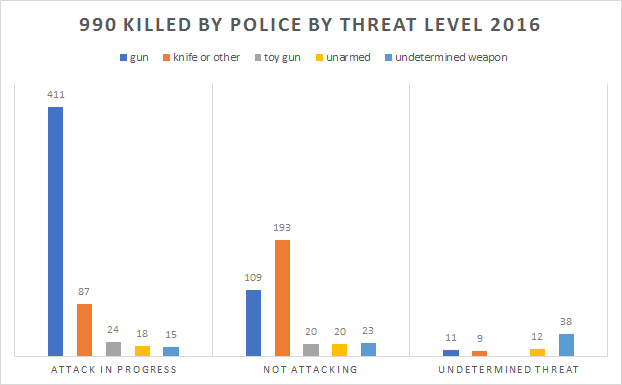
Again, surprisingly few people who are unarmed and not attacking police end up being shot by police.
I reworked the data published by the Washington Post because as usual it does not put it in a form that illustrates how many people were armed or attacking police when shot.
This is what the Washington Post and The Guardian said on the 12 the Washington Post classified as unarmed and not attacking police:
“Ciara Meyer, an unarmed 12-year-old white female, was shot on Jan. 11, 2016, in an apartment in Penn Township, Pa. A Pennsylvania constable was serving Meyer’s father with an eviction notice. Meyer’s father pointed a rifle at the constable, who opened fire. The bullet travelled through the father’s arm, striking Ciara.” Source: Fatal force: A Washington Post investigation of people shot and killed by police in 2016 – Washington Post.
Source: The Counted: people killed by police in the United States – interactive | US news | The Guardian.
“Kelsey Rose Hauser, an unarmed 25-year-old white woman, was shot on Jan. 16, 2016, in El Cajon, Calif. Hauser was a passenger in a stolen car that El Cajon police were pursuing. After a high-speed chase, the driver of the car drove toward an officer, who opened fire.” Source: Fatal force: A Washington Post investigation of people shot and killed by police in 2016 – Washington Post.
Source: The Counted: people killed by police in the United States – interactive | US news | The Guardian.
“Daniel Shaver, an unarmed 26-year-old white man, was shot on Jan. 17, 2016, in a hotel in Mesa, Ariz. Mesa police were called to the hotel to investigate reports that a man pointed a rifle from a window. When police questioned Shaver in a hallway, he reached toward his back and didn’t cooperate with the officer’s orders.” Source: Fatal force: A Washington Post investigation of people shot and killed by police in 2016 – Washington Post.
Source: The Counted: people killed by police in the United States – interactive | US news | The Guardian.
“Antronie Scott, an unarmed 36-year-old black man, was shot on Feb. 4, 2016, in San Antonio, Tex. Undercover San Antonio police officers were monitoring Scott, who had outstanding arrest warrants. When a uniformed officer approached Scott, he spun around with something in his hand. Police later determined that Scott was holding a cellphone.” Source: Fatal force: A Washington Post investigation of people shot and killed by police in 2016 – Washington Post.
Source: The Counted: people killed by police in the United States – interactive | US news | The Guardian.
“David Joseph, an unarmed 17-year-old black male, was shot on Feb. 8, 2016, in Austin, Tex. Austin police were responding to reports of an erratic, aggressive person. Joseph, who was naked, rushed toward the officer.” Source: Fatal force: A Washington Post investigation of people shot and killed by police in 2016 – Washington Post.
Source: The Counted: people killed by police in the United States – interactive | US news | The Guardian.
“Calin Roquemore, an unarmed 24-year-old black man, was shot on Feb. 13, 2016, in Beckville, Tex. Roquemore fled a traffic stop by a Texas state trooper. Roquemore refused the trooper’s orders to show his hands. No weapon was found at the scene.” Source: Fatal force: A Washington Post investigation of people shot and killed by police in 2016 – Washington Post.
Source: The Counted: people killed by police in the United States – interactive | US news | The Guardian.
“Marquintan Sandlin, an unarmed 32-year-old black man, was shot on Feb. 21, 2016, in Inglewood, Calif. The man was a passenger in a car stopped at an intersection. Inglewood police approached the car and noticed that the woman who was driving had a gun. Officers shot and killed Sandlin and the woman, Kisha Michael.” Source: Fatal force: A Washington Post investigation of people shot and killed by police in 2016 – Washington Post.
Source: The Counted: people killed by police in the United States – interactive | US news | The Guardian.
“Travis Boyd Bradley, an unarmed 36-year-old white man, was shot on March 2, 2016, in Bel Air, Md. Harford County deputies responded to a report of a person who was suicidal. After a standoff, Bradley came out of the residence and charged toward a deputy.” Source: Fatal force: A Washington Post investigation of people shot and killed by police in 2016 – Washington Post.
Source: The Counted: people killed by police in the United States – interactive | US news | The Guardian.
“Peter Gaines, an unarmed 37-year-old black man, was shocked with a stun gun and shot on March 12, 2016, in Houston, Tex. A Houston police officer approached Gaines after he vandalized a traffic sign. Gaines lunged at the officer.” Source: Fatal force: A Washington Post investigation of people shot and killed by police in 2016 – Washington Post.
Source: The Counted: people killed by police in the United States – interactive | US news | The Guardian.
“Joshua Grubb, an unarmed 30-year-old white man, was shot on March 13, 2016, in Lenoir City, Tenn. Lenoir City police were investigating the report of a drunken driver. Grubb attempted to flee with an officer in the back of his pickup truck.” Source: Fatal force: A Washington Post investigation of people shot and killed by police in 2016 – Washington Post.
Source: The Counted: people killed by police in the United States – interactive | US news | The Guardian.
“Cristian Rene Medina, an unarmed 23-year-old Hispanic man, was shot on March 16, 2016, in Florence, Calif. Los Angeles County sheriff’s deputies were responding to a report of a robbery. When they encountered Medina, who matched the description of the robbery suspect, he held his hands together as if he was holding a gun and pointed toward deputies. His family said he suffered from depression.” Source: Fatal force: A Washington Post investigation of people shot and killed by police in 2016 – Washington Post.
Source: The Counted: people killed by police in the United States – interactive | US news | The Guardian.
“Eric John Wilson, an unarmed 22-year-old man, was shot on April 17, 2016, in El Paso, Tex. El Paso police responded to a call about a suicidal person. Wilson told officers that he had two handguns and an assault rifle. He reached behind his back and pulled out a dark object, which turned out
to be a cellphone.” Source: Fatal force: A Washington Post investigation of people shot and killed by police in 2016 – Washington Post.
Source: The Counted: people killed by police in the United States – interactive | US news | The Guardian.
24 Apr 2016 Leave a comment
in constitutional political economy, economics of crime, economics of regulation, health economics, law and economics Tags: federalism, war on drugs
23 Apr 2016 Leave a comment
in economics of crime, law and economics, occupational choice Tags: Australia, career criminals, crime and punishment, criminal deterrence, deportations, economics of immigration, law and order
When a non-citizen spends 10 of his 40 odd years in Australia behind bars, most recently in 2011, the only question that should be posed is why was not he deported much earlier?
Source: Former criminal deported and separated from family after 40 years in Australia | Stuff.co.nz.
He is a career criminal who deserves no sympathy. He is the author of his own misfortunes in being separated from his family in Australia. Sympathy should go to his many victims, not to him.
More fool him when he spent 9 months in immigration detention because he chose to appeal his deportation. The criterion for automatic cancellation of Australian visas for criminals is accumulating 12 months in prison. That is a low threshold for automatic deportation unless the minister grants a waiver.
With 10 years behind bars, his appeal had no chance of success. He was a career criminal Australia could well be shot off.
21 Apr 2016 Leave a comment
in economic history, economics of bureaucracy, economics of crime, economics of media and culture, law and economics, politics - USA, Public Choice, rentseeking Tags: bribery and corruption

In the book Plunkitt of Tammany Hall William Riordan published many of George Washington Plunkitt’s thoughts about government and about big city machines. In the link below, you can find the passage that explains the difference between honest and dishonest graft.
Honest graft is using your connections and knowledge as a government official to enrich yourself. It is essentially what we would now call “insider trading.”
Honest graft is when a goverment official goes out (for example) and buys up land because he knows a city project will need that land and he will be able to make a lot of money by buying the land now while no one else knows that it is about to be bought by the city. He can buy it cheap and then sell it at a higher price to the city.
Dishonest graft consists of doing things like blackmailing people who are doing illegal or semi-illegal things. It can also consist of actually taking money directly from the city treasury.
It is more of what you would expect mobsters to do–things like forcing prostitutes to pay money to police in order to be allowed to work in a given area rather than being arrested.
Source: How does George Plunkitt define “honest/dishonest graft”? | eNotes.

Celebrating humanity's flourishing through the spread of capitalism and the rule of law
A History of the Alt-Right
Econ Prof at George Mason University, Economic Historian, Québécois
Celebrating humanity's flourishing through the spread of capitalism and the rule of law
Scholarly commentary on law, economics, and more
Beatrice Cherrier's blog
Celebrating humanity's flourishing through the spread of capitalism and the rule of law
Why Evolution is True is a blog written by Jerry Coyne, centered on evolution and biology but also dealing with diverse topics like politics, culture, and cats.
Celebrating humanity's flourishing through the spread of capitalism and the rule of law
A rural perspective with a blue tint by Ele Ludemann
DPF's Kiwiblog - Fomenting Happy Mischief since 2003
Celebrating humanity's flourishing through the spread of capitalism and the rule of law
The world's most viewed site on global warming and climate change
Tim Harding's writings on rationality, informal logic and skepticism
A window into Doc Freiberger's library
Let's examine hard decisions!
Commentary on monetary policy in the spirit of R. G. Hawtrey
Thoughts on public policy and the media
Celebrating humanity's flourishing through the spread of capitalism and the rule of law
Politics and the economy
A blog (primarily) on Canadian and Commonwealth political history and institutions
Reading between the lines, and underneath the hype.
Economics, and such stuff as dreams are made on
"The British constitution has always been puzzling, and always will be." --Queen Elizabeth II
Celebrating humanity's flourishing through the spread of capitalism and the rule of law
WORLD WAR II, MUSIC, HISTORY, HOLOCAUST
Undisciplined scholar, recovering academic
Celebrating humanity's flourishing through the spread of capitalism and the rule of law
Res ipsa loquitur - The thing itself speaks
In Hume’s spirit, I will attempt to serve as an ambassador from my world of economics, and help in “finding topics of conversation fit for the entertainment of rational creatures.”
Researching the House of Commons, 1832-1868
Articles and research from the History of Parliament Trust
Reflections on books and art
Posts on the History of Law, Crime, and Justice
Celebrating humanity's flourishing through the spread of capitalism and the rule of law
Exploring the Monarchs of Europe
Cutting edge science you can dice with
Small Steps Toward A Much Better World
“We do not believe any group of men adequate enough or wise enough to operate without scrutiny or without criticism. We know that the only way to avoid error is to detect it, that the only way to detect it is to be free to inquire. We know that in secrecy error undetected will flourish and subvert”. - J Robert Oppenheimer.
The truth about the great wind power fraud - we're not here to debate the wind industry, we're here to destroy it.
Celebrating humanity's flourishing through the spread of capitalism and the rule of law
Recent Comments