I went looking for the uptick in murders in U.S. cities. Here’s what I found. wapo.st/1QdNA0m http://t.co/w2dc8rnoFu—
Max Ehrenfreund (@MaxEhrenfreund) September 04, 2015
#NewYorkCity used to have a lot of murders
17 Sep 2015 2 Comments
in economic history, economics of crime, law and economics, politics - USA Tags: crime and punishment, crime rates, criminal deterrence, law and order, New York City
@thecounted How did the 62 unarmed Blacks killed by police in 2015 die @radleybalko @Mark_J_Perry
17 Sep 2015 2 Comments
in economics of crime, law and economics, politics - USA Tags: crime and punishment, law and order, police, police shootings, road accidents, road safety
I followed the coding by the Guardian despite reservations. Including those struck by police cars in routine accidents, none of them police chases, conflates one database with another and does not touch on the issue of the wisdom of police car chases. Including people who drive cars at police or flee with kidnapped children in a car is stretching the definition of unarmed. The wisdom of shooting at a car with children in it is a separate issue. The safety of the hostage taker is not a responsibility of the police, the safety of the children kidnapped in that car was.

Source: The Counted: people killed by police in the United States in 2015 – interactive | US news | The Guardian accessed 1 p.m. 16 September 2015 New Zealand standard Time.
About 10% of police shootings of unarmed people resulted in murder charges and a few of those still under investigation read as suspicious and may result in charges as well as more evidence is gathered.
Our count as of this afternoon is 823. Have a tip? Tweet us at @thecounted or visit theguardian.com/thecounted/tips http://t.co/96AM7pNPGH—
The Counted (@thecounted) September 14, 2015
That 10% figure of police shootings that result in murder charges is much higher if you exclude people who collapsed while in contact with police from underlying poor health either in a struggle or after being tasered – 20 or more out of 62, drove cars at police (3), killed in crossfire (2) or were killed in police car accidents (5). The figure is even higher when you exclude a good number of those who are struggling with police and the police fired in self defence lawfully. That is, if a police officer shoot someone at a safe distance without good cause, they face a high probability of being charged with murder.
The database I used today for the above figure on shooting of unarmed Blacks takes less than an hour to work your way through to code them for yourself, so if you doubt my coding, do your own coding and put up a rival figure. I will even consider a guest blog by you if you lack a forum.
Update: When I shared this post on the dataisbeautiful sub-reddit, the first comment on that post was to denounce me as a racist for sharing.
How did White, Black and Latino Americans killed by police die in 2015?
16 Sep 2015 Leave a comment
in economics of crime, law and economics, politics - New Zealand Tags: crime and punishment, criminal deterrence, law and order, police, police shootings

Source: The Counted: people killed by police in the United States in 2015 – interactive | US news | The Guardian Accessed 1 a.m. New Zealand standard Time 15th September 2015.

Source: The Counted: people killed by police in the United States in 2015 – interactive | US news | The Guardian Accessed 1 a.m. New Zealand standard Time 15th September 2015.

Source: The Counted: people killed by police in the United States in 2015 – interactive | US news | The Guardian Accessed 1 a.m. New Zealand standard Time 15th September 2015.

The 820 people killed by police by race in 2015 – updated again
15 Sep 2015 1 Comment
in economics of crime, law and economics, politics - USA, transport economics Tags: crime and punishment, law and order, police, police shootings, road accidents, road safety
I am surprised that the Guardian did not do this graphical analysis themselves. My analysis below shows the quite a few people were unarmed but many more were carrying guns, knives or other weapons.

Source: The Counted: people killed by police in the United States in 2015 – interactive | US news | The Guardian Accessed 1 a.m. New Zealand standard Time 15th September 2015.
You have to read through every individual data entry to work out how many of those killed had guns, and the many of these were shooting at police when they were shot dead. The same legwork is required to find out how many officers are on murder charges after killing civilians.
Watch your back in Rap & Hip-Hop, look after yourself in Heavy Metal and Punk
13 Sep 2015 Leave a comment
in economic history, economics of crime, economics of media and culture, health and safety, health economics, labour economics, law and economics, Music, occupational choice Tags: crime and punishment, homicide rates, law and order, suicide
What kills popular musicians? Depends on the genre http://t.co/BTDvdWOS4F—
paulkirby (@paul1kirby) September 11, 2015
Is domestic violence getting worse?
12 Sep 2015 Leave a comment
in economics of crime, law and economics Tags: crime and punishment, criminal deterrence, law and order, marriage and divorce
Domestic murder rates in the U.S. have fallen by nearly 50 percent for female partners. buff.ly/1Nksz5C http://t.co/ihEfDir6mj—
HumanProgress.org (@humanprogress) September 07, 2015
An update on ‘Better Angels’ by S. Pinker bit.ly/1M4mhUJ
New data shows violence remains in retreat overall. http://t.co/zgR41QxsZO—
Max Roser (@MaxCRoser) September 12, 2015
This #Vox political bias test is biased despite my good result
11 Sep 2015 Leave a comment
in economic growth, economic history, economics of climate change, economics of crime, environmental economics, health economics, macroeconomics
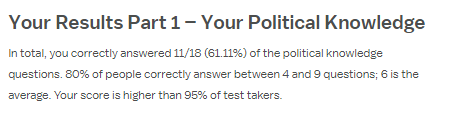
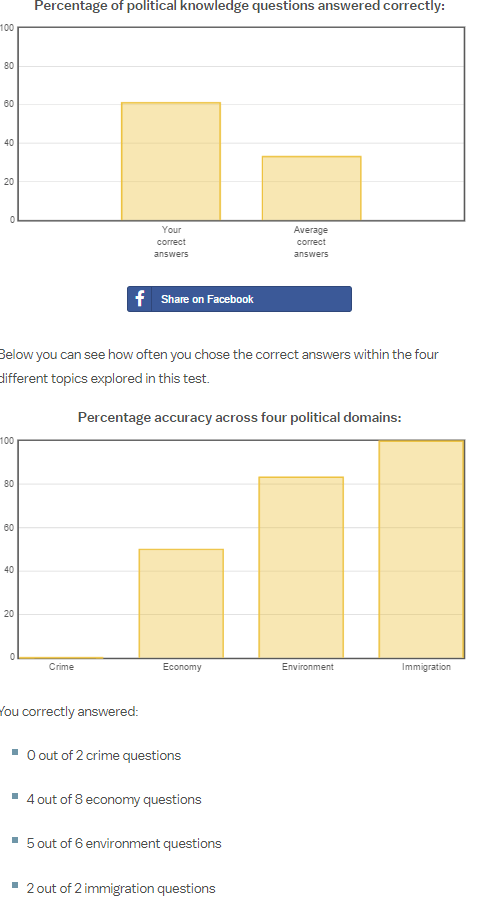
@radleybalko @thecounted How did the 169 unarmed people killed by police in 2015 die? @Mark_J_Perry updated
11 Sep 2015 2 Comments
in economics of crime, law and economics, politics - USA Tags: body cameras, crime and punishment, criminal deterrence, law and economics of evidence, law and order, Leftover Left, police, police shootings, presumption of innocence, William Blackstone
The Guardian is so anti-police that they included in their interactive database a drunk that drove into a police car and some poor bastard run over by the police cruiser searching for him at night.
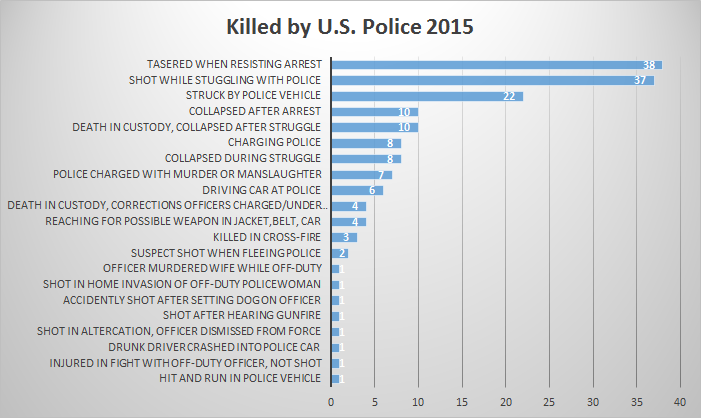
Another handy hint for an unarmed suspect is do not flee police by stealing a police cruiser with the officer dragging behind you. He may well shoot you. Police will certainly shoot an unarmed suspect if they flee arrest in a police cruiser, kidnapping the two children who happened to be in the back – their parents expect no less.

Most of the police killings of the unarmed in circumstances where better evidence would resolve doubts.

The Guardian would do a lot better by arguing that all Tasers should have cameras on them, all police cruisers should have cameras in them, and all police officers should have cameras on their lapels. These cameras are excellent for collecting evidence against criminals. There should also be plenty of cameras in police stations.

The first randomized controlled trial of police body cameras in the USA showed that cameras sharply reduce the use of force by police and the number of citizen complaints. In Seattle, the police department has set up its own YouTube channel, broadcasting a stream of blurred images to protect privacy.
Update: I recoded charging police and reaching for a possible weapon on your person or in a car into separate categories
1st drink driving arrest was today 1897
10 Sep 2015 Leave a comment
in economic history, economics of crime, law and economics, transport economics Tags: drink driving, road safety
How did the 19 unarmed people killed by police since 1 August 2015 die? @radleybalko @thecounted
10 Sep 2015 Leave a comment
in economics of crime, law and economics, politics - USA Tags: crime and punishment, deaths in custody, expressive voting, law and order, Leftover Left, police, police shootings
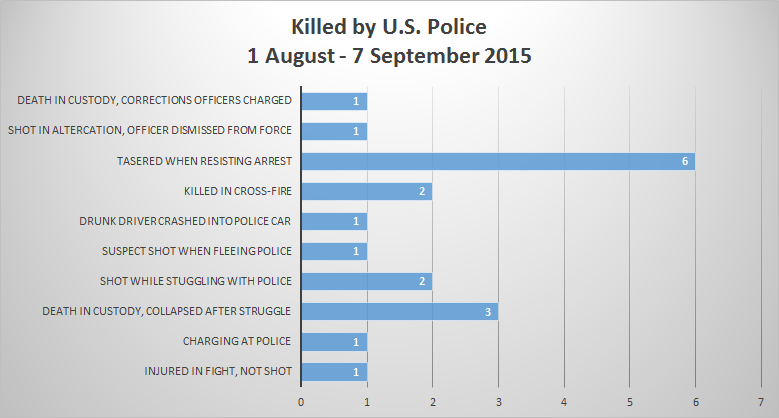
In coding the data from The Guardian interactive website, I included all 19 people they classified as unarmed and killed by police including
- a death in custody involving corrections officers,
- a drunk driver drove into the police car while turning left, and
- an off duty police officer getting into a fatal fight with a neighbour.
Unarmed people should not charge at armed police, struggle for their guns, or refuse to comply when threatened with a Taser, especially if poor of health or have a weak heart.
In the only two cases of police malfeasance – three corrections officer beating a prisoner to death or a trigger-happy police officer – charges have been laid or the officer dismissed pending further investigation. The man shot while fleeing police was a murder suspect.
War on Police? Or one of the safest years in law enforcement since 1887? @Mark_J_Perry goo.gl/qNQ2lO http://t.co/2zPjZmG2fQ—
AEIdeas Blog (@AEIdeas) September 09, 2015
Did Mass Incarceration Destroy the Black Family?
28 Aug 2015 Leave a comment
in discrimination, economics of crime, economics of love and marriage, labour economics, law and economics, politics - New Zealand, population economics, poverty and inequality, unemployment, urban economics, welfare reform Tags: crime and punishment, criminal deterrence, economics of the family, racial discrimination, single mothers, single parents, teen pregnancies
Did Mass Incarceration Destroy the Black Family? Not exactly. bit.ly/1f8jgXm http://t.co/1q2nKJnU9W—
City Journal (@CityJournal) August 13, 2015
#Drones and entrepreneurial alertness in thieving
27 Aug 2015 Leave a comment
in economics of crime, law and economics, technological progress Tags: creative destruction, crime and punishment, drones, entrepreneurial alertness
I welcome #amazon drones. But I also think future drone rustlers will shoot down or net them. New crime opportunity. http://t.co/KjAuqhA8Lm—
Danny Rose (@_DannyRose) July 30, 2015
Should backyard swimming pools be banned?
26 Aug 2015 Leave a comment
in applied price theory, economics of crime, economics of regulation, health and safety, law and economics, politics - USA, property rights Tags: gun control, meddlesome preferences, nanny state, risk risk trade-offs
Scientific Retractions are on the rise
25 Aug 2015 Leave a comment
in economics of crime, economics of education, law and economics Tags: conjecture and refutation, scientific fraud
Scientific Retractions are on the Rise, and That May Be a Good Thing
priceonomics.com/scientific-ret… http://t.co/jMrC8R0EI1—
Priceonomics (@priceonomics) June 24, 2015
Unexpected kind word for Parliament House protesters @GreenpeaceNZ @RusselNorman @NZGreens @greencatherine
15 Aug 2015 2 Comments
in constitutional political economy, economics of crime, environmental economics, global warming, law and economics, liberalism, politics - New Zealand, Public Choice, Rawls and Nozick, rentseeking Tags: civil disobedience, climate alarmism, expressive voting, Greenpeace, John Rawls, Justice Scalia, Leftover Left, rule of law
PRESS RELEASE: Greenpeace Parliament Climbers Convicted of Trespass bit.ly/1DRfKMG #realclimateaction http://t.co/sxRokpwRNk—
Greenpeace NZ (@GreenpeaceNZ) August 13, 2015
The Greenpeace vandals who trespassed at Parliament, climbing up to put signs down the front in flagrant disregard of the most ample possible options for peaceful protest right outside at least had the integrity to plead guilty. That shows some sort of fidelity to law and an acknowledgement that what they did was a criminal offence.
John Rawls makes the point that the purpose of civil disobedience is not to impose your will upon others but through your protest to implore them to reconsider their position and change the law or policy you are disputing.
Rawls argues that civil disobedience is never covert or secretive; it is only ever committed in public, openly, and with fair notice to legal authorities. Openness and publicity, even at the cost of having one’s protest frustrated, offers ways for the protesters to show their willingness to deal fairly with authorities. Rawls argues:
- for a public, non-violent, conscientious yet political act contrary to law being done (usually) with the aim of bringing about a change in the law or policies of the government;
- that appeals to the sense of justice of the majority;
- which may be direct or indirect;
- within the bounds of fidelity to the law; and
- whose protesters are willing to accept punishment. Although civil disobedience involves breaking the law, it is for moral rather than selfish reasons; the willingness to accept arrest is proof of the integrity of the act.
Rawls argues, and too many forget, that civil disobedience and dissent more generally contribute to the democratic exchange of ideas by forcing the champions of dominant opinion to defend their views.
Legitimate non-violent direct action are publicity stunts to gain attention and provoke debate within the democratic framework, where we resolve our differences by trying to persuade each other and convince the electorate.
Too many acts of non-violent direct action aim to impose their will on others rather than peaceful protests designed to bring about democratic change in the laws or policies of the incumbent government. That ‘might does not make right’ is fundamental to the rule of law. As United States Supreme Court Justice Antonin Scalia said
The virtue of a democratic system [with a constitutionally guaranteed right to free speech] is that it readily enables the people, over time, to be persuaded that what they took for granted is not so and to change their laws accordingly..
Both sides passionately but respectfully attempt to persuade their fellow citizens to accept their views. Win or lose, advocates for today’s losing causes can continued pressing their cases, secure in the knowledge that an electoral loss today can be negated by a later electoral win, which is democracy in action as Justice Kennedy explains:
…a democracy has the capacity—and the duty—to learn from its past mistakes; to discover and confront persisting biases; and by respectful, rationale deliberation to rise above those flaws and injustices…
It is demeaning to the democratic process to presume that the voters are not capable of deciding an issue of this sensitivity on decent and rational grounds.
The process of public discourse and political debate should not be foreclosed even if there is a risk that during a public campaign there will be those, on both sides, who seek to use racial division and discord to their own political advantage. An informed public can, and must, rise above this. The idea of democracy is that it can, and must, mature.
Freedom embraces the right, indeed the duty, to engage in a rational, civic discourse in order to determine how best to form a consensus to shape the destiny of the Nation and its people. These First Amendment dynamics would be disserved if this Court were to say that the question here at issue is beyond the capacity of the voters to debate and then to determine.
John Rawls’ view that fidelity to law and democratic change through trying to persuade each other is at the heart of civil disobedience reflects the difference between the liberal and the left-wing on democracy and social change as Jonathan Chait observed this week:
Liberals treat political rights as sacrosanct. The left treats social and economic justice as sacrosanct. The liberal vision of political rights requires being neutral about substance.
To the left, this neutrality is a mere guise for maintaining existing privilege; debates about “rights” can only be resolved by defining which side represents the privileged class and which side represents the oppressed…
Liberals believe that social justice can be advanced without giving up democratic rights and norms. The ends of social justice do not justify any and all means.
How the left-wing and liberal visions of democracy are different nymag.com/daily/intellig… http://t.co/Qk5vS9SaV4—
Jonathan Chait (@jonathanchait) August 13, 2015


Recent Comments