The World’s Most Corrupt Diplomats, As Told Through Parking Tickets

parking

Kuwait tops the list, with 246 violations per diplomat, followed by Egypt (under Mubarack), Chad, Sudan and Bulgaria. At the bottom, with no violations, are 21 diverse countries including not just the ever-polite U.K., Japan and Canada.

Most U.N. diplomats have improved their parking behaviour since 2002 when the U.S. began withholding parking fines from foreign aid payments: violations fell by 90% immediately after the measure was passed.

The British High Commissioner to New Zealand, plate DC1, nearly ran me over at pedestrian crossing yesterday outside the Wellington library, so this is not an unbiased post.

He was travelling too fast to stop in the central business district, where the speed limit is 30 kilometres per hour. You should not speed near pedestrian crossings because people are trying to walk out onto it. 

What causes pollution – David Friedman

Image

How to beat the share market

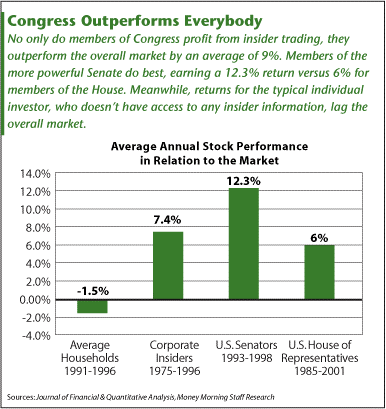
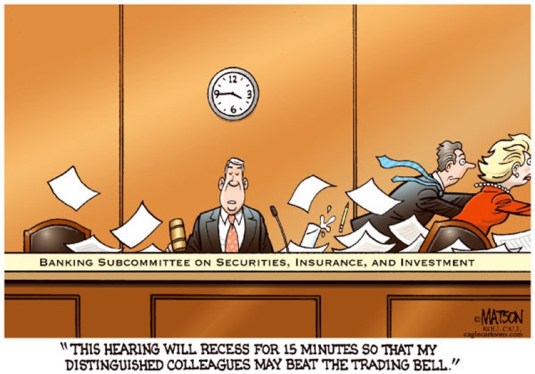
Become a United States senator. Their share portfolios out-perform the best of the best hedge fund managers, and the best hedge fund manager was paid 3 1/2 billion dollars last year; to get on the list for the top hedge fund manager, you make at least $300 million a year. Good things that politicians know how to outperform them on their modest salaries and busy schedules of public engagements and parliamentary sittings.


Using the financial disclosures of politicians, "Abnormal Returns From the Common Stock Investments of Members of the U.S. House of Representatives," built model portfolios and charted their performance. They found that House members outperform the market by 6 percentage points. Senators do even better, the authors say, citing their own earlier research from 2004.

Senate portfolios "show some of the highest excess returns ever recorded over a long period of time, significantly outperforming even hedge fund managers," with gains that are "both economically large and statistically significant."

These results suggest that congressmen and senators have access to non-public information on  particular businesses, industries or the economy as a whole and invest on  the basis that information. The good returns of Senators  and Congressmen last far too long to be no more than luck.


The politics of women’s self defence tips

Image

What a member of parliament is, is a legal curio. So are heads of state.

Under the Sale of Offices Act 1809, the sale of House of Commons seats was outlawed so membership of parliament must be freehold property. Prior to that 1808 Act, there is a lively trade in seats in the House of Commons: you can buy them outright, or just rent a seat  for a session of Parliament.

  • Being paid a salary as a member of parliament is very 20th century with the House of Representatives beating the House of Commons by 5 years.
  • Back in 1695, the House of Commons resolved that offering a bribe to a Member of Parliament shall be a high crime and misdemeanour liable to impeachment, and an MP accepting such a bribe shall be a matter of privilege.
  • In 1858, the House resolved to prohibit advocacy for fee or reward.
  • In 1947, a further resolution banning MPs from entering agreements which restricted their freedom to act and speak, or require them to act as a representative of outside bodies.

Prior to the 19th century virtually all European civil appointments were made through outright sale or patronage, included judicial courts, public finance, sheriffs, and notaries public so the offices were freeholds – effectively private property.

Once an office had been granted it could be mortgaged, sold privately or through public auction, and bequeathed to heirs. The key source of income from most offices was the right to charge fees for service.

The buying and selling applied to army officer commissions, but never to the British navy for reasons explained by Doug Allen in his clever writings on the economics of patronage and veniality. The sale of military commissions ended in 1871.

The queen is corporation sole in perpetual succession – she or he may possess property as monarch which is distinct from the property he or she possesses personally, and may do acts as monarch distinguished from their personal acts.

Elizabeth II has several corporations sole – Her Majesty the Queen in Right of the United Kingdom, Her Majesty the Queen in Right of Canada, Her Majesty the Queen in Right of Australia are all distinct corporations sole. She is also a distinct corporation sole for states and provinces.

Ministers of the crown can be corporations sole. This is administratively convenient as regards the ownership of property because it facilitates continuity when the office-holder changes.

There ends today’s trivia.

The deterrent effect of the sentences handed down in the immediate aftermath of the London riots 2011

Savage criminal sentences were handed down by the courts in the days after the London riots in 2011.

  • Nicholas Robinson (aged 23) was sentenced to 6 months imprisonment for stealing bottles of water (worth £3.50) from a looted shop in Brixton. His previous good character and early plea of guilty to a non-dwelling burglary, as well as the low value of goods stolen, the fact he was in education, and his remorse, were in his favour. These meant the magistrate decided to not send him up to the Crown Court where he would face a possible higher sentence.
  • Danielle Corns (19) was sentenced to 10 months for stealing two left-footed trainers in Wolverhampton and leaving them outside the shop.
  • Two 20-year olds were sentenced to 4 years imprisonment for creating a Facebook riot event in Northwich (which didn’t occur and to which no one attended).

7 out of 10 of sentences issued in the aftermath of the London riots were upheld in full in the Court of Appeal. Any reductions were modest. The longer sentence handed out was 23 years for conspiracy to murder to the leader of a gang who planned to drive to the riots carrying guns to attack the police.

Carpetright store after Tottenham riots.jpg

Brian Bell, Laura Jaitman and Stephen Machin (2014) used this sudden change in the judicial wind to measure the impact of tough sentences on crime.

Across London, they found a significant drop in “riot crimes” – burglary, criminal damage and violence against the person – over the six months following the riots.

Other crimes showed a tendency to increase, as though criminals were substituting away from these “expensive” crimes and towards the “cheaper” ones.

Crime is occupation choice: criminals commit crime because they find that profitable to do so. When criminals  anticipate that crime will be less profitable and more likely to be accompanied by the prison experience, less crimes are committed.

HT: timharford.com

H.L. Mencken on poverty as a cause of crime

HT: David Skarbek

Does mandatory arrest rules deter domestic violence?

  1. Many states have passed mandatory arrest laws, which require the police to arrest abusers when a domestic violence incident is reported. These laws were justified by a randomized experiment in Minnesota which found that arrests reduced future violence.

  2. Using the FBI Supplementary Homicide Reports, Iyengar found that mandatory arrest laws actually increased intimate partner homicides. He hypothesized that this increase in homicides is due to decreased reporting.

  3. Iyengar investigate validity of this reporting hypothesis by examining the effect of mandatory arrest laws on family homicides where the victim is less often responsible for reporting. For family homicides, mandatory arrest laws appear to reduce homicides.

  4. This study provided evidence that mandatory arrest  laws may have perverse effects on intimate partner violence, harming the very people they were seeking to help.

  5. Finding  that mandatory arrests deters victim reporting rather than perpetrator abuse provides valuable insight into the intricacies facing attempts to decrease intimate partner violence.

Source: Radha Iyengar “Does Arrest Deter Violence? Comparing Experimental and Non-experimental Evidence on Arrest Laws” in The Economics of Crime (2010) Chapter 12.

Figure 1: Plot of fifteen-year compilation of 911 calls and arrests for simple assault in Colorado Springs versus increase in population

But see “Explaining the Recent Decline in Domestic Violence” by Amy Farmer and Jill Tiefenthaler in Contemporary Economic Policy (2003) who found that three important factors  were likely to have contribute to the decline in domestic violence in the USA in the 1990s:

(1) the increased provision of legal services for victims of intimate partner abuse,

(2) improvements in women’s economic status, and

(3) demographic trends, most notably the aging of the population.

Forensic statistics and drugs in sport

Embedded image permalink

Years ago, I read a newspaper article in the Sydney Morning Herald about how forensic statistics was used to detect drugs in sport through the differences in athletic performance between men and women in track and field.

Drugs in certain sports make women  disproportionately stronger, and therefore  reduces the disparity between them and men in sports that require pure strength.

In the 1980s, the gap between men and women in track and field performances had been narrowing. In 1992, major improvements were made in drug testing. In consequence, the gap between men and women in athletic performance started to widen again.

In about 1992, as I recall, athletic records for women that used to be broken several times in one major international meeting  such as the Olympics suddenly stood for years before they were broken again.

HT: Phil Hurst and SecureGame

Blackstone’s Ratio

Blackstones-ratio.jpg

Image

The golden thread running through British justice

Our attempted carjacking

We were driving home the other night when the two cars in front of us came to a stop after we left the roundabout near the airport.

When they had slowly cleared the left lane of the highway, a young man was walking towards the traffic. He was obviously on drugs – the glazed look and strange walking.

I moved the car around him slowly and locked the car without much thought.

Half a second later, I hear the outside door handle on Luz’s side of the car. This lunatic was trying to break into moving cars on the highway.

I immediately sped away. I did not care about him. I wanted to get away as quickly as possible

We drove home, which is about two minutes away, then we rang the police. After a little bit of time working out the exact name of the street, they said they had received a number of reports about a man on the highway and police had been sent.

If I heard any bump or other evidence that he was actually injured as I sped away, I would have still sped away. There is a difference between leaving the scene of an accident and fleeing a carjacking by a crazed drug fiend.

If there was any suspicion that I had injured the carjacker while speeding away, I would have driven to the nearest police station, which is nearby, given them a summary of the facts and then postponed further comment pending legal advice.

So much for sleepy Wellington.

The punishment dilemma versus cutting the road toll Norwegian style

Traffic offences are example of the punishment dilemma: there but for the grace of god I as the offender.

DUI

That makes voters, most of who drive a car, reluctant to support strong punishments for crimes they might happen to commit somewhat accidentally rather than through some malicious intent.

Traffic offences are the breaches of the law  where ordinary citizens are most likely to have encounters with the police and the courts.

This is where the punishment dilemma between obeying the law and brute self-interest are at their sharpest. Everyone wants other people to obey the law , but they are not so sure about themselves, especially when the punishments are harsh.

Juries would not convict drivers for manslaughter so new offences such death by dangerous driving and by negligent driving were introduced with lighter prison terms. People would get a few months for killing people when drunk.

That has changed in recent decades with a hardening of community attitudes to dangerous driving and drunk driving.

An important reason is that with rising incomes, more people can afford a taxi so they a less likely to go down the steps because they are less likely to be caught in a situation of drink-driving or dangerous driving.

Norway has the strictest drink driving laws in Europe:

  • The maximum blood alcohol content is equal to a small glass of a weak drink and heavy punishments with few second chances.
  • The blood-alcohol limit for impaired driving is .02, with stiffer penalties for every point over that.
  • Driving under the influence of alcohol is punishable by at least 1 day in jail, a heavy fine and the loss of the driver’s license for a year.
  • Driving with a blood alcohol level of over 1.5 may lead to one year of prison.

Many Norwegians take a taxi to parties while others make arrangements to stay over with the hosts.

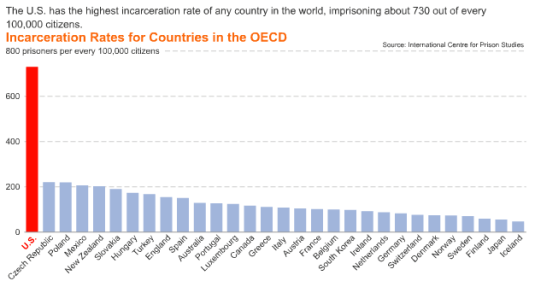
Prison numbers are too high?

How can prison numbers be too high? There are unsolved crimes: murders, robberies, sexual assaults and burglaries to name a few.

There are people out there who should have been arrested, convicted and sent to prison for serious crimes. Many of them are repeat offenders and career criminals.

I have never understood the reasoning behind the notion that prison numbers are too high.

Concerns about prison numbers being too high is exclusively a concern about the criminals who were sent to prison. Their victims are never mentioned nor are victims of unsolved crime who have been denied justice.

There is an economic literature on the efficient level of crime. Those that are concerned about prison numbers being too high explicitly reject the economics of crime literature for the purpose of framing public policy about criminal justice. The reason is obvious from this passage by David Friedman:

The economic analysis of crime starts with one simple assumption: Criminals are rational.

A mugger is a mugger for the same reason I am a professor-because that profession makes him better off, by his own standards, than any other alternative available to him.

Here, as elsewhere in economics, the assumption of rationality does not imply that muggers (or economics professors) calculate the costs and benefits of available alternatives to seventeen decimal places-merely that they tend to choose the one that best achieves their objectives.

If muggers are rational, we do not have to make mugging impossible in order to prevent it, merely unprofitable.

If the benefits of a profession decrease or its costs increase, fewer people will enter it-whether the profession is plumbing or burglary.

If little old ladies start carrying pistols in their purses, so that one mugging in ten puts the mugger in the hospital or the morgue, the number of muggers will decrease drastically-not because they have all been shot but because most will have switched to safer ways of making a living.

If mugging becomes sufficiently unprofitable, nobody will do it.

Putting more offenders in prison should decrease crime by both incapacitating incarcerated offenders and deterring potential offenders.

Do ‘more police’ make us safe? | vox

The massive re-deployment of police after the July 2005 London bombings is a test of whether more police reduce crime.

There was a 34% increase in hours worked by police in central-inner London in the six weeks that followed the attacks.

Draca, Machin and Witt in Panic on the Streets of London found a 11% fall in crime. A 10% increase in police leads to a 3% fall in crime. This is broadly consistent with previous casual estimates of the impact of police on crime.

Klick and Tabarrok (2005) found that increases in the Terror Alert levels in the Mall area of Washington, D.C cut crime. A 10% increase in police leads to a 3% fall in crime.

Previous Older Entries Next Newer Entries

David Andolfatto

Celebrating humanity's flourishing through the spread of capitalism and the rule of law

Monetary Non-Neutrality

Celebrating humanity's flourishing through the spread of capitalism and the rule of law

Reason Magazine

Celebrating humanity's flourishing through the spread of capitalism and the rule of law

Coyote Blog

Celebrating humanity's flourishing through the spread of capitalism and the rule of law

Thoughts from the North

Celebrating humanity's flourishing through the spread of capitalism and the rule of law

Fardels Bear

A History of the Alt-Right

Vincent Geloso

Econ Prof at George Mason University, Economic Historian, Québécois

Bassett, Brash & Hide

Celebrating humanity's flourishing through the spread of capitalism and the rule of law

Truth on the Market

Scholarly commentary on law, economics, and more

The Undercover Historian

Beatrice Cherrier's blog

Matua Kahurangi

Celebrating humanity's flourishing through the spread of capitalism and the rule of law

Temple of Sociology

Celebrating humanity's flourishing through the spread of capitalism and the rule of law

Velvet Glove, Iron Fist

Celebrating humanity's flourishing through the spread of capitalism and the rule of law

Why Evolution Is True

Why Evolution is True is a blog written by Jerry Coyne, centered on evolution and biology but also dealing with diverse topics like politics, culture, and cats.

NoTricksZone

Celebrating humanity's flourishing through the spread of capitalism and the rule of law

Homepaddock

A rural perspective with a blue tint by Ele Ludemann

Kiwiblog

DPF's Kiwiblog - Fomenting Happy Mischief since 2003

The Dangerous Economist

Celebrating humanity's flourishing through the spread of capitalism and the rule of law

Watts Up With That?

The world's most viewed site on global warming and climate change

The Logical Place

Tim Harding's writings on rationality, informal logic and skepticism

Doc's Books

A window into Doc Freiberger's library

The Risk-Monger

Let's examine hard decisions!

Uneasy Money

Commentary on monetary policy in the spirit of R. G. Hawtrey

Barrie Saunders

Thoughts on public policy and the media

Liberty Scott

Celebrating humanity's flourishing through the spread of capitalism and the rule of law

Point of Order

Politics and the economy

James Bowden's Blog

A blog (primarily) on Canadian and Commonwealth political history and institutions

Science Matters

Reading between the lines, and underneath the hype.

Peter Winsley

Economics, and such stuff as dreams are made on

A Venerable Puzzle

"The British constitution has always been puzzling, and always will be." --Queen Elizabeth II

The Antiplanner

Celebrating humanity's flourishing through the spread of capitalism and the rule of law

Bet On It

Celebrating humanity's flourishing through the spread of capitalism and the rule of law

History of Sorts

WORLD WAR II, MUSIC, HISTORY, HOLOCAUST

Roger Pielke Jr.

Undisciplined scholar, recovering academic

Offsetting Behaviour

Celebrating humanity's flourishing through the spread of capitalism and the rule of law

JONATHAN TURLEY

Res ipsa loquitur - The thing itself speaks

Conversable Economist

In Hume’s spirit, I will attempt to serve as an ambassador from my world of economics, and help in “finding topics of conversation fit for the entertainment of rational creatures.”

The Victorian Commons

Researching the House of Commons, 1832-1868

The History of Parliament

Articles and research from the History of Parliament Trust

Books & Boots

Reflections on books and art

Legal History Miscellany

Posts on the History of Law, Crime, and Justice

Sex, Drugs and Economics

Celebrating humanity's flourishing through the spread of capitalism and the rule of law

European Royal History

Exploring the Monarchs of Europe

Tallbloke's Talkshop

Cutting edge science you can dice with

Marginal REVOLUTION

Small Steps Toward A Much Better World

NOT A LOT OF PEOPLE KNOW THAT

“We do not believe any group of men adequate enough or wise enough to operate without scrutiny or without criticism. We know that the only way to avoid error is to detect it, that the only way to detect it is to be free to inquire. We know that in secrecy error undetected will flourish and subvert”. - J Robert Oppenheimer.