https://twitter.com/HelReynolds/status/655840855127912448/photo/1

Celebrating humanity's flourishing through the spread of capitalism and the rule of law
19 Oct 2015 Leave a comment
in economics of love and marriage, economics of media and culture, television Tags: entrepreneurial alertness, marriage and divorce, search and matching, The battle of the sexes, The Simpsons
06 Oct 2015 Leave a comment
in economics of education, economics of love and marriage, gender, health and safety, labour economics Tags: assortative mating, asymmetric marriage premium, College premium, dating market, marriage market, power couples, reversing gender gap, search and matching
Why dating in America for college-educated women is completely unfair wapo.st/1L1lULW http://t.co/hTCYCR5GCm—
Know More (@knowmorewp) September 09, 2015
04 Oct 2015 Leave a comment
in economics of love and marriage Tags: asymmetric marriage premium, household production, marital division of labour, marriage and divorce
Men need to get off the sofa and do some housework, data show wapo.st/1LOS9OQ http://t.co/yRfwISaXaH—
Know More (@knowmorewp) September 30, 2015
04 Oct 2015 Leave a comment
in economics of love and marriage, law and economics, property rights Tags: Europe, family name, surnames
Map of the most common surnames in Europe, 2011. http://t.co/GiYX5p4nWI—
Amazing Maps (@amazinmaps) September 13, 2015
26 Sep 2015 Leave a comment
in economics of love and marriage, law and economics Tags: dating market, marriage market, search and matching
What Do People Say on a Good First Date?
priceonomics.com/what-people-sa… http://t.co/FGQ6m4cz8N—
Priceonomics (@priceonomics) May 22, 2015
26 Sep 2015 Leave a comment
in economic history, economics of love and marriage Tags: British economy, British history, British politics, economics of fertility, economics of the family, family demographics, marriage and divorce, single families, single mothers
https://twitter.com/ONS/status/624500831023407104/photo/1
Almost half of all babies (47.5%) are now born outside marriage/civil partnership ow.ly/PDqCi http://t.co/aVqG1GAqMA—
(@ONS) July 15, 2015
20 Sep 2015 Leave a comment
in economics of love and marriage, labour economics, law and economics, poverty and inequality Tags: asymmetric marriage premium, economics of fertility, female labour force participation, male labour force participation, marriage and divorce, maternal labour force participation, single mothers, single parents
Marriage used to be a pairing of opposites: Men would work for pay and women would work at home. But in the second half of the 20th century, women flooded the labour force, raising their participation rate from 32 percent, in 1950, to nearly 60 percent in the last decade. As women closed the education gap, the very nature of marriage has changed. It has slowly become an arrangement pairing similarly rich and educated people. Ambitious workaholics used to seek partners who were happy to take care of the house. Today, they’re more likely to seek another ambitious workaholic.


The rich and educated are more likely to marry, to marry each other, and to produce rich and educated children. But this virtual cycle turns vicious for the poor.
Source: How America’s Marriage Crisis Makes Income Inequality So Much Worse – The Atlantic
19 Sep 2015 Leave a comment
in economics of love and marriage, law and economics Tags: China, dating markets, family demographics, India, marriage and divorce, marriage markets, Population demographics, search and matching, sex-ratios
For every 100 single women in China in 2050-54 there will be up to 186 single men
economist.com/news/asia/2164… http://t.co/ntkQxYR3Un—
Patrick Foulis (@PatrickFoulis) April 20, 2015
15 Sep 2015 Leave a comment
in economics of love and marriage, law and economics Tags: dating market, marriage and divorce, search and matching
31 Aug 2015 Leave a comment
in discrimination, economics of love and marriage, gender, labour economics, labour supply, politics - USA, poverty and inequality, welfare reform Tags: asymmetric marriage premium, child poverty, economics and fertility, engines of liberation, family poverty, marriage and divorce, marriage premium, single mothers, single parents
43.1% of single mothers are living in poverty this #MothersDay statusofwomendata.org http://t.co/OgWcmvLnDZ—
IWPR (@IWPResearch) May 10, 2015
28 Aug 2015 Leave a comment
in discrimination, economics of crime, economics of love and marriage, labour economics, law and economics, politics - New Zealand, population economics, poverty and inequality, unemployment, urban economics, welfare reform Tags: crime and punishment, criminal deterrence, economics of the family, racial discrimination, single mothers, single parents, teen pregnancies
Did Mass Incarceration Destroy the Black Family? Not exactly. bit.ly/1f8jgXm http://t.co/1q2nKJnU9W—
City Journal (@CityJournal) August 13, 2015
23 Aug 2015 Leave a comment
in economic history, economics of love and marriage, labour economics, labour supply, politics - Australia, politics - New Zealand, politics - USA, public economics Tags: Australia taxation and labour supply, British economy, marriage and divorce
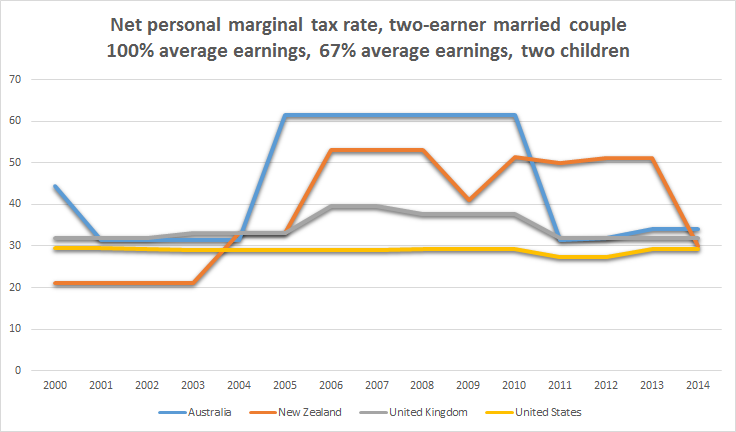
Source: OECD StatExtract.
22 Aug 2015 Leave a comment
in economic history, economics of love and marriage, labour economics, labour supply, politics - Australia, politics - New Zealand, politics - USA Tags: Australia, British economy, marriage and divorce, taxation and labour supply
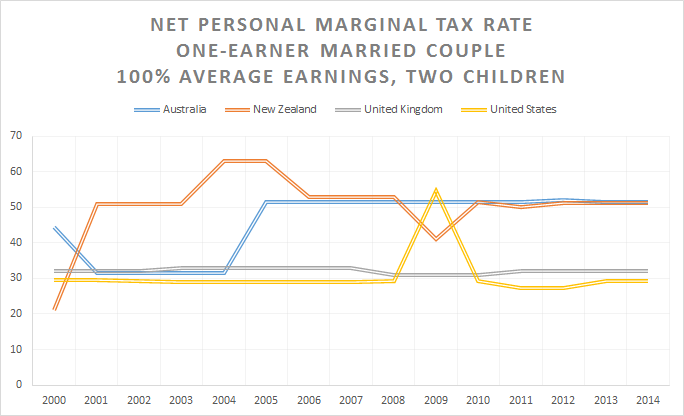
Source: OECD StatExtract.
15 Aug 2015 Leave a comment
in economics of love and marriage, human capital, labour economics, law and economics, welfare reform Tags: child rearing, economics of families, marital division of labour, marriage and divorce
More time with mom has little to no effect on children's well-being: thesocietypages.org/socimages/2015… http://t.co/zyirz1QvQs—
(@SocImages) April 08, 2015
Celebrating humanity's flourishing through the spread of capitalism and the rule of law
Celebrating humanity's flourishing through the spread of capitalism and the rule of law
Celebrating humanity's flourishing through the spread of capitalism and the rule of law
Celebrating humanity's flourishing through the spread of capitalism and the rule of law
Celebrating humanity's flourishing through the spread of capitalism and the rule of law
Celebrating humanity's flourishing through the spread of capitalism and the rule of law
Celebrating humanity's flourishing through the spread of capitalism and the rule of law
A History of the Alt-Right
Econ Prof at George Mason University, Economic Historian, Québécois
Celebrating humanity's flourishing through the spread of capitalism and the rule of law
Scholarly commentary on law, economics, and more
Beatrice Cherrier's blog
Celebrating humanity's flourishing through the spread of capitalism and the rule of law
Celebrating humanity's flourishing through the spread of capitalism and the rule of law
Celebrating humanity's flourishing through the spread of capitalism and the rule of law
Why Evolution is True is a blog written by Jerry Coyne, centered on evolution and biology but also dealing with diverse topics like politics, culture, and cats.
Celebrating humanity's flourishing through the spread of capitalism and the rule of law
A rural perspective with a blue tint by Ele Ludemann
DPF's Kiwiblog - Fomenting Happy Mischief since 2003
Celebrating humanity's flourishing through the spread of capitalism and the rule of law
The world's most viewed site on global warming and climate change
Tim Harding's writings on rationality, informal logic and skepticism
A window into Doc Freiberger's library
Let's examine hard decisions!
Commentary on monetary policy in the spirit of R. G. Hawtrey
Thoughts on public policy and the media
Celebrating humanity's flourishing through the spread of capitalism and the rule of law
Politics and the economy
A blog (primarily) on Canadian and Commonwealth political history and institutions
Reading between the lines, and underneath the hype.
Economics, and such stuff as dreams are made on
"The British constitution has always been puzzling, and always will be." --Queen Elizabeth II
Celebrating humanity's flourishing through the spread of capitalism and the rule of law
Celebrating humanity's flourishing through the spread of capitalism and the rule of law
WORLD WAR II, MUSIC, HISTORY, HOLOCAUST
Undisciplined scholar, recovering academic
Celebrating humanity's flourishing through the spread of capitalism and the rule of law
Res ipsa loquitur - The thing itself speaks
In Hume’s spirit, I will attempt to serve as an ambassador from my world of economics, and help in “finding topics of conversation fit for the entertainment of rational creatures.”
Researching the House of Commons, 1832-1868
Articles and research from the History of Parliament Trust
Reflections on books and art
Posts on the History of Law, Crime, and Justice
Celebrating humanity's flourishing through the spread of capitalism and the rule of law
Exploring the Monarchs of Europe
Cutting edge science you can dice with


Recent Comments