Figure 1: Female/male earnings ratio by partner status and motherhood, 2004 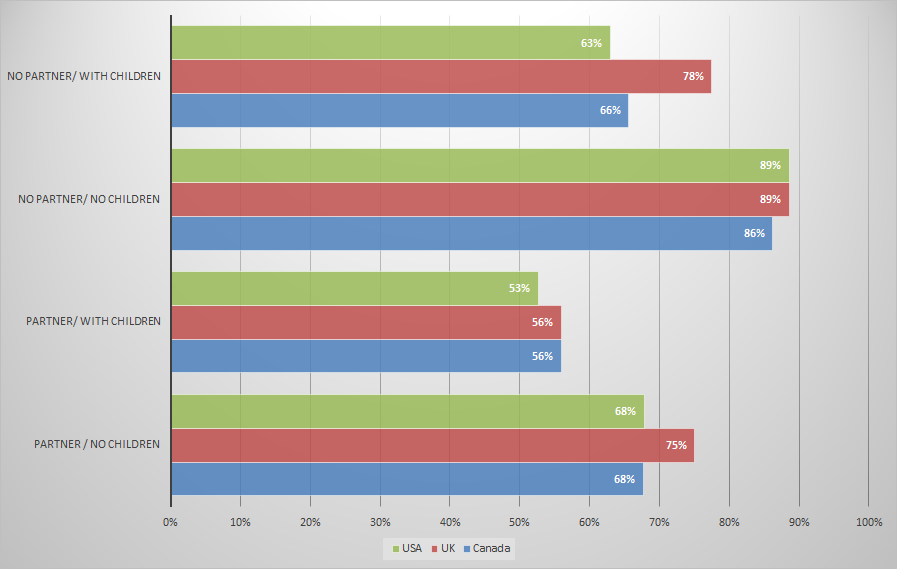 Source: LIS Cross-National Data Center in Luxembourg – Wave VI; individuals with positive earnings only. .
Females/male earnings ratio by partner status and motherhood – USA, UK, Canada
12 Jul 2015 Leave a comment
in discrimination, economics of love and marriage, gender, labour economics, labour supply, law and economics, occupational choice, politics - USA, poverty and inequality Tags: asymmetric marriage premium, British economy, Canada, gender wage gap, marriage and divorce, motherhood penalty
Poverty rates by age of youngest child – USA, UK, Canada and Australia
11 Jul 2015 Leave a comment
in economics of love and marriage, labour economics, labour supply, law and economics, politics - Australia, politics - USA, poverty and inequality, welfare reform Tags: Australia, British economy, Canada, child poverty, family poverty, marriage and divorce, single mothers, single parents
Figure 1: poverty rates by age of youngest child, 2004

Employment patterns of couples differential with families differ greatly across the OECD
10 Jul 2015 Leave a comment
in economics of love and marriage, gender, labour economics, labour supply, occupational choice Tags: economics of family, female labour force participation, labour force participation, maternal labour force participation, my labour force participation, part-time work
American exceptionalism: U.S parents more likely to both be working full time than almost any other OECD country http://t.co/QYBEeUmws4—
Kay Hymowitz (@KayHymowitz) July 08, 2014
Age differences in marriage
07 Jul 2015 1 Comment
in economics of love and marriage, law and economics Tags: family demographics, marriage and divorce
Most People Marry Someone Their Own Age: dadaviz.com/i/3343 #dataviz http://t.co/bZ90LtK508—
Randy Olson (@randal_olson) February 24, 2015
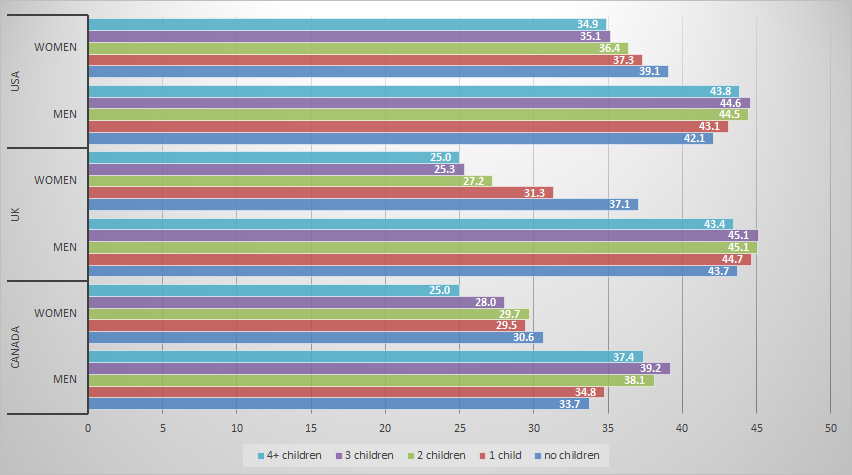
Average weekly working hours by gender and presence of children, Canada, UK and USA
07 Jul 2015 Leave a comment
in discrimination, economics of love and marriage, gender, labour economics, labour supply, law and economics Tags: economics of fertility, female labour force participation, household division of labour, marriage and divorce, maternal labour force participation
Figure 1: average weekly working hours for Current or Last Job(s) Held aged 20-54 by gender, 2004
Average age of marriage by gender since 1890 in the USA
05 Jul 2015 Leave a comment
in economic history, economics of love and marriage, economics of media and culture, law and economics, politics - USA Tags: economics of families, family demographics, marriage and divorce
Mawwiage. Mawwiage is wut bwings togetha… men who are about 2.5yrs older than their female counterparts. http://t.co/KQqKmNJn7P—
Tyler Vigen (@TylerVigen) May 25, 2015
Dual income nation
05 Jul 2015 Leave a comment
in economics of love and marriage, labour economics, labour supply, politics - USA, poverty and inequality Tags: asymmetric marriage premium, dual income couples, economics of families, reversing gender gap
The household division of labour and recreation
03 Jul 2015 Leave a comment
in economics of love and marriage, law and economics Tags: household division of labour, household production, marriage and divorce
Arnie’s new picture profile
30 Jun 2015 Leave a comment
in economics of love and marriage, law and economics, politics - USA Tags: economics of marriage, gave marriage, marriage and divorce
Arnie had the perfect response to a man criticising his pro-gay marriage photo i100.io/sGqSNTQ http://t.co/kfweyy8xAW—
i100 (@thei100) June 30, 2015
% of children living with 2 parents
23 Jun 2015 Leave a comment
% of children living with 2 parents
Israel 92%
Egypt 89
Turkey 88
Brazil 72
US 69
S Africa 36worldfamilymap.org/2014/e-ppendix… http://t.co/GveypeU6tK—
Conrad Hackett (@conradhackett) June 22, 2014
Many American families face negative affected income taxes rates
23 Jun 2015 Leave a comment
in economics of love and marriage, labour economics, politics - USA, public economics Tags: earned income tax credit, economics of families, family tax credits
What happened to black family formation in the 1970s?
22 Jun 2015 Leave a comment
in economics of love and marriage, labour economics, labour supply, law and economics, occupational choice Tags: child poverty, economics of the family, family poverty, single mothers, single parents
The War On Poverty has been a disaster for black kids. 2x kids living with unmarried mom. bit.ly/1alPWKB http://t.co/Cwi4C5NtHz—
Old Whig (@aClassicLiberal) April 12, 2015
The impact of parental employment on child poverty in couple families, Anglo-Saxon countries
21 Jun 2015 Leave a comment
in economics of love and marriage, labour economics, labour supply, law and economics, politics - Australia, politics - New Zealand, politics - USA, population economics, poverty and inequality, welfare reform Tags: Australia, British economy, Canada, child poverty, economics of families, family poverty, Ireland, labour force participation, single parents
Figure 1: child poverty rates in couple families by employment status, Anglo-Saxon countries, 2010
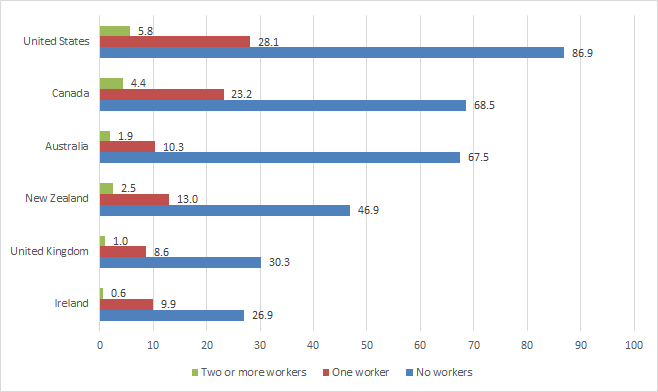
Source: OECD Family Database; Poverty thresholds are set at 50% of the median income of the entire population.
How the average day of American mums and dads has changed since 1965
12 Jun 2015 Leave a comment
in discrimination, economics of love and marriage, gender, labour economics, labour supply, law and economics, occupational choice Tags: economics of the family, home production, household division of labour, marriage and divorce
#Dailychart: How the average day of American mums and dads has changed since 1965 econ.st/1Hi43yt http://t.co/tY5DSpdVKN—
The Economist (@EconBizFin) June 08, 2015
Trends in what drives single motherhood
11 Jun 2015 Leave a comment
Divorce used to be biggest engine of single parenthood in America. No more. It's nonmarital childbearing cc@davidfrum http://t.co/J5yZtUukNW—
W Bradford Wilcox (@WilcoxNMP) June 10, 2015


Recent Comments