What Do People Say on a Good First Date?
priceonomics.com/what-people-sa… http://t.co/FGQ6m4cz8N—
Priceonomics (@priceonomics) May 22, 2015
What Do People Say on a Good First Date?
26 Sep 2015 Leave a comment
in economics of love and marriage, law and economics Tags: dating market, marriage market, search and matching
The decline of the traditional British family
26 Sep 2015 Leave a comment
in economic history, economics of love and marriage Tags: British economy, British history, British politics, economics of fertility, economics of the family, family demographics, marriage and divorce, single families, single mothers
https://twitter.com/ONS/status/624500831023407104/photo/1
Almost half of all babies (47.5%) are now born outside marriage/civil partnership ow.ly/PDqCi http://t.co/aVqG1GAqMA—
(@ONS) July 15, 2015
Another reason not to have a car alarm
26 Sep 2015 Leave a comment
in economics of crime, law and economics Tags: car alarms, crime and punishment, criminal deterrence, law and order
Car Alarms are completely f*cking useless.
priceonomics.com/are-car-alarms… http://t.co/tmJDHeIiGp—
Zachary Crockett (@zzcrockett) July 28, 2015
Drug Price Controls End Up Costing Patients Their Lives
24 Sep 2015 Leave a comment
in applied price theory, applied welfare economics, comparative institutional analysis, economics of regulation, entrepreneurship, health economics, industrial organisation, law and economics, politics - USA, property rights, survivor principle Tags: creative destruction, endogenous growth theory, innovation, intellectual property rights, patents and copyrights, pharmaceutical innovation, price controls
Our research shows that when prices fall, innovation falls even more. Patients would see their lives cut short by delayed or absent drugs.
Source: Drug Price Controls End Up Costing Patients Their Health – NYTimes.com
…cutting prices by 40 to 50 percent in the United States will lead to between 30 and 60 percent fewer R and D projects being undertaken in the early stage of developing a new drug. Relatively modest price changes, such as 5 or 10 percent, are estimated to have relatively little impact on the incentives for product development – perhaps a negative 5 percent.
Source: The Effect of Price Controls on Pharmaceutical Research


Entrepreneurial alertness in vehicle emissions testing
23 Sep 2015 1 Comment
in economics of crime, entrepreneurship, environmental economics, industrial organisation, law and economics, survivor principle, transport economics Tags: air pollution, entrepreneurial alertness, vehicle emissions testing, Volkswagen
Here's how Volkswagen's system for fooling the emission tests worked: nyti.ms/1Fdlcus http://t.co/U7hlLejNK0—
NYT Business (@nytimesbusiness) September 22, 2015
Many conservationists are against effective rhino conservation
23 Sep 2015 Leave a comment
in applied price theory, development economics, entrepreneurship, environmental economics, growth disasters, growth miracles, law and economics, property rights Tags: Africa, agricultural economics, do gooders, economics of conservation, economics of endangered species, endangered species, expressive voting, Leftover Left, Twitter left, unintended consequences
https://twitter.com/ConversationUK/status/646227223716872197/photo/1
https://twitter.com/dlAfrican/status/646215227076292608
Capturing the economic value of wildlife for the benefit of wildlife. New in PERC Reports: bit.ly/1JHerwj http://t.co/yijFIChPDo—
PERC (@PERCtweets) September 13, 2015
How private ownership and trophy hunting saved the southern white rhino: bit.ly/1HhZy55 #WorldRhinoDay http://t.co/s4PudPwrrI—
PERC (@PERCtweets) September 22, 2015
Deaths in police car chases
22 Sep 2015 Leave a comment
in economics of crime, law and economics, politics - USA Tags: crime and punishment, law and order, police, police car chases

@GreenpeaceNZ should not support the vexatious claims of climate refugees @NZGreens
22 Sep 2015 Leave a comment
in Economics of international refugee law, environmental economics, global warming, international economics, law and economics, politics - New Zealand Tags: climate refugees, global warming, Greenpeace, Kiribati, nuisance suits, political refugees, vexatious litigation, war refugees
Political support is tenuous enough for admitting more political refugees and war refugees to New Zealand without visa overstayers trying it on with claims for asylum on the basis of climate change – that they are a climate refugee.
Currently New Zealand small refugee quota of 750 is under review. Chances of that been increased to 1000 are reasonable. If people are trying to open the floodgates to millions of people as potential refugees of climate change, if Greenpeace’s own alarmist rhetoric about global warming is to be believed, Greenpeace only strengthens the hand of the anti-immigration and xenophobic parties such as New Zealand First and within the National Party caucus.
Not everyone is a worthy cause, particularly those who make vexatious legal claims that were always going to fail in court. The High Court, the Court of Appeal and the Supreme Court all ruled that it is not their place to expand the scope of the international refugee convention to cover those displaced by climate change. As the Court of Appeal ruled
No-one should read this judgment as downplaying the importance of climate change. It is a major and growing concern for the international community. The point this judgment makes is that climate change and its effect on countries like Kiribati is not appropriately addressed under the Refugee Convention.
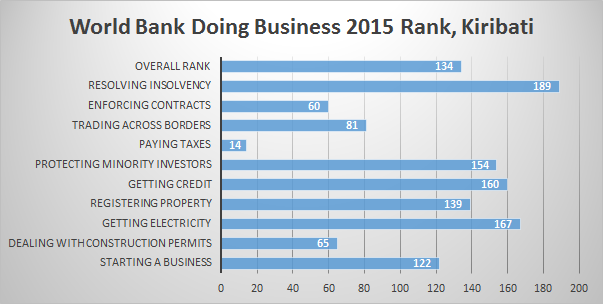
Source: Doing Business in Kiribati – World Bank Group
Kirabati can do a lot more to help itself rather than looking to others to solve its problems. It is ranked 133rd in the World Bank’s Doing Business database. This means it can do a lot to help its own development, which strengthens its resilience against climate change and rising sea levels. In the High Court, Priestley J observed:
The economic environment of Kiribati might certainly not be as attractive to the applicant and his fellow nationals as the economic environment and prospects of Australia and New Zealand. But he would not, if he returns, be subjected to individual persecution…
The appellant raised an argument that the international community itself was tantamount to the “persecutor” for the purposes of the Refugee Convention. This completely reverses the traditional refugee paradigm. Traditionally a refugee is fleeing his own government or a non-state actor from whom the government is unwilling or unable to protect him. Thus the claimant is seeking refuge within the very countries that are allegedly “persecuting” him.
Kiribati’s Human Development Index value for 2012 is 0.629—in the medium human development category—positioning the country at 121 out of 187 countries and territories. The rank is shared with Indonesia and South Africa. Kiribati is not unusually poor if it is similar in human development index ranking is to Indonesia and South Africa. Since 1980, Kiribati life expectancy at birth has increased from 55 years to 68 years. Average years of schooling is nearly 8 years and expected years of schooling for their children is now 12 years.
728 shot by police by race, 2015 @thecounted @radleybalko @Mark_J_Perry
21 Sep 2015 1 Comment
in economics of crime, law and economics, politics - USA Tags: crime and punishment, law and order, police, police shootings
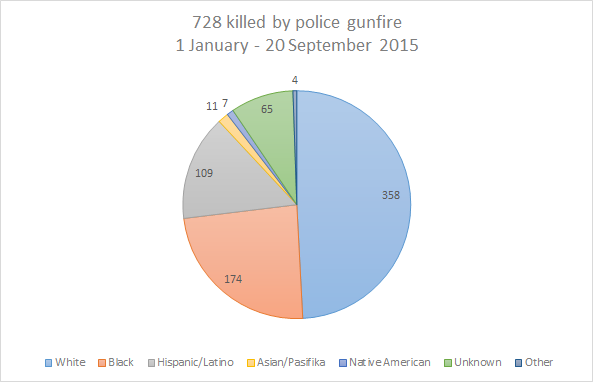
Source: The Counted: people killed by police in the United States in 2015 – interactive | US news | The Guardian accessed 20 September 2015 New Zealand standard time.
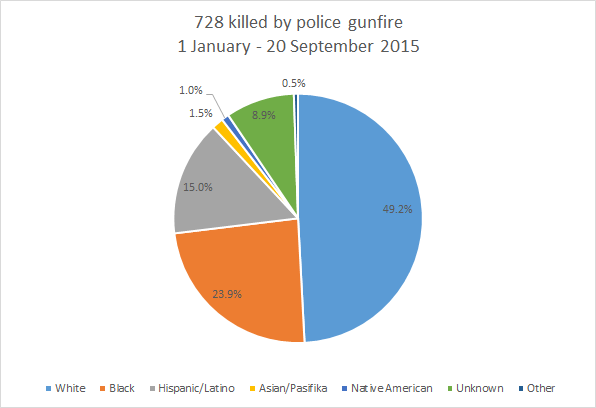
Source: The Counted: people killed by police in the United States in 2015 – interactive | US news | The Guardian accessed 20 September 2015 New Zealand standard time.
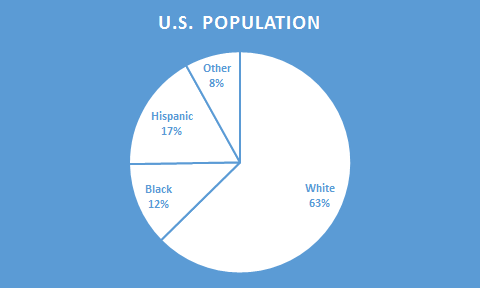
@ChristchurchCC Deputy Mayor is clueless about the criminal justice system
21 Sep 2015 Leave a comment
in economics of crime, law and economics, politics - New Zealand, television, transport economics, urban economics Tags: crime and punishment, evidence-based policy, law and order, local government, rational ignorance, rational rationality, road safety, Yes Minister
 In responding to demands for police to crack down on windscreen washers, some of whom intimidate motorists to pay, the deputy mayor of Christchurch showed a cultured ignorance of youth courts. She has never read newspaper reports that show that youth court defendants are never named and their convictions are not held against them as adults. Furthermore, she is unaware of the spent convictions law in New Zealand that expunges most convictions after seven years, especially petty convictions.
Stigler on economics as a big tent @RusselNorman @NZGreens @GreenpeaceNZ @Mark_J_Perry
21 Sep 2015 1 Comment

The 43 Taser deaths by race in 2015 @thecounted @radleybalko @Mark_J_Perry
21 Sep 2015 Leave a comment
in economics of crime, law and economics, politics - USA Tags: crime and punishment, law and order, police, tasers

Source: The Counted: people killed by police in the United States in 2015 – interactive | US news | The Guardian accessed 1:30 p.m. 20 September 2015 New Zealand standard Time.

Source: The Counted: people killed by police in the United States in 2015 – interactive | US news | The Guardian accessed 1:30 p.m. 20 September 2015 New Zealand standard Time.
Why did married couples get a pass on the great wage stagnation and the ravages of the top 1%?
20 Sep 2015 Leave a comment
in economics of love and marriage, labour economics, law and economics, poverty and inequality Tags: asymmetric marriage premium, economics of fertility, female labour force participation, male labour force participation, marriage and divorce, maternal labour force participation, single mothers, single parents
Marriage used to be a pairing of opposites: Men would work for pay and women would work at home. But in the second half of the 20th century, women flooded the labour force, raising their participation rate from 32 percent, in 1950, to nearly 60 percent in the last decade. As women closed the education gap, the very nature of marriage has changed. It has slowly become an arrangement pairing similarly rich and educated people. Ambitious workaholics used to seek partners who were happy to take care of the house. Today, they’re more likely to seek another ambitious workaholic.


The rich and educated are more likely to marry, to marry each other, and to produce rich and educated children. But this virtual cycle turns vicious for the poor.
Source: How America’s Marriage Crisis Makes Income Inequality So Much Worse – The Atlantic
@thecounted How did the 24 unarmed Hispanics/Latinos killed by police in 2015 die @radleybalko @Mark_J_Perry
20 Sep 2015 Leave a comment
in economics of crime, law and economics, politics - USA Tags: crime and punishment, criminal deterrence, law and order, police, police shootings
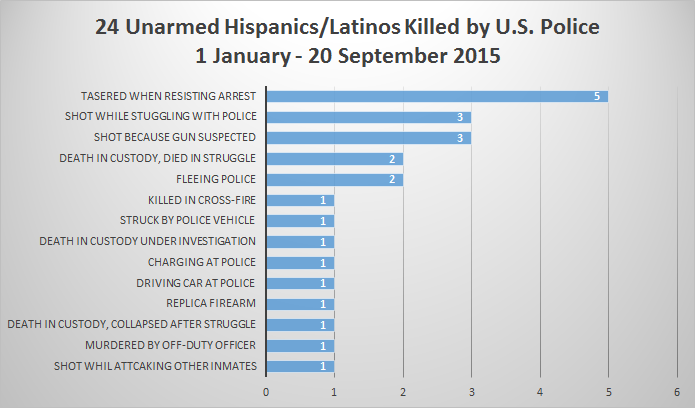
Source: The Counted: people killed by police in the United States in 2015 – interactive | US news | The Guardian accessed 1 p.m. 20 September 2015 New Zealand standard Time.
.
 Utopia, you are standing in it!
Recent Comments