Marijuana arrests by Presidential administration http://t.co/I3rpQxI7ag | pic.twitter.com/K5VIIpSXbf
— Explaining Sapiens (@XplningSapiens) March 28, 2015
Poverty and family structure in America
28 Mar 2015 Leave a comment
in economics of love and marriage, gender, labour economics, labour supply, politics - USA, poverty and inequality Tags: child poverty, single parents

Australia takes eight times as many refugees as New Zealand, per capita
27 Mar 2015 Leave a comment
in Economics of international refugee law, politics - Australia, politics - New Zealand Tags: economics of immigration, refugees
Sweden – the OECD's highest per capita recipient of asylum seekers bit.ly/1vfFEUh http://t.co/y6DmdJjAsE—
Guardian Data (@GuardianData) December 02, 2014
England riots culprits jailed for 1,800 years, which deterred crime
26 Mar 2015 Leave a comment
in economics of crime, labour economics, law and economics, occupational choice Tags: crime and punishment, criminal deterrence, London riots


The level of lawlessness was shocking and wholly inexcusable. The imposition of severe sentences, intended to provide both punishment and deterrence, must follow…
The context hugely aggravates the seriousness of each individual offence … the sheer numbers involved may have led some of the offenders to believe that they were untouchable and would escape detection…
When there is wanton and vicious violence of gross degree the court is not concerned with whether it originates from gang rivalry or from political motives. It is the degree of mob violence that matters and the extent to which the public peace is broken.”
The Lord Chief Justice Judge
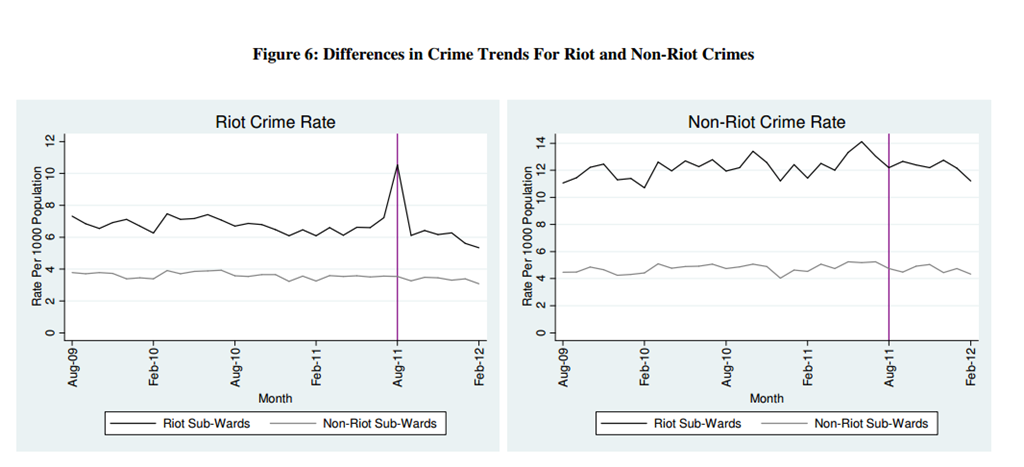
The response of the criminal fraternity in London to the sentences handed out during the London riots was very business like. Offending for those particular sentences dropped. Criminals substituted to other forms of crime to pursue their chosen occupation as a criminal in light of the changed incentives:
…a significant drop in riot crimes across London in the six months after the riots, consistent with a deterrence effect from the tougher sentencing. More evidence of general deterrence comes from the observation that crime also fell in the post‐riot aftermath in areas where rioting did not take place.
Is this the beginning of the rule of law in China? The right to say no to local bureaucrats?
24 Mar 2015 Leave a comment
in development economics, growth miracles, law and economics, property rights Tags: China, compulsory acquisition, rule of law, takings
An honest question for the Anti-science Left
24 Mar 2015 Leave a comment
in economics of crime, economics of media and culture, health economics, law and economics Tags: Anti-Science left, conjecture and refutation, eco-terrorism, philosophy of science
The North–South theory of product life cycles
23 Mar 2015 Leave a comment
in comparative institutional analysis, entrepreneurship, industrial organisation, law and economics, managerial economics, organisational economics, property rights, survivor principle, theory of the firm Tags: entrepreneurial alertness, foreign direct investment, incomplete contracts, incomplete property rights, North-South product life cycle, product life cycles
Forecasts of the offshoring of service jobs, as an example, can be constituted into a theory of North-South product cycles. The North-South theory of the life cycle of products starts with their research and development and refinement by entrepreneurs in the advanced countries (the North) with some exporting (Grossman and Helpmann 1991a, 1991b). These innovations require resources to be invested with uncertain prospects of success. Entrepreneurs in the North compete to discover new technology-intensive products using the ample supply of R&D workers and human capital-rich workers in the industrialised countries (Grossman and Helpmann 1991a, 1991b).

As a new product matures and its production becomes more standardised, the bulk of its production can migrate to the less developed countries (the South) to take advantage of lower production costs, and these countries will become net exporters. In the South, entrepreneurs focus more on imitation. They invest resources in importing and learning the production processes developed and proven to be a success in the North (Grossman and Helpmann 1991a, 1991b).
The shifting of production of standardised products to lower-wage foreign locations will frequently be within the originating company via a foreign affiliate, because of uncertainties about property rights and contract enforcement institutions in the host countries, and only later to independent foreign firms (Antràs 2005). Within corporate hierarchies, the high-skilled managers in the developed countries will specialise in problem-solving and non-routine tasks. They will interact with middle managers and production workers in developing countries who perform the routine tasks (Antràs et al. 2006, 2008).
Contracts are typically incomplete either because they are difficult to write and/or because the court cannot enforce them. The World Trade Organization (2005, 2008) concluded that, for example, the location of offshored services depends on:
- labour costs,
- trade costs,
- the quality of institutions, particularly the legal framework,
- the tax and investment regime,
- the quality of infrastructure, particularly telecommunications, and
- skills, particularly language and computer skills.
Risks in contract negotiation and enforcement will influence which types of production is outsourced. Roughly one-third of world trade is infra-firm, and this intra-firm trade is concentrated in the capital-intensive industries because of the costs and risks of investing in contracting with arm’s-length suppliers (Antràs 2003). Considerations about R&D incentives, the availability of human capital and the quality of contract enforcement institutions weigh heavily on the development of new products and their initial and later locations of different stages of production.
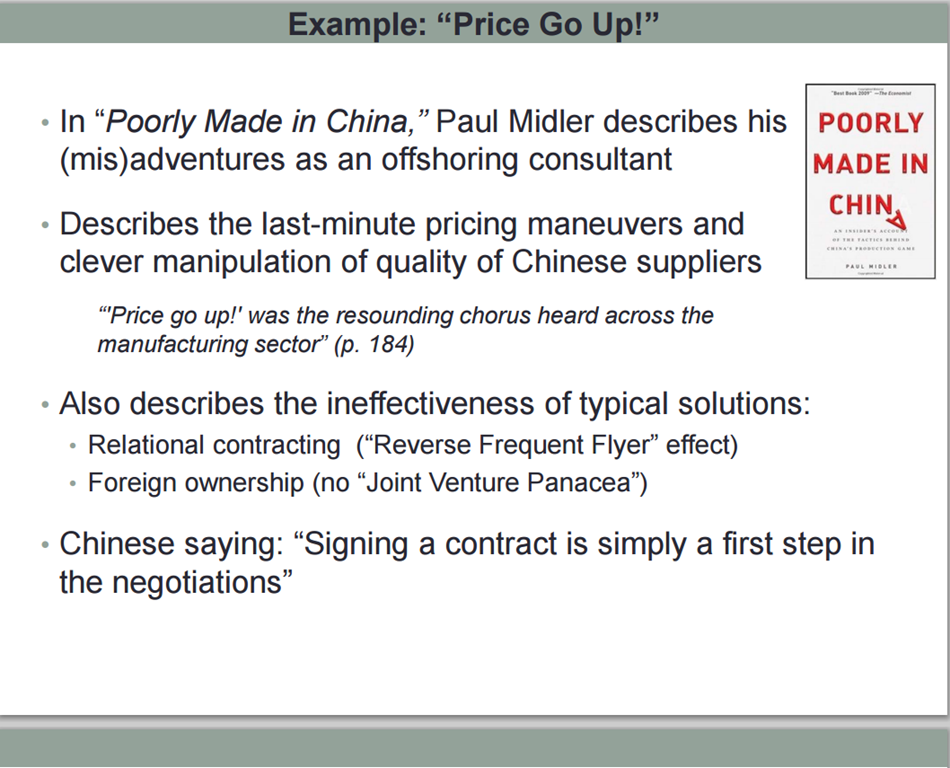
Products are initially developed in the highly industrialised countries because their sophisticated legal systems allow contracts to be enforced. Even then, in industrialised countries, the difficulties of writing and enforcing complicated contracts over the quality of new products early in the product life cycle encourages firms to make those products internally within the firm. Early in the product life cycle, if sub-contractors were used for key imports, there would have to be continual renegotiation of contracts contracts to incorporate new innovations and learning by doing. As Antras says:
Global production networks necessarily entail intensive contracting between parties located in different countries and thus subject to distinct legal systems0
As the new product standardises, and product quality in consequence becomes easier to measure and contract over, initially the innovating firm will sub-contract within the industrialised country but in time will import from developing countries. In the first instance, these imports may be from affiliates established in the developing country to ensure greater control of product quality through direct ownership of the factory. As Antras says:
Firms contemplating doing business in a country with weak contracting institutions might decide to do so within firm boundaries to have more control.
The size and shape of the firm is a direct response to mitigate the costs of contracting over quality that is hard to measure and which is constantly changing early in the product cycle. By assigning ownership rights to the party undertaking the more important investment in quality early in the product life cycle, entrepreneurs and innovators can minimise the losses caused by lack of enforceable contracts over quality when quality is changing rapidly as the firm moves through the product life cycle.

Boeing blamed the delays on the delivery of the Dreamliner on an unwillingness of sub-contractors to stand by their contractual obligations. In response, Boeing acquired some of the key sub-contractors to ensure that they delivered as promised. This is a classic operation of the theory of the firm where the entrepreneur brings within the firm what is too expensive to transact on the market because of difficulties in measuring quality and defining and enforcing property rights over what has been contracted.
Sales to locations with weak contractual enforcement are more likely to be cash in advance
22 Mar 2015 Leave a comment
in comparative institutional analysis, development economics, law and economics, property rights
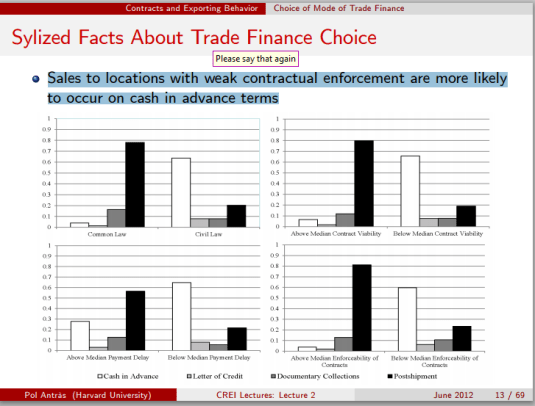
In another triumphant British Justice, trade credit is much more likely in common law countries and in countries with honest courts.
The Economic Determinants of Marriage | Demos
21 Mar 2015 Leave a comment
in economics of love and marriage, labour economics, law and economics Tags: engines of liberation, single parenthood, single parents

Men near the bottom of the ladder have seen their earnings and economic status collapse. This has made them less attractive mates, both because of the earnings collapse itself and some of its likely secondary effects. Diminished capacity to support others, especially relative to a normal standard of living, might also cause them to find relationships less attractive or even humiliating.
Women across the board have seen their economic prospects improve. This has made them more capable of escaping or avoiding miserable and abusive relationships, which are much more common on the bottom.

Indian parents are scaling walls to help their kids cheat because economics
20 Mar 2015 Leave a comment
in economics of crime, economics of education, human capital, occupational choice Tags: cheating, signalling
I ask what is the point of passing an exam where there is widespread cheating, and in consequence the exam has little credibility. What is the point of holding an exam when there is widespread cheating?
If you seek to learn skills, cheating would be totally counter-productive. But if the exam simply produces a credential that people accept, students look for ways to get the credential as painlessly as possible.
Cheating works best if the signalling model of education is true. Students should cheat more in those courses that offer the least productivity gains.
Serious cheaters have been found to be more likely to be younger and have a lower grade point average. But as Alex Tabarrok argues
“I sometimes find evidence of cheating on exams but I rarely take action, I don’t have to. Almost invariably the cheaters get abysmally low grades even without penalty.
Some people I know get annoyed when students without evident handicap ask for and receive special treatment such as extra time on exams. I comply without rancor as the extra time never seems to help. Over the years I have had a number of students ask for incompletes. None have ever become completes.
I call this the law of below averages.”
How better educated whites are driving political polarization – The Washington Post
20 Mar 2015 Leave a comment
in economics of love and marriage, gender, politics - USA, Public Choice Tags: abortion, political polarisation

On or about 1990, as a latter-day Virginia Woolf might say, American politics changed. I wouldn’t take the blip of the dotted line at 1990 very seriously–sampling variability and all that–but the general pattern in the graph above is real, and appear in all sorts of other data. In 1988 and before: zero correlations of partisanship with attitudes; since 1992, the correlations have been big and getting larger…
Not only is the abortion/party relationship primarily driven by whites, it is substantially stronger among white elites–that is, people with high income, education, or levels of political information.

via How better educated whites are driving political polarization – The Washington Post.
On marijuana, Obama is content to evolve rather than to lead the way – The Washington Post
18 Mar 2015 Leave a comment
in economics of crime, economics of media and culture, health economics, liberalism, politics - USA, Public Choice Tags: marijuana decriminalisation, medical marijuana decriminalisation
For a lame duck president doing a lot to cultivate his legacy, Obama is really dragging his feet here if he is in any way a social liberal

via On marijuana, Obama is content to evolve rather than to lead the way – The Washington Post.

 Utopia, you are standing in it!
Recent Comments