
How to beat the share market
15 Aug 2014 Leave a comment
in economics of crime, financial economics, Public Choice, rentseeking Tags: insider trading, official corruption
Become a United States senator. Their share portfolios out-perform the best of the best hedge fund managers, and the best hedge fund manager was paid 3 1/2 billion dollars last year; to get on the list for the top hedge fund manager, you make at least $300 million a year. Good things that politicians know how to outperform them on their modest salaries and busy schedules of public engagements and parliamentary sittings.
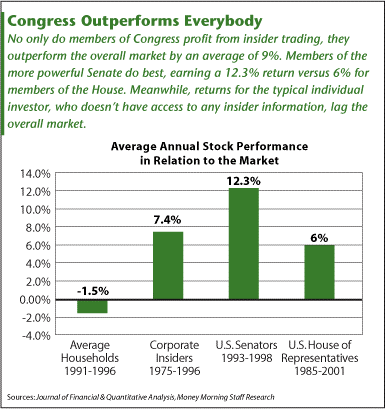
Using the financial disclosures of politicians, "Abnormal Returns From the Common Stock Investments of Members of the U.S. House of Representatives," built model portfolios and charted their performance. They found that House members outperform the market by 6 percentage points. Senators do even better, the authors say, citing their own earlier research from 2004.
Senate portfolios "show some of the highest excess returns ever recorded over a long period of time, significantly outperforming even hedge fund managers," with gains that are "both economically large and statistically significant."
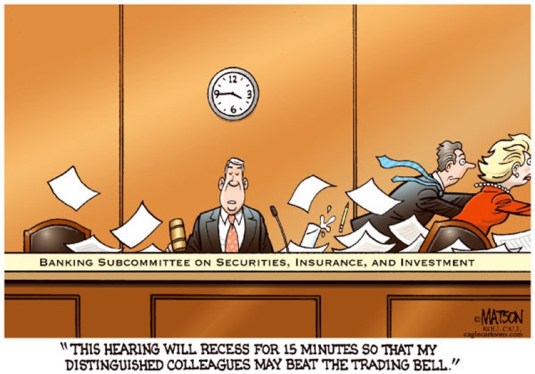
These results suggest that congressmen and senators have access to non-public information on particular businesses, industries or the economy as a whole and invest on the basis that information. The good returns of Senators and Congressmen last far too long to be no more than luck.
Hate speech is still speech, and much of hate speech is the gauche expression of everyday ideas
12 Aug 2014 Leave a comment
in constitutional political economy, law and economics, liberalism Tags: free speech, hate speech, political correctness, trigger warning

A lot of polite political conversation is, on close inspection, hate speech but expressed with the manners your mother taught you. Well-brought up children can get their ideas across with just as much bite as the uncouth without going potty mouthed.
Now let’s think of religion: leaving to one side the hateful things religions say about each other, according to them religious types, we non-believers are supposed to burn in the Devil’s own private furnace. As I recall, Baptists believe that the Pope is the Antichrist and the mass is idolatry.

In an age of information overload, it is easy to fall back on our own prejudices and insulate ourselves with comforting opinions that reaffirm our core beliefs. the blogosphere forms into information cocoons and echo chambers. People can avoid the news and opinions they don’t want to hear.
The politically correct are often among the most uncouth. Some of the worst things said about Sarah Palin in 2008 cannot be repeated on a blog hoping to be safe to view at work.

Marxist ideologies even worse: it should have a trigger warning over the entire field because of a hurtful things it says about capitalists and their motivation.

Scorn, ridicule and satire is as welcome as a bee sting and is always controversial to some and continuously goes beyond the bounds of good taste and conventional manners. Scorn, ridicule and satire often shock people into reconsidering their world view.

In a court case about a particularly vile cartoon in Hustler about Jerry Falwell, the United States Supreme Court said:
Debate on public issues will not be uninhibited if the speaker must run the risk that it will be proved in court that he spoke out of hatred; even if he did speak out of hatred, utterances honestly believed contribute to the free interchange of ideas and the ascertainment of truth…
The appeal of the political cartoon or caricature is often based on exploitation of unfortunate physical traits or politically embarrassing events – an exploitation often calculated to injure the feelings of the subject of the portrayal.
A good example of using shock value to make a point is the Ohio strip club that held a topless counter-protest outside a church they were attempting to shut down.

The target of their counter-protest was a church that spent the last nine years protesting outside their club seeking to shut it down. You must admire both side’s determination.


What a member of parliament is, is a legal curio. So are heads of state.
11 Aug 2014 1 Comment
in constitutional political economy, economics of crime, law and economics, property rights Tags: bribery and corruption, constitutional law, patronage

Under the Sale of Offices Act 1809, the sale of House of Commons seats was outlawed so membership of parliament must be freehold property. Prior to that 1808 Act, there is a lively trade in seats in the House of Commons: you can buy them outright, or just rent a seat for a session of Parliament.
- Being paid a salary as a member of parliament is very 20th century with the House of Representatives beating the House of Commons by 5 years.
- Back in 1695, the House of Commons resolved that offering a bribe to a Member of Parliament shall be a high crime and misdemeanour liable to impeachment, and an MP accepting such a bribe shall be a matter of privilege.
- In 1858, the House resolved to prohibit advocacy for fee or reward.
- In 1947, a further resolution banning MPs from entering agreements which restricted their freedom to act and speak, or require them to act as a representative of outside bodies.
Prior to the 19th century virtually all European civil appointments were made through outright sale or patronage, included judicial courts, public finance, sheriffs, and notaries public so the offices were freeholds – effectively private property.
Once an office had been granted it could be mortgaged, sold privately or through public auction, and bequeathed to heirs. The key source of income from most offices was the right to charge fees for service.
The buying and selling applied to army officer commissions, but never to the British navy for reasons explained by Doug Allen in his clever writings on the economics of patronage and veniality. The sale of military commissions ended in 1871.
The queen is corporation sole in perpetual succession – she or he may possess property as monarch which is distinct from the property he or she possesses personally, and may do acts as monarch distinguished from their personal acts.
Elizabeth II has several corporations sole – Her Majesty the Queen in Right of the United Kingdom, Her Majesty the Queen in Right of Canada, Her Majesty the Queen in Right of Australia are all distinct corporations sole. She is also a distinct corporation sole for states and provinces.
Ministers of the crown can be corporations sole. This is administratively convenient as regards the ownership of property because it facilitates continuity when the office-holder changes.
There ends today’s trivia.
Why Bills of Rights
08 Aug 2014 Leave a comment
in constitutional political economy, law and economics Tags: Bill of Rights, democracy, Justice Robert Jackson, rule of law

Advertising and free speech: the best test of truth is the power of the thought to get itself accepted in the competition of the market
08 Aug 2014 Leave a comment

The deterrent effect of the sentences handed down in the immediate aftermath of the London riots 2011
05 Aug 2014 Leave a comment
in economics of crime, law and economics Tags: crime and punishment, criminal deterrence, London riots 2011
Savage criminal sentences were handed down by the courts in the days after the London riots in 2011.
- Nicholas Robinson (aged 23) was sentenced to 6 months imprisonment for stealing bottles of water (worth £3.50) from a looted shop in Brixton. His previous good character and early plea of guilty to a non-dwelling burglary, as well as the low value of goods stolen, the fact he was in education, and his remorse, were in his favour. These meant the magistrate decided to not send him up to the Crown Court where he would face a possible higher sentence.
- Danielle Corns (19) was sentenced to 10 months for stealing two left-footed trainers in Wolverhampton and leaving them outside the shop.
- Two 20-year olds were sentenced to 4 years imprisonment for creating a Facebook riot event in Northwich (which didn’t occur and to which no one attended).
7 out of 10 of sentences issued in the aftermath of the London riots were upheld in full in the Court of Appeal. Any reductions were modest. The longer sentence handed out was 23 years for conspiracy to murder to the leader of a gang who planned to drive to the riots carrying guns to attack the police.

Brian Bell, Laura Jaitman and Stephen Machin (2014) used this sudden change in the judicial wind to measure the impact of tough sentences on crime.
Across London, they found a significant drop in “riot crimes” – burglary, criminal damage and violence against the person – over the six months following the riots.
Other crimes showed a tendency to increase, as though criminals were substituting away from these “expensive” crimes and towards the “cheaper” ones.
Crime is occupation choice: criminals commit crime because they find that profitable to do so. When criminals anticipate that crime will be less profitable and more likely to be accompanied by the prison experience, less crimes are committed.
HT: timharford.com
H.L. Mencken on poverty as a cause of crime
03 Aug 2014 Leave a comment
in economics of crime, labour economics, law and economics, occupational choice Tags: crime and punishment, H.L Mencken

HT: David Skarbek
Can One Enviropreneur Save an Endangered Species? See for Yourself | Learn Liberty
01 Aug 2014 Leave a comment
in entrepreneurship, environmental economics, law and economics, property rights Tags: endangered species, enviropreneurs


Does mandatory arrest rules deter domestic violence?
30 Jul 2014 Leave a comment
in economics of crime, law and economics Tags: domestic violence, mandatory arrests, offsetting behaviour

- Many states have passed mandatory arrest laws, which require the police to arrest abusers when a domestic violence incident is reported. These laws were justified by a randomized experiment in Minnesota which found that arrests reduced future violence.
-
Using the FBI Supplementary Homicide Reports, Iyengar found that mandatory arrest laws actually increased intimate partner homicides. He hypothesized that this increase in homicides is due to decreased reporting.
-
Iyengar investigate validity of this reporting hypothesis by examining the effect of mandatory arrest laws on family homicides where the victim is less often responsible for reporting. For family homicides, mandatory arrest laws appear to reduce homicides.
-
This study provided evidence that mandatory arrest laws may have perverse effects on intimate partner violence, harming the very people they were seeking to help.
-
Finding that mandatory arrests deters victim reporting rather than perpetrator abuse provides valuable insight into the intricacies facing attempts to decrease intimate partner violence.
Source: Radha Iyengar “Does Arrest Deter Violence? Comparing Experimental and Non-experimental Evidence on Arrest Laws” in The Economics of Crime (2010) Chapter 12.

But see “Explaining the Recent Decline in Domestic Violence” by Amy Farmer and Jill Tiefenthaler in Contemporary Economic Policy (2003) who found that three important factors were likely to have contribute to the decline in domestic violence in the USA in the 1990s:
(1) the increased provision of legal services for victims of intimate partner abuse,
(2) improvements in women’s economic status, and
(3) demographic trends, most notably the aging of the population.
 Utopia, you are standing in it!
Recent Comments