At least 20% of New Zealand workers are subject to occupational regulation

There are at least 98 regulated occupations in New Zealand covering about 20% of the workforce. In 2011, this amounts to 440,371 workers. The skills that are regulated range across all skill sets and many occupations:

  • 49% of regulation is in the form of a licence;
  • 18% of regulated work is in the form of licensing of tasks;
  • 31% of regulated workers require a certificate; and
  • 4% of regulated workers require registration.

There are 32 different governing Acts that regulated occupations in New Zealand with 55% of the workers subject to occupational regulation are employed in just five occupations:

  • 98,000 teachers;
  • 48,500 nurses;
  • 42,730 bar managers;
  • 32,733 chartered accountants; and
  • 22,749 electricians.

The Health Practitioners Competency Assurance Act 2003 regulates 22 occupations and a total of 89,807 workers. The next best is the 10 occupations regulated by the Health and Safety in Employment Act 2002 which regulates an unknown number of occupations. The Civil Aviation Act 1990 regulates eight occupations and 19,095 workers, the Building Act 2004 regulates seven occupations and 21,101 workers and the Maritime Transport Act 1994 regulates six occupations and 20,500 workers. 12 of the regulated occupations are regulated under laws passed since 2007.

The purpose of occupational regulation is to protect buyers from quacks and lemons – to overcome asymmetric information about the quality of the provider of the service.

Adverse selection occurs when  the seller knows more than the buyer about the true quality of the product or service on offer. This can make it difficult for the two people to do business together. Buyers cannot tell the good from the bad products on offer so many they do not buy to all and withdraw from the market.
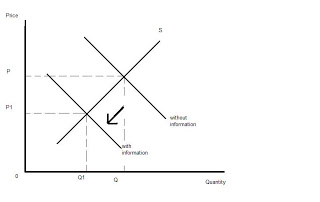
Goods and services divide into inspection, experience and credence goods.

  • Inspection goods are goods or services was quality can be determined before purchase price inspecting them;
  • Experience goods are goods whose quality is determined after  purchase in the course of consuming them; and
  • Credence goods are goods  whose quality may never be known for sure  as to whether the good or service actually worked – was that car repair or medical procedure really necessary?

The problem of adverse selection over experience and credence goods present many potentially profitable but as yet unconsummated wealth-creating transactions because of the uncertainty about quality and reliability.

Buyers are reluctant to buy if they are unsure of quality, but if such assurances can be given in a credible manner, a significant increase in demand is possible.

Any entrepreneur who finds ways of providing credible assurances of the quality of this service or work stands to profit handsomely. Brand names and warranties are examples of market generated institutions that overcome these information gaps through screening and signalling.
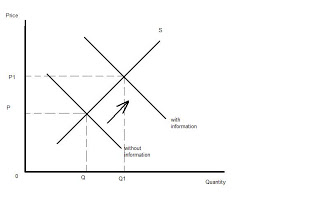
Screening is the less informed party’s effort, usually the buyer, to learn the information that the more informed party has. Successful screens have the characteristic that it is unprofitable for bad types of sellers to mimic the behaviour of good types.

Signalling is an informed party’s effort, usually the seller, to communicate information to the less informed party.

The main issue with quacks in the labour market is whether there are a large cost of less than average quality service, and is there a sub-market who will buy less than average quality products in the presence of competing sellers competing on the basis of quality assurance. This demand for assurance creates opportunities for entrepreneurs to profit by providing assurance.

David Friedman wrote a paper about contract enforcement in cyberspace where the buyer and seller is in different countries so conventional mechanisms such as the courts are futile in cases where the quality of the good is not as promised or there is a failure to deliver at all:

Public enforcement of contracts between parties in different countries is more costly and uncertain than public enforcement within a single jurisdiction.

Furthermore, in a world where geographical lines are invisible, parties to publicly enforced contracts will frequently not know what law those contracts are likely to fall under. Hence public enforcement, while still possible for future online contracts, will be less workable than for the realspace contracts of the past.

A second and perhaps more serious problem may arise in the future as a result of technological developments that already exist and are now going into common use. These technologies, of which the most fundamental is public key encryption, make possible an online world where many people do business anonymously, with reputations attached to their cyberspace, not their realspace, identities

Online auction and sales sites address adverse selection with authentication and escrow services, insurance, and on-line reputations through the rating of sellers by buyers.

E-commerce is flourishing despite been supposedly plagued by adverse selection and weak contract enforcement against overseas venders.

In the labour market, screening and signalling take the form of probationary periods,  promotion ladders, promotion tournaments, incentive pay and the back loading of pay in the form of pension investing and other prizes and bonds for good performance over a long period.

In the case of the labour force, there are good arguments that a major reason for investments in education is as a to signal quality, reliability, diligence as well as investment in a credential that is of no value the case of misconduct or incompetence. Lower quality workers will find it very difficult if not impossible to fake quality and reliability in this way – through investing in higher education.

In the case of teacher registration, for example, does a teacher registration system screen out any more low quality candidates for recruitment than do proper reference checks and a police check for a criminal record.

Mostly disciplinary investigations and deregistrations under the auspices of occupational regulation is for gross misconduct  and criminal convictions rather than just shading of quality.

Much of personnel  and organisational economics is about the screening and sorting of applicants, recruits and workers by quality and the assurance of performance.

Alert entrepreneurs have every incentive to find more profitable ways to manage the quality of their workforce and sort their recruitment pools.

Baron and Kreps (1999) developed the recruitment taxonomy made up of stars, guardians and foot-soldiers.

Stars hold jobs with limited downside risk but high performance is very good for the firm – the costs of hiring errors for stars such as an R&D worker are small: mostly their salary. Foot-soldiers are employees with narrow ranges of good and bad possible outcomes.

Guardians have jobs where bad performance can be a calamity but good job performance is only slightly better than an average performance.

Airline pilots and safety, compliance, finance and controller jobs are all examples of guardian jobs where risk is all downside. Bad performance of these jobs can  bring the company down. Dual control is common in guardian jobs.

The employer’s focus when recruiting and supervising guardians is low job performance and not associating rewards and promotions with risky behaviours. Employers will closely screen applicants for guardian jobs, impose long apprenticeships and may limit recruiting to port-of-entry jobs.

The private sector has ample experience in handling risk in recruitment for guardian jobs. Firms and entrepreneurs are subject to a hard budget constraints that apply immediately if they hire quacks and duds.

Blackboard economics says that governments may be able to improve on market performance but as Coase warned that actually implement regulatory changes in real life is another matter:

The policy under consideration is one which is implemented on the blackboard.

All the information needed is assumed to be available and the teacher plays all the parts. He fixes prices, imposes taxes, and distributes subsidies (on the blackboard) to promote the general welfare.

But there is no counterpart to the teacher within the real economic system

Occupational regulation  comes with the real risk of the regulation turning into an anti-competitive barrier to entry as Milton Friedman (1962) warned:

The most obvious social cost is that any one of these measures, whether it be registration, certification, or licensure, almost inevitably becomes a tool in the hands of a special producer group to obtain a monopoly position at the expense of the rest of the public.

There is no way to avoid this result. One can devise one or another set of procedural controls designed to avert this outcome, but none is likely to overcome the problem that arises out of the greater concentration of producer than of consumer interest.

The people who are most concerned with any such arrangement, who will press most for its enforcement and be most concerned with its administration, will be the people in the particular occupation or trade involved.

They will inevitably press for the extension of registration to certification and of certification to licensure. Once licensure is attained, the people who might develop an interest in undermining the regulations are kept from exerting their influence. They don’t get a license, must therefore go into other occupations, and will lose interest.

The result is invariably control over entry by members of the occupation itself and hence the establishment of a monopoly position.

Friedman’s PhD was published in 1945 as Income from Independent Professional Practice. With co-author Simon Kuznets, he argued that licensing procedures limited entry into the medical profession allowing doctors to charge higher fees than if competition were more open.

Data Source: Martin Jenkins 2012, Review of Occupational Regulation, released by the Ministry of Business, Innovation and Employment under the Official Information Act.

David Friedman – Poor People are Worse off Thanks to Government – YouTube

via David Friedman – Poor People are Worse off Thanks to Government – YouTube.

David Friedman – Application of Economic Analysis to the Law

https://www.youtube.com/watch?v=zHTj0iccdVM#t=87

Legal rules exist to change what people do…

Economics deals with how people respond to incentives…

Economics can both help make sense of the law and help decide what the law should be…

what we call the principles of justice may be actually be rules for thumb for producing efficient outcomes.

A professor of law and economics who has never take a course for credit in either law or economics

Coase, Boulding and Marshall on mathematical economics

Can anyone think of a mathematical economics proposition that was accepted that was not consistent with what Kenneth Boulding called the literary vagueness of classical economics and economic sociology:

Conventions of generality and mathematical elegance may be just as much barriers to the attainment and diffusion of knowledge as may contentment with particularity and literary vagueness…

It may well be that the slovenly and literary borderland between economics and sociology will be the most fruitful building ground during the years to come and that mathematical economics will remain too flawless in its perfection to be very fruitful.

If mathematical economics came up with a result that was not reproducible through economic intuition, did the result become popular or were they ignored? Until this barrier is passed, mathematics will be a shorthand language rather than an engine of enquiry, as Alfred Marshall argued long ago:

[I had] a growing feeling in the later years of my work at the subject that a good mathematical theorem dealing with economic hypotheses was very unlikely to be good economics: and I went more and more on the rules –

(1) Use mathematics as a shorthand language, rather than an engine of inquiry.

(2) Keep to them till you have done.

(3) Translate into English.

(4) Then illustrate by examples that are important in real life.

(5) Burn the mathematics.

(6) If you can’t succeed in (4), burn (3). This last I did often.

Marshall also

saw that excessive reliance on this instrument [mathematics] might lead us astray in pursuit of intellectual toys, imaginary problems not conforming to the conditions of real life.

The old common law versus modern product liability law

Image

Posner and Epstein Debate Patent System

Justice Antonin Scalia on the popular will and the role of the courts

David Friedman on How to Privatize Everything

The rights of an Englishman

Image

Information costs are just costs?


Yoram Barzel and Harold Demsetz pointed out that some economists want to stigmatise information costs. Armen Alchian was in this camp too.

Demsetz asked why the costs of finding, digging up and processing an ore deposit is a legitimate cost, but the costs of finding and interpreting information are illegitimate costs. There is an arbitrary classification of costs going on here according to Demsetz:

…there exists an efficient amount of ignorance in an economic system if the cost of acquiring information is positive.

The amount of ignorance that is efficient increases as does the cost of transacting (viewed as the cost of conveying information). Ignorance not only may be bliss, it also may be efficient.

One cannot claim that resources are wrongly allocated simply because information is not possessed or negotiation is absent; nor can one claim that resources are misplaced because a specific market does not exist.

None of these is free, and the costs of acquiring information and creating and maintaining markets may be so high as to make it efficient to forego some information and some markets.

A decision that something is not worth taking into account is not, because of this, a source of inefficiency. That this something is not taken into account is a reckoning if it follows from a thoughtful anticipation that it is not worth taking into account. An explicit accounting for every ‘something’ would be inefficient indeed in a world in which knowledge is not free

The economics of refugee asylum, refoulement and jumbo jets

Before 1914 it was possible to travel between a number of countries without a passport. British subjects were free to move to and from countries that were part of the British Empire and British Commonwealth of Nations long after they gain full sovereignty. Scots were automatically French citizens for 500 years up until 1907.

The British Nationality Act 1948 allowed the 800 million British subjects in the British Empire to live and work in the United Kingdom without needing a visa. Commonwealth citizens were not subject to immigration control until 1962.

The Aliens Act 1905 was the first major piece of modern immigration legislation and set up an inspectorate at ports of entry to the UK. Its officers had the power to refuse entry to aliens who were considered ‘undesirable

The 1951 refugees’ convention was signed three years after the UK passed the British Nationality Act 1948. Back in the 1950s, easy international travel was a luxury for the few so uncontrollable borders and mass economic migration from afar was not foreseen. Welfare states were in their infancy.

Many people can now save up to travel far away by air, sea and land. This leads to a screening problem caused by economic migrants lying about their backgrounds.

This gives countries an incentive to evade their obligations raising standards of proof under the 1951 Convention, resulting in ‘more refoulement of refugees to their place of persecution’.

See The Economics of International Refugee Law, Ryan Bubb, Michael Kremer, and David I. Levine Journal of Legal Studies (June 2011) for more discussion.

Their suggestion that developed countries pay poor countries to take refugees from persecution just shows how bare the policy cupboard appears to be. The transfer of refugee claimants from wealthy states to poorer states could ameliorate the screening problem by inducing self-selection among refugee claimants. Fewer economic migrants will apply for refugee states if they have to go to another poor country.

Coase and Demsetz on comparative institutional analysis and the fallacy of comparing actual institutions with unrealistic, idealised alternatives

Ronald Coase (copyright Coase Institute (http://coase.org)) Demsetzatgmu.jpg

It is my belief that the failure of economists to reach correct conclusions about the treatment of harmful effects cannot be ascribed simply to a few slips in analysis.  It stems from basic defects in the current approach to problems of welfare economics

Ronal Coase (1960)

The view that now pervades much public policy economics implicitly presents the relevant choice as between an ideal norm and an existing ‘imperfect’ institutional arrangement.

This nirvana approach differs considerably from a comparative institution approach in which the relevant choice is between alternative real institutional arrangements…

the design of institutional  arrangements that provide incentives to encourage experimentation (including the development of new products, new knowledge, new reputations, and new ways of organizing activities) without overly insulating these experiments from the ultimate test
of survival

Harold Demsetz (1969)

The Simple Case for Laissez-Faire

The discussion so far suggests a simple solution to the problem of creating efficient legal rules – private property plus freedom of exchange.

Everything belongs to someone. Everyone is free to buy or sell on any terms mutually acceptable to buyer and seller… Any new good belongs to whoever produced it.

So if the cost of producing a good, the summed cost of all the necessary inputs, is less than its value to whoever values it most, it will pay someone to buy the inputs, produce the good, and sell it to the highest bidder.

Not only do all goods end up in their highest valued uses, but all goods are produced if and only if their value to whoever values them most is greater than their cost to whoever can produce them most easily

On marriage as a humanly devised set of constraints

Doug Allen challenges you to describe marriage to a 19 year old male who had never heard of it before:

  • Marriage is all about responsibility, monogamy and a painful exit if things go awry.
  • Yes, there is the prospect of children, and mutual support, but only if you sign up to child support obligations, community property rules and many other constraints that are enforceable.

The role of the state in marriage is all about protecting mothers from opportunistic breach of a long-term contract with sequential performance. Mothers produce the children up-front while the fathers support the children over a long period subsequent. The problem is dead-beat dads.

Ronald Coase on blackboard economics

Slideshow: Ronald Coase, 1910-2013

This neglect of other aspects of the system has been made easier by another feature of modern economic theory – the growing abstraction of the analysis, which does not seem to call for a detailed knowledge of the actual economic system or, at any rate, has managed to proceed without it.

Holmstrom and Tirole, writing on The Theory of the Firm in the recently published Handbook of Industrial Organization, conclude at the end of their article of 63 pages that "the evidence/theory ratio… is currently very low in this field". Peltzman has written a scathing review of the Handbook in which he points out how much of the discussion in it is theory without any empirical basis.

What is studied is a system which lives in the minds of economists but not on earth.

I have called the result "blackboard economics". The firm and the market appear by name but they lack any substance. The firm in mainstream economic theory has often been described as a "black box". And so it is.

This is very extraordinary given that most resources in a modern economic system are employed within firms, with how these resources are used dependent on administrative decisions and not directly on the operation of a market.

Consequently, the efficiency of the economic system depends to a very considerable extent on how these organisations conduct their affairs, particularly, of course, the modern corporation.

Even more surprising, given their interest in the pricing system, is the neglect of the market or more specifically the institutional arrangements which govern the process of exchange.

As these institutional arrangements determine to a large extent what is produced, what we have is a very incomplete theory.

Four years before his Nobel lecture, Coase was more specific:

Marginal cost pricing is a policy is largely without merit.

How then can one explain the widespread support that it has enjoyed in the economics profession?

I believe it is the result of economists using an approach which I have termed “blackboard economics.”

The policy under consideration is one which is implemented on the blackboard. All the information needed is assumed to be available and the teacher plays all the parts. He fixes prices, imposes taxes, and distributes subsidies (on the blackboard) to promote the general welfare.

But there is no counterpart to the teacher within the real economic system. There is no one who is entrusted with the task that is performed on the black- board.

In the back of the teacher’s mind (and sometimes in the front of it) there is, no doubt, the thought that in the real world the government would fill the role he plays. But there is no single entity within the government which regulates economic activity in detail, carefully adjusting what is done in one place to accord with what is done elsewhere.

Coase argued that  marginal cost pricing is not only inefficient, but even inferior to average cost pricing due to:

(i) the fact that under marginal cost pricing, consumers are not forced to pay the full costs of the goods they purchase, leading to potentially inefficient consumption choices;

(ii) the lack of information necessary for the government to determine whether consumers would be willing to pay an amount sufficient to cover the total cost of the goods produced, and costly nature of attempts to make such estimates; and

(iii) the fact that the governmental subsidy necessary to ensure firm survival under a marginal cost pricing scheme will likely be financed through distortionary taxes, thereby creating or exacerbating a distortion in one market at the same time that it corrects a distortion in another.

Previous Older Entries Next Newer Entries

Vincent Geloso

Econ Prof at George Mason University, Economic Historian, Québécois

Bassett, Brash & Hide

Celebrating humanity's flourishing through the spread of capitalism and the rule of law

Truth on the Market

Scholarly commentary on law, economics, and more

The Undercover Historian

Beatrice Cherrier's blog

Matua Kahurangi

Celebrating humanity's flourishing through the spread of capitalism and the rule of law

Temple of Sociology

Celebrating humanity's flourishing through the spread of capitalism and the rule of law

Velvet Glove, Iron Fist

Celebrating humanity's flourishing through the spread of capitalism and the rule of law

Why Evolution Is True

Why Evolution is True is a blog written by Jerry Coyne, centered on evolution and biology but also dealing with diverse topics like politics, culture, and cats.

Down to Earth Kiwi

Celebrating humanity's flourishing through the spread of capitalism and the rule of law

NoTricksZone

Celebrating humanity's flourishing through the spread of capitalism and the rule of law

Homepaddock

A rural perspective with a blue tint by Ele Ludemann

Kiwiblog

DPF's Kiwiblog - Fomenting Happy Mischief since 2003

The Dangerous Economist

Celebrating humanity's flourishing through the spread of capitalism and the rule of law

Watts Up With That?

The world's most viewed site on global warming and climate change

The Logical Place

Tim Harding's writings on rationality, informal logic and skepticism

Doc's Books

A window into Doc Freiberger's library

The Risk-Monger

Let's examine hard decisions!

Uneasy Money

Commentary on monetary policy in the spirit of R. G. Hawtrey

Barrie Saunders

Thoughts on public policy and the media

Liberty Scott

Celebrating humanity's flourishing through the spread of capitalism and the rule of law

Point of Order

Politics and the economy

James Bowden's Blog

A blog (primarily) on Canadian and Commonwealth political history and institutions

Science Matters

Reading between the lines, and underneath the hype.

Peter Winsley

Economics, and such stuff as dreams are made on

A Venerable Puzzle

"The British constitution has always been puzzling, and always will be." --Queen Elizabeth II

The Antiplanner

Celebrating humanity's flourishing through the spread of capitalism and the rule of law

Bet On It

Celebrating humanity's flourishing through the spread of capitalism and the rule of law

History of Sorts

WORLD WAR II, MUSIC, HISTORY, HOLOCAUST

Roger Pielke Jr.

Undisciplined scholar, recovering academic

Offsetting Behaviour

Celebrating humanity's flourishing through the spread of capitalism and the rule of law

JONATHAN TURLEY

Res ipsa loquitur - The thing itself speaks

Conversable Economist

In Hume’s spirit, I will attempt to serve as an ambassador from my world of economics, and help in “finding topics of conversation fit for the entertainment of rational creatures.”

The Victorian Commons

Researching the House of Commons, 1832-1868

The History of Parliament

Articles and research from the History of Parliament Trust

Books & Boots

Reflections on books and art

Legal History Miscellany

Posts on the History of Law, Crime, and Justice

Sex, Drugs and Economics

Celebrating humanity's flourishing through the spread of capitalism and the rule of law

European Royal History

Exploring the Monarchs of Europe

Tallbloke's Talkshop

Cutting edge science you can dice with

Marginal REVOLUTION

Small Steps Toward A Much Better World

NOT A LOT OF PEOPLE KNOW THAT

“We do not believe any group of men adequate enough or wise enough to operate without scrutiny or without criticism. We know that the only way to avoid error is to detect it, that the only way to detect it is to be free to inquire. We know that in secrecy error undetected will flourish and subvert”. - J Robert Oppenheimer.

STOP THESE THINGS

The truth about the great wind power fraud - we're not here to debate the wind industry, we're here to destroy it.

Lindsay Mitchell

Celebrating humanity's flourishing through the spread of capitalism and the rule of law

Alt-M

Celebrating humanity's flourishing through the spread of capitalism and the rule of law

croaking cassandra

Economics, public policy, monetary policy, financial regulation, with a New Zealand perspective

The Grumpy Economist

Celebrating humanity's flourishing through the spread of capitalism and the rule of law