What is evidence of price collusion?

Posner and Easterbrook suggest that these industry behaviours together are suspicious.

  1. Fixed relative market shares among top firms over time.
  2. Declining absolute market shares of the industry leaders.
  3. Persistent price discrimination.
  4. Certain types of exchanges of price information.
  5. Regional price variations.
  6. Identical sealed bids for tenders.
  7. Price, output, and capacity changes at the time of the suspected initiation of collusion.
  8. Industry-wide resale price maintenance or non-price vertical restraints.
  9. Relatively infrequent price changes; smaller price reactions as a result of known cost changes.
  10. Demand is highly responsive to price changes at market price.
  11. Level and pattern of profits relatively favourable to smaller firms.
  12. Particular pricing and marketing strategies.

Aaron Director’s most creative suggestion of evidence of price collusion is disputes between the marketing and finance departments of a large company. The market department wants to cut prices because there would be a large increase in sales. The finance department says no because this would take the price below the monopoly or agreed cartel price.

The next time you make an allegation of price fixing

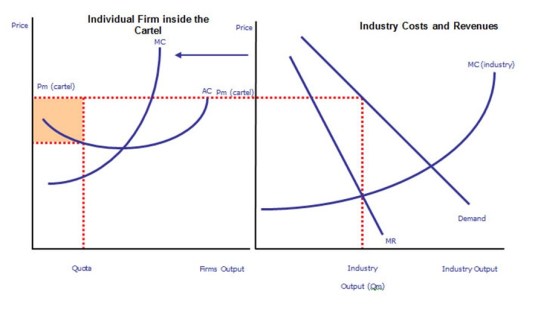
Remember this, firms are only likely to collude in certain market environments.

Brozen and Posner suggest the following pre-conditions to collusion

  • market concentration on the supply side;
  • no fringe of small sellers;
  • high transport costs from neighbouring markets;
  • small variations in production costs between firms;
  • readily available information on prices;
  • inelastic demand at the competitive price;
  • low pre-collusion industry profits;
  • long lags on new entry;
  • many buyers (otherwise selective discounting to big buyers will be too tempting while monitoring adherence to the agreement will be difficult);
  • no significant product differentiation;
  • large suppliers selling at the same level in the distribution chain;
  • a simple price, credit and distribution structure;
  • price competition is more important than other forms of competition;
  • demand is static or declining over time; and
  • stagnant technological innovation and product redesign.

Stable collusive arrangements are thus likely to be rare; the absence of any of the conditions will tend to undermine the potential for successful collusion.

The best of the online materials by and about Ronald Coase

Ronald Coase

Obituaries

The Telegraph

The Guardian

Financial Times

Independent

New York Times

Economist

University of Chicago on the announcement of his death

University of Chicago Ronald H. Coase, Founding Scholar in Law and Economics, 1910-2013

Steve Medema

Recent interviews and op-eds:

1997 Interview Interview in Reason Magazine

2001 A conversation with Ronald H. Coase

2002 Why Economics Will Change Speech on why economics will and ought to change

2003 Coase Centennial Speech (video) Speech at the University of Chicago Law School

2002 Ronald H. Coase, The Intellectual Portrait Series: A Conversation with Ronald H. Coase 

2010 Interview on 100th Birthday Interview on Ronald Coase’s 100th birthday

2012 Coase on Externalities, the Firm, and the State of Economics

2012 WSJ Opinion Article, with Ning Wang Opinion article by Ronald Coase and Ning Wang concerning the development of modern China, in the Wall Street Journal, April 6, 2012.

2012 Harvard Business Review Article Article by Ronald Coase concerning the need to reengage modern economics with the economy, in the Harvard Business Review, December 2012.

2013 Cato Policy Report Article, with Ning Wang Article by Ronald Coase and Ning Wang summarizing the work of their book on China, in the Cato Policy Report, January/February 2013.

2012 Small Business Economics Interview on 102nd Birthday Interview conducted by Siri Terjesen and Ning Wang.

2013 Interview Interview with Ronald Coase, conducted by Ning Wang. (Some material is in Chinese.)

About Ronald Coase

Nobel award 1991 Bank of Sweden Prize in Economic Sciences in memory of Alfred Nobel

Coase’s work in perspective Nobel Foundation, on the 1991 prize in economics

Essay on Coase’s work The Swedes Get It Right, by David Friedman

Richard Posner on Coase and his methodology 

Don Boudreaux on Coase

Ronald H. Coase. Biography. Concise Encyclopedia of Economics.

Ronald Coase—The Nature of Firms and Their Costs by Robert L. Formaini and Thomas F. Siems

Best of his papers

2013 How China Became Capitalist Cato Policy report with Ning Wang

2013 Saving Economics from Economists Havard Business Review

2000 The Acquisition of Fisher Body by General Motors Journal of Law and Economics, Vol. 43, No. 1 (April 2000), pp. 15-31. pdf

1996 Law and Economics and A. W. Brian Simpson Journal of Legal Studies, Vol. 25, No. 1 (January 1996), pp. 103-119.

1993 Law and Economics at Chicago Journal of Law and Economics, Vol. 36, No. 1, Part 2 (April 1993), pp. 239-254.

1992 The Institutional Structure of Production The American Economic Review, Vol. 82, No. 4 (September 1992), pp. 713-719. pdf

1988 Blackmail Virginia Law Review, Vol. 74, No. 4 (May 1988), pp. 655-676. pdf

1988 The Nature of the Firm: Origin Journal of Law, Economics, & Organization, Vol. 4, No. 1 (Spring 1988), pp. 3-17. pdf

1988 The Nature of the Firm: Meaning Journal of Law, Economics, & Organization, Vol. 4, No. 1 (Spring 1988), pp. 19-32.

1988 The Nature of the Firm: Influence Journal of Law, Economics, & Organization, Vol. 4, No. 1 (Spring 1988), pp. 33-47.

1979 Payola in Radio and Television Broadcasting Journal of Law and Economics, Vol. 22, No. 2 (October 1979), pp. 269-328.

1978 Economics and Contiguous Disciplines The Journal of Legal Studies, Vol. 7, No. 2 (June 1978), pp. 201-211.

1977 Advertising and Free Speech The Journal of Legal Studies, Vol. 6, No. 1 (January 1977), pp. 1-34.

1976 Adam Smith’s View of Man Journal of Law and Economics, Vol. 19, No. 3 (October 1976), pp. 529-546. pdf

1975 Marshall on Method Journal of Law and Economics, Vol. 18, No. 1 (April 1975), pp. 25-31.

1974 The Lighthouse in Economics Journal of Law and Economics, Vol. 17, No. 2 (October 1974), pp. 357-376.

1974 The Choice of the Institutional Framework: A Comment Journal of Law and Economics, Vol. 17, No. 2 (October 1974), pp. 493-496.

1974 The Market for Goods and the Market for Ideas (in The Economics of the First Amendment) The American Economic Review

1972 The Appointment of Pigou as Marshall’s Successor Journal of Law and Economics, Vol. 15, No. 2 (October 1972), pp. 473-485.

1972 Durability and Monopoly Journal of Law and Economics, Vol. 15, No. 1 (April 1972), pp. 143-149.

1972 Industrial Organization: A Proposal for Research, Economic Research: Retrospect and Prospect Vol 3: Policy Issues and Research Opportunities in Industrial Organization

1970 The Theory of Public Utility Pricing and Its Application The Bell Journal of Economics and Management Science, Vol. 1, No. 1 (Spring 1970), pp. 113-128.

1966 The Economics of Broadcasting and Government Policy (in The Economics of Broadcasting and Advertising) The American Economic Review, Vol. 56, No. 1/2 (March 1966), pp.440-447.

1960 The Problem of Social Cost Journal of Law and Economics Vol. 3 (October 1960), pp. 1-44 pdf

 1959 The Federal Communications Commission Journal of Law and Economics Vol. 2 (October 1959), pp. 1-40 pdf

1946 The Marginal Cost Controversy Economica, New Series, Vol. 13, No. 51 (August 1946), pp. 169-182.

1937 The Nature of the Firm Economica, New Series, Vol. 4, No. 16 (November 1937), pp. 386-405 pdf

Reviews of Others’ Work

1977 Reviewed Work: Selected Economic Essays and Addresses by Arnold Plant Journal of Economic Literature, Vo.. 15, No. 1 (Mar. 1977), pp. 86-88.

some via http://www.coase.org/coaseonline.htm
Lord Denning quotes

The House of Commons starts its proceedings with a prayer. The chaplain looks at the assembled members with their varied intelligence and then prays for the country

Daily Telegraph (1989)

“The poorest man may in his cottage bid defiance to all the forces of the Crown.

It may be frail—its roof may shake—the wind may blow through it—the storm may enter—the rain may enter—but the King of England cannot enter—all his force dares not cross the threshold of the ruined tenement.” So be it—unless he has justification by law.

Southam v Smout [1964] 1 QB 308 at 320

There are many things in life more worth while than money.

One of these things is to be brought up in this our England, which is still “the envy of less happier lands”.

I do not believe it is for the benefit of children to be uprooted from England and transported to another country simply to avoid tax… Many a child has been ruined by being given too much. The avoidance of tax may be lawful, but it is not yet a virtue.

Re Weston’s Settlements, [1969] 1 Ch 223

“Unlike my brother judge here, who is concerned with law,” he once teased at a legal dinner, “I am concerned with justice.”

What is the argument on the other side? Only this, that no case has been found in which it has been done before. That argument does not appeal to me in the least.

If we never do anything which has not been done before, we shall never get anywhere. The law will stand still while the rest of the world goes on, and that will be bad for both

A family law case

In June 1970, a big earth-moving machine got stuck in the mud. It sank so far as to be out of sight. It cost much money to get it out. Who is to pay the cost?

British Crane Hire Corporation Ltd v. Ipswich Plant Hire Ltd [1970] 1 All ER 1059

Broadchalke is one of the most pleasing villages in England.

Old Herbert Bundy, the defendant, was a farmer there.

His home was at Yew Tree Farm.  It went back for 300 years.  His family had been there for generations.

It was his only asset.

But he did a very foolish thing.  He mortgaged it to the bank.

Lloyds Bank v. Bundy [1973] 3 All ER 757

More information on Lord Denning, the son of a draper and the most celebrated English judge of the 20th century, is here and here

Lord Denning

Denning was the last judge to have the right to stay in the job for life. He joked that he had “every Christian virtue, except resignation”. He retired aged 83 after making some rather poorly chosen remarks and died a few months after his 100th birthday.

Richard Epstein “The Coming Meltdown in Labor Relations”

Basing policy on a scientific consensus is a new development for environmentalists

Previously the precautionary principle was used to introduce doubt when there was no doubt. But when climate science turned in their favour, environmentalists wanted public policy to be based on the latest science.

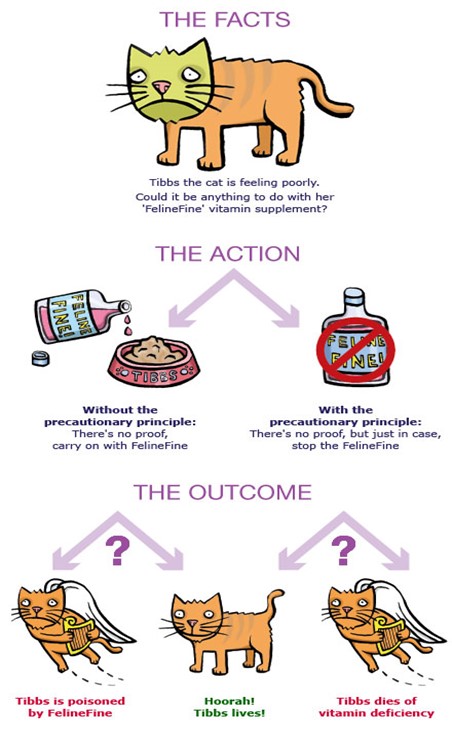
The precautionary principle is deeply incoherent. We should take precautions but there are always risks on both sides of a decision; inaction can bring danger, but so can action. Precautions themselves create risks so the precautionary principle bans what it simultaneously requires.

There is never perfect certainty about the nature and causes of health and environmental threats, so environmental and health regulations are almost always adopted despite some residual uncertainty.

We live in a Schumpeterian world where new risks replace old risks.

The obvious question is it safer or more precautionary to focus on the potential harms of new activities or technologies without reference to the activities or technologies they might displace? Jonathan Alder explains

In any policy decision, policy makers can make two potential errors regarding risk.

On the one hand, policy makers may err by failing to adopt measures to address a health or environmental risk that exists.

On the other hand, policy makers may adopt regulatory measures to control a health or environmental risk that does not exist.

Both types of error can increase risks to public health.


Consider the overwhelming consensus among researchers that biotech crops are safe for humans and the environment

This is a conclusion that is rejected by the very environmentalist organisations that loudly insist on the policy relevance of the scientific consensus on global warming.

In his 2012 Dimbleby lecture, Sir Paul Nurse calls for a re-opening the debate about GM crops based on scientific facts and analysis:

We need to consider what the science has to say about risks and benefits, uncoloured by commercial interests and ideological opinion. It is not acceptable if we deny the world’s poorest access to ways that could help their food security, if that denial is based on fashion and ill-informed opinion rather than good science.

Cass Sunstein wrote that in its strongest and most distinctive forms, the precautionary principle imposes a burden of proof on those who create potential risks, and requires regulation of activities even if it cannot be shown that those activities are likely to produce significant harms:

…apparently sensible questions have culminated in an influential doctrine, known as the precautionary principle.

The central idea is simple: Avoid steps that will create a risk of harm.

Until safety is established, be cautious; do not require unambiguous evidence.

Yet the precautionary principle, for all its rhetorical appeal, is deeply incoherent.

It is of course true that we should take precautions against some speculative dangers.

But there are always risks on both sides of a decision; inaction can bring danger, but so can action.

Precautions, in other words, themselves create risks – and hence the principle bans what it simultaneously requires.

Sunstein is a Democrat whose White House appointment to the head the White House Office of Information and Regulatory Affairs under Obama was opposed by the Left of the Democrat Party because of his views on the precautionary principle and his support of cost-benefit analysis as a primary tool for assessing regulations. Sunstein again:

The simplest problem with the precautionary principle is that regulation might well deprive society of significant benefits, and even produce a large number of deaths that would otherwise not occur.

Genetic modification holds out the promise of producing food that is both cheaper and healthier – resulting, for example, in products that might have large benefits in developing countries.

The point is not that genetic modification will definitely have those benefits, or that the benefits of genetic modification outweigh the risks.

The point is that the precautionary principle provides no guidance

The epitome of anti-science is support for the precautionary principle and opposition to cost-benefit analysis in assessing regulations. Which side of politics is guilty of this?

Environmentalists accept the views of scientists when its suits their anti-progress agenda. In other cases, the precautionary principle is used to delay judgment, reject science such as on GMOs and demand ever more evidence.

Environmentalists are all for the precautionary principle except when applied to natural medicines, organic food and marijuana.

In praise of traffic cops

Due to budget cuts, 35% of Oregon State Highway Police were laid off. These mass layoffs dramatically reduced citations and resulted in a 10-20% increase in injuries and fatalities.

The strongest effects were under fair weather conditions outside of city-limits where state police employment levels were most relevant.

These results in DeAngelo and Hansen’s “Life and Death in the Fast Lane: Police Enforcement and Traffic FatalitiesAmerican Economic Journal: Economic Policy 2014 suggest that a highway fatality can be prevented with $309,000 of additional expenditures on traffic police.

A standard measure of the “value of a statistical life” is it is worth taking regulatory or law enforcement actions that reduce the risks of death when the costs of these actions are less than about $9 million per life saved.

Road safety is an area where James Buchanan’s punishment dilemma is strong:

For some laws or behavioural rules, the individual’s self-interest may override adherence [to the law], at least in certain circumstances.

Traffic violations offer a good example here.

Recognizing that he may himself violate traffic regulations on occasion, the individual may be reluctant to accept institutions that impose severe penalties, despite his preferences that all “others” than himself should be led to obey the general rules by sufficiently severe sanctions.

Just as the individual prefers that all others abide voluntarily by law while he remains free to violate it, so, too, he prefers that differentially severe punishment for law violation be meted out to others than himself.

Voters are less than keen to support strong penalties and convict when sitting on juries because of the fear that there but for the grace of god go I: that they would be in the dock at the receiving end of the heavy punishments.

If we commit to punish offenders and those who might commit offenses are deterred by this commitment to punish them, there would be fewer offenses. This also means doing the unpleasant things of meeting out these punishment when there are offenses by the undeterred:

  • It is painful to subject others to punishment (“son, this is going to hurt me as much as it hurts you”); and
  • It is even more painful to vote for penalties that may be imposed on yourself in person.

The initially low penalties for causing death by dangerous driving is an example of the punishment dilemma. These penalties only slowly increased over several decades as societal attitudes hardened.

Richard Epstein: Income, Wealth and Inequality. Leveling Up or Leveling Down?


Chicago Unbound | 60+ years of University of Chicago Law Online, mostly ungated

Chicago Unbound contains 60+ years of scholarship, most of it ungated online, of the members of University of Chicago Law School

Faculty_scholarship

Law School Publications

Working_papers

Coase_Sandor_institute

via Chicago Unbound | University of Chicago Law School Research.

PEETA (People Enjoy Eating Tasty Animals)-updated

The web site formally known as People Enjoy Eating Tasty Animals (PEETA) is one of my favourite web sites.

When called PEETA in 1996 or so, this web site was the subject of a pioneering intellectual property court case by PETA.

Grilled Steak Recipe with Garlic-Herb Butter

The web site is a resource for those who enjoy eating meat, wearing fur and leather, hunting, and the fruits of scientific research. More on animal testing later with the help of Penn and Teller.

via People Eating Tasty Animals.

BTW, why are people not allowed to eat tasty animals, but other animals are allowed to eat each other if they can catch them. Should carnivores be required to become vegans? That would be a death sentence for them.

The Case for Boring Courts and Very Bored Lawyers

The world would be a better place if law was the most boring occupation about.

Lawyers and the court room make for great TV drama, but if the outcome of most litigation was fairly predictable, we would all be better-off.

Ordinary people would not fear law suits or suing to uphold their rights if the law was simple. With the law clear-cut, every-one knows where they stand. People settle out of court. They do not misbehave in the first place because they know they will be liable and will have to pay.

Richard Epstein contents that

…greater judicial sophistication has not brought forth higher quality judgments, but rather the reverse

…An easy mistake for a modern judge to make is to assume that the tools he or she possesses are capable of being put to good ends, and that it is possible to tell which of the parties in a given case are the ‘good guys’ and which are the ‘bad guys’.

…Most of the cases that a judge sees are aberrations.

Yet it is a great mistake for a judge to assume that the rules a court creates only apply to the aberrational cases.

The legal rules will also govern the mundane cases that remain within the system, to be resolved without litigation.

The judge needs to fear that laying down an ideal rule for this one case in a thousand may unglue the system that works well for the other 999 cases.

We all bargain in the shadow of the courts and the law. Bargaining and the enforcement of contracts and property rights and the resolution of disputes would be a lot cheaper if we knew what would happen if we did not settle and went to court.

As an example of the simple rules he champions, Epstein proposed that the default divorce settlements be 50:50.

Epstein also supports employment at will as the default rule because "you’re fired, I quit" could not be simpler to understand and administer.

Everyone knows where they stand and a free to make more detailed marital or employment agreements if they wish. Many do: contractors and short-term routinely earn a premium over permanent employees with more job security.

The law attracts more than its share of reformers wanting to use the courts and judge-made law for political purposes.

If you want to reform the world, do what we ordinary people have to do: change your vote, write a mail to an MP, protest, donate to or even join a political party, or run for parliament.

Some lawyers think themselves above how ordinary people must resolve their differences in democracies: by trying to persuade each other and elections.

The great strength of democracy is a small group of concerned and thoughtful citizens can band together and change things by running for office and winning elections.

That is how new Australian parties such as the Labor Party, the Country Party, Democratic Labor Party, the Australian Democrats and the Greens changed Australia. One Nation even had its 15 minutes of fame with its 11 MPs. Australian state upper houses even have Christian, family and shooters parties and many independents. A middle-of-the-road Senate independent in South Australia nearly topped the poll.

All of these parties started in a living room full of angry, motivated people.

I agree with Antonin Scalia when he said that the purpose of the law is to slow the impassioned majority down:

Judges are sometimes called upon to be courageous, because they must sometimes stand up to what is generally supreme in a democracy: the popular will.

Their most significant roles, in our system, are to protect the individual criminal defendant against the occasional excesses of that popular will, and to preserve the checks and balances within our constitutional system that are precisely designed to inhibit swift and complete accomplishment of that popular will.

Those are tasks which, properly performed, may earn widespread respect and admiration in the long run, but — almost by definition — never in the particular case.

Democracy is government by checks and balance by putting the parties and branches of government in continual tension with each other – it is not trusting the specific people who are currently in power.

Famous Fables of Economics: Myths of Market Failures – Daniel Spulber (ed)

Table of Contents

Introduction: Economic Fables and Public Policy: Daniel F. Spulber.

  1. The Lighthouse in Economics: Ronald H. Coase.

  2. The Voluntary Provision of Public Goods? The Turnpike Companies of Early America: Daniel B. Klein.

  3. The Fable of the Bees: An Economic Investigation: Steven N. S. Cheung.

  4. The Fable of the Keys: Stan J. Liebowitz, and Stephen E. Margolis.

  5. Beta, Macintosh, and Other Fabulous Tales: Stan J. Liebowitz and Stephen E. Margolis.

  6. Delivering Coal by Road and Rail in Britain: The Efficiency of the “Silly Little Bobtailed Wagons”: Va Nee L. Van Vleck.

  7. The Acquisition of Fisher Body by General Motors: Ronald H. Coase.

  8. The Fable of Fisher Body: Ramon Casadesus-Masanell and Daniel F. Spulber.

  9. Sharecropping: Steven N. S. Cheung.

  10. Predatory Price Cutting: The Standard Oil (N.J.) Case: John S. McGee.

  11. Another Look at Alcoa: Raising Rivals’ Costs Does Not Improve the View: John E. Lopatka and Paul E. Godek.

  12. How Much Did the Liberty Shipbuilders Learn? New Evidence for an Old Case Study: Peter Thompson.

  13. Financial Legends: The Economist.

via Wiley: Famous Fables of Economics: Myths of Market Failures – Daniel Spulber.

Interview with Ronald Coase

http://www.youtube.com/watch?feature=player_detailpage&v=fpfi0gsTjrs#t=2

see also Ronald Coase is dead: here are five of his papers you need to read

Do monopoly concessions increase or decrease gambling?

Do monopoly concessions such as for casinos and the TAB increase or decrease gambling? Is the under-supply of output by a monopoly a good or a bad thing when the good itself is seen as a bad.

James Buchanan started his 1973 paper ‘A defence of organised crime?’ quoting Samuel Butler:

… we should try to make the self-interest of cads a little more coincident with that of decent people

Buchanan’s simple idea is that if a monopoly restricts the output of goods, a standard analytical result, then it must also restrict the output of bads! Buchanan end’s his paper with:

It is not from the public-spiritedness of the leaders of the Cosa Nostra that we should expect to get a reduction in the crime rate but from their regard for their own self-interests

The Cosa Nostra did have a reputation for running honest casinos and keeping crime down nearby.

If an illegal monopoly or cartel becomes competitive and barriers to entry are eliminated, in the long run, more illegal goods will be traded at the new equilibrium.

Should gambling outlets be public monopolies because they would be smaller, badly run and slow to innovate? The monopolisation of bads may shift us in the direction of social optimality. Buchanan, of course, adds that:

The analysis does nothing toward suggesting that enforcement agencies should not take maximum advantage of all technological developments in crime prevention, detection and control.

The rationality postulate is under attack from the other people are stupid fallacy-updated

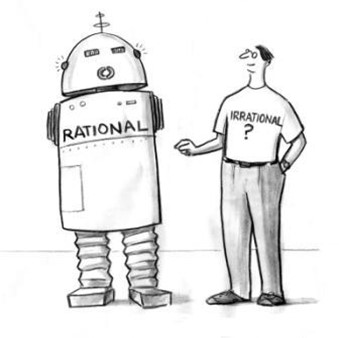
The rationality postulate is under attack from the other people are stupid fallacy: not you, not me, not present company, of course, but the nameless them over there; the perpetually baffled, every man jack of them.

These no-hopers are deemed competent to vote and DRIVE CARS, but they cannot get their head around a credit card. How the them over there find their way to work every morning must be a mystery to behavioural economists. One summary of behavioural labour economics is this:

The key empirical findings from field research in behavioural economics imply that individuals can make systematic errors or be put off by complexity, that they procrastinate, and that they hold non-standard preferences and non-standard beliefs

I found the chapter in Tullock and McKenzie’s book on token economies in mental hospitals to be most enlightening.

The tokens were for spending money at the hospital canteen and trips to town and other privileges. They were earned by keeping you and your area clean and helping out with chores.

The first token economies were for chronic, treatment-resistant psychotic inpatients.

In 1977, a major study, still considered a landmark, successfully showed the superiority of a token economy compared to the standard treatments. Despite this success, token economies disappeared from the 1980s on.

Experiments which would now be unethical showed that the occupational choices and labour supply of certified lunatics responded to incentives in the normal, predictable way.

For example, tokens were withdrawn for helping clean halls and common areas. The changes in occupational choice and reductions in labour supply was immediate and as predicted by standard economics.

Some patients would steal the tokens for other patients, so the token individually marked, and the thefts almost stopped. Crime must pay even for criminally insane inpatients.

Kagel reported that:

The results have not varied with any identifiable trait or characteristic of the subjects of the token economy – age, IQ, educational level, length of hospitalization, or type of diagnosis.

Behavioural economics is an excellent example of how engaging in John S. Mill’s truth that engaging with people who are partly or totally wrong sharpens your arguments, improves their presentation and deepens your analysis.

People have a better understanding of rationality such as through the work of Vernon Smith on ecological and constructivist rationality and of how people deal with human frailties and correct error through specialisation, exchange and learning.

  • George Stigler in his Existence of X-inefficiency paper opposed attributing behaviour to errors because error can explain everything so it explains nothing until we have a theory of error.
  • Kirzner in “XInefficiency, Error and the Scope for Entrepreneurship” wrote that error is pervasive in economic processes. Rational Misesian human actors are human enough to err.

What is inefficient about the world, said Kirzner, is at each instant, an opportunity for improvements, in one way or another and is yet simply not yet noticed. The lure of pure entrepreneurial profits harnesses the systematic elimination of errors and points the way to the market generated institutions necessary for steady social improvements to emerge. Brand names are an obvious example of an institution to overcome doubts about product quality. Middle-men and brokers specialise in performing much of the calculation burdens in their markets.

Many still compare real-world marketplaces to idealised regulation overseen by bureaucrats free of the very biases they are nudging us along to overcome. There are real constraints that limit the options available to fix what are seen as problems to be solved.

Vernon Smith when asked about behavioural economics, wondered how so cognitively flawed a creature made it out of the caves. Vernon Smith argued that the answer had a lot to do with the institutions that emerged to overcome human limitations:

Markets are about recognizing that information is dispersed in all social systems and that the problem of society is to find, devise, and discover institutions that incentivize and enable people to make the right decisions without anyone having to tell them what to do.

Smith and Hayek both posit that market institutions rather than individuals bear the primary cognitive burden in coordinating economic activity. To quote Vernon Smith:

What we learn from experiments is that any group of people can walk into a room, be incentivized with a well-defined private economic environment, have the rules of the oral double auction explained to them for the first time, and they can make a market that usually converges to a competitive equilibrium, and is 100 per cent efficient—they maximize the gains from exchange—within two or three repetitions of a trading period.

Yet knowledge is dispersed, with no participant informed of market supply and demand, or even understanding what that means.

This strikingly demonstrates what Adam Smith called ”a certain propensity in human nature . . . to truck, barter, and exchange one thing for another”

These double oral auctions converged to the competitive price even with as few as three or four sellers with neither the buyers nor sellers knowing anything of the values or costs of others in the market. Price-taking behaviour was not necessary to reach these competitive outcomes.

Behavioural economics is a clumsy way of discussing the pervasiveness of errors because insufficient attention is paid to decentralised, emergent market processes that correct them, often long ago.

Previous Older Entries Next Newer Entries

Vincent Geloso

Econ Prof at George Mason University, Economic Historian, Québécois

Bassett, Brash & Hide

Celebrating humanity's flourishing through the spread of capitalism and the rule of law

Truth on the Market

Scholarly commentary on law, economics, and more

The Undercover Historian

Beatrice Cherrier's blog

Matua Kahurangi

Celebrating humanity's flourishing through the spread of capitalism and the rule of law

Temple of Sociology

Celebrating humanity's flourishing through the spread of capitalism and the rule of law

Velvet Glove, Iron Fist

Celebrating humanity's flourishing through the spread of capitalism and the rule of law

Why Evolution Is True

Why Evolution is True is a blog written by Jerry Coyne, centered on evolution and biology but also dealing with diverse topics like politics, culture, and cats.

Down to Earth Kiwi

Celebrating humanity's flourishing through the spread of capitalism and the rule of law

NoTricksZone

Celebrating humanity's flourishing through the spread of capitalism and the rule of law

Homepaddock

A rural perspective with a blue tint by Ele Ludemann

Kiwiblog

DPF's Kiwiblog - Fomenting Happy Mischief since 2003

The Dangerous Economist

Celebrating humanity's flourishing through the spread of capitalism and the rule of law

Watts Up With That?

The world's most viewed site on global warming and climate change

The Logical Place

Tim Harding's writings on rationality, informal logic and skepticism

Doc's Books

A window into Doc Freiberger's library

The Risk-Monger

Let's examine hard decisions!

Uneasy Money

Commentary on monetary policy in the spirit of R. G. Hawtrey

Barrie Saunders

Thoughts on public policy and the media

Liberty Scott

Celebrating humanity's flourishing through the spread of capitalism and the rule of law

Point of Order

Politics and the economy

James Bowden's Blog

A blog (primarily) on Canadian and Commonwealth political history and institutions

Science Matters

Reading between the lines, and underneath the hype.

Peter Winsley

Economics, and such stuff as dreams are made on

A Venerable Puzzle

"The British constitution has always been puzzling, and always will be." --Queen Elizabeth II

The Antiplanner

Celebrating humanity's flourishing through the spread of capitalism and the rule of law

Bet On It

Celebrating humanity's flourishing through the spread of capitalism and the rule of law

History of Sorts

WORLD WAR II, MUSIC, HISTORY, HOLOCAUST

Roger Pielke Jr.

Undisciplined scholar, recovering academic

Offsetting Behaviour

Celebrating humanity's flourishing through the spread of capitalism and the rule of law

JONATHAN TURLEY

Res ipsa loquitur - The thing itself speaks

Conversable Economist

In Hume’s spirit, I will attempt to serve as an ambassador from my world of economics, and help in “finding topics of conversation fit for the entertainment of rational creatures.”

The Victorian Commons

Researching the House of Commons, 1832-1868

The History of Parliament

Articles and research from the History of Parliament Trust

Books & Boots

Reflections on books and art

Legal History Miscellany

Posts on the History of Law, Crime, and Justice

Sex, Drugs and Economics

Celebrating humanity's flourishing through the spread of capitalism and the rule of law

European Royal History

Exploring the Monarchs of Europe

Tallbloke's Talkshop

Cutting edge science you can dice with

Marginal REVOLUTION

Small Steps Toward A Much Better World

NOT A LOT OF PEOPLE KNOW THAT

“We do not believe any group of men adequate enough or wise enough to operate without scrutiny or without criticism. We know that the only way to avoid error is to detect it, that the only way to detect it is to be free to inquire. We know that in secrecy error undetected will flourish and subvert”. - J Robert Oppenheimer.

STOP THESE THINGS

The truth about the great wind power fraud - we're not here to debate the wind industry, we're here to destroy it.

Lindsay Mitchell

Celebrating humanity's flourishing through the spread of capitalism and the rule of law

Alt-M

Celebrating humanity's flourishing through the spread of capitalism and the rule of law

croaking cassandra

Economics, public policy, monetary policy, financial regulation, with a New Zealand perspective

The Grumpy Economist

Celebrating humanity's flourishing through the spread of capitalism and the rule of law