the collapse of Communism has taught political economists several things:
first, that economic policy is always nested within a set of institutions—that there are economic/financial, political/legal, and social/cultural issues, which all must be taken into account;
second, that leadership matters throughout the transition process;
and third, that historical contingency can either work in your favour or cut against the successful transition.
And I would add a fourth one: that political power corrupts even the most informed and idealistic of individuals, such that you cannot count on ideological alignment to win the day. You have instead a small window of opportunity in which ideological alignment can be utilized to establish institutions that make it difficult for even bad men to do much harm.
In other words, the goal of our political/legal institutions should not be to ensure that the best and the brightest can govern, but instead that if the worst get in power, they can do little damage. This is the idea of a “robust political economy”.
What Have We Learned from the Collapse of Communism? by Peter Boettke
13 Apr 2014 Leave a comment
in Austrian economics, constitutional political economy, development economics, entrepreneurship, law and economics, liberalism, Public Choice Tags: collapse of communism
The Rhino’s Horn and exactly why Australia was colonised-updated
12 Apr 2014 Leave a comment
in development economics, law and economics, property rights Tags: Australia, colonisation, property rights, rhino
Doug Allen in The Rhino’s Horn explains why owners sometimes reduce the value of certain attributes of their property because this reduces the incentives for others to steal it. These attributes may be of little value to you but of much greater value to those seeking to steal it.
The rhino’s horn is cut off to stop poaching. The horn is a mass of hair so removing it is painless. This is much cheaper than hiring bodyguards for every Rhino.

My garage door was tagged last year. I do not have this small tag cleaned-off because it would just invite another tagger to have a go.
Allen argued that it is cheaper to reduce the value of that part of the asset that others want to steal than spend a fortune defending it against potential theft. With regard to Australia, he said:
The country had, ironically, been discovered and claimed first by the Dutch, who at the time were a significant force in the region.
Starting in 1772, the French began their first claim to the territory. Although ignored by the British, the French sent expeditions in 1785 and 1792, making significant explorations of southern Australia and Tasmania. The French did not cease these efforts until the 1820s.
Australia was first colonised in 1788 as a penal colony. Very expensive to do, but it did fill-up the only valuable part – Sydney harbour – with 60,000 mainly riffraff and low life. This penal colony for a number of decades made the only valuable part of Australia more unattractive to other European powers to conquer. Allen explains:
In the case of Australia, the hypothesis might appear silly.
How much reduction in the first-best value to a continent can come from 60,000 convicts?
However, one must keep in mind that the only value of Australia at the end of the eighteenth century was from Sydney Harbour, Norfolk Island, and a few other strategic locations.
On these margins, the convicts could lower the value considerably
… After the War of 1812 Britain realized the strategic significance of Bermuda and subsequently established a penal colony there.
A prosperous colony is an attractive colony to conquer so imperial army and navy resources would have deployed to defending it. Prosperous locals and locally recruited troops can switch loyalties.
An empire full of prosperous colonies makes you an attractive target for other European powers to gang up on and divide the spoils. This may explain why some colonial powers had mixed feelings about developing their colonies. Robert Lucas observed that:
Stagnation at income levels slightly above subsistence is the state of traditional agricultural societies anywhere and any time. But neither did the modern imperialisms—the British included—alter or improve incomes for more than small elites and some European settlers and administrators.
France lost its once vast North American colonies through wars. Many colonies changed hands after the countless European wars as part of peace settlements.
A fool-proof test of the competitive impact of a merger
11 Apr 2014 Leave a comment
in industrial organisation, law and economics Tags: Aaron Director, antitrust law, competition law, mergers
Was it Frank Easterbrook in the 1980s or Aaron Director in the 1950s who said that the clearest evidence of a pro-competitive merger was if the rival firms in the same market asked the competition law enforcement agency to take action against it?

Do the competitors oppose the merger? If they do, the merger must lower prices and put their profits under pressure.
When was the last time a competitor complained about their rivals putting their prices up? Either they hold their prices and take their business or follow their pricing lead: can’t lose.
Business rivals have an interest in higher prices. Consumers seek lower prices. Easterbrook suggested that lower prices should always be lawful under competition law.
The aim of competition law is to increase consumer welfare by preventing restrictions of output that increase prices: prevent “prices that are too high” due to monopoly power. The merits of that statement is for another blog posting.
George Stigler was blunt on regulating to promote competition:
Regulation and competition are rhetorical friends and deadly enemies: over the doorway of every regulatory agency save two should be carved: “Competition Not Admitted.” The Federal Trade Commission’s doorway should announce, “Competition Admitted in Rear,” and that of the Antitrust Division, “Monopoly Only by Appointment”
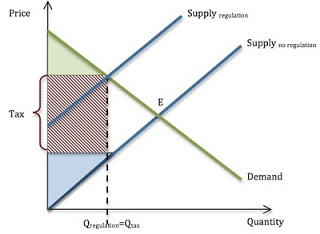
Enough taxation can reduce legal marijuana consumption to current regulated levels, and spare us the war on drugs
09 Apr 2014 Leave a comment
in applied welfare economics, law and economics, public economics Tags: illegal goods, marijuana, prohibition
The economics of illegal goods weighs extremely heavily in favour of legalization and taxation rather than banning and enforcing, as Gary Becker, Kevin Murphy, and Michael Grossman outline in The Economic Theory of Illegal Goods: The Case of Drugs (NBER Working Paper, 1994).
….If the government seeks to regulate the quantity of marijuana consumed, it should choose to do so with a pricing mechanism such as taxation (from which it can earn revenue) rather than a ban (which is costly to enforce). The result is otherwise the same.
Gun control as an arms race-updated
07 Apr 2014 1 Comment
in law and economics Tags: arms races, gun control
U.S. has 4.4% of world's population, but 42% of world's civilian-owned guns. bit.ly/1GlBQ68 via @voxdotcom https://t.co/MdCaKYvHEg—
The Intercept (@the_intercept) October 01, 2015
Gun control is not going to happen in the USA because of the poor incentives for law-abiding individuals to retreat from high levels of legal private gun ownership when criminals will keep their guns. Harry Clarke pointed out that:
The political popularity of guns is strengthened by Prisoner’s Dilemma disincentives for individuals to retreat from high levels of gun ownership.
Accepting a gun buyback would be unattractive to citizens who would recognize high levels of overall gun ownership in the community and, hence, their own personal increased vulnerability if those with criminal intent acted rationally and kept their weapons.
The U.S. Department of Justice’s National Crime Victimization Survey showed the risk of serious injury from a criminal attack is 2.5 times greater for women offering no resistance than for women resisting with a gun.
- The key to the success of Australian and New Zealand gun laws was low levels of gun crime and minimal use of guns for self-defence.
- There was no arms race as compared to the USA where criminals and civilians are both armed. It is easy to control an arms race that has not started.
- The New Zealand, Australian and even the British police rarely have to discharge their weapons.
The Police do not normally carry guns where I live. Economics explains why. There is no arms race.
- Self-defence is not a valid reason to possess firearms in New Zealand. The law does not permit the possession of firearms ‘in anticipation’ that a firearm may need to be used in self-defence.
- The last time of a gun was fired in self-defence by a civilian in New Zealand may have been in 2007.
John Lott was subject to a witch hunt for saying rather straight forward arguments as:
Criminals are deterred by higher penalties. Just as higher arrest and conviction rates deter crime, so does the risk that someone committing a crime will confront someone able to defend him or herself.
Ready access to guns in moments of despair increases suicide rates. Suicides in the Israeli Defence Force fell 40% when young soldiers were not allowed to take their guns home at the week-end. On the other hand, Palestinian terrorists switched from mass shootings to suicide bombings because too many Israelis carry guns.
Getting rid of gun free zones would be a good start because they attract spree killers. Spree killers overcome their delusions and the voices in their heads for just long enough to invest much time finding places filled with defenceless victims. (Virginia Tech was a gun free zone).
America hasn't gone more than 8 days without a mass shooting bit.ly/1MLiaNF (via @washingtonpost) https://t.co/lDZQzFvh5P—
Catherine Mulbrandon (@VisualEcon) October 01, 2015
The last thing spree killers want is to be quickly shot down like the dogs they are such as at that American church in 2007. The Church later fired the guard when they found out she was a lesbian.

Found this interesting report here
At Columbine High School, the attack coincided with the “school resource officer” (a sheriff’s deputy) being off-campus.
The officer returned during the start of the attacks, and fired some long-distance shots at the killers. Those shots drove the killers into the school building, and saved the lives of several students who had been wounded.
The officer failed to pursue the killers into the building.
Dozens of additional officers arrived within minutes, but none of them entered the building either, even though an open 911 line indicated that killings were taking place in the library, while police stood outside just a few feet away.
At least 11 of the 13 Columbine deaths could have been prevented if the police had acted promptly.
Since Columbine, police tactics have changed drastically, to emphasize that whoever is at the scene should immediately and aggressively counter-attack an active shooter.
Penn and Teller suggested that any gun controls should apply only to men and that all guns must be pink in colour.
I agree. Guns do not kill people, people do not kill people, men use guns to kill men and women. In the USA, why stop women from owing guns for protecting themselves from men.
in 1996, Texas repealed its 100-year old law prohibiting concealed weapons after a restaurant massacre. One of the survivors left her gun in her car parked outside because of this law. She lost her parents in the massacre. She was a good shot.
This story is an example of trade-offs. It shows that there is more than one side to gun control especially when trapped in an arms race with a high gun ownership equilibrium . The New Zealand, Australian and even British arms race are in low gun ownership equilibriums.
The Economics of Foreign & Military Intervention with Chris Coyne
04 Apr 2014 Leave a comment
in applied welfare economics, constitutional political economy, development economics, law and economics, liberalism, Public Choice
The Bootlegger and Baptists theory of environmental regulation
04 Apr 2014 Leave a comment
in law and economics, Public Choice Tags: interest group politics
Environmentalists accept the views of the majority of scientists when its suits their agenda. In other cases, the precautionary principle is used to suspend judgment, reject science such as on GMOs and demand ever more evidence.
A good discussion of environmental interest group coalitions is Bootleggers, Baptists, and the Global Warming Battle by Bruce Yandle and Stuart Buck
- The theory’s name is meant to evoke 19th century laws banning alcohol sales on Sunday.
- Baptists supported Sunday closing laws for moral and religious reasons, while bootleggers were eager to stifle their legal competition, so they can sell more of their moonshine.
- Politicians can pose as acting in the interests of public morality, even while taking political support and contributions from bootleggers.

Yandle and Buck argue that during the battle over the Kyoto Protocol, the "Baptist" environmental groups provided moral support and political cover while "bootlegger" corporations and the EU and developing nations worked in the background to seek economic advantages over their rivals about who has to cut their carbon emissions most and least:
National governments are strategically positioning themselves to benefit from the negotiations while operating under cover of the international environmental groups sounding the alarm about global warming.
When we survey the participants, we find that some countries, such as the United Kingdom, are positioned to exploit carbon reductions they have made in the past by raising the cost to economies that still rely heavily on coal.
Other countries, including developing countries, are allowed higher emissions. These countries see opportunities for payments from the developed countries for reducing carbon emissions or for offsetting actions such as planting trees.
In addition, within countries, some industries are favoured by the rules and, within industries, some firms will also be favoured.
Meanwhile, environmentalists are running interference and providing cover.
The same goes for the war on drugs. The last thing that drug gangs want is the drugs they are black-marketing to be made legal. The prohibition era in the USA had the same political dynamics.
Then there is BAPTISTS? THE POLITICAL ECONOMY OF POLITICAL ENVIRONMENTAL INTEREST GROUPS By Todd J. Zywicki, 53 Case Western Reserve Law Review 315 (2002-2003). Zywicki specified three testable implications on the public interest model of the activities of environmental interest groups:
(1) A desire to base policy on the best-available science;
(2) A willingness to engage in deliberation and compromise to balance environmental protection against other compelling social and economic interests; and,
(3) A willingness to consider alternative regulatory strategies that can deliver environmental protection at a lower-cost than command-and-control regulation.
On all three counts, Zywicki found that the public-interest explanation for the activities of environmental interest groups fails to describe their behaviour. Instead, the evidence on each of these three tests is consistent with a self-interested model of the behaviour of environmental groups.
Zywicki concluded that environmental regulation can be best understood as the product of an unlikely alliance of "Baptists and Bootleggers" – public-interested environmental activist groups and private-interested firms and industries seeking to use regulation for commercial advantage, private gain and expressive politics.
Bootleggers and Baptists highlights the role of trade-offs and comparative advantage in the competition among pressure groups for political influence.
Both Gary Becker (1984) and Sam Peltzman (1980) predicted that interest group coalitions would be sub-groups of business, unions, workers, consumers and expressive voters. These coalitions form and realign as demand and cost conditions evolve.
Odd political alliances always arise. The coalition of the Christian Right and radical feminists on the Left joining to fight to censor pornography is a classic. They each wanted to ban the same thing for the exact opposite reasons.
Managerial Econ: Thwarting Innovation in Sunscreen
03 Apr 2014 1 Comment
in applied welfare economics, economics of regulation, law and economics, organisational economics
One consequence of strict FDA rules on drug approvals is that it is really expensive to improve sunscreen.
The Washington Post has a new story titled “FDA review of new sunscreen ingredients has languished for years, frustrating advocates.”
Since 10,000 Americans die of melanoma every year, this delay has real consequences for consumers. How many people did the FDA kill this year?
One of the greatest moments in TV – The Wire – Major Colvins speech: A paper bag for drugs
02 Apr 2014 Leave a comment
the best single case made for ending the war on drugs from the greatest TV show of them all. A bit over 3 minutes long.
Years ago, I remember reading a short news note about a Rand study of occupational hazards facing drug gangs in Washington, DC in the 1970s.
In a typical career of a few years, the annual risks were these:
- The chances of being caught by the police was 22% – usually 18 months in prison;
- the chances of serious injury 7%;
- The chances of being murdered by a business associate or market rival was 1.4%;
- the pay for street dealers is rather poor and not much better than their next best job opening.
Gave up on the war on drugs right there and then. Death and injury are the main occupational hazards of a drug dealer.
Murder was the leading cause of death of young black Americans.
Another paper pointed out that one reason the death penalty did no work so well was because people spent so long on death row due to appeals that taking them out of the drug trade increased their life expectancy.
The execution rate on death row is about twice the death rate from accidents and violence for all American men, and only slightly greater than the rate of accidental and violent death for all black males aged 15 to 34.
Bad prison conditions—well known, pervasive and immediate—have a more significant deterrent role against crime. Death row is a rather safe place to be?
David Friedman on Bits From the Latest IPCC Report
02 Apr 2014 Leave a comment
in applied welfare economics, David Friedman, economics of natural disasters, environmental economics
I have not yet gotten into the full report but, judging from accounts I have seen, 2°C of additional warming is about what it suggests we can expect by 2100 if we don’t do much to prevent it. So if policies to prevent warming reduce the annual growth rate of world income from (say) 2% to 1.98%, the resulting loss will just about cancel the gain. Not a compelling argument for switching from fossil fuels to solar power.
via Ideas: Bits From the Latest IPCC Report.

The withering away of the union wage premium
01 Apr 2014 Leave a comment
in economics of regulation, labour economics, law and economics, politics - USA, unions Tags: union wage premium
The union wage premium is supposed to be 10-15%. There is evidence that it may be close to zero and has been close to zero for some time at least in the USA.

In this paper (QJE 2004), John DiNardo and David Lee compared business establishments from 1984 to 1999 where US unions barely won the union certification election (e. g., by one vote) with workplaces where the unions barely lost.
If 50% plus 1 workers vote in favour of the union proposing to organise them, management has to bargain for a collective agreement in good faith with the certified union, if the union loses, management can ignore that union.
Most winning union certification elections resulted in the signing of a collective agreement not long after. Unions who barely win have as good a chance of securing a collective agreement as those unions that win these elections by wide margins. Few firms subsequently bargained with a union that just lost the certification election. Employers can choose to recognise a union.
Because the vote is so close, a particular workplace becoming unionised was close to a random event.
- This closeness of the union certification election may disentangle unionisation from just being coincident with well-paid workplaces, more skilled workers and well-paid industries.
- Unions could be organising at highly profitable firms that are more likely to grow and pay higher wages independent of any collective bargaining. The unions are claiming credit for wage rises that would have happened anyway.
DiNardo and Lee found only small impacts of unionisation on all outcomes that they examined:
- The estimated changes for wages are close to zero.
- Impacts on survival rates of the unionised business and their profitability were equally tiny.
- This evidence suggests that in recent decades, requiring an employer to bargain with a certified union has had little impact because unions have been unsuccessful in winning significant wage gains.
This means that there may not be a union wage premium at all since the early 1980s in the USA.
Private sector union membership is about 7% in the USA. Private sector union membership is barely in the teens in Australia and New Zealand. Fewer people are joining unions because they are not of any value to them.
The transferability of these results to Australia are in doubt, to the extent that there is the option for compulsory arbitration, which there is. The union wage premium may be the product of the ability to lobby for wage regulation.
New Zealand and U.S. unions are more similar in that both are on their own in bargaining with employers for a wage rise. The U.S. result sends a message to New Zealand that unions are a bit of a relic in terms of wage bargaining.
Regulated industries are a little different because it is wise for employers to share the rents from the higher prices with their employees as higher wages. They then unite in a political coalition to support continued regulation and tariffs. There are far fewer industries these days where entry is regulated and prices are higher because of such anti-competitive regulation.
These results about the small size of the union wage premium, of course, would come as no surprise to Milton Friedman. He said in 1950 that most unions could not overcome market forces that would tend to keep wages aligned with competitive rates.
Ronald Coase: Centennial Coase Lecture
30 Mar 2014 Leave a comment
in industrial organisation, law and economics, Ronald Coase
Three cheers for rude political discourse
25 Mar 2014 Leave a comment
in law and economics, liberalism, libertarianism Tags: Attack Ads, hate speech, Jerry Falwell, Larry Flynt, political discourse
There is nothing unusual about ill-mannered political discourse. In the 1980s, a cartoonist went in search of Ronald Reagan’s brain.
A good discussion on political manners is in the Supreme Court judgment on the Larry Flynt, Jerry Falwell case, which included a 200-year history of American political cartoons.

The Court noted that the political cartoon is a weapon of attack, of scorn and ridicule and satire. It is usually as welcome as a bee sting and is always controversial to some and continuously goes beyond the bounds of good taste and conventional manners.
From the viewpoint of history, the Court held that it is clear that our political discourse would have been considerably poorer without them. The Court stated:
Debate on public issues will not be uninhibited if the speaker must run the risk that it will be proved in court that he spoke out of hatred; even if he did speak out of hatred, utterances honestly believed contribute to the free interchange of ideas and the ascertainment of truth.
Shrillness is commonplace in political discourse as is ignorance and ill manners. The Court held that:
The appeal of the political cartoon or caricature is often based on exploitation of unfortunate physical traits or politically embarrassing events – an exploitation often calculated to injure the feelings of the subject of the portrayal.
Everyone has the right to speak and all adults can vote, including those who disagree with you and even fill you with revulsion.
Politics and hatred of your opponents go hand in hand. Politics is a blood sport for driven people.
More than a few hate capitalism and speak in unflattering, even hateful, tones of the successful and other class enemies. Mises explained the youthful allure of socialism:
It promises a Paradise on earth, a Land of Heart’s Desire full of happiness and enjoyment, and—sweeter still to the losers in life’s game—humiliation of all who are stronger and better than the multitude…
Liberalism and capitalism address themselves to the cool, well-balanced mind. They proceed by strict logic, eliminating any appeal to the emotions.
Socialism, on the contrary, works on the emotions, tries to violate logical considerations by rousing a sense of personal interest and to stifle the voice of reason by awakening primitive instincts.
Every day spent pondering on the rudeness of your opponents is a day not spent showing the middle ground that the opposing viewpoint is wrong.
You play into their hands by taking your eyes off the prize. Back to that former union boss Ronald Reagan:
American politics is littered with, as George Will added eloquently, the bleached bones of those who under-estimated Ronald Reagan.
What global warming will cost us if we do nothing
18 Mar 2014 1 Comment
in David Friedman, economics of climate change, environmental economics, Public Choice Tags: climate change, global warming, ice ages, social cost
David Friedman at Ideas delved into the best estimate of the global cost of global warming – by William Nordhaus – $4.1 trillion this century. This is $48 billion a year – 1/20th of one per cent of world income! Friedman then asked this:

Friedman’s even better argument on the social costs of global warming is that the costs of unlikely but catastrophic risks are included in the social cost arithmetic to make the problem serious. Without including them, global warming up to about a 2-degree warming provides a net benefit.

Friedman shows great insight when he goes on to say that there is “no similar attempt to take account of low probability, high cost consequences of preventing global warming”.
That low probability, high cost consequence, which will occur sooner or later, is the next ice age. The next ice age could include a drop in sea levels of three hundred feet and half a mile of ice over the top of London and Chicago. That would bring a new meaning to climate change refugees. We are in a relatively warm period – an interglacial – in an ice age that started two million years ago.
Friedman asked whether “It is at least possible that global warming is all that is preventing the interglacial from ending”.
The great tactical victory of environmentalists is keeping the debate on the science going because even if the science is right, the economic costs are small.
How much will global warming cost is the correct question for policy debate. Let the science be settled!
Economists have no more expertise to judge the science of global warming than they do in judging the science behind the inevitability of super volcanoes going off again such as the one just north of me. The Yellow stone national park super volcano is 50,000 years overdue, by the way.
Economists can comment on the likely consequences, intended and unintended, of different choices and the constraints that different national and international institutional frameworks place on what policy choices might be made.
The chances of India, China and the rest of the Third World agreeing to forego or even slow their economic development to fight global warming is zero even before you consider the international collective action, verification and free rider problems. Adaptation and ‘richer is safer’ are the only game in town whichever way the climate goes!
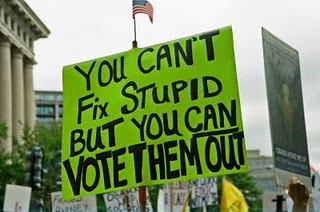
On throwing the rascals out
18 Mar 2014 Leave a comment
in Joseph Schumpeter, Public Choice, Richard Posner Tags: elections, electoral cycles, Joseph Schumpeter, political mandates, retrospective voting, Richard Posner
“American democracy,” writes Richard Posner, “enables the adult population, at very little cost in time, money or distraction from private pursuits commercial or otherwise, to punish at least the flagrant mistakes and misfeasances of officialdom, to assure an orderly succession of at least minimally competent officials, to generate feedback to the officials concerning the consequences of their policies, to prevent officials from (or punish them for) entirely ignoring the interests of the governed, and to prevent serious misalignments between government action and public opinion.”
Too many, in Richard Posner’s view, want to remake democracy with the faculty workshop as their model. Such deliberation has demanding requirements for popular participation in the democratic process, including a high level of knowledge and analytical sophistication and an absence, or at least severe curtailment, of self-interested motives.
Much empirical research demonstrates that citizens have astonishingly low levels of political knowledge. Most lack very basic knowledge of political parties, candidates and issues, much less the sophisticated knowledge necessary to meet the demands of a deliberative democracy.
Posner champions Joseph Schumpeter’s view of democracy as a superior alternative to the unrealistic visions of deliberative democracy.

Schumpeter disputed the widely held view that democracy was a process by which the electorate identified the common good, and that politicians carried this out:
- The people’s ignorance and superficiality meant that they were manipulated by politicians who set the agenda.
- Although periodic votes legitimise governments and keep them accountable, their policy programmes are very much seen as their own and not that of the people, and the participatory role for individuals is limited.
Schumpeter’s theory of democratic participation is that voters have the ability to replace political leaders through periodic elections. Citizens do have sufficient knowledge and sophistication to vote out leaders who are performing poorly or contrary to their wishes. The power of the electorate to turn elected officials out of office at the next election gives elected officials an incentive to adopt policies that do not outrage public opinion and administer the policies with some minimum honesty and competence.
The outcome of Schumpeterian democracy in the 20th century, where governments are voted out rather than voted in, is that most of modern public spending is income transfers that grew to the levels they are because of support from the average voter.

Political parties on the Left and Right that delivered efficient increments and streamlinings in the size and shape of government were elected, and then thrown out from time to time, in turn, because they became tired and flabby or just plain out of touch.
 Utopia, you are standing in it!
Recent Comments