There is much work yet to be done in New Zealand to improve housing affordability, despite recent declines in valuations. Eric Crampton writes – It wasn’t that long ago that New Zealand’s housing market made international news because of its insanity. In 2016, The Guardian tagged Auckland as the “hottest property market in the world” […]
The long road to housing affordability
The long road to housing affordability
11 Feb 2025 Leave a comment
in applied price theory, economics of bureaucracy, economics of regulation, income redistribution, law and economics, politics - New Zealand, property rights, Public Choice, rentseeking, transport economics, urban economics Tags: housing affordability, land supply, zoning
Ireland: Good Corporate Tax Policy vs. Bad Government Spending Policy
11 Feb 2025 Leave a comment
in budget deficits, business cycles, economic growth, economic history, Euro crisis, fiscal policy, global financial crisis (GFC), great recession, labour economics, labour supply, law and economics, macroeconomics, monetary economics, public economics Tags: Ireland, taxation and investment
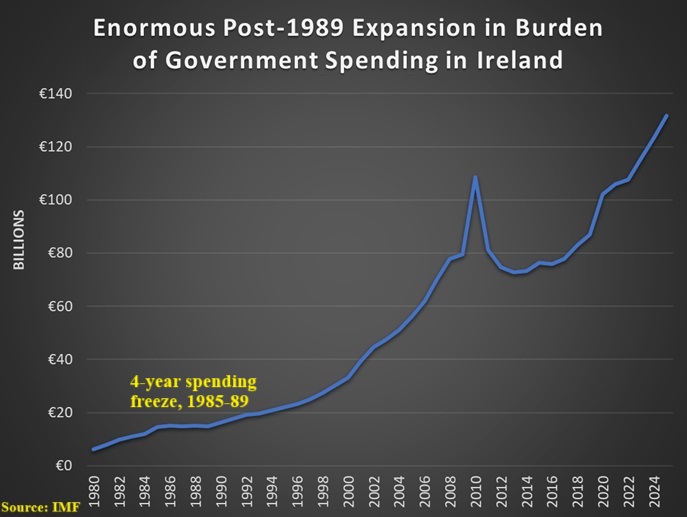
I’m a big fan of Ireland’s low corporate tax rate for three reasons. First, it shows that good tax policy generates positive economic outcomes as per-capita GDP in Ireland has grown by record amounts. Second, it shows that lower tax rates can in some cases lead to more revenue. Sort of a turbo-charged version of […]
Ireland: Good Corporate Tax Policy vs. Bad Government Spending Policy
Five More Climate Lawsuits Shot Down
10 Feb 2025 Leave a comment
in economics of climate change, energy economics, environmental economics, environmentalism, global warming, law and economics, politics - USA, property rights Tags: climate activists, climate alarmism, nuisance suits

Legal Newsline reports the string of climate lawfare defeats in their article Fifth judge agrees with Big Oil, dismisses another climate change case. Excerpts in italics with my bolds and added images. TRENTON, N.J. (Legal Newsline) – A New Jersey state court judge refuses to be the one who sets international energy standards and has […]
Five More Climate Lawsuits Shot Down
Simon Wiesenthal’s interview for Penthouse Magazine
09 Feb 2025 Leave a comment
in defence economics, economics of crime, law and economics, laws of war, war and peace Tags: Nazi Germany, The Holocaust, World War II

Earlier this week, I wrote a blog post featuring quotes from Holocaust survivors. Among them, I came across a powerful statement by Simon Wiesenthal: “For your benefit, learn from our tragedy. It is not a written law that the next victims must be Jews. It can also be other people. We saw it begin in […]
Simon Wiesenthal’s interview for Penthouse Magazine
NCAA bans transgender athletes from women’s sports
09 Feb 2025 Leave a comment
in discrimination, gender, law and economics, liberalism, Marxist economics, politics - USA, property rights, sports economics Tags: free speech, political correctness, regressive left, sex discrimination

(This is my 29,994th post, so we’ll reach 30,000 by the end of the weekend. I don’t know what to think about that!) I think we all know now that most Americans, and a majority of individuals in both Democratic and Republican parties, oppose the participation of trans-identified males in women’s sports, presumably on the […]
NCAA bans transgender athletes from women’s sports
“Insubordination”: FBI Official Accused of Defying White House Reform Efforts
07 Feb 2025 Leave a comment
in economics of bureaucracy, law and economics, politics - USA, Public Choice Tags: 2024 presidential election

Last week, some of us discussed concerns over the demand of the Trump Administration for the names of all FBI agents involved in January 6th cases. While noting that we did not have all of the details, I wrote that this would be a critical test for the Administration between reform and revenge. Line FBI […]
“Insubordination”: FBI Official Accused of Defying White House Reform Efforts
Nicholas Reed Langen: The Use and Abuse of Citizenship Deprivation: SSHD v Kolicaj
07 Feb 2025 Leave a comment
in defence economics, economics of crime, law and economics, war and peace Tags: British politics, constitutional law, Middle-East politics, war against terror

Any British citizen that happens to hold citizenship for another country could find themselves in an invidious position. If the Home Secretary decides that it would be ‘conducive to the public good’, they can single-handedly strip a person of their citizenship, and with it, their right to remain in the country. So long as the deprivation […]
Nicholas Reed Langen: The Use and Abuse of Citizenship Deprivation: SSHD v Kolicaj
It’s comforting to hear Hipkins’ stance on an all-powerful Treaty Commissioner – but what might change his mind?
06 Feb 2025 Leave a comment
in discrimination, law and economics, politics - New Zealand, property rights Tags: Age of Enlightenment, constitutional law, free speech, political correctness, racial discrimination, regressive left
Bob Edlin writes – Labour leader Chris Hipkins has told RNZ’s Morning Report the Labour Party will not support the Māori Party’s outrageous call for the establishment of a parliamentary commissioner for the Treaty of Waitangi with the extraordinary power to veto parliamentary decisions. His position is stated in this account of his response to […]
It’s comforting to hear Hipkins’ stance on an all-powerful Treaty Commissioner – but what might change his mind?
Gender gaps in education and declining marriage rates
06 Feb 2025 Leave a comment
in applied price theory, econometerics, economics of love and marriage, economics of marriage, human capital, labour economics, law and economics, poverty and inequality Tags: assortative mating, economics of fertility
Over the past half-century, the share of men enrolled in college has steadily declined relative to women. Today, 1.6 million more women than men attend four-year colleges in the U.S. This trend has not lowered marriage rates for college women, a substantial share of whom have historically married economically stable men without college degrees. Both […]
Gender gaps in education and declining marriage rates
Identity-based hiring goes wild in New Zealand
05 Feb 2025 Leave a comment
in discrimination, economic history, economics of education, human capital, labour economics, labour supply, law and economics, liberalism, Marxist economics, occupational choice, politics - New Zealand, property rights, Public Choice, public economics, rentseeking Tags: affirmative action, Age of Enlightenment, constitutional law, free speech, political correctness, racial discrimination, regressive left

Just to show you how, in the hiring process, New Zealand gives much more weight to identity than to merit, I enclose part of the job description for the position of Chief Operating Officer of Wellington Water, the water utility for the Greater Wellington region (Wellington, a lovely city, is the capital of New Zealand). […]
Identity-based hiring goes wild in New Zealand
*Progressive Myths*: The Caplan-Huemer Interview
05 Feb 2025 Leave a comment
in econometerics, economic history, law and economics, liberalism, Marxist economics, politics - USA, Public Choice Tags: Age of Enlightenment, conjecture and refutation, free speech, philosophy of science, political correctness, regressive left
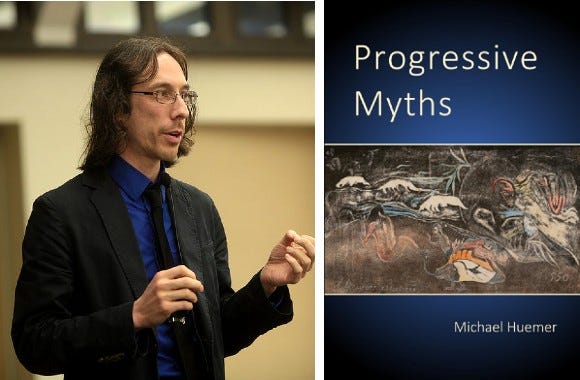
I recently interviewed Mike Huemer on his new Progressive Myths. To repeat, I consider it “the best book on wokeness.” You know you’re reading a special book by page 3, when Huemer states:I will not give a neutral presentation in the following chapters, but I do aim to give an objective presentation. I am a…
*Progressive Myths*: The Caplan-Huemer Interview
Property, liberty, transparency: the principled basis for the Regulatory Standards Bill
04 Feb 2025 Leave a comment
in Adam Smith, applied price theory, economics of bureaucracy, economics of regulation, law and economics, politics - New Zealand, property rights, Public Choice, rentseeking
Bryce Wilkinson writes – If you believe some of its critics, the pending Regulatory Standards Bill is a demonic measure to end New Zealand society as we know it. This is beyond false; it is ridiculous. In fact, it is a modest transparency measure. It will better inform the public about laws and regulations likely […]
Property, liberty, transparency: the principled basis for the Regulatory Standards Bill
Mocking European Statism
04 Feb 2025 1 Comment
in applied price theory, Austrian economics, comparative institutional analysis, economic growth, economics of bureaucracy, economics of regulation, entrepreneurship, environmental economics, financial economics, industrial organisation, international economics, labour economics, labour supply, law and economics, liberalism, macroeconomics, Marxist economics, property rights, Public Choice, public economics, rentseeking, survivor principle, theory of the firm Tags: employment law, European Union
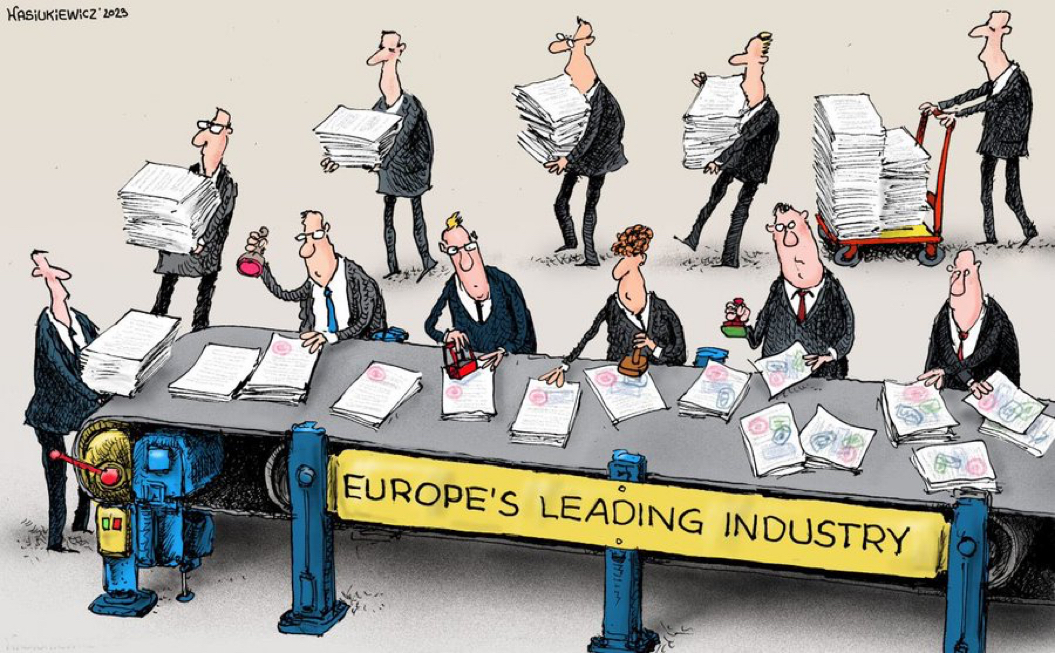
I have a special page for humor involving Europe, but I have not added to it since sharing some Brexit humor in 2016. Let’s being the process of catching up with some amusing cartoons and memes mocking our government-loving cousins on the other side of the Atlantic Ocean. I’ve made the serious point that bureaucrats […]
Mocking European Statism
Spoiling for a Fight: Why Challenging Birthright Citizenship is a Win-Win for Trump
04 Feb 2025 Leave a comment
in International law, labour economics, labour supply, law and economics, politics - USA Tags: 2024 presidential election, constitutional law, economics of immigration, regressive left

Below is my column in the Hill on the move of the Trump Administration against birthright citizenship. The Trump Administration believes that this is fight worth either winning or even losing in the courts. Roughly half of the country oppose birthright citizenship. The key is where those voters are coming from. The minority of voters […]
Spoiling for a Fight: Why Challenging Birthright Citizenship is a Win-Win for Trump
Babies and the Macroeconomy
02 Feb 2025 Leave a comment
in applied price theory, development economics, economic history, economics of love and marriage, economics of marriage, human capital, labour economics, labour supply Tags: ageing society, economics of fertility, marriage and divorce
By Claudia Goldin. From NPR’s Planet Money.”Countries around the world have seen a jaw-dropping decline in fertility rates. In this paper, Claudia Goldin, the 2023 winner of the Nobel Prize in economic sciences, offers a new theory to help explain why (listen to The Indicator’s conversation with her back in 2021). Goldin starts by providing…
Babies and the Macroeconomy


Recent Comments