Roger Partridge writes: A new submission to the Committee from banking experts Andrew Body and Simon Jensen provides fresh evidence of these costs. Their analysis shows the Reserve Bank’s capital rules add between 0.25 and 0.375 percentage points to mortgage rates compared with Australia. For a million-dollar mortgage, that means between $2,500 and $3,750 in […]
The cost of Reserve Bank regulation
The cost of Reserve Bank regulation
02 Mar 2025 Leave a comment
in applied price theory, business cycles, economics of bureaucracy, economics of natural disasters, economics of regulation, inflation targeting, macroeconomics, monetary economics, politics - New Zealand, Public Choice Tags: monetary policy
Forty years of floating
01 Mar 2025 Leave a comment
in budget deficits, business cycles, economic growth, economic history, Euro crisis, global financial crisis (GFC), great recession, history of economic thought, inflation targeting, macroeconomics, monetary economics Tags: floating exchange rates

Last year there was an interesting new book out, made up of 29 collected short papers by (more or less) prominent economists given at a 2023 conference to mark Floating Exchange Rates at Fifty. The fifty years related to the transition back to generalised floating of the major developed world currencies in 1973 (think USD, […]
Forty years of floating
Ireland: Good Corporate Tax Policy vs. Bad Government Spending Policy
11 Feb 2025 Leave a comment
in budget deficits, business cycles, economic growth, economic history, Euro crisis, fiscal policy, global financial crisis (GFC), great recession, labour economics, labour supply, law and economics, macroeconomics, monetary economics, public economics Tags: Ireland, taxation and investment
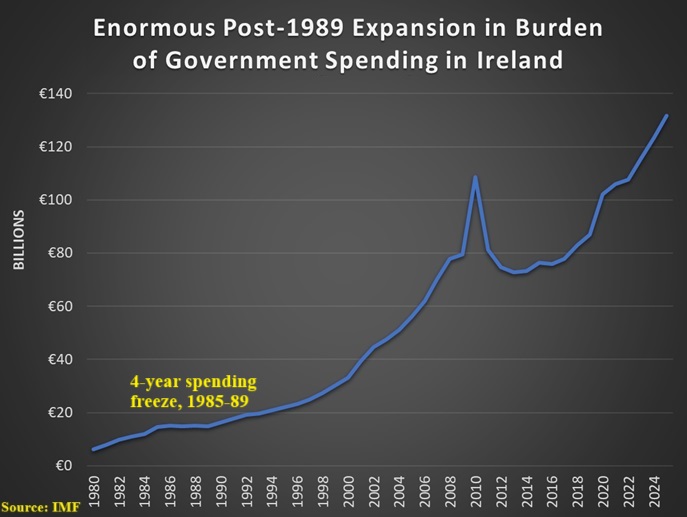
I’m a big fan of Ireland’s low corporate tax rate for three reasons. First, it shows that good tax policy generates positive economic outcomes as per-capita GDP in Ireland has grown by record amounts. Second, it shows that lower tax rates can in some cases lead to more revenue. Sort of a turbo-charged version of […]
Ireland: Good Corporate Tax Policy vs. Bad Government Spending Policy
Left-Wing Economists Were Wildly Wrong about Javier Milei and his Libertarian Agenda for Argentina
10 Jan 2025 Leave a comment
in applied price theory, Austrian economics, budget deficits, business cycles, comparative institutional analysis, constitutional political economy, development economics, economic growth, economics of regulation, financial economics, fiscal policy, growth disasters, growth miracles, history of economic thought, income redistribution, international economics, labour economics, law and economics, liberalism, libertarianism, macroeconomics, Marxist economics, monetarism, monetary economics, political change, politics - USA, property rights, Public Choice, public economics, rentseeking, unemployment Tags: Argentina
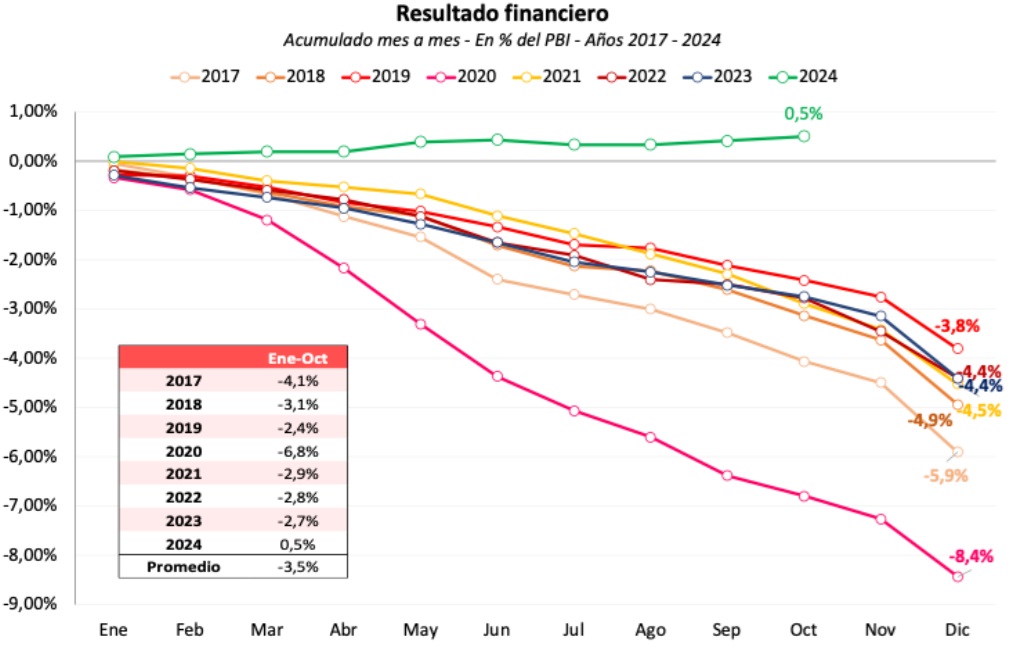
It’s easy to mock economists. Consider the supposedly prestigious left-leaning academics who asserted in 2021 that Biden’s agenda was not inflationary. At the risk of understatement, they wound up with egg on their faces.* Today, we’re going to look at another example of leftist economists making fools of themselves. It involves Argentina, where President Javier […]
Left-Wing Economists Were Wildly Wrong about Javier Milei and his Libertarian Agenda for Argentina
Some Jimmy Carter observations from the 1970s
01 Jan 2025 Leave a comment
in business cycles, defence economics, economic history, economics of regulation, energy economics, macroeconomics, monetary economics, politics - USA, war and peace Tags: Middle-East politics
Usually I am reluctant to criticize or even write about the recently departed, but perhaps for former Presidents there is greater latitude to do so. I never loved Jimmy Carter, and I saw plenty of him on TV and read about his administration on a daily basis in The New York Times. I fully appreciate […]
Some Jimmy Carter observations from the 1970s
Nobel Laureate Paul Krugman’s GDP Graph Confirms the Bottom has Fallen Out of the New Zealand Economy
18 Dec 2024 Leave a comment
in budget deficits, business cycles, economic growth, economic history, fiscal policy, macroeconomics, monetary economics, politics - New Zealand
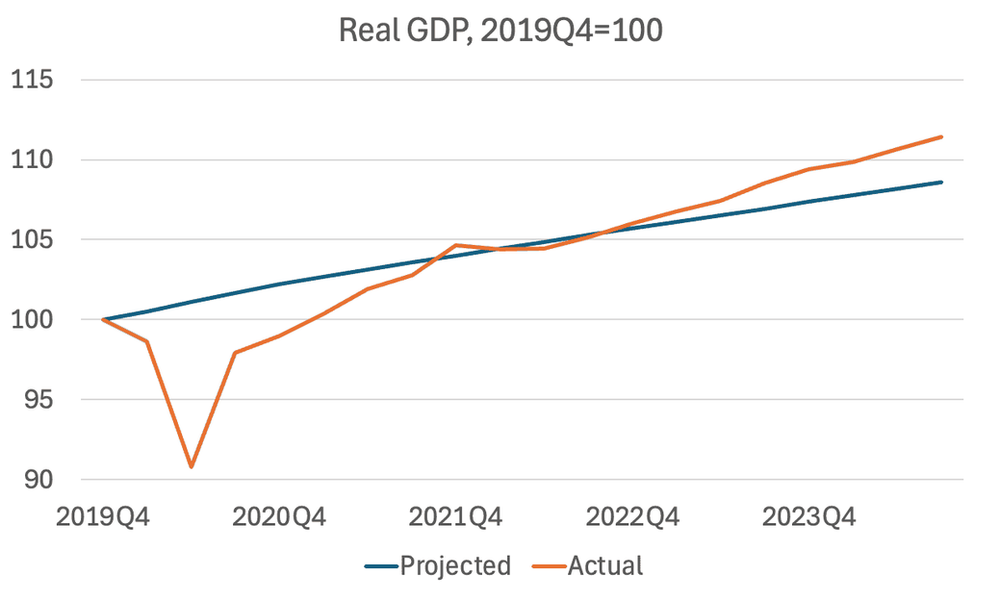
High profile US Economist Paul Krugman has written a New York Times article in which he shows in one graph the incredible resilience and performance of the American Economy. The dark blue line below tracks the pre-pandemic long-run trend in Real GDP. Meanwhile the orange line is actual real GDP. Krugman remarks that now, in…
Nobel Laureate Paul Krugman’s GDP Graph Confirms the Bottom has Fallen Out of the New Zealand Economy
o1 explains why you should not dismiss Fischer Black on money and prices
08 Dec 2024 Leave a comment
in applied price theory, business cycles, economic growth, financial economics, fiscal policy, history of economic thought, macroeconomics, monetarism, monetary economics Tags: monetary policy
The prediction of inflation dynamics—how prices change over time—has increasingly confounded modern macroeconomists. Throughout much of the twentieth century, there seemed to be clear relationships linking the money supply, economic slack, and price levels. Monetarism, the school of thought that posits a stable connection between the growth rate of a money aggregate and the subsequent […]
o1 explains why you should not dismiss Fischer Black on money and prices
Usual suspects want more debt
30 Nov 2024 Leave a comment
in applied price theory, budget deficits, business cycles, economic growth, fiscal policy, labour economics, liberalism, macroeconomics, Marxist economics, monetary economics, politics - New Zealand, Public Choice, public economics, unemployment Tags: monetary policy
A group of economists have written to Nicola Willis complaining about the modest fiscal restraint imposed on the public sector. Grant Robertson grew government expenditure by $76 billion/year or a massive 7.6% of GDP, leaving NZ with a structural deficit. Many were champions of his policies or worked for him, and now they complain his […]
Usual suspects want more debt
Trump’s victory: Golden age or fiscal reckoning?
14 Nov 2024 Leave a comment
in business cycles, economic growth, fiscal policy, industrial organisation, international economics, labour economics, law and economics, macroeconomics, monetary economics, politics - USA, property rights, public economics Tags: 2024 presidential election
Oliver Hartwich writes – In his victory speech, Donald Trump promised Americans a new “golden age”. While he had the numbers to win the election, the economic realities he faces will make delivering on his promise challenging. Trump’s victory reflects many Americans’ frustrations with living standards and inflation during the Biden-Harris administration. Vice President Kamala […]
Trump’s victory: Golden age or fiscal reckoning?
Biden-Harris policies and their consequences were no surprise to those paying attention
30 Oct 2024 Leave a comment
in applied price theory, applied welfare economics, budget deficits, business cycles, econometerics, economic growth, economic history, economics of bureaucracy, economics of regulation, energy economics, entrepreneurship, environmental economics, financial economics, fiscal policy, global warming, health economics, income redistribution, industrial organisation, law and economics, macroeconomics, monetary economics, politics - USA, property rights, Public Choice, public economics, rentseeking Tags: 2024 presidential election, drug lags, taxation and entrepreneurship, taxation and investment
Milton Friedman used to advise researchers to focus on large policy changes rather than attempting to separate a small change’s signal from the noise. In this sense, the “ambitious” policy agenda of the Biden-Harris administration was expected to be a gift to the research community. Accepting this gift, since 2020 I have been making forecasts…
Biden-Harris policies and their consequences were no surprise to those paying attention
Another zero lower bound prediction bites the dust
28 Sep 2024 Leave a comment
in applied price theory, budget deficits, business cycles, economic growth, fiscal policy, history of economic thought, labour economics, macroeconomics, monetary economics, public economics, unemployment Tags: New Keynesian macroeconomics
Popular New Keynesian macroeconomic models predict that cuts in various types of distortionary taxes are contractionary when monetary policy is constrained at the zero lower bound. We turn to a long span of history in the United Kingdom to test this hypothesis. Using a new long-run dataset of narrative-identified tax changes from 1918to 2020, we […]
Another zero lower bound prediction bites the dust
Proof that NZ’s Reserve Bank has Inflicted Unnecessary Pain up and down the Nation.
27 Sep 2024 Leave a comment
in business cycles, economic growth, fiscal policy, labour economics, macroeconomics, monetary economics, politics - New Zealand, politics - USA, unemployment Tags: economics of pandemics, monetary policy
In the past few hours, it has been stated that the US economy grew at a solid 3% rate last quarter, as given in the American government’s final estimate. New Zealand’s economy, on the other hand, shrank at a rate of -0.2%. The US Federal Funds rate (the equivalent of NZ’s Official Cash Rate, OCR)…
Proof that NZ’s Reserve Bank has Inflicted Unnecessary Pain up and down the Nation.
Failing Banks
11 Sep 2024 Leave a comment
in business cycles, economic history, financial economics, global financial crisis (GFC), great depression, great recession, macroeconomics, monetary economics, politics - USA Tags: bank panics, bank runs
From Sergio Correia, Stephan Luck, and Emil Verner: Why do banks fail? We create a panel covering most commercial banks from 1865 through 2023 to study the history of failing banks in the United States. Failing banks are characterized by rising asset losses, deteriorating solvency, and an increasing reliance on expensive non-core funding. Commonalities across…
Failing Banks
Interview with Greg Mankiw: New Keynesian Macro, Growth, and Economic Policy
04 Sep 2024 Leave a comment
in applied price theory, budget deficits, business cycles, development economics, econometerics, economic growth, economic history, Edward Prescott, fiscal policy, great depression, history of economic thought, labour economics, law and economics, macroeconomics, Milton Friedman, monetarism, monetary economics, politics - USA, Public Choice, Robert E. Lucas, unemployment
Jon Hartley interviews Greg Mankiw on topics including New Keynesian macroeconomics, growth, and economic policy more broadly at his Capitalism and Freedom website (August 20, 2024, video and transcript available). Here are a few of the comments that caught my eye. On big models and small models in studying the macroeconomy: [O]n the issue of…
Interview with Greg Mankiw: New Keynesian Macro, Growth, and Economic Policy
Fiscal and monetary policy
27 Aug 2024 Leave a comment
in budget deficits, business cycles, econometerics, economic growth, economic history, financial economics, fiscal policy, history of economic thought, inflation targeting, macroeconomics, monetary economics, politics - New Zealand Tags: monetary policy

Over the last few years, The Treasury seems to have been toying with bidding for a more significant role for fiscal policy as a countercyclical stabilisation tool It seemed to start when Covid hubris still held sway – didn’t we do well? – and the first we saw of it in public was at a […]
Fiscal and monetary policy


Recent Comments