Michael Reddell writes – There were good things in the Budget. There may be few/no votes in better macroeconomic statistics and, specifically, a monthly CPI but – years late (for which the current government can’t really be blamed) – it is finally going to happen.
Not that long ago, New Zealand’s fiscal balances looked pretty good by advanced country standards. Sure, the fiscal pressures from longer life expectancies were beginning to build – as they were in most of the advanced world – but in absolute and relative terms New Zealand still looked in pretty good shape. Just a few […]
There’s an enormous amount of data showing that people in the United States enjoy much higher livings standards than Europeans. That’s not too surprising since most European governments have adopted large-sized welfare states while Americans are (comparatively!) lucky in that we have a medium-sized welfare state. That’s all very straightforward and uncontroversial. What’s not completely […]
Maybe not, isn’t that a form of double counting? After all, defense spending is there to enable the production of other goods and services, it is not useful per se. Chandler S. Reilly and Vincent Geloso recalculate the history of U.S. economic growth using this new method: In fact, our corrections applied to the entire […]
I’m currently in Finland for meetings with various people and I learned that the country’s bloated public sector and expensive welfare state are imposing a very heavy cost on the economy. How heavy of a cost? According to IMF data, there’s been no growth in per-capita GDP over the past 18 years. Why is Finland […]
The US economy has emerged from the pandemic growing at a faster pace than the UK and other high-income countries. Simon Pittaway tackles the question of why in “Yanked away: Accounting for the post-pandemic productivity divergence between Britain and America” (Resolution Foundation, April 2025). The average standard of living in any economy, over time, will…
Myron Scholes was on top of the world in 1997, having won the Nobel Prize in economics that year for his work in financial economics, work that he had applied in the real world in a wildly successful hedge fund, Long Term Capital Management. But just one year later, LTCM was saved from collapse only […]
Elon recently re-opened the perennial debate about whether Social Security is a ponzi scheme. Here’s my, lightly edited post from 2011. Elon is in good company calling social security a ponzi scheme. First up is Nobel prize winner Paul Samuelson who wrote: The beauty of social insurance is that it is actuarially unsound. Everyone who reaches […]
Former chairman of the Federal Reserve Board of Governors (and FOMC), Ben Bernanke, was yesterday the first of two keynote speakers at the Reserve Bank’s conference to mark 35 years of inflation targeting, which first became a formalised thing here in New Zealand. He indicated that he’d be speaking about inflation targeting in general and […]
That’s the title of a 2024 book by a couple of Australian academic economists, Steven Hamilton (based in US) and Richard Holden (a professor at the University of New South Wales). The subtitle of the book is “How we crushed the curve but lost the race”. It is easy to get off on the wrong […]
Last year there was an interesting new book out, made up of 29 collected short papers by (more or less) prominent economists given at a 2023 conference to mark Floating Exchange Rates at Fifty. The fifty years related to the transition back to generalised floating of the major developed world currencies in 1973 (think USD, […]
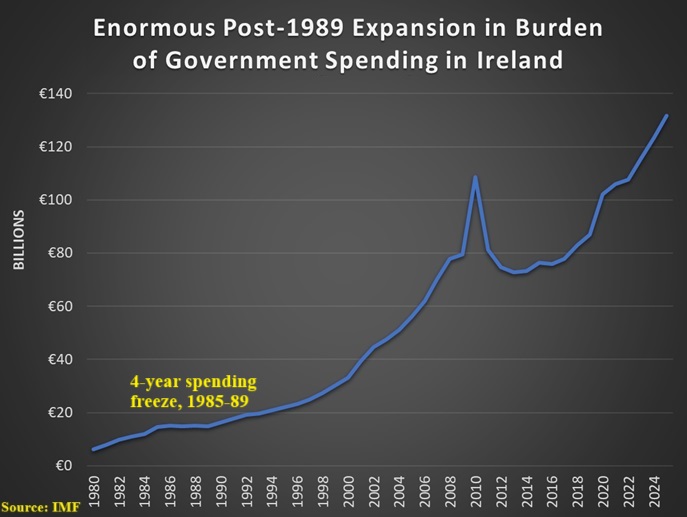
I’m a big fan of Ireland’s low corporate tax rate for three reasons. First, it shows that good tax policy generates positive economic outcomes as per-capita GDP in Ireland has grown by record amounts. Second, it shows that lower tax rates can in some cases lead to more revenue. Sort of a turbo-charged version of […]
Other than Art Laffer, I think of myself as the world’s biggest advocate of the Laffer Curve. I’ve literally written hundreds of columns explaining and promoting the concept. My goal is to help people understand that there is not a linear relationship between tax rates and tax revenue. Why is this the case? Because when […]
Don Brash and Michael Reddell write – When Don was young and Michael’s parents were young, New Zealand had among the very highest material standards of living in the world. It really was, in the old line, one of the very best places to bring up children. But no longer. For 75 years now, with […]
Why Evolution is True is a blog written by Jerry Coyne, centered on evolution and biology but also dealing with diverse topics like politics, culture, and cats.
“We do not believe any group of men adequate enough or wise enough to operate without scrutiny or without criticism. We know that the only way to avoid error is to detect it, that the only way to detect it is to be free to inquire. We know that in secrecy error undetected will flourish and subvert”. - J Robert Oppenheimer.



 Utopia, you are standing in it!
Recent Comments