Today on the MR Podcast Tyler and I discuss the “New Monetary Economics”. Here’s the opening TABARROK: Today we’re going to be talking about the new monetary economics. Now, perhaps the first thing to say is that it’s not new anymore. The new monetary economics refers to a set of claims and ideas about monetary economics […]
Marginal Revolution Podcast–The New Monetary Economics!
Marginal Revolution Podcast–The New Monetary Economics!
25 Dec 2024 Leave a comment
in applied price theory, history of economic thought, macroeconomics, monetarism, monetary economics Tags: monetary policy
Nobel Laureate Paul Krugman’s GDP Graph Confirms the Bottom has Fallen Out of the New Zealand Economy
18 Dec 2024 Leave a comment
in budget deficits, business cycles, economic growth, economic history, fiscal policy, macroeconomics, monetary economics, politics - New Zealand
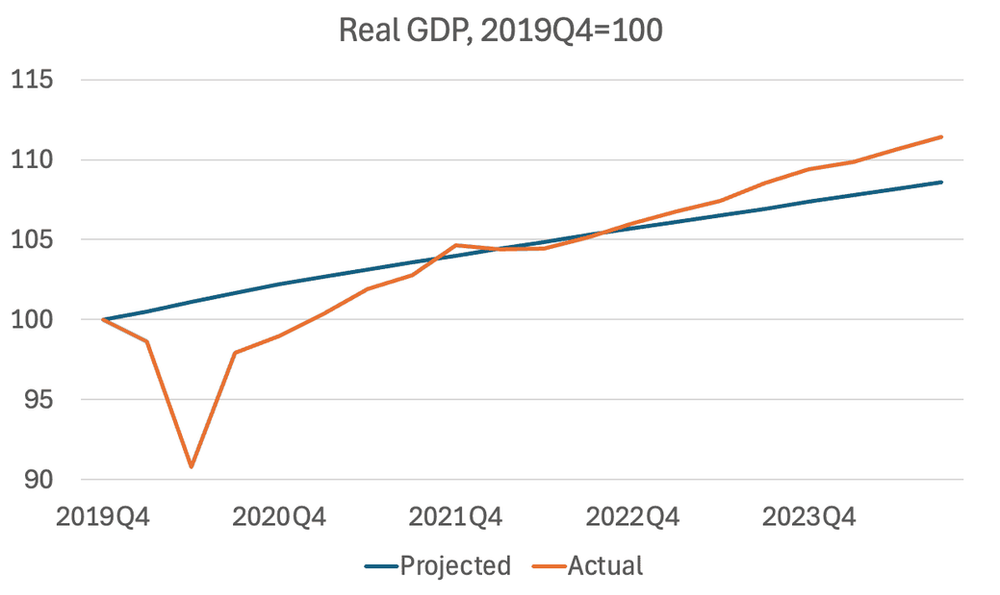
High profile US Economist Paul Krugman has written a New York Times article in which he shows in one graph the incredible resilience and performance of the American Economy. The dark blue line below tracks the pre-pandemic long-run trend in Real GDP. Meanwhile the orange line is actual real GDP. Krugman remarks that now, in…
Nobel Laureate Paul Krugman’s GDP Graph Confirms the Bottom has Fallen Out of the New Zealand Economy
o1 explains why you should not dismiss Fischer Black on money and prices
08 Dec 2024 Leave a comment
in applied price theory, business cycles, economic growth, financial economics, fiscal policy, history of economic thought, macroeconomics, monetarism, monetary economics Tags: monetary policy
The prediction of inflation dynamics—how prices change over time—has increasingly confounded modern macroeconomists. Throughout much of the twentieth century, there seemed to be clear relationships linking the money supply, economic slack, and price levels. Monetarism, the school of thought that posits a stable connection between the growth rate of a money aggregate and the subsequent […]
o1 explains why you should not dismiss Fischer Black on money and prices
How is the Russian war economy doing?
08 Dec 2024 1 Comment
in applied price theory, defence economics, development economics, economic growth, economics of regulation, entrepreneurship, fiscal policy, growth disasters, income redistribution, industrial organisation, international economics, law and economics, macroeconomics, monetary economics, property rights, Public Choice, war and peace Tags: Russia, Ukraine
Here is a gloomy account from Vladimir Mirov: Ruble depreciation will contribute to inflation even further, as Russia is continued to be heavily reliant on imports – this is a kind of self-sustaining spiral. I also strongly disagree with those who say that cheaper ruble is “good” for exporters and the budget. Exporters have yet […]
How is the Russian war economy doing?
Usual suspects want more debt
30 Nov 2024 Leave a comment
in applied price theory, budget deficits, business cycles, economic growth, fiscal policy, labour economics, liberalism, macroeconomics, Marxist economics, monetary economics, politics - New Zealand, Public Choice, public economics, unemployment Tags: monetary policy
A group of economists have written to Nicola Willis complaining about the modest fiscal restraint imposed on the public sector. Grant Robertson grew government expenditure by $76 billion/year or a massive 7.6% of GDP, leaving NZ with a structural deficit. Many were champions of his policies or worked for him, and now they complain his […]
Usual suspects want more debt
Milei and populism
23 Nov 2024 1 Comment
in applied price theory, budget deficits, comparative institutional analysis, constitutional political economy, development economics, economic growth, economics of bureaucracy, economics of regulation, fiscal policy, growth disasters, income redistribution, macroeconomics, monetarism, monetary economics, Public Choice, rentseeking, unemployment Tags: Argentina
Bryan Caplan and Daniel Klein both opine on Milei and populism, Dan being very enthusiastic, while Bryan praising Milei but more reserved in his praise of populism. I too am a big fan of Milei, and I think he is still on a good track. If his reforms do not succeed, likely it will not […]
Milei and populism
Popuphobia’s Javier Milei Problem
22 Nov 2024 1 Comment
in development economics, economic growth, economics of bureaucracy, economics of regulation, fiscal policy, growth disasters, income redistribution, labour economics, law and economics, liberalism, libertarianism, macroeconomics, Marxist economics, monetary economics, property rights, Public Choice, public economics, rentseeking, unemployment Tags: Argentina

My dear friend and colleague Dan Klein wrote this. He loves feedback, so please share your thoughts in the comments. And he’d especially appreciate reactions from friends Shikha Dalmia and Nils Karlson, which I’d definitely be glad to run.P.S. Dan asked me to link to the latest Milei news.I define popuphobe as someone who propagates…
Popuphobia’s Javier Milei Problem
Setelinleikkaus: When Finns snipped their cash in half to curb inflation
18 Nov 2024 Leave a comment
in applied price theory, economic history, financial economics, law and economics, macroeconomics, monetarism, monetary economics, property rights Tags: Finland, monetary policy

On the last day of 1945, with World War II finally behind it, Finland’s government announced a new and very strange policy.All Finns were required to take out a pair of scissors and snip their banknotes in half. This was known in Finland as setelinleikkaus, or banknote cutting. Anyone who owned any of the three…
Setelinleikkaus: When Finns snipped their cash in half to curb inflation
Trump’s victory: Golden age or fiscal reckoning?
14 Nov 2024 Leave a comment
in business cycles, economic growth, fiscal policy, industrial organisation, international economics, labour economics, law and economics, macroeconomics, monetary economics, politics - USA, property rights, public economics Tags: 2024 presidential election
Oliver Hartwich writes – In his victory speech, Donald Trump promised Americans a new “golden age”. While he had the numbers to win the election, the economic realities he faces will make delivering on his promise challenging. Trump’s victory reflects many Americans’ frustrations with living standards and inflation during the Biden-Harris administration. Vice President Kamala […]
Trump’s victory: Golden age or fiscal reckoning?
Reeves to make Bank of England put climate change and growth on equal footing
31 Oct 2024 Leave a comment
in economics of bureaucracy, economics of climate change, energy economics, environmental economics, environmentalism, global warming, macroeconomics, monetary economics, Public Choice Tags: British politics, climate activists, climate alarmism, monetary policy

By Paul Homewood So much for the Bank’s much vaunted independence! Rachel Reeves is planning to make the Bank of England take climate change as seriously as growth, as the Chancellor seeks to use her maiden Budget to overhaul the economy. In a letter to Governor Andrew Bailey on Wednesday, Ms Reeves is […]
Reeves to make Bank of England put climate change and growth on equal footing
Biden-Harris policies and their consequences were no surprise to those paying attention
30 Oct 2024 Leave a comment
in applied price theory, applied welfare economics, budget deficits, business cycles, econometerics, economic growth, economic history, economics of bureaucracy, economics of regulation, energy economics, entrepreneurship, environmental economics, financial economics, fiscal policy, global warming, health economics, income redistribution, industrial organisation, law and economics, macroeconomics, monetary economics, politics - USA, property rights, Public Choice, public economics, rentseeking Tags: 2024 presidential election, drug lags, taxation and entrepreneurship, taxation and investment
Milton Friedman used to advise researchers to focus on large policy changes rather than attempting to separate a small change’s signal from the noise. In this sense, the “ambitious” policy agenda of the Biden-Harris administration was expected to be a gift to the research community. Accepting this gift, since 2020 I have been making forecasts…
Biden-Harris policies and their consequences were no surprise to those paying attention
Inquiring into banking
02 Oct 2024 Leave a comment
in applied price theory, economics of bureaucracy, economics of regulation, financial economics, macroeconomics, monetary economics, politics - New Zealand, Public Choice Tags: monetary policy competition law

Hard on the heels of the Commerce Commission’s inquiry into some aspects of banking competition, Parliament’s Finance and Expenditure Committee is also holding an inquiry. Submissions weren’t open for very long and have now closed, but the full terms of reference are here. It is a select committee inquiry, so it is hard to be […]
Inquiring into banking
Another zero lower bound prediction bites the dust
28 Sep 2024 Leave a comment
in applied price theory, budget deficits, business cycles, economic growth, fiscal policy, history of economic thought, labour economics, macroeconomics, monetary economics, public economics, unemployment Tags: New Keynesian macroeconomics
Popular New Keynesian macroeconomic models predict that cuts in various types of distortionary taxes are contractionary when monetary policy is constrained at the zero lower bound. We turn to a long span of history in the United Kingdom to test this hypothesis. Using a new long-run dataset of narrative-identified tax changes from 1918to 2020, we […]
Another zero lower bound prediction bites the dust
Proof that NZ’s Reserve Bank has Inflicted Unnecessary Pain up and down the Nation.
27 Sep 2024 Leave a comment
in business cycles, economic growth, fiscal policy, labour economics, macroeconomics, monetary economics, politics - New Zealand, politics - USA, unemployment Tags: economics of pandemics, monetary policy
In the past few hours, it has been stated that the US economy grew at a solid 3% rate last quarter, as given in the American government’s final estimate. New Zealand’s economy, on the other hand, shrank at a rate of -0.2%. The US Federal Funds rate (the equivalent of NZ’s Official Cash Rate, OCR)…
Proof that NZ’s Reserve Bank has Inflicted Unnecessary Pain up and down the Nation.
Why the Fed Cut Sent Stocks Soaring
23 Sep 2024 Leave a comment
in applied price theory, entrepreneurship, financial economics, macroeconomics, monetary economics Tags: monetary policy
When rates go low, future profits go high. Everyone wants a cutBy Richard B. McKenzie. Excerpt:”Profits in the future, dollar for dollar, are worth less than current dollars. This is because current profits can earn interest between now and the future, which means that future profits must be discounted by some percentage to make them…
Why the Fed Cut Sent Stocks Soaring


Recent Comments