By Timothy Cogley. He was then at the Federal Reserve Bank of San Francisco (1999). He is now at New York University. “In recent years, a number of economists have expressed concern that the stock market is overvalued. Some have compared the situation with the 1920s, warning that the market may be headed for a…
Monetary Policy and the Great Crash of 1929: A Bursting Bubble or Collapsing Fundamentals?
Monetary Policy and the Great Crash of 1929: A Bursting Bubble or Collapsing Fundamentals?
11 Jun 2024 Leave a comment
in business cycles, economic growth, economic history, great depression, history of economic thought, macroeconomics, monetarism, monetary economics Tags: monetary policy
Comparing Treasury and Reserve Bank forecasts
06 Jun 2024 Leave a comment
in budget deficits, business cycles, economic growth, fiscal policy, macroeconomics, monetary economics, politics - New Zealand Tags: monetary policy

I put a range of charts on Twitter late last week illustrating why, from a macroeconomic perspective, I found the government’s Budget deeply underwhelming. I won’t repeat them but will just show two here. The first is the Treasury’s estimate of how the bit of the operating deficit not explained just by swings in the […]
Comparing Treasury and Reserve Bank forecasts
Caught out! The NZ Initiative’s Article in the Herald Blaming the RBNZ for our Rip-Off Big Banks is Contradicted by its Own Expert Witness. (Willis Beware).
06 Jun 2024 Leave a comment
in applied price theory, global financial crisis (GFC), great recession, industrial organisation, law and economics, macroeconomics, monetary economics, politics - New Zealand Tags: competition law
When it comes to the question of how best to avoid a banking collapse and multi-billion dollar bailout that can drag a whole nation into depression, the best solution, according to Chicago-Stanford economist, John Cochrane, is to require banks to set aside a fraction of their own funds as reserves to cover losses they may…
Caught out! The NZ Initiative’s Article in the Herald Blaming the RBNZ for our Rip-Off Big Banks is Contradicted by its Own Expert Witness. (Willis Beware).
Bailouts Forever
02 Jun 2024 Leave a comment
in business cycles, economic history, financial economics, global financial crisis (GFC), macroeconomics, monetary economics, politics - USA Tags: deposit insurance
When interest rates rise, the price of long-term assets falls. Consequently, when the Fed began raising interest rates in 2022, the value of bonds and mortgages dropped, causing significant accounting losses for banks heavily invested in these assets. Silicon Valley Bank went bust, for example, because depositors fled upon realizing it was holding lots of […]
Bailouts Forever
MPS
22 May 2024 Leave a comment
in budget deficits, business cycles, economic growth, financial economics, fiscal policy, inflation targeting, macroeconomics, monetary economics
Two central banks
18 May 2024 Leave a comment
in economic history, inflation targeting, macroeconomics, monetary economics, politics - Australia, politics - New Zealand Tags: monetary policy
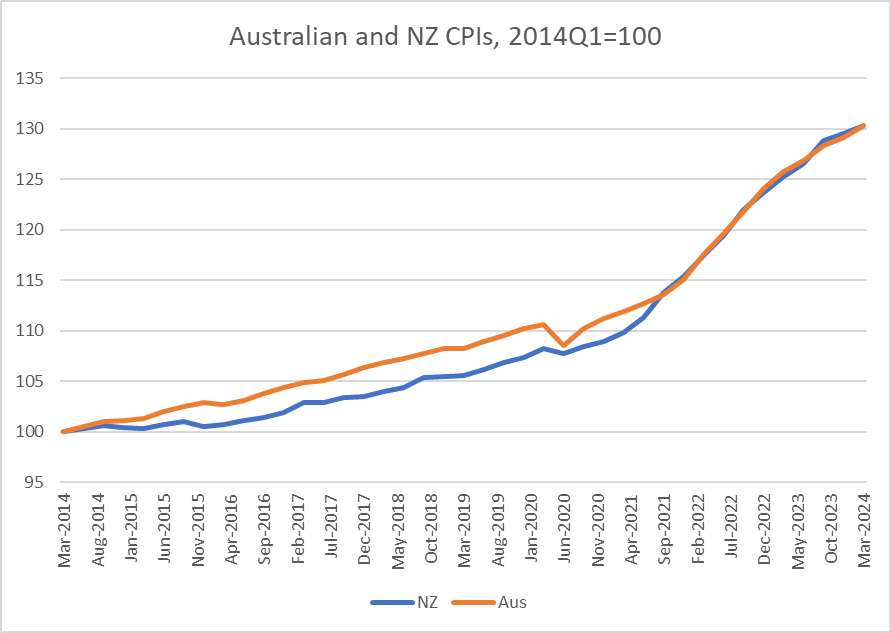
Michael Reddell writes – I got curious yesterday about how the Australia/New Zealand real exchange rate had changed over the last decade, and so dug out the data on the changes in the two countries’ CPIs. Over the 10 years from March 2014 to March 2024, New Zealand’s CPI had risen by 30.3 per cent […]
Two central banks
More Good Results from Argentina
28 Apr 2024 Leave a comment
in budget deficits, business cycles, comparative institutional analysis, development economics, economic growth, economic history, economics of bureaucracy, economics of regulation, fiscal policy, growth disasters, income redistribution, labour economics, liberalism, libertarianism, macroeconomics, Marxist economics, monetary economics, Public Choice, rentseeking, unemployment Tags: Argentina
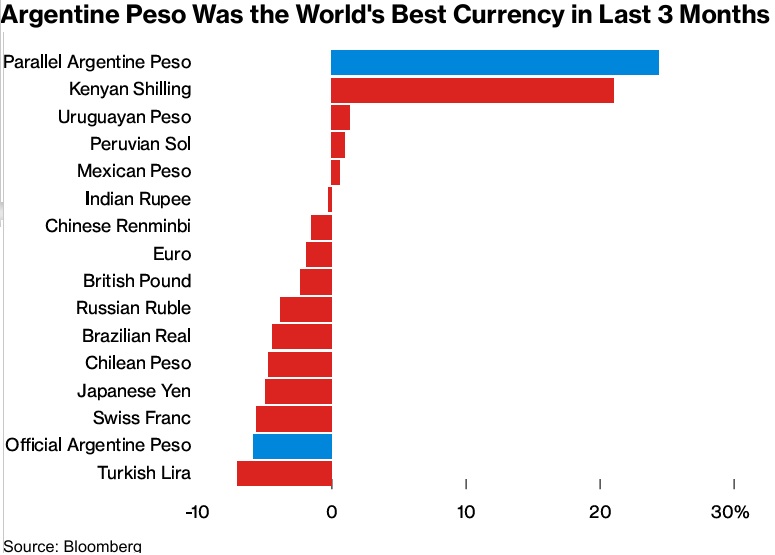
The most important election of 2023 took place in Argentina, where that nation’s voters elected the libertarian candidate, Javier Milei, as their new president. I discussed the outlook for Milei’s agenda on a recent appearance of the Schilling Show. Here’s a brief excerpt. As you can see, I’m worried that Milei faces enormous obstacles. Argentina […]
More Good Results from Argentina
Still no prudential regulation case around climate change
24 Apr 2024 Leave a comment
in economics of bureaucracy, economics of climate change, environmental economics, environmentalism, financial economics, global warming, industrial organisation, law and economics, macroeconomics, monetary economics, politics - New Zealand, Public Choice, survivor principle Tags: climate alarmism
Eric Crampton writes – The Reserve Bank of New Zealand desperately wants to find reasons to have workstreams in climate change. It makes little sense.
Still no prudential regulation case around climate change
19 Apr 2024 Leave a comment
in budget deficits, business cycles, economic growth, economic history, fiscal policy, great depression, history of economic thought, labour economics, macroeconomics, monetarism, monetary economics, unemployment
MICHAEL REDDELL: Not very bothered by deficits
03 Apr 2024 Leave a comment
in budget deficits, business cycles, economic history, fiscal policy, macroeconomics, monetary economics, politics - New Zealand
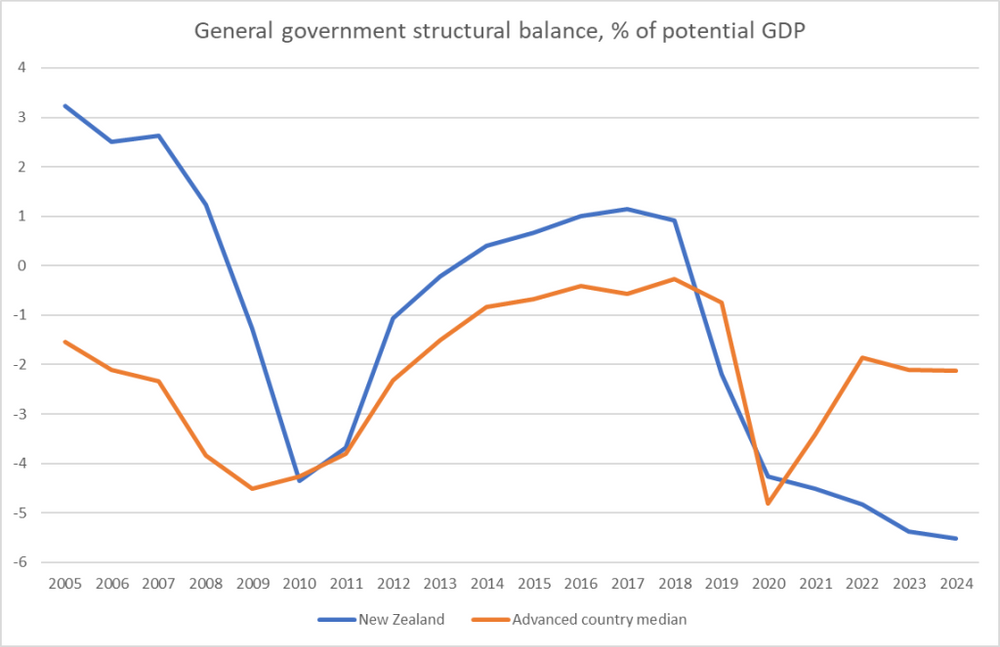
I was away last week so have been rather late in getting to the Budget Policy Statement and associated material released last Wednesday. It does not make for pleasant reading, at least if one cares at all about governments not borrowing to pay for the groceries. Once upon a time – still not that long…
MICHAEL REDDELL: Not very bothered by deficits
How credible is the Milei plan?
24 Mar 2024 Leave a comment
in applied price theory, budget deficits, business cycles, development economics, economic growth, financial economics, fiscal policy, growth disasters, income redistribution, international economics, macroeconomics, monetary economics, Public Choice, public economics Tags: Argentina
Here is a good Substack essay by Nicolas Cachanosky, excerpt: Inflation expectations depend on what is expected to happen to the budget in the months to come. It is natural, then, to ask whether the observed surpluses are sustainable in the months ahead. Answering this question requires looking at two things. First, how was the fiscal […]
How credible is the Milei plan?
One Year Since the Meltdown at Silicon Valley Bank: Commercial Real Estate and Ongoing Threats
13 Mar 2024 Leave a comment
in applied price theory, economics of information, economics of regulation, financial economics, macroeconomics, monetary economics, politics - USA Tags: banking panics

One year ago in March 2023, Silicon Valley Bank melted down, quickly followed by similar meltdowns at Signature Bank and First Republic Bank. Measured by the nominal size of bank assets, these were three of the biggest four US bank failures in history. (The failure of Washington Mutual Bank in 2008 remains the largest.) Was…
One Year Since the Meltdown at Silicon Valley Bank: Commercial Real Estate and Ongoing Threats
This kind of macro theory is underrated
01 Mar 2024 Leave a comment
in applied price theory, business cycles, fiscal policy, history of economic thought, job search and matching, macroeconomics, monetary economics Tags: real business cycle theory
Demand shocks as technology shocks: We provide a macroeconomic theory where demand for goods has a productive role. A search friction prevents perfect matching between producers and potential customers. Larger demand induces more search, which in turn increases GDP and measured TFP. We embed the product-market friction in a standard neoclassical model and estimate it […]
This kind of macro theory is underrated
How good was Paul Samuelson’s macroeconomics?
25 Feb 2024 Leave a comment
in business cycles, economic history, history of economic thought, macroeconomics, Milton Friedman, monetary economics Tags: monetary policy, wage and price controls
Reading the new Nicholas Wapshott book and also Krugman’s review (NYT) of it, it all seemed a little too rosy to me. So I went back and took a look at Paul Samuelson the macroeconomist. I regret that I cannot report any good news, in fact Samuelson was downright poor — you might say awful […]
How good was Paul Samuelson’s macroeconomics?
T. C. Koopmans Demolishes the Phillips Curve as a Guide to Policy
12 Feb 2024 Leave a comment
in business cycles, econometerics, economic history, history of economic thought, macroeconomics, monetary economics
Nobel Laureate T. C. Koopmans wrote one of the most famous economics articles of the twentieth century, “Measurement Without Theory,” a devastating review of an important, and in many ways useful and meritorious, study of business cycles by two of the fathers of empirical business-cycles research, Arthur F. Burns and Wesley C. Mitchell, Measuring Business […]
T. C. Koopmans Demolishes the Phillips Curve as a Guide to Policy


Recent Comments