By Timothy Cogley. He was then at the Federal Reserve Bank of San Francisco (1999). He is now at New York University. “In recent years, a number of economists have expressed concern that the stock market is overvalued. Some have compared the situation with the 1920s, warning that the market may be headed for a…
Monetary Policy and the Great Crash of 1929: A Bursting Bubble or Collapsing Fundamentals?
Monetary Policy and the Great Crash of 1929: A Bursting Bubble or Collapsing Fundamentals?
11 Jun 2025 Leave a comment
in business cycles, economic history, great depression, macroeconomics, monetary economics Tags: monetary policy
An American Enterprise Institute Discussion of “The Triumph of Economic Freedom”
05 Jun 2025 Leave a comment
in applied price theory, comparative institutional analysis, constitutional political economy, development economics, economic growth, economic history, growth disasters, growth miracles, history of economic thought, macroeconomics Tags: anticapitalist mentality, capitalism and freedom
Tweet The post An American Enterprise Institute Discussion of “The Triumph of Economic Freedom” appeared first on Cafe Hayek.
An American Enterprise Institute Discussion of “The Triumph of Economic Freedom”
Productivity growth languishing
05 Jun 2025 Leave a comment
in economic growth, macroeconomics, politics - New Zealand

I hadn’t had a look for a while at the OECD labour productivity (real GDP per hour worked) data, but the release of the latest OECD Economic Outlook the other day prompted me to spend some time in the (less user-friendly than it was) OECD database. It takes a while for all the data to […]
Productivity growth languishing
Advertising for a Governor
03 Jun 2025 Leave a comment
in economics of bureaucracy, inflation targeting, macroeconomics, monetary economics, politics - New Zealand, Public Choice Tags: monetary policy

If you want to be Reserve Bank Governor, think you have what it takes, (and haven’t yet been approached by the Board’s recruitment company) you will need to get moving. Applications close on Friday. As a reminder, much of the process (unusually by international standards) is controlled by the Bank’s Board, most of whom were […]
Advertising for a Governor
*Crisis Cycle*
02 Jun 2025 Leave a comment
in budget deficits, business cycles, currency unions, Euro crisis, fiscal policy, global financial crisis (GFC), great recession, history of economic thought, international economic law, international economics, macroeconomics, monetarism, monetary economics, Public Choice Tags: European Union
That is the new book by John H. Cochrane, Luis Garicano, and Klaus Masuch, and the subtitle is Challenges, Evolution, and Future of the Euro. Excerpt: Our main theme is not actions taken in crises, but that member states and EU institutions did not clean up between crises. They did not reestablish a sustainable framework […]
*Crisis Cycle*
MPC members speaking
31 May 2025 Leave a comment
in budget deficits, business cycles, economic growth, economics of bureaucracy, macroeconomics, monetary economics, politics - New Zealand, Public Choice Tags: monetary policy

In both The Post and the Herald this morning there are reports of interviews with executive members of the Reserve Bank’s Monetary Policy Committee: the Bank’s chief economist Paul Conway in The Post and his boss, and the deputy chief executive responsible for monetary policy and macroeconomics, Karen Silk in the Herald. In a high-performing […]
MPC members speaking
May Monetary Policy Statement
30 May 2025 Leave a comment
in budget deficits, business cycles, economic growth, fiscal policy, inflation targeting, labour economics, macroeconomics, monetary economics, politics - New Zealand, public economics, unemployment Tags: monetary policy
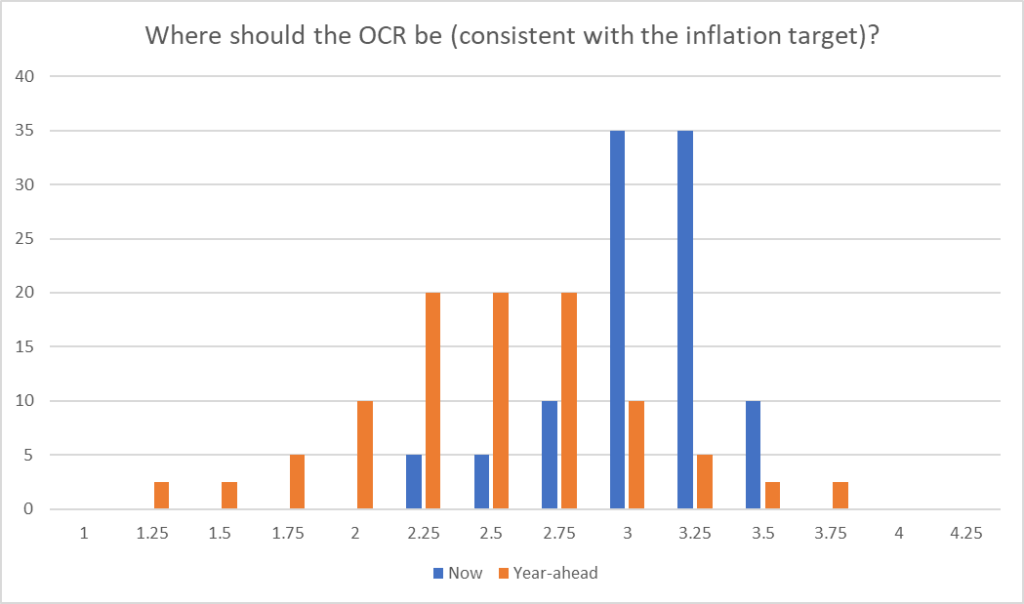
Michael Reddell writes – Procrastinating this morning, I asked Grok to write a post in my style on yesterday’s Monetary Policy Statement. Suffice to say, I think I’ll stick to thinking and writing for myself for the time being. Among the many oddities of Grok’s product was the conviction that Adrian Orr was still Governor. Mercifully […]
May Monetary Policy Statement
One last post on Investment Boost
27 May 2025 Leave a comment
in applied price theory, economic growth, fiscal policy, macroeconomics, politics - New Zealand, public economics Tags: taxation and investment

After the discussion in my post yesterday on the Investment Boost subsidy scheme announced in the Budget I thought a bit more about who was likely to benefit the most from it. The general answer of course is the purchasers of the longest-lived assets. Why? Because if you have an asset which IRD estimates to […]
One last post on Investment Boost
Some more post-Budget thoughts
27 May 2025 Leave a comment
in budget deficits, business cycles, economic growth, fiscal policy, macroeconomics, politics - New Zealand, Public Choice, public economics Tags: taxation and investment

On two separate themes; aggregate fiscal policy, and the Investment Boost initiative. Aggregate fiscal policy Over the weekend for some reason I was prompted to look up the Budget Responsibility Rules that Labour and the Greens committed to in early 2017 (my commentary on them here). At the time, the intention seemed to be to […]
Some more post-Budget thoughts
Deficits forever?
24 May 2025 Leave a comment
in budget deficits, fiscal policy, macroeconomics, politics - New Zealand, Public Choice, public economics
Eric Crampton writes – This week’s budget projected no return to balanced books. It is difficult to see how recent budgets from National and Labour comply with the Public Finance Act’s fiscal responsibility provisions. It is a problem.
Deficits forever?
The (deeply underwhelming) Budget
23 May 2025 Leave a comment
in applied price theory, budget deficits, economic growth, economics of regulation, entrepreneurship, fiscal policy, macroeconomics, politics - New Zealand, Public Choice, public economics

Michael Reddell writes – There were good things in the Budget. There may be few/no votes in better macroeconomic statistics and, specifically, a monthly CPI but – years late (for which the current government can’t really be blamed) – it is finally going to happen.
The (deeply underwhelming) Budget
Fiscal starting points
19 May 2025 Leave a comment
in budget deficits, business cycles, economic growth, fiscal policy, macroeconomics, politics - New Zealand, Public Choice Tags: economics of pandemics

Not that long ago, New Zealand’s fiscal balances looked pretty good by advanced country standards. Sure, the fiscal pressures from longer life expectancies were beginning to build – as they were in most of the advanced world – but in absolute and relative terms New Zealand still looked in pretty good shape. Just a few […]
Fiscal starting points
US Holders of Foreign Assets, Foreign Holders of US Assets, and Exorbitant Privilege
18 May 2025 Leave a comment
in financial economics, macroeconomics, monetary economics

US investors put money in assets of other countries, including “portfolio investment” which focuses on ownership of stocks and bonds without a management interest, and “foreign direct investment” which is owning enough of a foreign company to have a management interest. Conversely, foreign investors put money into US dollar assets in the US economy. Erin…
US Holders of Foreign Assets, Foreign Holders of US Assets, and Exorbitant Privilege
Calculating America’s Lead over Europe
16 May 2025 Leave a comment
in applied price theory, economic growth, economic history, macroeconomics Tags: European Union

There’s an enormous amount of data showing that people in the United States enjoy much higher livings standards than Europeans. That’s not too surprising since most European governments have adopted large-sized welfare states while Americans are (comparatively!) lucky in that we have a medium-sized welfare state. That’s all very straightforward and uncontroversial. What’s not completely […]
Calculating America’s Lead over Europe
Should gdp include defense spending?
15 May 2025 Leave a comment
in applied price theory, defence economics, economic growth, economic history, macroeconomics
Maybe not, isn’t that a form of double counting? After all, defense spending is there to enable the production of other goods and services, it is not useful per se. Chandler S. Reilly and Vincent Geloso recalculate the history of U.S. economic growth using this new method: In fact, our corrections applied to the entire […]
Should gdp include defense spending?


Recent Comments