TweetWant to get a few hours’ worth of solid learning in less than 35 enjoyable minutes? Listen to my Mercatus Center colleague David Beckworth’s podcast (from October 2022) with George Selgin on the New Deal. Seriously. It will be 34-plus minutes very well spent. George’s book – False Dawn – is forthcoming from the University…
George Selgin on the New Deal and Recovery (and Relief and Reform)
18 Nov 2023 Leave a comment
in budget deficits, business cycles, economic growth, economic history, fiscal policy, great depression, labour economics, labour supply, macroeconomics, monetary economics, unemployment
My Conversation with the excellent Jennifer Burns
17 Nov 2023 Leave a comment
in Austrian economics, business cycles, economics of education, Euro crisis, F.A. Hayek, global financial crisis (GFC), great depression, great recession, history of economic thought, macroeconomics, Milton Friedman, monetarism, monetary economics
Here is the audio, video, and transcript. Here is the episode description: Jennifer Burns is a professor history at Stanford who works at the intersection of intellectual, political, and cultural history. She’s written two biographies Tyler highly recommends: her 2009 book, Goddess of the Market: Ayn Rand and the American Right and her latest, Milton Friedman: The […]
My Conversation with the excellent Jennifer Burns
Quantity theory of money, or fiscal theory of the price level?
16 Nov 2023 Leave a comment
in defence economics, development economics, economic history, growth disasters, history of economic thought, law and economics, macroeconomics, monetary economics, property rights Tags: monetary policy, Somalia
The rebel-controlled Yemeni rial is made up entirely of a fixed supply of notes printed prior to 2016. In the chart below you can see it appreciating in value (the blue line) against the dollar, issued by the world’s most powerful state. pic.twitter.com/vioXHmz2wQ — John Paul Koning (@jp_koning) November 15, 2023
Quantity theory of money, or fiscal theory of the price level?
Shameless central bankers
15 Nov 2023 Leave a comment
in business cycles, economics of bureaucracy, financial economics, fiscal policy, inflation targeting, macroeconomics, monetary economics, Public Choice Tags: monetary policy

It was in mid-August that this particular bit of shameless Reserve Bank spin got going. From a post in late August It proved to be nonsense of course. Once we had access to the short little IMF piece, published at the back of the Fund’s Article IV review, it was clear that it all amounted […]
Shameless central bankers
Milton Friedman: The Last Conservative | Hoover Institution
15 Nov 2023 Leave a comment
in applied price theory, budget deficits, business cycles, economic growth, economic history, fiscal policy, global financial crisis (GFC), great depression, great recession, history of economic thought, inflation targeting, labour economics, macroeconomics, Milton Friedman, monetarism, monetary economics, unemployment Tags: monetary policy
Filling in the Gaps: Next Steps for the Fiscal Theory of the Price Level
15 Nov 2023 Leave a comment
in applied price theory, budget deficits, business cycles, econometerics, economic history, financial economics, fiscal policy, great depression, great recession, history of economic thought, inflation targeting, macroeconomics, monetarism, monetary economics Tags: monetary policy
Jennifer Burns on Milton Friedman 11/13/23
14 Nov 2023 Leave a comment
in applied price theory, Austrian economics, business cycles, comparative institutional analysis, econometerics, economic history, economics of education, economics of regulation, fiscal policy, great depression, history of economic thought, labour economics, liberalism, libertarianism, macroeconomics, Milton Friedman, monetarism, monetary economics Tags: monetary policy
Why Is There Divergence Between the United States and Europe?
11 Nov 2023 Leave a comment
in business cycles, currency unions, economic growth, macroeconomics

In economics, convergence theory is the common-sense observation that poor countries – in general – should grow faster than rich countries. But a general principle sometimes has exceptions, and that’s why I put together my anti-convergence club. If you look at members of that club, you’ll notice that when rich countries grow faster than poor […]
Why Is There Divergence Between the United States and Europe?
Book Presentation with John Cochrane: “The Fiscal Theory of the Price Le…
09 Nov 2023 Leave a comment
in budget deficits, business cycles, econometerics, economic growth, economic history, Euro crisis, fiscal policy, global financial crisis (GFC), great depression, great recession, history of economic thought, inflation targeting, macroeconomics, Milton Friedman, monetarism, monetary economics, public economics Tags: monetary policy
Ralph Hawtrey, Part 1: An Overview of his Career
06 Nov 2023 Leave a comment
in business cycles, economic history, fiscal policy, great depression, history of economic thought, labour economics, macroeconomics, monetary economics, unemployment
One of my goals when launching this blog in 2011 was to revive interest in the important, but unfortunately neglected and largely forgotten, contributions to monetary and macroeconomic theory of Ralph Hawtrey. Two important books published within the last year have focused attention on Ralph Hawtrey: The Federal Reserve: A New History by Robert Hetzel, […]
Ralph Hawtrey, Part 1: An Overview of his Career
Caplan-Singer Debate Video
05 Nov 2023 Leave a comment
in economic growth, economics of education, entrepreneurship, history of economic thought, human capital, income redistribution, labour economics, labour supply, macroeconomics, occupational choice, poverty and inequality, Public Choice, public economics Tags: taxation and entrepreneurship, taxation and investment, taxation and labour supply
A year ago, Jonah Franks, who runs Public Intellectuals for Charity, organized a debate between me and Peter Singer on “Do the rich pay their fair share?” I already posted my opening statement, my reflections on the debate, along with two follow-ups on Singer’s “Noble Lie.” The debate video itself, however, was gated for paying…
Caplan-Singer Debate Video
More Evidence for Trump’s Corporate Tax Reform, Part I
03 Nov 2023 Leave a comment
in applied price theory, econometerics, economic growth, entrepreneurship, fiscal policy, macroeconomics, public economics Tags: taxation and investment

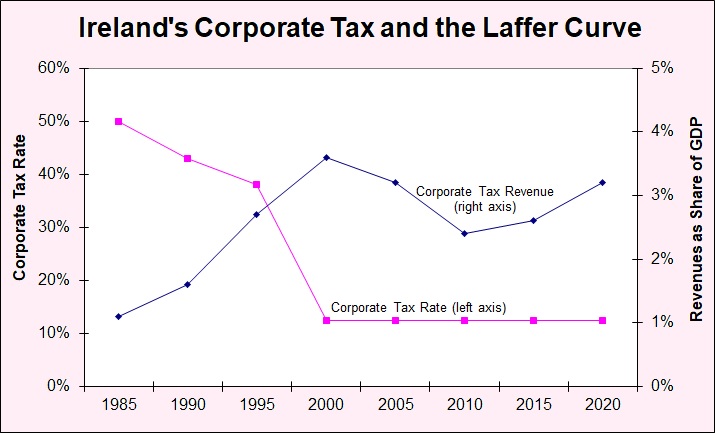
I’m very critical of bad policies we got during the Trump years, most notably profligacy and protectionism. But I shower praise on the good policies, such as the 2017 tax legislation (especially the lower corporate tax rate and the curtailing of the state and local tax deduction). Today, we’re going to focus on the positive. […]
More Evidence for Trump’s Corporate Tax Reform, Part I
*GOAT* on Friedrich A. Hayek and his delusions
31 Oct 2023 Leave a comment
in Austrian economics, business cycles, history of economic thought, macroeconomics, monetary economics
When writing GOAT: Who is the Greatest Economist of all Time, and Why Does It Matter? I vowed I would write the whole truth. Not just that I agreed with everything I wrote (the case with every book), but I that I would relate all that I was thinking. Here is one part of the […]
*GOAT* on Friedrich A. Hayek and his delusions
Accountability
27 Oct 2023 Leave a comment
in economics of bureaucracy, macroeconomics, monetary economics, Public Choice

On Saturday dozens of candidates for the governing Labour Party stood for election to Parliament. The aim was to form (at least a big part of) the next government. They didn’t succeed. People will debate for decades precisely what motivated the public as a whole to vote as we did, but having governed for the […]
Accountability

Recent Comments