Edward Prescott on monetary policy and the business cycle
06 Jul 2019 Leave a comment
in business cycles, Edward Prescott, macroeconomics, monetary economics

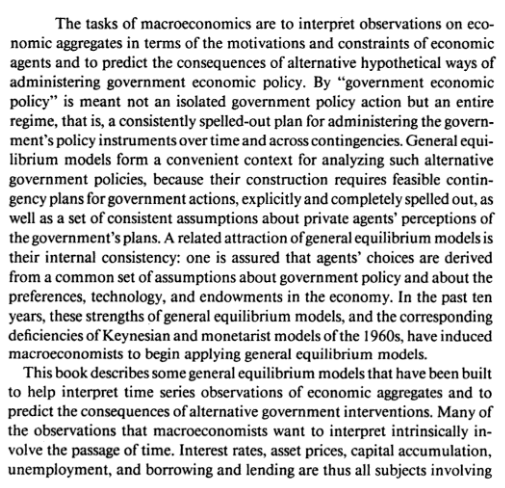
From Five Macroeconomic Myths
Prescott, Edward C.
Wall Street Journal
11 Dec 2006.
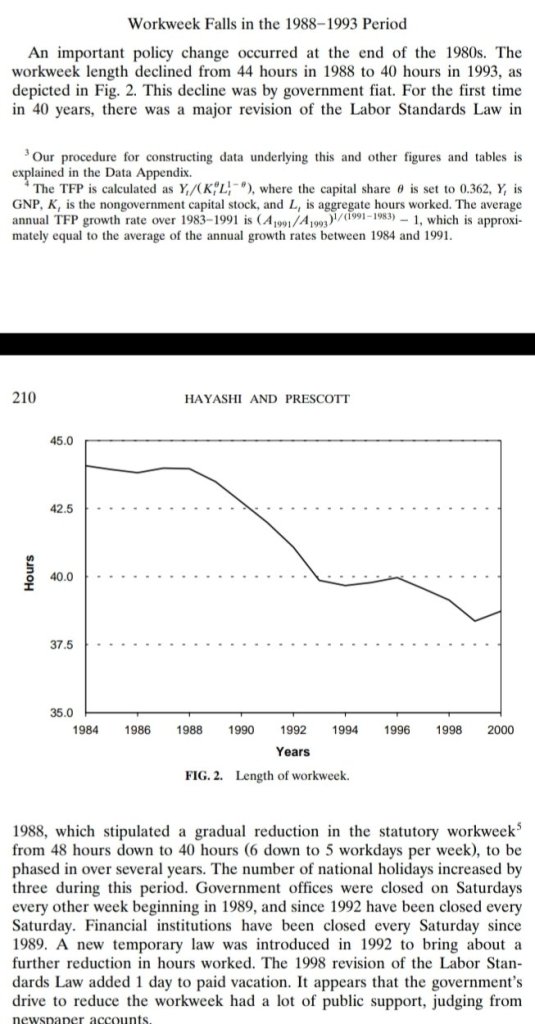
Edward Prescott on Japan’s Lost Decade and the end of the 6-day working week
06 Jul 2019 Leave a comment
in business cycles, economic growth, economics of regulation, Edward Prescott, labour supply
Alan Walters predicted this in the 1960s
06 Jul 2019 Leave a comment
in economic history, macroeconomics, monetarism, monetary economics

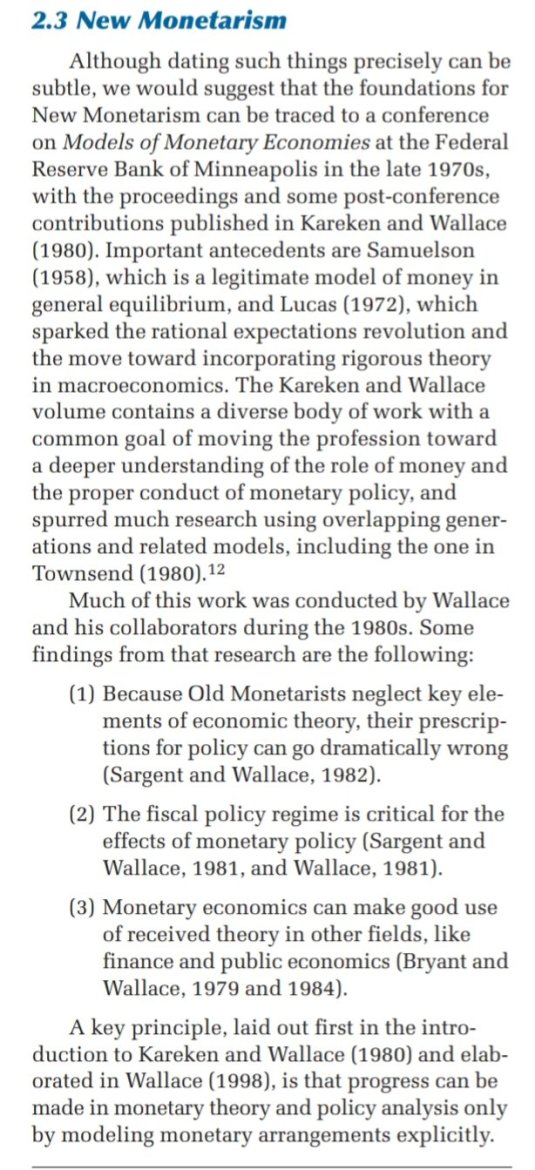
THE SUCCESS OF THE FED AND THE DEATH OF MONETARISM. By: KISHOR, N. KUNDAN, KOCHIN, LEVIS A., Economic Inquiry, Jan2007, Vol. 45, Issue 1
How neoclassical are New Keynesian dynamic stochastic general equilibrium models?
01 Jul 2019 Leave a comment
in business cycles, history of economic thought, macroeconomics

In sum, New Keynesian models are most certainly not reincarnations of textbook IS–LM models with maximization added on. Rather, they are real business cycle models augmented with a few distortions—typically sticky prices and monopoly power—and shocks that do little to contribute to fluctuations or influence the nature of optimal policy
From Kehoe, Patrick J., Virgiliu Midrigan, and Elena Pastorino. 2018. “Evolution of Modern Business Cycle Models: Accounting for the Great Recession.” Journal of Economic Perspectives, 32 (3): 141-66.
@paulkrugman on @ProfSteveKeen
01 Jul 2019 Leave a comment
in macroeconomics, politics - New Zealand

From https://krugman.blogs.nytimes.com/2012/04/02/oh-my-steve-keen-edition/ and see https://creditwritedowns.com/2012/04/banks-matter-krugmans-barter-mysticism.html for the text of broken link
Why am I reminded of Neoclassical Economics? Let me count the ways…
Firstly, there are similar underlying principles to the DSGE models that now dominate Neoclassical macroeconomics, and as with Ptolemaic Astronomy, these underlying principles clearly fail to describe the real world. They are:
- All markets are barter systems which are in equilibrium at all times in the absence of exogenous shocks—even during recessions—and after a shock they will rapidly return to equilibrium via instantaneous adjustments to relative prices;
- The preferences of consumers and the technology employed by firms are the “deep parameters” of the economy, which are unaltered by any policies set by economic policy makers; and
- Perfect competition is universal, ensuring that the equilibrium described in (1) is socially optimal.
If that were actually the real world, then not only would there not be a crisis now, there would never have been a Great Depression either—and recessions would simply be minor statistically unpredictable but inevitable events when the majority of shocks hitting the economy were negative, and they would rapidly be resolved by adjustments to relative prices (wages included, of course).
So economists like Krugman—who describe themselves as “New Keynesians”—have tweaked the base case to derive models that “ape” real-world data, with “sticky” prices rather than perfectly flexible ones, “frictions” that slow down quantity adjustments, and imperfect competition to generate less-than-optimal social outcomes.
This is Ptolemaic Economics: take a model that is utterly unlike the real world, and which in its pure form can’t possibly fit real world data, and then add “imperfections” so that it can appear to do so.
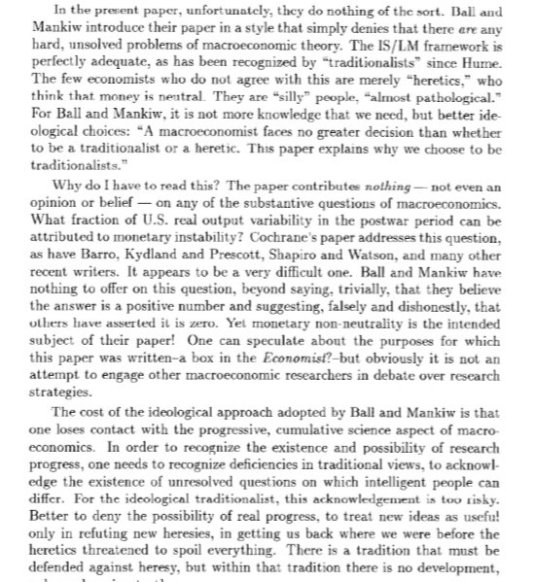
From Champ and Freeman
01 Jul 2019 Leave a comment
in business cycles, econometerics, macroeconomics, monetary economics Tags: monetary neutrality

Robert Lucas on unemployment
30 Jun 2019 Leave a comment
in applied price theory, business cycles, labour economics, labour supply, macroeconomics, monetary economics, Robert E. Lucas, unemployment Tags: search and matching

Thomas J. Sargent – Keynote Address on effects of open borders
30 Jun 2019 Leave a comment
in applied price theory, applied welfare economics, comparative institutional analysis, development economics, economic history, history of economic thought, industrial organisation, international economics, macroeconomics Tags: free trade
Why do Keynesian macroeconomists still bother?
29 Jun 2019 Leave a comment
in business cycles, fiscal policy, macroeconomics, monetarism, monetary economics

Chari, V. V., Patrick J. Kehoe, and Ellen R. McGrattan. 2009. “New Keynesian Models: Not Yet Useful for Policy Analysis.” American Economic Journal: Macroeconomics, 1 (1): 242-66.


Recent Comments