The death tax presumably is the most destructive tax on a per-dollar-collected basis, but I suspect the capital gains tax is in second place. Like the death tax, the capital gains tax is pure double taxation, thus exacerbating the tax code’s bias against saving and investment. And the capital gains tax is particularly foolish since […]
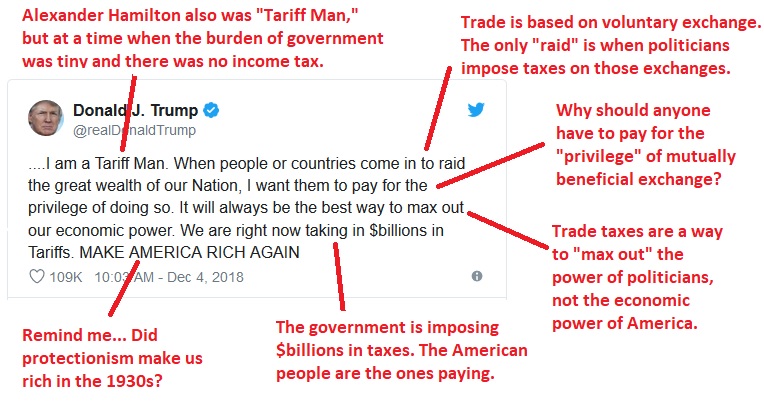
Donald Trump, who describes himself as “Tariff Man,” recently wrote a column in defense of his protectionist trade policy for the Wall Street Journal. After reading the column, my first thought was that Trump was trying to show he is more economically illiterate than Joe Biden (a big challenge, as seen here and here). And […]
Olivier Blanchard writes: The French are not lazy. They just enjoy leisure more than most (no irony here) And this is perfectly fine: As productivity increases, it is perfectly reasonable to take it partly as more leisure (fewer hours per week, earlier retirement age), and only partly in income. He has follow-up points and clarifications…
Unless you’re a policy wonk, I realize “exciting” may not be the right word to describe new developments in public-finance economics. For nerds, however, three economists at the Joint Committee on Taxation have some important new research on the Laffer Curve. The study, authored by Rachel Moore, Brandon Pecoraro, and David Splinter, concludes that the […]
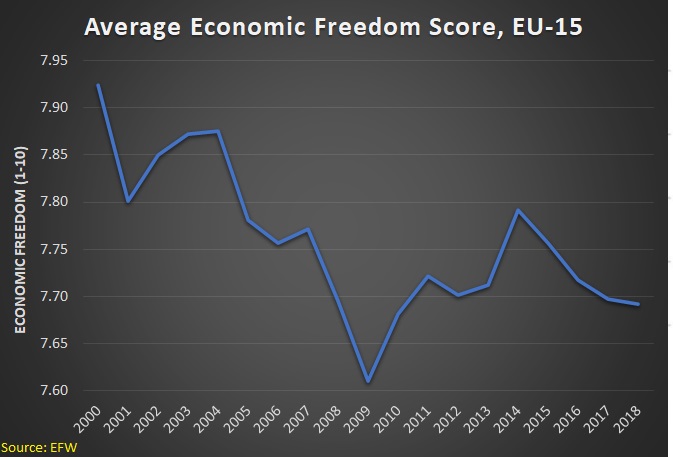
About five years ago, I fretted about the gradual erosion of economic liberty in Western Europe. And I followed up two years ago with similar analysis, grousing that the entire western world was joining Western Europe in the drift toward more statism. When you combine this grim trend with data about demographic decline, which is […]
That is the topic of my latest Free Press column, here is one excerpt: What else are currency values telling us today? The Japanese yen continues a very weak run, now coming in at about 158 to the U.S. dollar. I can recall when it was common for the yen to stand at about 100…
In 2016, here’s some of what I wrote about the economic outlook in Illinois. And I shared the same observation when writing about California in 2018. There’s a somewhat famous quote from Adam Smith (“there is a great deal of ruin in a nation“) about the ability of a country to survive and withstand lots of […]
As I wrote nine years ago, Oxfam is a pathetic organization. Originally created to help the poor, it has been captured by activists who peddle class warfare. But they play that role in an incredibly sloppy fashion. In all the debates I’ve been part of over the years, no left-leaning academic has been willing to […]
Let us hope: Britain is seeing early signs of a long-awaited turnaround of its productivity woes, according to an alternative measure that suggests output per hour worked has risen at a pace not seen since before the financial crisis. The Resolution Foundation said a “blistering” productivity surge has been masked by problems with official statistics and pointed…
There is a new and optimistic paper by Lukas Althoff and Hugo Reichardt: Artificial intelligence is changing which tasks workers do and how they do them. Predicting its labor market consequences requires understanding how technical change affects workers’ productivity across tasks, how workers adapt by changing occupations and acquiring new skills, and how wages adjust…
“Fiscal dominance” refers to a situation where government debt grows so large that the nation’s central bank feels that it has little choice except to focus on making sure the government does not default–even if it means a surge of inflation. Janet Yellen described the issue and risks of fiscal dominance concisely in her comments…
When he first ran for President, I observed that Trump was a big-government Republican. This doesn’t mean he’s part of the moderate GOP establishment, like Bush and Romney. But it does mean that there is considerable overlap in terms of supporting bad policy, as indicated by my last two columns. Yesterday, I wrote about his […]
The Reserve Bank announced: “Following the completion of the review commissioned by the Board in March, we are pleased to announce modernised capital rules that will support an efficient and resilient financial system,” said Rodger Finlay, Chair of the RBNZ Board. “We recalibrated our risk appetite to have regard to our new Financial Policy Remit,…
Here is another piece for “contrarian Tuesday,” like it or not: We construct an international panel data set comprising three distinct yet plausible measures of government indebtedness: the debt-to-GDP, the interest-to-GDP, and the debt-to-equity ratios. Our analysis reveals that these measures yield differing conclusions about recent trends in government indebtedness. While the debt-to-GDP ratio has…
US economic growth can be divided into two parts: more hours worked, or more productivity per hour worked. In the past, the US labor force has been rising over time: the US labor force totaled 107 million people in 1980, 142 million in 2000, and was up to 171 million this year. However, after several…
Why Evolution is True is a blog written by Jerry Coyne, centered on evolution and biology but also dealing with diverse topics like politics, culture, and cats.
In Hume’s spirit, I will attempt to serve as an ambassador from my world of economics, and help in “finding topics of conversation fit for the entertainment of rational creatures.”




Recent Comments