16th SAET Conference on Current Trends in Economics – Robert E. Lucas, JR
28 Jun 2018 Leave a comment
in business cycles, development economics, economic growth, economic history, macroeconomics, monetary economics, Robert E. Lucas
What Was the Industrial Revolution?
13 Jun 2018 Leave a comment
in development economics, economic history, human capital, macroeconomics, Robert E. Lucas Tags: industrial revolution
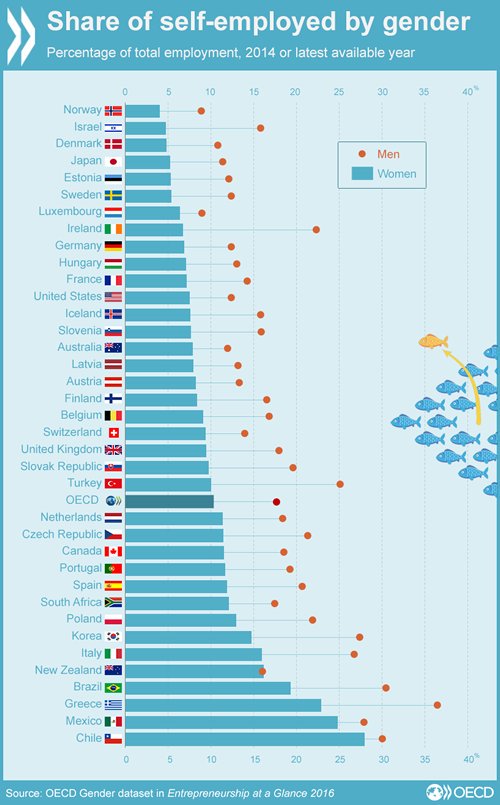
No gender gap in self-employment in New Zealand
26 May 2017 Leave a comment
in discrimination, entrepreneurship, gender, industrial organisation, labour economics, labour supply, occupational choice, Robert E. Lucas, survivor principle Tags: female labour supply
Robert E. Lucas, JR on the industrial revolution
22 Feb 2017 Leave a comment
in applied price theory, development economics, economic growth, economic history, macroeconomics, Robert E. Lucas Tags: industrial revolution, The Great Enrichment
Why are ideas the new land? | Robert E. Lucas
03 Dec 2016 Leave a comment
in applied price theory, development economics, Robert E. Lucas
How did the industrial revolution impact family planning? | Robert E. Lucas
17 Nov 2016 Leave a comment
in applied welfare economics, development economics, economic history, history of economic thought, labour economics, macroeconomics, Robert E. Lucas Tags: economics of fertility, industrial revolution
Was Karl Marx right? | Robert E. Lucas
21 Oct 2016 Leave a comment
in Marxist economics, Robert E. Lucas Tags: Karl Marx
Does inflation stimulate the economy? | Robert E. Lucas
19 Oct 2016 Leave a comment
in fiscal policy, macroeconomics, monetary economics, Robert E. Lucas Tags: fiscal stimulus
Robert Lucas on the voluntary and involuntary unemployment distinction
05 Oct 2016 Leave a comment
in job search and matching, labour economics, labour supply, macroeconomics, Robert E. Lucas, unemployment Tags: involuntary unemployment, job search, search and matching
Robert Lucas in a famous 1978 paper argued that all unemployment was voluntary because involuntary unemployment was a meaningless concept:
“The worker who loses a good job in prosperous time does not volunteer to be in this situation: he has suffered a capital loss. Similarly, the firm which loses an experienced employee in depressed times suffers an undesirable capital loss.
Nevertheless the unemployed worker at any time can always find some job at once, and a firm can always fill a vacancy instantaneously. That neither typically does so by choice is not difficult to understand given the quality of the jobs and the employees which are easiest to find.
Thus there is an involuntary element in all unemployment, in the sense that no one chooses bad luck over good; there is also a voluntary element in all unemployment, in the sense that however miserable one’s current work options, one can always choose to accept them.”
I agree that we all make choices subject to constraints. To say that a choice is involuntary because it is constrained by a scarcity of job-opportunities information is to say that choices are involuntary because there is scarcity. Alchian said there are always plenty of jobs because to suppose the contrary suggests that scarcity has been abolished.
Lucas elaborated further in 1987 in Models of Business Cycles:
A theory that does deal successfully with unemployment needs to address two quite distinct problems. One is the fact that job separations tend to take the form of unilateral decisions – a worker quits, or is laid off or fired – in which negotiations over wage rates play no explicit role.
The second is that workers who lose jobs, for whatever reason, typically pass through a period of unemployment instead of taking temporary work on the ‘spot’ labour market jobs that are readily available in any economy.
Of these, the second seems to me much the more important: it does not ‘explain’ why someone is unemployed to explain why he does not have a job with company X. After all, most employed people do not have jobs with company X either. To explain why people allocate time to a particular activity – like unemployment – we need to know why they prefer it to all other available activities: to say that I am allergic to strawberries does not ‘explain’ why I drink coffee.
Neither of these puzzles is easy to understand within a Walrasian framework, and it would be good to understand both of them better, but I suggest we begin by focusing on the second of the two.
@Noahpinion says 20% losing their jobs is a small price to pay in #fightfor15
14 Jun 2016 Leave a comment
in applied price theory, applied welfare economics, labour economics, minimum wage, Robert E. Lucas
https://twitter.com/EconBizFin/status/626687442834300928
Noah Smith is a type of friend that should make poor Americans prefer their republican enemies. At least they are not fanatics. Fanatics never give up. Evil people have other things to do with their dastardly days.
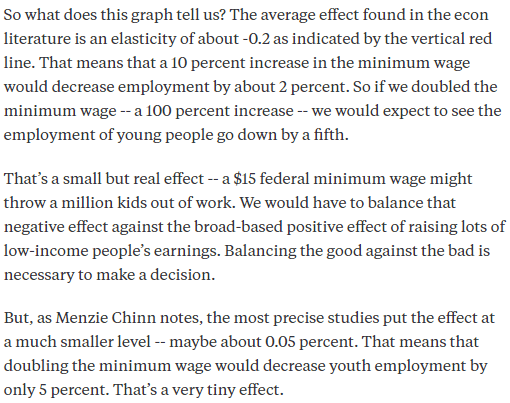
Source: A Higher Minimum Wage Won’t Lead to Armageddon – Bloomberg View.
Describing 1/5th of young people losing their jobs after a doubling of the federal minimum wage to $15 per hour as a small but real effect is a type of callousness that not even Donald Trump could stoop. What is Even Noah Smith admits that large minimum wage increases experiment with the fortunes of young people
We don’t really know what happens when you raise the minimum wage to $15 — but soon, we will know. We will be able to see whether employment rates fall in L.A., Seattle, and San Francisco.
We will be able to see whether people who can’t get work migrate from these cities to cities with lower minimum wages. We will be able to see if employment growth suddenly slows after the enactment of the policy. In other words, federalism will do its job, by allowing cities to act as policy laboratories for the rest of the country.
These one million young people who may well lose their jobs under a $15 minimum wage are real living people starting out their work in lives in a country with a rather inadequate unemployment benefits especially for the long-term unemployed.
Noah Smith wants to throw them onto the scrapheap through a large increase in the minimum wage because he is too cheap to support a large increase in the earned income tax credit.
If doubling the minimum wage to throw 20% of the workforce out of a job passes the brutal utilitarian calculus of bleeding-heart progressives, why not double everybody’s wages? Show the strength of your conviction about these Kruger–Card minimum wage results which repeal the laws of supply and demand.
https://twitter.com/AlvaroLaParra/status/738776906988822528
The leading reason for empirical research and economic history is to warns us not to repeat the mistakes of the past and not try experiments that are obvious folly. People and the economy should not be used as lab rats as Lucas explains in his short speech “What Economists Do”
I want to understand the connection between the money supply and economic depressions.
One way to demonstrate that I understand this connection–I think the only really convincing way–would be for me to engineer a depression in the United States by manipulating the U.S. money supply.
I think I know how to do this, though I’m not absolutely sure, but a real virtue of the democratic system is that we do not look kindly on people who want to use our lives as a laboratory. So I will try to make my depression somewhere else.
What Was the Industrial Revolution? – Robert E. Lucas
18 May 2016 Leave a comment
in economic growth, economic history, fiscal policy, Robert E. Lucas Tags: industrial revolution
A Mall divided by different city minimum wage laws @SueMoroney @GreenCatherine
26 Apr 2016 1 Comment
in applied price theory, applied welfare economics, economics of regulation, labour economics, minimum wage, politics - New Zealand, politics - USA, Robert E. Lucas Tags: Alan Manning, city minimum wage laws, living wage, monopsony
The Westfield Valley Fair Mall is half in San Jose city and half in Santa Clara city. In 2012, San Jose raised its minimum wage from $8 to $10 per hour.
National Public Radio in 2014 had a brilliant broadcast on the implications of this new city minimum wage law on the Westfield Valley Fair Mall. As the broadcast said:
This change created two economic worlds within a single, large building. Employees doing more or less the same work, just steps away from each other, started making different wages.
The radio show discussed what happened on the $8 side of the Mall and then on the $10 side through interviews with employers and workers.
On the then $8 per hour minimum wage side of the Mall, employers quickly noticed that many of their employees quit to jobs elsewhere in the same Mall. These same employees found that the quality of job applicants also fell away seriously. There were noticeable differences in the personalities traits and dress standards presented by the $8 an hour job applicants and $10 an hour job applicants.
As is to be expected because information about job opportunities is costly, some of the minimum wage employees did not know that other parts of the Mall paid more.
(This change in job turnover rates and applicant pool quality subsequent to the minimum wage increase in San Jose has implications for the inequality of bargaining power between workers and employers. Minimum wage workers do keep an eye on competing opportunities and take them up when better options arise – JR aside).
Since 2012, the minimum wage rates in the Mall have changed again: Santa Clara’s minimum wage initially increased to $9 an hour – the state-wide minimum wage, which had increased from $8 per hour; San Jose’s $10.15 per hour.
Those city minimum wages were increased further this year to $11 in Santa Clara city and $10.30 in San Jose city respectively by the respective city councils.
The state-wide minimum wage in California is to increase to $15 per hour by 2020 under a law just passed. California’s current $10-per-hour minimum wage is already among the highest in the country — only Washington, DC, has a higher minimum wage at $10.50 per hour.
Getting back to what was said in the National Public Radio broadcast, the show then moved on to the Gap Store, which straddled the two city boundaries.

Source: Episode 562: A Mall Divided : Planet Money : NPR.
The Gap Store had the option of keeping a record of how much time employees spent in each city within its store and pay accordingly under each city law. The Gap raised everybody’s wage to $10.
There was then a fascinating interview with a Pretzels store owner. The question she asked herself every time she bought anything was how many pretzels se had to sell to cover the cost. She quickly concluded that she could not sell enough additional pretzels to cover the wage rise.
There is another Pretzels store just around the corner from her in the same mall but in the other city so she could not raise her prices by that much. She had a picture of that day’s menu and price list of the competing Pretzels store on her smart phone.
She instead took a cut in her profit. This flowed back to her employers because they received an annual bonus based on 15% of each year’s profit. They did not like that reduction in their bonus.
In a delicious irony, this same entrepreneur owned another Pretzels store in a different part of the Mall but which was in the other city subject to the lower minimum wage law. She owned two of the three pretzels stores in that Mall.
She solved the problem in staff morale by rotating her staff in alternate weeks between her two stores in the same Mall but different cities and paying them accordingly.
In my opinion, this NPR story is pretty much a vindication of standard microeconomics of minimum wage laws. Minimum wage workers are alert to their opportunities and take the best ones available to them but this is not perfect because of cost of information. As Manning observed in his superb book Monopsony in Motion:
That important frictions exist in the labor market seems undeniable: people go to the pub to celebrate when they get a job rather than greeting the news with the shrug of the shoulders that we might expect if labor markets were frictionless.
And people go to the pub to drown their sorrows when they lose their job rather than picking up another one straight away. The importance of frictions has been recognized since at least the work of Stigler (1961, 1962).
As George Stigler argued, information is costly to obtain in the labour market and this leads to price and wage dispersion with this variance related to the cost of searching for information. He concluded that the one-price (one-wage) market will occur only where the cost of information about the prices (wages) offered by buyers and sellers is zero.
Finally, minimum wages rises threaten the profitability of businesses and therefore their survival. That puts low-pay jobs at risk. As Bhaskar, Manning and To (2002) explain in their survey paper on monopsony:
Notice also that because a binding minimum wage reduces employers’ profits when there is free entry into and exit out of the labor market, some employers will be forced to exit. Employer exit has a negative effect on total employment through the loss of exiting employer payrolls.
That is, although establishments that remain after the imposition of a minimum wage increase their employment, some employers are forced out of business.
Thus, minimum wages have two opposing effects: the employment-increasing “oligopsony” effect and the employment-reducing “exit” effect. The overall effect of a minimum wage depends on which effect dominates.
An increase in the family tax credit puts no jobs at risk and is a superior alternative to minimum wage laws. Minimum wage increases throw some low page workers onto the social scrapheap.
Some look upon these large minimum state and city wage increases as worthwhile policy experiments. As Dube said:
… 30 to 40 percent of the California workforce will get a raise … This will be a big experiment. It’s far outside of our evidence base… If you’re risk-averse, this would not be the scale at which to try things.
On the other hand, if you think that wages are really low and they’ve been low for a really long time and we can afford to take some risks, doing things at this scale will get us more evidence.
“Big experiments” to use Dube’s words such as these with state and city minimum wages laws are wrong as Robert Lucas explained in 1988:
I want to understand the connection between in the money supply and economic depressions.
One way to demonstrate that I understand this connection–I think the only really convincing way–would be for me to engineer a depression in the United States by manipulating the U.S. money supply.
I think I know how to do this, though I’m not absolutely sure, but a real virtue of the democratic system is that we do not look kindly on people who want to use our lives as a laboratory. So I will try to make my depression somewhere else.
What Was the Industrial Revolution? – Robert E. Lucas
04 Apr 2016 Leave a comment
in development economics, economic growth, economic history, history of economic thought, Robert E. Lucas Tags: industrial revolution
Will global warming boost economic growth? @GreenpeaceNZ @RusselNorman The revenge of the broken window fallacy
03 Dec 2015 Leave a comment
in applied price theory, economic growth, entrepreneurship, environmental economics, global warming, macroeconomics, Robert E. Lucas Tags: climate alarmists, endogenous growth theory, entrepreneurial alertness, exogenous growth theory, global warming, Matthew Kahn, neoclassical growth theory, offsetting, Robert Solow, unbalanced growth, unintended consequences

 Utopia, you are standing in it!
Recent Comments