Some economics of zero hours contracts – part 1: concepts, definitions and initial puzzles

Unions say New Zealand employers are following trends overseas and adopting zero hour contracts: workers have to be available for work, but have no hours guaranteed. Unite Union national director Mike Treen said:

McDonald’s, KFC, Pizza Hut, Starbucks, Burger King, Wendy’s – all of the contracts have no minimum hours, and so people can be – and are – rostered anywhere from three to 40 hours a week, or sometimes 60 hours a week, and it depends a lot on how you get on with your manager.

No official figures are available on the number of people on zero hour contracts in New Zealand, but they are are available in the UK in the chart below. About 250,000 workers in the UK work on zero hours contracts.

These workers agree not to work for anyone else, but are not promised regular work at all with their new employer.

The question that must always be asked is why do people who are deemed competent to vote and drive cars sign zero hours contract? What is in it for them? David Friedman asked this question about the economics of restraint of trade agreements for employees:

…the employer who insists on an employee signing a non- competition agreement will find that he must pay, in additional wages or other terms of employment, the cost that the agreement imposes upon the employee, as measured by the employee and revealed in his actions.

It follows that the employer will insist on such an agreement only if he believes that its value to him is greater than its cost to the employee…

The contract is designed, after all, with the objective of getting the other party to sign it.

If I am designing the contract and offering it to many other parties, that may put me in a position to commit myself to insisting on terms that give me a large fraction of the benefit that the contract produces.

But it is still in my interest to maximize the size of that net benefit-which I do by only insisting on terms that are worth at least as much to me as they cost the other party.

The inherent inequality of bargaining power between employers and workers and the reserve army of the unemployed must not be all that they are cracked up to be these days if low paid workers have to sign legally enforceable restraint of trade agreements.

Obviously, the few members of the reserve army of the unemployed lucky enough to have a low pay, insecure job that offers no regular hours today have so many other job options that their employers must get them to agree not to quit and job-hop at will. Jobs must be readily available  to low paid workers for otherwise why do employers insist on this restraint of trade in employment agreements.

Why do workers sign these contracts, which can include a promise of exclusive services – not working for other employers? Several subsequent blog posts will attempt to answer this question

The inherent inequality of bargaining power between employers and workers doesn’t work too well here because  the worker is accepting this job as compared to these other options , which may include employment in an existing job.

Once a worker is on-the-job and has accumulated job specific human capital, issues of post-contractual opportunism come up on both sides.

An important function of the employment contract is to prevent attempts to renegotiate terms and conditions once one side of the other has committed to the relationship and will find it costly to go elsewhere.

Zero hours contracts are negotiated upfront, which makes them unappealing to anyone already has a job, unless the terms and conditions of a zero hour contract, including the wages paid are much more appealing than officious observers make out.

Richard Epstein made this point about the general operation of the labour market, which is of relevance to our search to the answers to the questions posed by this blog post:

Labour markets are not characterized by tricky externalities. They do not pollute streams or require the creation of public goods. They are not characterized by genuine breakdowns in information, as workers are in a position to observe the conditions of their employment on a day-to-day basis.

Left to their own devices, without explicit support from union activities, they will be highly competitive, and thus work hard to allocate scarce human capital to its most productive use.

Workers have the option to quit for higher wages, and employers can always seek out low cost techniques to reduce their labour costs.

Any short-term dislocation for firms or individuals is more than offset by the overall increase in the system productivity, spurred in part by clear signals that should increase investments in human capital.

Zero hours contracts are a new labour market phenomena . That is no reason to automatically default to monopoly explanations for their emergence, including their emergence in a highly competitive industries and highly competitive labour markets where  employees change jobs regularly.

As Coase said in the context of industrial organisation as a whole and novel business practices in particular:

One important result of this preoccupation with the monopoly problem is that if an economist finds something—a business practice of one sort or other—that he does not understand, he looks for a monopoly explanation. And as in this field we are very ignorant, the number of ununderstandable practices tends to be rather large, and the reliance on a monopoly explanation, frequent.

The next blog post arises out of my first exposure to the labour economics of working arrangements. Specifically, how the fixed costs of employment and the fixed cost of going to work  both lead to minimum hours constraints in most employment contracts.

Most of what I know about the  labour, personnel and organisational economics of working arrangements  was about explaining  why employers would expect an employee to work as a minimum number of hours if they were to employ them at all. Always good to start with explanations as to why zero hours should not exist, but they clearly do.

Subsequent blog posts will discuss zero hours contracts in the context of the team production and organisational architecture; and zero hours contracts, equalising differentials and job sorting.

The Effective Decision – Peter Drucker

1. Classifying the problem. Is it generic? Is it exceptional and unique? Or is it the first manifestation of a new genus for which a rule has yet to be developed?

2. Defining the problem. What are we dealing with?

3. Specifying the answer to the problem. What are the “boundary conditions”?

4. Deciding what is “right,” rather than what is acceptable, in order to meet the boundary conditions.. What will fully satisfy the specifications before attention is given to the compromises, adaptations, and concessions needed to make the decision acceptable?

5. Building into the decision the action to carry it out. What does the action commitment have to be? Who has to know about it?

6. Testing the validity and effectiveness of the decision against the actual course of events. How is the decision being carried out? Are the assumptions on which it is based appropriate or obsolete?

via The Effective Decision.

Claudia Goldin on the main cause of the gender wage gap

Image

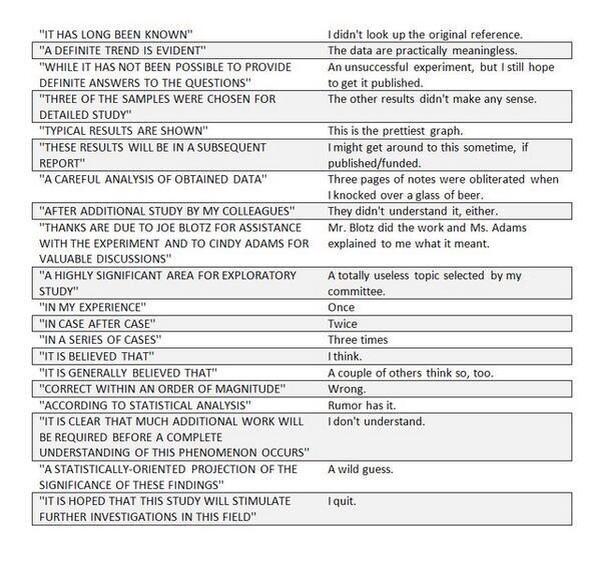
Academic jargon decoded

image

Image

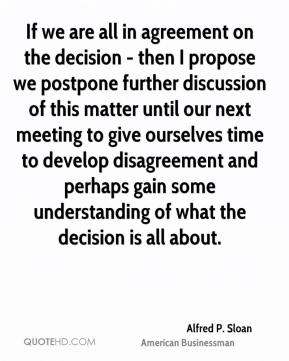
Sloan on the key to good decisions

image

Image

Who rules Japan? A public choice analysis of the courts and the bureaucracy

Gullible gaijin (外人), especially those in the foreign media, foreign ministries and academia think that the bureaucrats rule Japan. Nothing could be further from the truth.

I’ll illustrate this first with the way in which the ruling Liberal Democratic Party (LDP) in Japan exercises a tight control over the courts.

Judges in Japan are career judges starting straight out of a specialised Law School for trainee judges in their late 20s as an assistant judge with various promotions all the way to the top to various courts with different jurisdictions in different places in Japan.

Control over transfers between courts in different parts of Japan as well as over promotions is the key to making sure judges know what is required of them and punishing those judges who step out of line.

Japanese lower court judges are reassigned every three years to different courts in different parts of the country.  Most Japanese judges find administrative duties prestigious and branch office assignments embarrassing.

The judicial secretariat supervised by the Supreme Court can moves judges up and down the hierarchy from the High Courts (the courts of appeals) to the District Courts (the trial courts) to the Family Courts and to the branch offices of the District and Family Courts. It routinely sends judges to less prestigious postings. Supreme Court judges are appointed directly by the government in their 60s and must retire at the age of 70.

  • Like the vast majority of other professionals, Japanese judges want to live in Tokyo if possible, and in Osaka if not.
  • If a difficult judges is posted to the north of Japan, which is next to Siberia, they must leave their family behind because of the need to go to good schools and universities.

Every Japanese judge knows that when they are reassigned, the next reassignment is not necessarily as prestigious as the last, depending on how they rule in contentious cases.

J. Mark Ramseyer and Eric B. Rasmusen have written several very good papers and a book on this topic of judicial independence, or more correctly, the lack of judicial independence in Japan.

Lower court judges defer to the wishes of the LDP on sensitive political questions because they will do better in their careers. Japan has a judicial career structure that rewards and punishes judges according to their work product, including their rulings in sensitive political cases.

Ramseyer and Rasmusen reviewed the quality of the assignments of 400 judges after deciding politically charged cases, holding constant proxies for effort, intelligence, seniority, and political bias.  These political sensitive cases involve judges:

  • who held the Self-Defence Force or U.S. bases unconstitutional;
  • rejected national electoral apportionment schemes advantageous to the LDP; and
  • enjoined the national government in administrative law suits.

Ramseyer and Rasmusen found that judges who defer to the LDP in politically disputes do better in their career assignments than those who do not. Similarly, judges who grant injunctions against the national (but not local) government have less successful careers.

This distinction is important because the national government wants to keep local governments in line with the laws they pass. This differentiation between issuing injunctions against local governments, but not the national government, shows the detail at which judicial decisions are controlled by the ruling party through favourable assignments and promotions.

Ramseyer and Rasmusen also found that:

  • judges who joined a communist-leaning bar organization in the 1960s had fewer administrative postings than those who did not join;
  • judges who  consistently convicted criminal defendants spent less time in branch offices than those who occasionally acquitted;
  • judges who found their tax opinions reversed on appeal had fewer administrative assignments and more branch office postings than those without such reversals; and
  • judges who held a ban on door-to-door canvassing unconstitutional suffered in their careers.

If the national government, the ruling LDP, exercises such close control over the courts, it would be surprising that they let the bureaucracy tell them what to do.

The LDP controls the bureaucracy, even though it isn’t apparent, as explained by Mark Ramseyer.

The most reliable agent for your interests is the agent who thinks he in charge because the face has grown to fit the mask. Ramseyer as pointed out that a bureaucracy would act the same whether

  1. it were completely independent or
  2. it were doing only what the LDP wants (i.e. observational equivalence).

Ramseyer and Rosenbluth argue that the institutional framework of government – the rules of the game among political players – decisively shapes the character of political competition and incentives in Japan.

The ruling LDP works within Japanese electoral rules to maximize its success with voters, and within constitutional constraints to enforce its policies on bureaucrats and judges.

The LDP has several ways of keeping the bureaucracy under control:

  • They can easily veto any bureaucratic actions;
  • They have control over promotion;
  • They encourage dissatisfied constituents to report complaints to the LDP;
  • Would-be politicians work in the bureaucracy and have to please the party if they want to run;
  • Ministries compete for policy influence;
  • The LDP requires “large portions of [bureaucrats’] lifetime earnings as bonds contingent on faithful performance” through their control of post-retirement jobs.

The LDP keeps bureaucratic action closely in line with its preferences through the control of promotions and three yearly  transfers and by encouraging intense rivalry between ministries.

Bureaucrats who do as they are told  and anticipate the needs  of their political masters in the LDP get the best transfers and are promoted to the top and then win the best post-retirement positions.

Japanese bureaucrats start retiring in their mid 40s so having a favourable post retirement job is vital. The Japanese system is based on back loading of pay. This is a well-known system for ensuring fidelity of agents where effort and performance is more difficult to monitor.

The main payoff been a bureaucrat in Japan is the prize at the end of the road. This prize will be denied for you if you step out of line, don’t do as you’re told and don’t know what is required of you.

My political science professor in Japan at the National Graduate Institute of Policy Studies (GRIPS) introduced me to the work of Mark Ramseyer in 1996. Ramseyer is completely fluent in Japanese and writes in Japanese as well as English on law and economics.

Some economics of co-authorship

liebowitztable1

The bad explanation of the proliferation of co-authorship is academic rent seeking and CV padding. We do live in a world, publish or perish and academic productivity does decline quite markedly when tenure is secured.

The good explanation is more co-authors is an efficient response to the rising burden of knowledge where teams of authors need to get across much larger fields than in the past.  In  empirical economics, one co-author might specialise in the econometrics, while the other author tells them what to do.

Ben Jones in ‘The Burden of Knowledge and the Death of the Renaissance Man: Is Innovation Getting Harder? found that as knowledge accumulates as technology advances, successive generations of innovators may face an increasing educational burden.

Innovators can compensate through lengthening their time in education and narrowing expertise, but these responses come at the cost of reducing individual innovative capacities. This has implications for the organization of innovative activity – a greater reliance on teamwork – and has negative implications for economic growth.

HT: Stan Liebowitz via andrew gelman

Danny Devito explains both creative destruction and the social responsibility of business

The incentives of a firm and its customers aren’t always properly aligned

image

Image

Timeless Tips for ‘Simple Sabotage’ — Central Intelligence Agency

via Timeless Tips for ‘Simple Sabotage’ — Central Intelligence Agency.

The personnel economics of putting up election billboards

I’ve been out of late, helping put up election billboards. Maybe I should get a life, but I noticed that the quality of effort by volunteers was much better than that by the contractors hired by the Internet – Mana party. Everybody in that party appears to be paid including the leader for $140K year. She is not yet in Parliament.

The Internet-Mana party election billboards are very heavy, solid wooden signs and obviously pre-manufactured and must be driven around in a truck. They are certainly too heavy to be put on the back of a trailer behind a private car.

Our signs are constructed on site from a dozen pieces of wood of various sizes. The only pre-prepared part is the billboard itself with fits on the back of a trailer.

What first took my interest is the contractors hired by the Internet – Mana party signs seem to pay not all that much regard to the traffic flow. Some of their signs are parallel with the traffic so hardly anybody can see them. They are all one sided signs.

When we are putting up a election billboard, we squabble like a bunch of old women over the exact angle each sign should face the traffic to capture the most number of passing cars and buses. Everybody has an opinion including those doing it for the first time.

We then squabble about whether the sign should be one-sided or two sided depending upon how well it can be viewed from the other side by traffic coming the other way.

We also squabble about its positioning and height to maximise the number of views by the passing traffic relative to the positioning all the other signs.

There is also a lot of vandalism of these signs by rather naive people who don’t understand that the passing motorist looks at the vandalised signs first.

It takes a whole lot of hatred to vandalised a sign in this way. Photos of the above sign immediately went viral. For some reason, the National party has repaired that sign. I don’t know why.

Promotions as prizes

Promotions assign employees to jobs better suiting their abilities and quickly move up the more talented workers but there are other purposes behind promotions (Baron and Kreps 1999; Lazear 1998; Gibbons 1997).

Employees can be promoted because those employees left behind are motivated to supply more effort and invest in hard to verify human capital by the lure of their own advancement at a later date (Lazear and Rosen 1981; Rosen 1986).

There is no need for tasks, responsibilities and rates of output to change between the pre-promotion and post-promotion jobs (Lazear 1998). More senior jobs may be handsomely paid not because a higher rate of output is expected from the promoted employee but instead, in part at least, to stand as a prize to encourage greater effort by more junior employees (Lazear 1998; Lazear and Rosen 1981).

Promotions as prizes are more common where the individual contributions of team members to joint outputs are costly to measure and reward with accuracy. In such dilemmas, it is often still possible to rank who are the more productive and talented members of teams and to promote their higher performers based on these relativities (Lazear and Rosen 1981; Lazear 1998; Baron and Kreps 1999; Prendergast 1993, 1999).

A major contribution of newly promoted employees to the productivity of their workplaces may be enlivening greater employee effort at the more junior levels in the hope of filling their shoes later (Lazear 1998).

Sports tournaments are an example of promotion tournaments. The huge prize is awarded for a very small advantage in productivity over the next best player.This prize motivates everyone to work harder in something of a rat race.

Correcting inefficiency is a money making opportunity

Image

Some principles of job design

A job is a grouping of tasks (Lazear 1998). Job design objectives include technological efficiency, flexibility to temporary and permanent changes, explicit incentives, intrinsic motivation and commitment, and social aspects such as peer pressure, social comparisons and social interactions (Baron and Kreps 1999; Lazear 1998).

Job design parameters include the level and the breath of job content, the variability over time of task assignment and extent of rotations, the specific mix of tasks of worker or group at any time, individual effort or team membership, and the level of autonomy (Baron and Kreps 1999).

Multi-task working environments are common. Most jobs group together a variety of tasks with each requiring different degrees of employee effort and attention. The design of jobs and rewards to employees affects the level and allocation of employee effort and initiative (Holmstrom and Milgrom 1991; Lazear 1998).

The complexity of tasks that are grouped into many jobs allows workers to work harder on measured and rewarded tasks at the expense of unmeasured and unrewarded outputs and quality, and workers can take excessive risks or be too cautious (Baron and Kreps 1999; Prendergast 1999; Lazear 1998).

Employee effort can be strategically shifted between measurement periods, or too much time is spent influencing supervisors’ evaluations. In addition, workplaces require co-operation but giving strong rewards for individual efforts can undermine team performance (Lazear 1998; Baron and Kreps 1999).

Employers bundle tasks into specific jobs. There are competing merits in specialised and broad task assignment (Brickley, Smith and Zimmerman 2004). Specialised task assignments exploits comparative advantage of employees in specific task and lowers cross-training expenses, but foregoes complementarities across tasks, increases coordination costs, and reduces flexibilities (Brickley, Smith and Zimmerman 2004). Phased retirement affects the nature and specialisation of task assignments because fewer tasks can be bundled into a part-time job.

Every firm must provide incentives embedded into job and team designs so that employees act in the way the employer wishes, giving the agreed level of effort and correctly allocating their efforts across different tasks as the employer would want them to do in the presence of uncertainty, incomplete and dispersed information and costly observation and measurement (Alchian and Demsetz 1972; McKenzie and Lee 1998; Holmstrom and Milgrom 1991).

Employers do not always know what instructions to give to their employees. This is because employers lack access to all of the local and tacit information dispersed across the firm and individual employees about what can be done, what needs to be done and what has changed. Incentives are important to ensuring that workers have the freedom of action to best use the information particular and local to their particular jobs, equipment and customer interactions and are correctly rewarded for taking the initiative (McKenzie and Lee 1998).

Entrepreneurs reap profits from discovering the job designs and wage policies that elicit the agreed level of employee effort and the desired levels of initiative, self-management and expeditious use of local knowledge across the multiple tasks that each employee must perform across time in their jobs and teams.

The first rule of decision-making in business

Image

Previous Older Entries Next Newer Entries

Bassett, Brash & Hide

Celebrating humanity's flourishing through the spread of capitalism and the rule of law

Truth on the Market

Scholarly commentary on law, economics, and more

The Undercover Historian

Beatrice Cherrier's blog

Matua Kahurangi

Celebrating humanity's flourishing through the spread of capitalism and the rule of law

Temple of Sociology

Celebrating humanity's flourishing through the spread of capitalism and the rule of law

Velvet Glove, Iron Fist

Celebrating humanity's flourishing through the spread of capitalism and the rule of law

Why Evolution Is True

Why Evolution is True is a blog written by Jerry Coyne, centered on evolution and biology but also dealing with diverse topics like politics, culture, and cats.

Down to Earth Kiwi

Celebrating humanity's flourishing through the spread of capitalism and the rule of law

NoTricksZone

Celebrating humanity's flourishing through the spread of capitalism and the rule of law

Homepaddock

A rural perspective with a blue tint by Ele Ludemann

Kiwiblog

DPF's Kiwiblog - Fomenting Happy Mischief since 2003

The Dangerous Economist

Celebrating humanity's flourishing through the spread of capitalism and the rule of law

Watts Up With That?

The world's most viewed site on global warming and climate change

The Logical Place

Tim Harding's writings on rationality, informal logic and skepticism

Doc's Books

A window into Doc Freiberger's library

The Risk-Monger

Let's examine hard decisions!

Uneasy Money

Commentary on monetary policy in the spirit of R. G. Hawtrey

Barrie Saunders

Thoughts on public policy and the media

Liberty Scott

Celebrating humanity's flourishing through the spread of capitalism and the rule of law

Point of Order

Politics and the economy

James Bowden's Blog

A blog (primarily) on Canadian and Commonwealth political history and institutions

Science Matters

Reading between the lines, and underneath the hype.

Peter Winsley

Economics, and such stuff as dreams are made on

A Venerable Puzzle

"The British constitution has always been puzzling, and always will be." --Queen Elizabeth II

The Antiplanner

Celebrating humanity's flourishing through the spread of capitalism and the rule of law

Bet On It

Celebrating humanity's flourishing through the spread of capitalism and the rule of law

History of Sorts

WORLD WAR II, MUSIC, HISTORY, HOLOCAUST

Roger Pielke Jr.

Undisciplined scholar, recovering academic

Offsetting Behaviour

Celebrating humanity's flourishing through the spread of capitalism and the rule of law

JONATHAN TURLEY

Res ipsa loquitur - The thing itself speaks

Conversable Economist

Celebrating humanity's flourishing through the spread of capitalism and the rule of law

The Victorian Commons

Researching the House of Commons, 1832-1868

The History of Parliament

Articles and research from the History of Parliament Trust

Books & Boots

Reflections on books and art

Legal History Miscellany

Posts on the History of Law, Crime, and Justice

Sex, Drugs and Economics

Celebrating humanity's flourishing through the spread of capitalism and the rule of law

European Royal History

Exploring the Monarchs of Europe

Tallbloke's Talkshop

Cutting edge science you can dice with

Marginal REVOLUTION

Small Steps Toward A Much Better World

NOT A LOT OF PEOPLE KNOW THAT

“We do not believe any group of men adequate enough or wise enough to operate without scrutiny or without criticism. We know that the only way to avoid error is to detect it, that the only way to detect it is to be free to inquire. We know that in secrecy error undetected will flourish and subvert”. - J Robert Oppenheimer.

STOP THESE THINGS

The truth about the great wind power fraud - we're not here to debate the wind industry, we're here to destroy it.

Lindsay Mitchell

Celebrating humanity's flourishing through the spread of capitalism and the rule of law

Alt-M

Celebrating humanity's flourishing through the spread of capitalism and the rule of law

croaking cassandra

Economics, public policy, monetary policy, financial regulation, with a New Zealand perspective

The Grumpy Economist

Celebrating humanity's flourishing through the spread of capitalism and the rule of law

International Liberty

Restraining Government in America and Around the World