

Transition to electric vehicles puts heavy pressure on production of critical metals
12 Nov 2019 Leave a comment

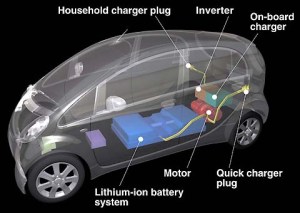 Typical electric car set-up
Critics of fuel power speak of the finite nature of oil and natural gas discoveries. A reminder here that resources are far from unlimited for EVs, in the short term at least. No sign of much appetite for switching to smaller cars either, with SUV demand rising fast.
The current production of a number of critical metals is insufficient for the large-scale transition to electric vehicles.
This is the conclusion of a report by environmental scientists Benjamin Sprecher and organisations Copper8 and Metabolic, reports TechXplore.
As a solution, they advocate more electric car-sharing, cars with a smaller battery and improved recycling.
Small country, big impact
The Dutch Climate Policy aims for 1.9 million electric cars in the Netherlands by 2030, compared to 171,000 at this moment—a growth of more than 1000 percent in less than 11 years.
But according to the report “Critical Metals Demand…
View original post 334 more words
The Great Escape
12 Nov 2019 Leave a comment
in health economics Tags: child mortality, infant mortality, The Great Escape

When the lab rats are smarter
12 Nov 2019 Leave a comment
in applied price theory, behavioural economics, econometerics, economics of information, experimental economics, industrial organisation Tags: The fatal conceit

Feminism’s Biggest Blindspot Revealed | Cafe Classroom
12 Nov 2019 Leave a comment
in discrimination, economics of education, gender, human capital, labour economics, labour supply, law and economics, Marxist economics, occupational choice, politics - USA, poverty and inequality Tags: political correctness, regressive left, women's liberation
Life behind the Berlin Wall | The Economist
12 Nov 2019 Leave a comment
in comparative institutional analysis, defence economics, development economics, economic history, economics of bureaucracy, income redistribution, International law, law and economics, Public Choice, rentseeking, war and peace Tags: Berlin, fall of communism, Germany
Life on both sides of the Berlin wall
12 Nov 2019 Leave a comment
in defence economics, economic history, economics of crime, law and economics, Marxist economics Tags: Berlin, fall of communism, Germany
More evidence of nominal wage cuts
12 Nov 2019 Leave a comment
in applied price theory, business cycles, economic history, labour economics, labour supply, macroeconomics, unemployment Tags: Keynesian macroeconomics, New Keynesian macroeconomics


The Only Land Battle Fought on U.S. soil in WWII (Strange Stories)
12 Nov 2019 Leave a comment
in defence economics, war and peace Tags: World War II
Oranga Tamariki blundered in Hawke’s Bay, true – but that’s no reason to disqualify it from dealing with family violence
11 Nov 2019 Leave a comment

The strong whiff of “treaty” politicking has accompanied the intense scrutiny of Oranga Tamaraki in recent months, including the Waitangi Tribunal’s announcing an urgent inquiry into the child protection agency’s practices towards Māori children.
No-one, curiously, seems much bothered about the agency’s practices towards other children.
Oranga Tamariki staffers certainly invited closer scrutiny when they tried to take a baby from her mother in Hawke’s Bay in May, a bungled operation that was the subject of a Newsroom investigation. This prompted howls of outrage, cries of institutional racism and the calling of national hui.
The tribunal’s Chief Judge Wilson Issac said:
“I conclude there are sufficient grounds for an urgent inquiry into a specific contemporary issue concerning a risk of significant and irreversible prejudice to Māori arising from current Oranga Tamariki policy and practice.”
View original post 1,293 more words
November 11, 1918: Emperor Karl of Austria-Hungary and the end of the Habsburg Monarchy.
11 Nov 2019 Leave a comment

Karl I (Karl Franz Joseph Ludwig Hubert Georg Otto Maria; August 17, 1887 – April 1, 1922) was the last Emperor of Austria, the last King of Hungary (as Karl IV), last King of Bohemia (as Karl III), and the last monarch belonging to the House of Habsburg-Lorraine before the dissolution of Austria-Hungary.

Karl, Emperor of Austria and King of Bohemia
Karl was born August 17, 1887 in the Castle of Persenbeug in Lower Austria. His parents were Archduke Otto Franz of Austria and Princess Maria Josepha of Saxony. At the time, his granduncle Franz Joseph reigned as Emperor of Austria and King of Hungary. Upon the death of Crown Prince Rudolph in 1889, the Emperor’s brother, Archduke Karl Ludwig, was next in line to the Austro-Hungarian throne. However, his death in 1896 from typhoid made his eldest son, Archduke Franz Ferdinand, the new heir presumptive.
Marriage
In 1911, Archduke Karl…
View original post 772 more words


Recent Comments