
Most Popular Search Engines 1994 – 2019
21 Sep 2019 Leave a comment
in economic history, economics of information, economics of media and culture, entrepreneurship, industrial organisation, survivor principle Tags: creative destruction
All Fired Up: Texan Wildfire Sparked by Self-Incinerating Wind Turbine
20 Sep 2019 Leave a comment


The number of wildfires sparked by these things grows by the day. Contrary to their ‘super-safe’, ‘clean’, ‘green’ image, giant industrial wind turbines are the perfect incendiary device.
Around the world, hundreds have exploded into in palls of smoke and balls of flame – in the process – each one raining molten metal and over 1,000 litres of flaming gear oil and hydraulic fluid (see our post here) and burning plastic earthwards.
Wind turbine fires are ten times more common than the wind industry and its parasites claim (see our post here and check out this website: http://turbinesonfire.org).
The wind industry has been forced to concede that at least 4 bushfires were started by wind turbines in Australia, so far:
- Ten Mile Lagoon in Western Australia in the mid-1990s;
- Lake Bonney, Millicent (SA) in January 2006 (see the photo below);
- Cathedral Rocks Wind Farm, Port Lincoln (SA) in…
View original post 480 more words
Michael Detmold: The Unconstitutional Brexit Letter
20 Sep 2019 Leave a comment

 1. Responsible Government

Parliament is an institution of responsible government. The essence of the common law principle of responsible government is the constitution of a regime of confidence: a government is required to carry the confidence of Parliament. This is the fundamental connexion of the executive (the Government) to the Parliament.
The European Union (Withdrawal) (No 2) Act 2019 does two main things. It requires the Prime Minister to write a wholly dictated letter seeking a further extension of the Brexit date, and it requires from the executive certain reports to the Parliament as to progress in the Brexit negotiations. The first I shall show is unconstitutional because it is (a) inconsistent with the principle of responsible governance, (b) it is undemocratic, and (c) it is not an Act of real legislation at all. But the second is clearly valid: progress reports by the executive to the Parliament are a…
View original post 1,489 more words
Are markets efficient?
20 Sep 2019 Leave a comment
in economics of information, financial economics Tags: efficient markets hypothesis
@TimurKuran: Persistent Authoritarianism in the Middle East and the Islamic Law
20 Sep 2019 Leave a comment
in comparative institutional analysis, constitutional political economy, defence economics, development economics, economic history, economics of bureaucracy, economics of crime, Gordon Tullock, growth disasters, income redistribution, international economic law, international economics, International law, law and economics, property rights, Public Choice, rentseeking Tags: autocracy
The Looming Threat of Higher Capital Gains Taxation
20 Sep 2019 Leave a comment

I wrote yesterday about the generic desire among leftists to punish investors, entrepreneurs, and other high-income taxpayers.
Today, let’s focus on one of the specific tax hikes they want. There is near-unanimity among Democratic presidential candidates for higher tax rates on capital gains.
Given the importance of savings and investment to economic growth, this is quite misguided.
The Tax Foundation summarizes many of the key issues in capital gains taxation.
…viewed in the context of the entire tax system, there is a tax bias against income like capital gains. This is because taxes on saving and investment, like the capital gains tax, represent an additional layer of tax on capital income after the corporate income tax and the individual income tax. Under a neutral tax system, each dollar of income would only be taxed once.
…Capital gains face multiple layers of tax, and in addition, gains are not adjusted…
View original post 707 more words
From the military spouses union
20 Sep 2019 Leave a comment
in discrimination, economics of crime, gender, law and economics, politics - New Zealand, politics - USA, property rights Tags: law and order, political correctness, regressive left

Bruce Gilley – “African Civilization and the Premature Termination of Colonialism”
20 Sep 2019 Leave a comment
in comparative institutional analysis, constitutional political economy, defence economics, development economics, economic history, economics of bureaucracy, economics of crime, growth disasters, growth miracles, history of economic thought, income redistribution, international economic law, International law, law and economics, property rights, Public Choice, public economics, rentseeking Tags: economics of colonialism
Watch “Andrew Sullivan: It Gets better for gays — But Not Through Politics
20 Sep 2019 Leave a comment
in discrimination, economic history, economics of crime, economics of information, economics of media and culture, law and economics, politics - Australia, politics - New Zealand, politics - USA, property rights Tags: gay marriage
A brief (and fascinating) history of currency counterfeiting: Focusing on Australia and some other cases
20 Sep 2019 Leave a comment

Richard Finlay and Anny Francis of RBA in this research note give a fascinating account of currency counterfeiting. They focus on Australia but pull examples from other countries too. Perhaps one of the best things that have read in this year so far.
Counterfeiting has a rich and varied history going back to the very earliest forms of money. It has been pursued for personal gain – although at the significant risk of jail time, or, in the past, death – as well as for economic and political destabilisation by hostile countries. Both high- and low-value denominations are liable to be attacked. Currency issuers and counterfeiters are, and always have been, locked in a battle of innovation, with government authorities adapting and innovating in order to deter counterfeiting. Acceleration in the rate of technological development, however, seems to have shortened the timeframe over which each new security feature remains counterfeit-resistant…
View original post 461 more words
Ministry of Justice: New Policy on caring for Transgender Prisoners.
20 Sep 2019 Leave a comment

This policy was revised and updated and published in August 2019. You can read the full policy 👉 Here
This was revised after the high profile cases of male rapists operating in the female estate. There is no explicit reference to the cases though they do include a warning about staff leaking information to the media.
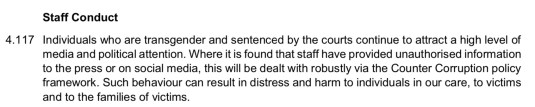
The policy exposes how far the, legally protected, characteristic of sex has been eroded by allowing anyone, regardless of biology, to declare they are a woman. The prison system is illustrative of just how far Gender Identity ideology is embedded within our legislature and public policy.
Here is a clip from James Morton of the Scottish Trans Alliance which shows that Female prisoners are the subjects of a dangerous laboratory experiment. James is listed as an author of the Scottish Prisons Policy which deals with Transgender Prisoners. As James is a lobbyist…
View original post 1,367 more words


Recent Comments