

The Battle of Passchendaele – Mutiny in the German Navy I THE GREAT WAR Week 158
20 Sep 2019 Leave a comment
in defence economics, war and peace Tags: World War I
From back when everyone knew vaccines saved kids
19 Sep 2019 Leave a comment
in economic history, health economics, Music, television Tags: vaccines

New Report Shows Decades Of Failed Climate Predictions
19 Sep 2019 Leave a comment

Funny how it’s the dire predictions that turn out to be overheated, but the climate…not so much. That doesn’t deter self-styled ‘campaigners’ from spouting the same kind of nonsense ad infinitum though. Doomsayers have been claiming time is running out for humanity since the 1970s at least, and the media still lap it up.
Think tank compiles decades’ worth of failed climate predictions
– – –
Rep. Alexandria Ocasio-Cortez recently suggested Miami would disappear in “a few years” due to climate change, says Fox News (via The GWPF).
The United Nations is convening a “Climate Action Summit” next week. And climate activist Greta Thunberg is on Capitol Hill this week telling lawmakers they must act soon.
But while data from NASA and other top research agencies confirms global temperatures are indeed rising, a newly compiled retrospective indicates the doomsday rhetoric is perhaps more overheated.
View original post 313 more words
George Letsas: Non-Justiciability of Prorogation: A Matter of Law and Logic?
19 Sep 2019 Leave a comment

 The case of Gina Miller v the Prime Minister and Others (‘Miller 2’) is presently being heard by the Supreme Court and the issue of justiciability is central. Some commentators have sought to defend the claimant’s submission that no exercise of a prerogative power is completely immune from judicial review. But the Supreme Court, like the Divisional Court, may not be ready to accept that this general proposition accurately reflects the current state of the law. In this post, I put forward an interpretation that salvages the general doctrine of non-justiciability, while departing from the conclusion that the High Court reached. Even if the Supreme Court is minded to accept the traditional doctrine of non-justiciability, it would still not follow that the specific prorogation before the Court is non-justiciable.
Justiciability as a threshold issue
The High Court treated justiciability as a threshold issue: if prorogation, as a subject-matter of executive…
View original post 1,942 more words
In Pursuit of the Perfect Portfolio: Eugene F. Fama
19 Sep 2019 Leave a comment
in financial economics Tags: active investing, efficient markets hypothesis, passive investing
The Numbers Game: Let’s Party Like It’s 1973!
19 Sep 2019 Leave a comment
in economic history, politics - USA Tags: pessimism bias, The Great Enrichment
LINCOLN’S SPIES: THEIR SECRET WAR TO SAVE THE NATION by Douglas Waller
19 Sep 2019 Leave a comment


(President Abraham Lincoln and General U.S. Grant)
It goes without saying that intelligence gathering during the American Civil War was an inexact science. Information was derived from a myriad of sources that included; newspaper articles, railroad passengers and riders, free blacks, runaway slaves, deserters, prisoners of war, local farmers and other non-combatants along with the Union’s use of hot air balloons during the first half of the war. This menagerie of sources produced a great deal of conflicting information that needed to be sifted through and analyzed. The key information rested on how many troops each side possessed and their location. The end result was a decision-making process that at times was flawed and battlefield decisions that rested on a weak foundation. If one was to compare the intelligence strengths of the Union and the Confederacy, the northern spy network had major advantages and, in the end, would create an…
View original post 913 more words
Former NASA Astronaut Explains How Hygiene Is Different in Space | WIRED
19 Sep 2019 Leave a comment
in economics of media and culture Tags: space

David Friedman – Hidden Order: The Economics of Everyday Life
19 Sep 2019 Leave a comment
in applied price theory, applied welfare economics, comparative institutional analysis, constitutional political economy, David Friedman, defence economics, economic history, law and economics, property rights Tags: anarchocapitalism
How many days a year did people work in England before the Industrial Revolution?
19 Sep 2019 Leave a comment

By Judy Stephenson (University College London)
The full paper that inspired this blog post will be published on The Economic History Review and is currently available on early view here
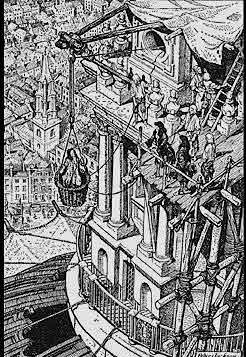 St Paul’s Cathedral – the construction of the Dome. Available at <https://www.explore-stpauls.net/oct03/textMM/DomeConstructionN.htm>
How many days a year did people work in England before the Industrial Revolution? For those who don’t spend their waking hours desperate for sources to inform wages and GDP per capita over seven centuries, this question provokes an agreeable discussion about artisans, agriculture and tradition. Someone will mention EP Thompson and clocks or Saint Mondays. ‘Really that few?’ It’s quaint.
But, for those of us who do spend our waking hours desperate for sources to inform wages and GDP per capita over seven centuries the question has evolved in the last few years into a debate about productivity and when modern economic growth began in…
View original post 796 more words
Book Review: The Retreat of Western Liberalism
19 Sep 2019 Leave a comment


In the aftermath of the election of Donald Trump as US president a cartoon in The New Yorker (by @WillMcPhail and shown above) went viral. It shows passengers on a plane voting to replace the smug, out of touch pilot with a regular passenger, more like us.
The cartoon is fantastic, the type of thing that a political scientist like me could use as the basis for an in-depth discussion of the challenges of expertise and democracy in a 3-hour graduate seminar. But if you aren’t enrolled in a graduate course on contemporary politics, you are in luck.
View original post 1,185 more words
Climate Politics as Manichean Paranoia – Roger Pielke Jr The GWPF, July 2017
19 Sep 2019 Leave a comment
in economics of information, energy economics, environmental economics, global warming, politics - Australia, politics - New Zealand, politics - USA, Public Choice Tags: climate alarmists, regressive left


Recent Comments