Inflation-indexed bonds: are they telling us anything?
30 Nov 2018 Leave a comment

Data from New Zealand’s inflation-indexed bond market has been a bit of a mystery for some time.
If one looks at US data, the gap between conventional and indexed government bond yields – the “breakeven” or implied inflation expectation – makes sense. Here is the data for the last five years or so.
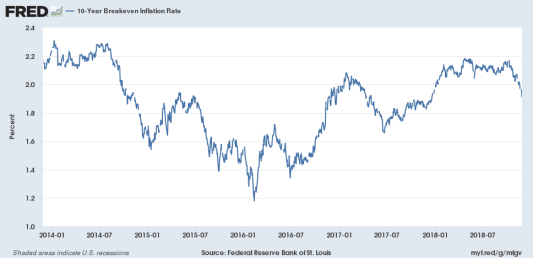
The US inflation target is around 2 per cent and for the last couple of years the breakevens have been pretty close to that. There was a period of real weakness in 2015/16 but it didn’t last that long, and even then the breakevens were only averaging around 1.5 per cent. If you were inclined to focus on the severe limitations US monetary policy will face in the next serious recession, you might even think 2 per cent breakevens for the average of the next 10 years is a bit high – after all, the Fed…
View original post 1,288 more words
This should start with boy bands to stop all the screaming
30 Nov 2018 Leave a comment
in economics of crime, economics of religion, law and economics Tags: political correctness, regressive left

Fair point
30 Nov 2018 Leave a comment
in economics of crime, economics of religion, law and economics Tags: free speech, political correctness, regressive left

David D. Friedman — A Positive Account of Rights (Budapest, 2018)
30 Nov 2018 Leave a comment
in applied welfare economics, comparative institutional analysis, constitutional political economy, David Friedman, economic history, history of economic thought, law and economics, property rights
How Facing Your Fears Can Help You Conquer Them
30 Nov 2018 Leave a comment
in economics of media and culture Tags: cognitive psychology
Human Crash Test Dummies – Faster than a Speeding Bullet
30 Nov 2018 Leave a comment
in economics of media and culture, labour economics, law and economics, transport economics
Doug Allen “The Duel of Honor – screening for unobserved social capital”
30 Nov 2018 Leave a comment
in applied price theory, comparative institutional analysis, economic history, economics of crime, human capital, law and economics, property rights Tags: asymmetric information, screening, signalling
Bertrand Russell on Bernard Shaw and wit as a substitute for wisdom
30 Nov 2018 1 Comment
in economics of media and culture, Marxist economics Tags: useful idiots
The Science of Lying
30 Nov 2018 Leave a comment
in economic history, law and economics Tags: evolutionary psychology
The Open Society Foundations & the transgender movement
29 Nov 2018 Leave a comment

by Michael Biggs
Michael Biggs is Associate Professor of Sociology at the University of Oxford and Fellow of St Cross College. He researches social movements and collective protest.
The transgender movement has transformed cultural norms and social institutions at breathtaking speed. Most of us, becoming acquainted with the trans issue for the first time, are astonished to discover the extent of the gender revolution. The movement has accomplished in a few years what the movements for women’s and for gay and lesbian rights took many decades to achieve.
Part of the explanation is the amount of money behind transgenderism. The Gender Industrial Complex, as we may call it, has many components. Lucrative sponsorship comes from pharmaceutical companies and medical providers. Charities originally established to fight for homosexual rights (like Human Rights Campaign in the United States and Stonewall in Britain) wield large budgets. Last but not least, three American billionaires…
View original post 939 more words


Recent Comments