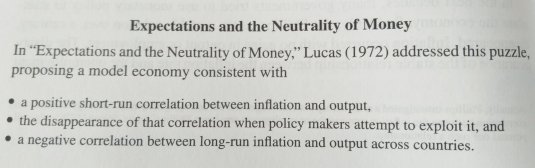
The Recession of 2007–? by Robert E. Lucas
17 Nov 2018 Leave a comment
in budget deficits, business cycles, economic growth, global financial crisis (GFC), great recession, macroeconomics, monetary economics, Robert E. Lucas
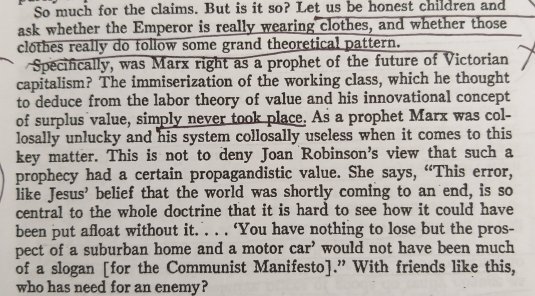
Wise words from Paul Samuelson (and Joan Robinson) for @Ocasio2018 @jeremycorbyn @SenSanders
17 Nov 2018 Leave a comment
in applied price theory, comparative institutional analysis, development economics, growth disasters, growth miracles, history of economic thought, industrial organisation, labour economics, Marxist economics, poverty and inequality Tags: Paul Samuelson
Robert Craig: What Happens Constitutionally If the Draft Withdrawal Agreement Is Voted Down?
17 Nov 2018 Leave a comment
Could take 2 months for Tory party members to elect a leader from the two shortlisted by MPs

 Now that a draft withdrawal agreement has been settled with the European Commission, the next step is a ‘meaningful vote’ in the House of Commons pursuant to s 13 European Union Withdrawal Act (‘EUWA’) which I analysed recently on this blog with Gavin Phillipson. This post seeks to explore what the Prime Minister might do if the draft agreement is voted down. Three potential scenarios are suggested. The theme of this post is that the ripple effects of the Fixed-term Parliaments Act (‘FTPA’) mean that previously accepted constitutional norms may have been affected and it may be helpful to explore what could happen as a result.
Scenario 1 – Theresa May resigns as party leader but not Prime Minister
If Theresa May were to lose the “meaningful vote” on her proposed agreement, a central plank of her premiership will have been rejected by her party and by the House…
View original post 2,546 more words
Why Isn’t Beer Sold in Plastic Bottles?
17 Nov 2018 Leave a comment
in environmental economics, health economics
Edward C. Prescott – money in the production function
16 Nov 2018 Leave a comment
in Edward Prescott, macroeconomics, monetary economics
BBC WS ‘OS’ presents an inverted portrayal of Gaza rocket attacks
16 Nov 2018 Leave a comment

As we saw in a previous post, the lead item in the November 13th edition of the BBC World Service radio programme OS – formerly ‘Outside Source’ – was described in its synopsis thus:
“It’s the heaviest exchange of aerial fire between Israeli soldiers and Hamas militants since the full-blown conflict in 2014. The violence follows an Israeli special forces operation inside Gaza which went wrong late on Sunday, causing the deaths of Palestinian militants and an Israeli soldier. We hear from local people living in Gaza.”
After listeners had been given some bizarre and entirely one-sided ‘context’ to that story (with no mention whatsoever of the fact that Hamas has been attacking Israeli civilians with rockets and mortars for 17 years), presenter Ben James introduced (from 04:35 here) his first inadequately identified interviewee in what he had previously described as “your guide to the important stuff…
View original post 1,323 more words
Why incompetent people think they’re amazing – David Dunning
16 Nov 2018 Leave a comment
in economics of education, economics of media and culture, health economics, human capital Tags: cognitive psychology
Note for @Ocasio2018 @SenSanders @jeremycorbyn
16 Nov 2018 Leave a comment
in applied price theory, economic history, industrial organisation, labour economics, macroeconomics, Marxist economics Tags: labour theory of value

Dinosaur asteroid hit ‘worst possible place’
16 Nov 2018 Leave a comment

 Credit: quora.com
The energy that went into making the impact crater is thought to be equivalent to 10 billion Hiroshima A-bombs, as BBC News explains. Nowhere to run/hide/escape.
Scientists who drilled into the impact crater associated with the demise of the dinosaurs summarised their findings so far in a BBC Two documentary on Monday.
The researchers recovered rocks from under the Gulf of Mexico that were hit by an asteroid 66 million years ago. The nature of this material records the details of the event.
It is becoming clear that the 15km-wide asteroid could not have hit a worse place on Earth.
View original post 207 more words
Greenland ice sheet hides huge ‘impact crater’
16 Nov 2018 Leave a comment
 Topographic map of Greenland
Something creating a 19-mile wide dent in the Earth’s surface would clearly have been a major strike. If confirmed it would be the most northerly impact crater on Earth.
What looks to be a large impact crater has been identified beneath the Greenland ice sheet, reports BBC News.
The 31km-wide depression came to light when scientists examined radar images of the island’s bedrock.
Investigations suggest the feature was probably dug out by a 1.5km-wide iron asteroid sometime between about 12,000 and three million years ago.
View original post 231 more words
Joshua Wright’s remarks applies to @NZprodcom’s market studies as well
16 Nov 2018 Leave a comment
in applied price theory, industrial organisation, law and economics, politics - New Zealand

From https://www.nytimes.com/roomfordebate/2016/11/14/should-the-government-bring-back-trust-busting
Not all mothers welcome Pike River re-entry decision as a ‘victory for families’
16 Nov 2018 Leave a comment

The headline at Stuff – playing on emotions that have been running high for years on the West Coast – highlighted a “victory for families and the little people”.
The headline quote was provided by “an elated Anna Osborne” after the Government gave the all-clear for a $23 million manned re-entry into Pike River Mine, where 29 men died in an explosion eight years ago.
The aim of re-entry, as the Stuff report explained, is to gather any evidence of what might have caused the methane explosion (which implies there can be no certainty the evidence will be found).
View original post 555 more words


Recent Comments