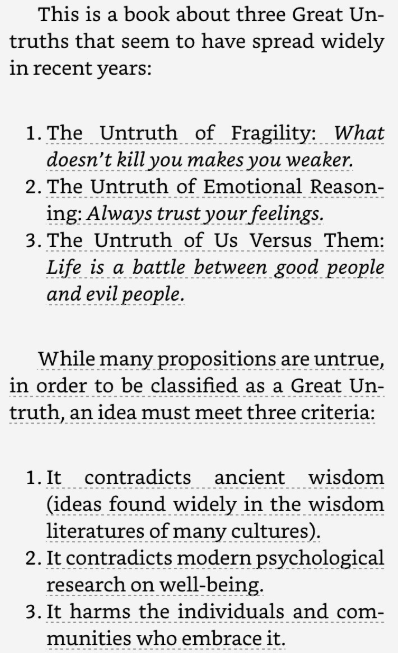
From @JonHaidt and @glukianoff’s The Coddling of the American Mind: How Good Intentions and Bad Ideas Are Setting Up a Generation for Failure
07 Sep 2018 Leave a comment
in economics of media and culture, liberalism

Reserve Bank Amendment Bill – a submission
07 Sep 2018 Leave a comment

Submissions to Parliament’s Finance and Expenditure Committee on the Reserve Bank of New Zealand (Monetary Policy) Amendment Bill close today. Despite my scepticism about the value of the process – given that the Bank and the Minister are already actively recruiting members of their tame Monetary Policy Committee – I did lodge a submission this morning.
The full text is here Submission to FEC Reserve Bank of NZ Amendment bill Sept 2018
Most of it covers ground I’ve dealt with here over recent months, albeit in more abbreviated form. There are two main aspects to the bill:
- the proposed change in the statutory goal of monetary policy, and
- the creation of a statutory Monetary Policy Committee.
On the former
The case for having active discretionary monetary policy is – and always has been – about cyclical stabilisation. We don’t need an active Reserve Bank to deliver broadly stable price levels over…
View original post 1,832 more words
Entrevista con Edward Prescott
07 Sep 2018 Leave a comment
in budget deficits, business cycles, development economics, economic growth, Edward Prescott, fiscal policy, global financial crisis (GFC), great depression, great recession
Did Corbyn spin doctor Seumas Milne’s 2014 speech breach antisemitism definition?
07 Sep 2018 Leave a comment

Yesterday, the Labour Party adopted – at least for the time being – the IHRA Working Definition of Antisemitism with all its examples, though with a caveat which Labour Friends of Israel claimed had the potential to undermine the example which labels antisemitic calling “the existence of a State of Israel is a racist endeavor”.
One example from the IHRA definition recently approved by the Labour Party not directly related to Israel seems relevant in light of a 2014 speech by Seumas Milne – currently Jeremy Corbyn’s communications chief and then Guardian associate editor – that we highlighted in a post at the time.
The IHRA example defines as antisemitic the following:
Calling for, aiding, or justifying the killing or harming of Jews in the name of a radical ideology or an extremist view of religion
Now, here’s Milne on Aug. 9, 2014, during Israel’s war with Hamas, speaking to
View original post 287 more words
Imran Khan is bad for Pakistan’s democracy | IN 60 SECONDS
07 Sep 2018 Leave a comment
in comparative institutional analysis, constitutional political economy, development economics, economic history, economics of bureaucracy, economics of crime, growth disasters, law and economics, poverty and inequality, Public Choice, rentseeking Tags: Pakistan, war against terror

#OTD Edward R. Murrow: First Night of the Blitz (aired the morning after)
07 Sep 2018 Leave a comment
in defence economics, laws of war, war and peace Tags: World War II

Tracey Ullman – Controversial Statue Review Committee
07 Sep 2018 Leave a comment
in economics of media and culture, television Tags: political correctness
Missing Minimum Monopsony Moods
07 Sep 2018 Leave a comment

Monopsony in labor markets is seems to be becoming a hotter topic year after year. I can’t help but cynically think that some of its popularity is due to the fact that it can be used as a rationale for policies that are widely popular with the public, but less so with economists, like minimum wages, worker safety legislation, unemployment insurance, and legal protection for unions. However, the reasons why monopsonies are a problem for economists don’t seem to be the reason why more politicized commentators oppose them.
A quick review on the economics: a monopsony is a lesser-known cousin of the monopoly, so lesser known that any economist discussing monopsony with noneconomists will hiss the “s” in monopsssssssssssssssony to emphasize the difference. The difference here is that, in a monopsony market, there is only one buyer of the good in question, which, in this case, is labor. The existence…
View original post 433 more words


Recent Comments