Don’t Be a Feminist: The Fleischman Interview with Bryan Caplan
26 May 2023 Leave a comment
in applied price theory, applied welfare economics, discrimination, econometerics, economic history, gender, human capital, labour economics, labour supply, occupational choice, poverty and inequality Tags: sex discrimination
May 25, 1659 & 1660: Lord Protector Richard Cromwell & King Charles II of England, Scotland and Ireland
26 May 2023 Leave a comment

May 25, 1659 – Richard Cromwell resigns as Lord Protector of England following the restoration of the Long Parliament, beginning a second brief period of the republican government called the Commonwealth of England.
Richard Cromwell was born in Huntingdon on October 4, 1626, the third son of Oliver Cromwell and his wife Elizabeth. Little is known of his childhood. He and his three brothers were educated at Felsted School in Essex close to their mother’s family home. There is no record of his attending university. In May 1647, he became a member of Lincoln’s Inn; however he was not called to the bar subsequently. Instead, in 1647 Richard Cromwell joined the New Model Army as a captain in Viscount Lisle’s lifeguard, and later that year was appointed captain in Thomas Fairfax’s lifeguard.
In 1649, Richard Cromwell married Dorothy Maijor, daughter of Richard Maijor, a member of the Hampshire gentry. He…
View original post 1,379 more words
Does the Maori Roll Really Empower Maori?
25 May 2023 Leave a comment
Prior to MMP, if there was no Maori roll, half a dozen regional National party seats would have been more marginal making a labour government more likely

I pinched this guest opinion piece from over at the BFD where it appeared yesterday.
The Author Corina Shields appears to be a mid to late twenties lady with two children. There is a photo which I have not brought across to this post that indicates she is in a stable relationship.
Lets have a look and see what she said.
It would be foolish of me to write this without acknowledging the fact that this subject is one that has the potential to upset some Maori and, hopefully, the government and their friends. But nonetheless, it is one I feel strongly about, so if it means dealing with people’s ill-perceived notions of who I am as a person so be it. All I ask is that people at least read what I have to say before forming a judgement about me.
To get to the point, I need to…
View original post 1,362 more words
May 23, 1533: The Marriage of King Henry VIII and Infanta Catherine of Aragon is declared annulled
24 May 2023 Leave a comment
During his marriage to Catherine of Aragon, King Henry VIII conducted an affair with Mary Boleyn, Catherine’s lady-in-waiting. There has been speculation that Mary’s two children, Henry Carey and Catherine Carey, were fathered by Henry, but this has never been proved, and the king never acknowledged them as he did in the case of Henry FitzRoy. In 1525, as Henry grew more impatient with Catherine’s inability to produce the male heir he desired, he became enamoured of Mary Boleyn’s sister, Anne Boleyn, then a charismatic young woman of 25 in the queen’s entourage. Anne, however, resisted his attempts to seduce her, and refused to become his mistress as her sister had.
It was in this context that Henry considered his three options for finding a dynastic successor and hence resolving what came to be described at court as the king’s “great matter”. These options were legitimising Henry FitzRoy, which would…
View original post 852 more words
Reparations for historic crimes
24 May 2023 Leave a comment

In case you’re not aware, there has been a growing movement in the USA that somewhat parallels the Treaty of Waitangi settlements here.
A small number of American academics, and now a growing number of Left-wing activists and minor politicians, are demanding that Blacks in America should be individually paid millions of dollars to compensate for the enslavement of their ancestors. It’s now reached the point where an official State government commission appointed in California has produced a recommendation to the State legislature of some$800 billion, or nearly three times the state’s annual budget.
This for a State that joined as a free state (meaning free of slaves) in 1850. How this would be figured out in detail is not explained, but perhaps the Democrats could return to their one-drop-of-blood rule? Or perhaps this blunter suggestion from a Democraticcouncilwoman:
Speaking before the Greater Metro Denver Ministerial Alliance, Cdebaca
View original post 456 more words
The Kyujo Incident The Coup that Almost Kept Japan in WWII
24 May 2023 Leave a comment
in defence economics, war and peace Tags: Japan, World War II
Reappraising England’s reformed electoral map, 1832-1868: the impact of the 1832 Reform Act
23 May 2023 Leave a comment

As part of our series reflecting on the recent‘Politics before Democracy’ conference, Dr Martin Spychal, a Senior Research Fellow on the 1832-1868 Commons project, discussesthe impact of the 1832 reform legislation on English electoral politics.
At the 2023 Politics before Democracy conference I discussed the 1832 reform legislation and its impact on English electoral politics between 1832 and 1868. The paper was based on research completed for my forthcoming book, Mapping the State: English boundaries and the 1832 Reform Act, and a preliminary survey of the research completed for the History of Parliament’s ongoing Commons 1832-1868 project.
Three major themes emerged from my paper. First, electoral organisation was an inescapable aspect of political life across England’s* constituency system after 1832. Second, franchise, boundary and registration reform in 1832 explicitly refocused constituency politics around the social, economic and political circumstances of England’s counties and boroughs, and was…
View original post 1,421 more words
Greece 2023a
22 May 2023 Leave a comment

Greece today held what will almost certainly be its first of two general elections of 2023 (hence the ‘a’ in the title above). The incumbent New Democracy (ND) won a substantial plurality of the vote, around 41%, over Syriza’s 20%. By seats, ND has 146, which is 48.7% (BBC, Wiki). That’s five seats short of a majority. The advantage ratio (%seats/%votes) is relatively high (1.19), but the electoral system did not quite manufacture a majority. And therein lies the reason why there will be another election, most likely.
In most recent elections, Greece has used a bonus-adjustment system, whereby the plurality party automatically wins 50 seats before the remaining 250 are allocated proportionally among those clearing the legal threshold (3%). However, back in 2016, the Syriza government passed an electoral system reform that removed the bonus provision. Under the Greek constitution, an electoral reform can take place…
View original post 396 more words

Even 3°C Warming Can’t Stop World Prosperity
21 May 2023 Leave a comment

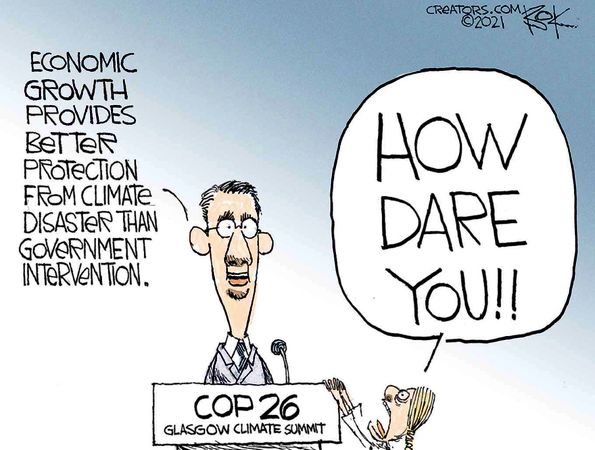

The 3°C Scenario: What’s the economic impact of severe global warming? James Pethokoukis writes at his substack. Excerpts in italics with my bolds and added images.
Even with an extreme scenario, the world should be richer and more capable in 2050
You may have noticed some concerning climate headlines popping up today in your smartphone notifications:
- “‘Sounding the alarm’: World on track to breach a critical warming threshold in the next five years” – CNN
- “Global warming likely to exceed 1.5C within five years, says weather agency” – Financial Times
- “Global warming set to break key 1.5C limit for first time” – BBC
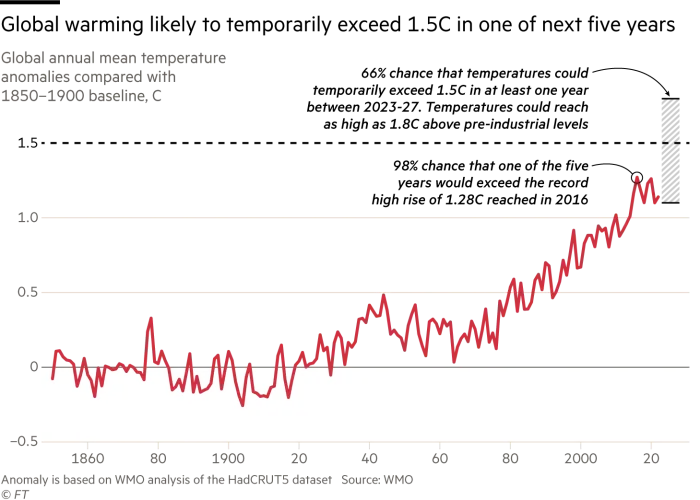
As the above FT chart neatly shows, the newsy forecast is about breaching the 1.5°C level in a single year, not a permanent increase. That said, the UN’s Intergovernmental Panel on Climate Change says humanity better get used to 1.5° and higher without a drastic shift away…
View original post 667 more words
Episode 6: Mormons, Adventists & Jehovah’s Witnesses | Christian Denominations Family Tree Series
21 May 2023 Leave a comment
in economic history, economics of media and culture, economics of religion
Neil Armstong on faking the moon landing
21 May 2023 Leave a comment
in economics of education, economics of media and culture

Clintel Report Blows Lid Off Biased IPCC Report, Permeated With Errors, Bias
20 May 2023 Leave a comment

 But not the end he was thinking of ? [credit: wizbangblog.com]
Each successive report is spun up for political purposes to look more alarming than the last one, with minimal change to any relevant data.
– – –
The IPCC ignored crucial peer-reviewed literature showing that normalized disaster losses have decreased since 1990 and that human mortality due to extreme weather has decreased by more than 95% since 1920, say Marcel Crok and Andy May @ Climate Change Dispatch.
The IPCC, by cherry-picking from the literature, drew the opposite conclusions, claiming increases in damage and mortality due to anthropogenic climate change.
These are two important conclusions of the report The Frozen Climate Views of the IPCC, published by the Clintel Foundation.
The 180-page report is – as far as we know – the first serious international ‘assessment’ of the IPCC’s Sixth Assessment Report.
View original post 366 more words
The Kirov-Class Sea Eagle: A Modern-Day Battleship
20 May 2023 Leave a comment
in defence economics, war and peace
GRAHAM ADAMS: Te Pāti Māori – Kingmaker or Labour’s albatross?
20 May 2023 Leave a comment

- Graham Adams writes –
Chris Hipkins must be fast realising that with friends like Te Pāti Māori he really doesn’t need enemies. In fact, the strong possibility Labour will require its support to form a government is looking like a real threat to its chances of re-election in October.
When Chris Luxon last week ruled out coming to an arrangement with Te Pāti Māori in post-election negotiations it lost its crown as “kingmaker” — although some journalists persist in calling it that. Mostly it will now be seen as tied to the Labour-Greens bloc on the left.
After Luxon had drawn a line in the sand — and dubbed a union of Labour, the Greens and Te Pāti Māori a “coalition of chaos” — Hipkins felt moved to assert his own authority by warning Te Pāti Māori not to get too far ahead of itself in issuing “bottom lines”…
View original post 2,008 more words


Recent Comments