Life in Alsace Lorraine
17 Jan 2022 Leave a comment
in defence economics, economic history, International law, war and peace Tags: France, Germany
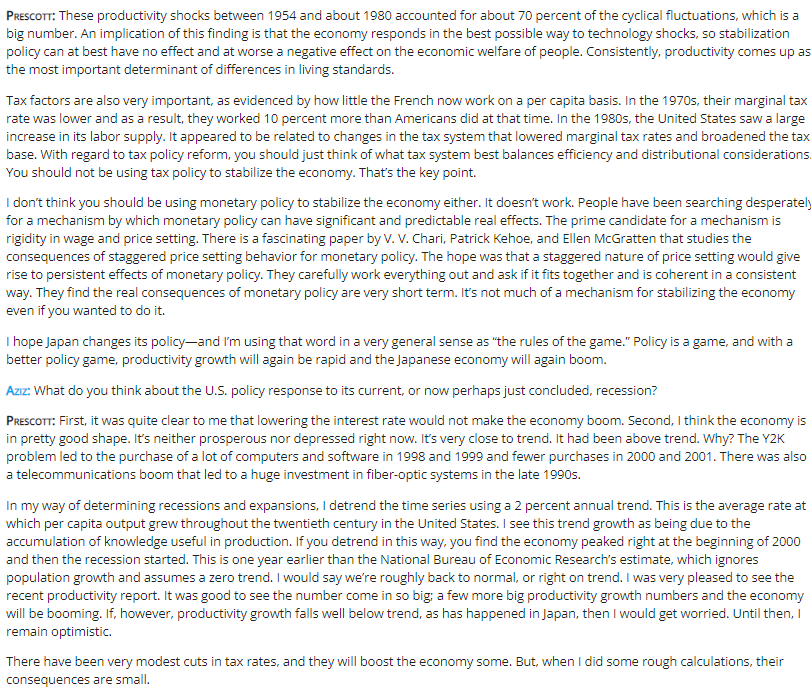
Your work on the US found that productivity shocks explain most of the cyclical fluctuations the economy has experienced. Does this finding have any bearing on the nature of public policy?
17 Jan 2022 Leave a comment
in business cycles, economic history, economics of regulation, Edward Prescott, growth miracles, labour economics, labour supply, macroeconomics, monetary economics, public economics
The Ongoing Horror of Cuban Socialism
17 Jan 2022 Leave a comment

Back in 2014, I compared the long-run economic performance of Cuba and Hong Kong.
Both jurisdictions were roughly equal about 60 years ago. But the data show a dramatic performance gap ever since the communists took power in Cuba,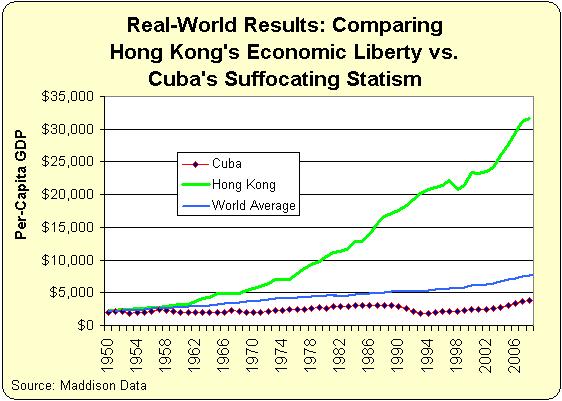 with Hong Kong (which was very pro-market back then) enjoying much bigger increases in prosperity.
Sadly, not much has changed in Cuba since I wrote that column.
The communist dictatorship is still there, and the economy is still socialist (notwithstanding even Castro admitting its failure).
And this means ongoing misery for ordinary people.
Here are some excerpts from a story published by Agence France-Presse.
Cubans are no strangers to queuing for everything from bread to toothpaste, often standing for hours under a blazing sun with no access to a toilet or drinking water, and always with the fear of leaving empty-handed. It is a daily ordeal Cubans have endured…
View original post 652 more words
Empirical Austrian Economics?
17 Jan 2022 Leave a comment

David Friedman recently got into an online debate with Walter Block that could be seen as a boxing match between “Austrian economics” and the “Chicago School of Economics”. In the wake of this debate, Friedman assembled his thoughts in this piece which is supposed (if I understand properly) to be published as a chapter in an edited volume. Upon reading this piece, I thought it worthy of providing my thoughts in part because I see myself as being both a member of both schools of thought and in part because I specialize in economic history. And here is the claim I want to make: I don’t see any meaningful difference between both and I don’t understand why there are perpetual attempts to create a distinction.
But before that, let’s do a simple summary of the two views according to Friedman (which is the first part of the essay). The “Chicago”…
View original post 973 more words
Keep the dream alive
17 Jan 2022 Leave a comment
in discrimination, Marxist economics Tags: political correctness, regressive left, virtue signalling

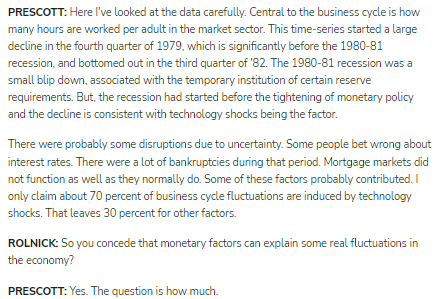
What about the recession of 1980-81?
16 Jan 2022 Leave a comment
in business cycles, Edward Prescott, financial economics, macroeconomics, monetary economics
Risible Renewables: Weather-Dependent Wind Power – Never There When You Need It Most
16 Jan 2022 Leave a comment


Pin your energy needs on the weather, and prepare for disappointment, over and over and over again.
South Australians know it, Germans know it, Texans and Californians know it, all too well.
In the latter part of 2021, as the Big Calm descended across Western Europe, Brits learned all about it, too. Quietly firing up once-mothballed, but ever-reliable, coal-fired power plants and feverishly importing nuclear power from France.
All up, the ‘inevitable transition’ to an all wind and sun-powered future has amounted to little more than a well-orchestrated high farce.
On that score, Paul Homewood takes a look at what passes for research into the likelihood of total wind power output collapses in Britain.
While Paul reckons that no one is suggesting the wind will stop blowing completely around the postage stamp of territory that is the UK, we’ll set out a couple from the archives to prove that…
View original post 3,096 more words
16 Jan 2022 Leave a comment

The view that technology shocks, those affecting production opportunities, are the major driving force behind business cycles, accounting for about 70 percent of these fluctuations.
16 Jan 2022 Leave a comment
in business cycles, economic history, Edward Prescott, macroeconomics, monetary economics
Tom Ballard at 2018 Marxism conference
16 Jan 2022 Leave a comment
in applied price theory, comparative institutional analysis, economic history, economics of bureaucracy, income redistribution, law and economics, Marxist economics, property rights, Public Choice, television
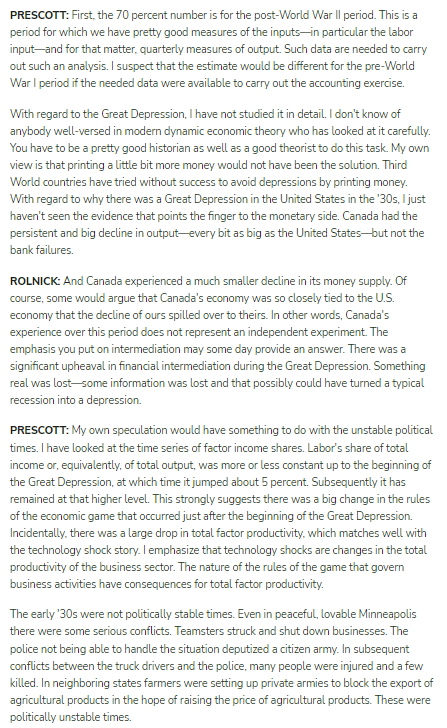
Prescott (1996) on the power of central banks
15 Jan 2022 Leave a comment
in business cycles, econometerics, economic history, Edward Prescott, financial economics, macroeconomics, monetary economics
Reaping The Whirlwind: Europe’s Wind & Solar Obsession Sends Power Prices Rocketing
15 Jan 2022 Leave a comment

Europeans have squandered untold $billions on chaotically intermittent wind and solar. The only evident results being routine power rationing, blackouts and power prices doubling every 12 months, or so.
The article below from Bloomberg lays it out fairly clearly: those countries obsessed with wind and solar are literally reaping the whirlwind, as power prices spiral out of control.
Bloomberg is, of course, a propaganda outlet for renewable energy rent-seekers, so don’t expect to see it ever name the culprits for Europe’s self-inflicted renewable energy disaster. In the piece below, the closest Bloomberg gets is when it points out that the “crisis was also aggravated by lower than normal wind speeds”. No joke!
Because the likes of Germany, Spain and the UK heavily depend upon wind and solar, output collapses triggered by, you guessed it, sunset and/or calm weather are driving demand for power from reliable sources, such as coal, gas…
View original post 495 more words


Recent Comments