
Tony Heller dismantles more climate junk science and fraud from The Washington Post.
Why Price Stickiness Matters, or Doesn’t
29 Jul 2021 Leave a comment

When I was a young economics graduate student at UCLA in the early 1970s during the heyday of that wonderful department, convinced, like most of the other UCLA grad students, that I was in the best graduate program in the country (and therefore the world), where the deepest, most creative, economic theorists in the world, under the relaxed and amiable leadership of Armen Alchian — whose failure to win a Nobel Prize is really the failure of the Nobel selection committee — would eventually succeed in unifying economic theory by reformulating macroeconomics on correctly specified microfoundations, I naively entertained for a while the idea that I would write a Ph.D. dissertation on some aspect of the problem of price rigidity. However, I never could do more than formulate some general observations about the theoretical role of price rigidity in macroeconomic models and compose a superficial survey of the empirical literature…
View original post 1,356 more words
UK government backs scheme for motorway cables to power lorries
29 Jul 2021 Leave a comment

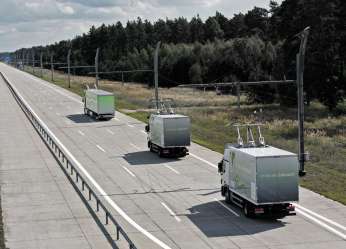 E-truck test route in Germany [image credit: transport-online.de] Another one from the Department of Bad Ideas? Before they rush into anything, they might want to note the assessment of a writer for Mass Transit magazine 10 years ago, on the subject of overhead (catenary) lines. Here’s the opening paragraph in full: ‘They are expensive. They are dangerous. They are unsightly.’ Much more here, but let’s quote a few other comments:
‘Overhead lines require a lot of maintenance given the direct contact of the pantographs and their constant exposure to weather’
‘Winter storms play havoc with overhead wire systems’
‘Loose wires in the summer and wire breaks in the winter as a result of lines contracting and expanding with the temperature also create maintenance headaches’
‘A catenary line is a live wire suspended in the air. Weather issues therefore become serious safety concerns.’
Did somebody mention climate change as a…
View original post 304 more words
Krugman on Mr. Keynes and the Moderns
29 Jul 2021 Leave a comment
UPDATE: Re-upping this slightly revised post from July 11, 2011
Paul Krugman recently gave a lecture “Mr. Keynes and the Moderns” (a play on the title of the most influential article ever written about The General Theory, “Mr. Keynes and the Classics,” by another Nobel laureate J. R. Hicks) at a conference in Cambridge, England commemorating the publication of Keynes’s General Theory 75 years ago. Scott Sumner and Nick Rowe, among others, have already commented on his lecture. Coincidentally, in my previous posting, I discussed the views of Sumner and Krugman on the zero-interest lower bound, a topic that figures heavily in Krugman’s discussion of Keynes and his relevance for our current difficulties. (I note in passing that Krugman credits Brad Delong for applying the term “Little Depression” to those difficulties, a term that I thought I had invented, but, oh well, I am happy to share the credit…
View original post 1,246 more words
Churchill Was a Drunk… or was he?! – Doped WW2 Leaders Part 2
29 Jul 2021 Leave a comment
in defence economics, health economics, war and peace Tags: World War II
The Rape of Belgium And The Battle of Tannenberg I THE GREAT WAR – Week 5
29 Jul 2021 Leave a comment
in defence economics, laws of war, war and peace Tags: World War I
The Big Battery Myth: Why Battery Storage Can’t Save Intermittent Wind & Solar
29 Jul 2021 Leave a comment

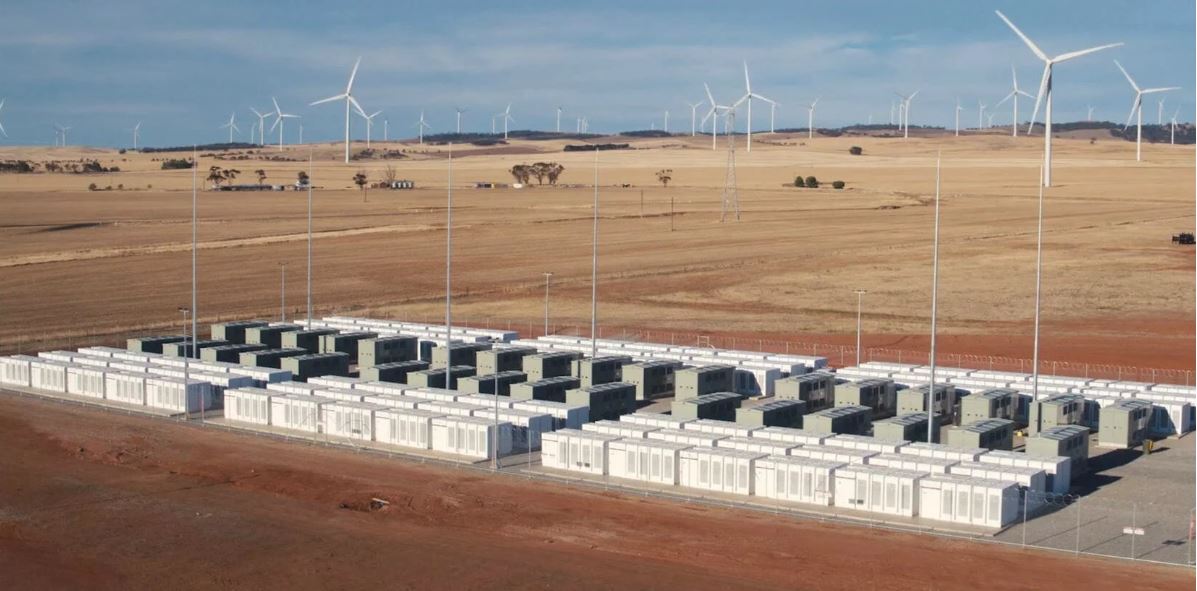
For almost a century, electricity generation and distribution were treated as a tightly integrated system: it was designed and built as one, and is meant to operate as designed. However, the chaotic delivery of wind and solar have all but trashed the electricity generation and delivery system, as we know it. Germany, California and South Australia are only the most obvious examples.
Unable to fend off their critics, the narrative among renewable energy rent-seekers quickly shifted their narrative to “grid-scale storage”, like they’d forgotten the bread and milk on their way home from work.
For wind and solar acolytes, physics and economics are boring impediments. However, the colossal cost of giant lithium batteries means that – between now and kingdom come – their contribution to our electrical supply will remain laughably trivial. Rafe Champion provides a helpful description and analysis of why battery storage will never save wind and solar from…
View original post 1,152 more words
Blitzkrieg on Speed – Nazis on Crystal Meth Part 2 – WW2 SPECIAL
29 Jul 2021 Leave a comment
in defence economics, health economics, laws of war, war and peace Tags: addiction, World War II
British Parliament to restore Queen’s prerogative to dissolve Parliament
28 Jul 2021 Leave a comment


The Parliament of the United Kingdom is set to start debate on legislation that seeks to revive the Queen’s power to dissolve parliament that was formerly exercised by virtue of the royal prerogative.
A. V. Dicey, a constitutional theorist from the 19th century, described the royal prerogative as “the remaining portion of the Crown’s original authority, and it is therefore … the name for the residue of discretionary power left at any moment in the hands of the Crown, whether such power be in fact exercised by the King himself or by his Ministers”.
View original post 172 more words
The Dissolution and Calling of Parliament Bill – a return to constitutional normality?
28 Jul 2021 Leave a comment


Alison Young argues that the Dissolution and Calling of Parliament Bill transfers power from parliament to the government, and not to the people, and that it is wrong to place the blame for the extraordinary events of 2019 on the provisions of the Fixed-term Parliaments Act.
The Fixed-term Parliaments Act 2011 (FTPA) has not had a good press. So much so, that a promise to repeal the Act was included in the 2019 manifestos of both the Labour Party and the current Conservative government. However, as the second reading of its replacement, the Dissolution and Calling of Parliament Bill demonstrates, the apparent consensus ends there. There appeared to be two strong themes to the debate. First, how far does the FTPA’s replacement transfer power from parliament back to the government, or from parliament back to the people? Second, to what extent did the FTPA cause the difficulties – however…
View original post 1,833 more words
Net Zero by 2050 is dead in the water. So what’s plan B?
28 Jul 2021 Leave a comment
 More to come? [image credit: thecount.com] Futile climate obsessions over 0.01% of the Earth’s atmosphere have clouded the political world so badly that thinking straight seems to have gone out of the window. Bad news for voters, left with no-one sensible to turn to.
– – –
Boris Johnson has always tried to take a ‘cakeist’ position on Net Zero, says the Telegraph (via The GWPF).
We can drastically cut carbon emissions while boosting living standards, he claims.
But the truth is, the sacrifices being demanded of us in the name of Net Zero are incompatible with democracy, and the PM knows it.
View original post 317 more words
#globalwarming #climateemergency @Greenpeace
28 Jul 2021 Leave a comment
in applied welfare economics, energy economics, environmental economics, global warming Tags: climate alarmists
Public health forgot it was about public health – Jay Bhattacharya
28 Jul 2021 Leave a comment
in health economics Tags: economics of pandemics
Boris Johnson kicks gas boiler ban into the long grass after mounting backlash
28 Jul 2021 Leave a comment
Oliver Hart, Incomplete Contracts and Control
28 Jul 2021 Leave a comment
in applied price theory, applied welfare economics, behavioural economics, comparative institutional analysis, economics of information, economics of regulation, financial economics, industrial organisation, law and economics, property rights, Ronald Coase, theory of the firm


Recent Comments